|
|
A.M. Costa Rica
Your daily English-language news source Monday through Friday |
||
 |
 |
 |
|
|
 |
||||||||||||||||||||
|

|
|||||||||||||||||||
 |
||||||||||||||||||||
|
|
|||||||||||||||||||
 |
 |
| What we published this week: | Monday | Tuesday | Wednesday | Thursday | Friday | Earlier |
|
|
|
|
|
|
|
Food |
|
Jo
Stuart |
|
|
| A.M. Costa Rica's Second news page | |||||||||
| San José, Costa Rica, Thursday, May 17, 2012, Vol. 12, No. 98 | |||||||||
|
|
|
|
|
|
|
Food |
|
Jo
Stuart |
 |
 |
 |
|
extradition will be quashed By
the A.M. Costa Rica staff
The Sea Shepherd Conservation Society is hoping that the German foreign ministry of the justice ministry will halt the extradition of its founder, Paul Watson. Watson remains in a German jail awaiting paperwork from Costa Rica, which seeks to put him on trial for a 2002 incident in Guatemalan waters. Sea Shepherd, which is based in the State of Washington, is becoming more and more shrilled as it issues statements on the case. The latest Wednesday said “Germany Considers Sending Whale Defender to What Will be a Death Sentence in Costa Rica.” The organization also sees a conspiracy. It said in the latest release: “Should Captain Watson be extradited to Costa Rica, he will certainly not receive a fair trial and his safety cannot be guaranteed. Sea Shepherd Conservation Society is doing everything it can to provide Captain Watson with the best legal defense team possible. Between the illegal Japanese whalers and the shark finning mafia in Costa Rica, Captain Watson has formidable enemies who seek to stop his efforts to defend marine life.” Watson also sees a conspiracy behind his arrest on a Costa Rican warrant instead of the usual mechanizations of the dysfunctional Costa Rica justice system. He said from his cell, as reported by Sea Shepherd: “In our efforts to defend the lives of whales, dolphins, seals, sharks, and fish we have made some powerful enemies, most notably the government of Japan. It is no coincidence that the extradition request by Costa Rica was issued the same month (October 2011) as the Japanese whaling (ICR) lawsuit against Sea Shepherd was initiated. The extradition request was in reference to a complaint from Costa Rican fishermen who I caught poaching in Guatemalan waters. The fishermen were not injured and their boat was not damaged. The incident was fully documented for the film “Sharkwater.” Interpol originally denied this extradition order and deemed it as politically motivated. Therefore the question must be asked why Germany is now taking into account accusations made by illegal poachers.” Costa Rican judicial officials say the country is preparing the document to seek Watson's extradition. The case is curious because Watson is considered a fugitive because he did not show up for a 2006 hearing. However, he told a reporter at the time he never had been notified. He had left Costa Rica shortly after the 2002 incident that generated the charges. Costa Rica judicial officials appear to have decided to issue an international warrant in 2001. There is no indication that they even went so far as to try to email Watson. He is highly visible and in the news frequently because of his run-ins with the Japanese whaling fleet. There also is no indication that the prosecutors and judges now involved in the case watched the “Sharkwater” film which contains footage of the ocean encounter. Sea Shepherd said that the German prosecutor in Frankfurt made an unusual statement at a public court session. Said Sea Shepherd: “In a highly unusual move, the Public Prosecutor stated that the German Ministry of Justice and the German Ministry of Foreign Affairs have the power to stop the extradition procedures on political grounds. If the German Ministry of Justice and/or the German Ministry of Foreign Affairs give notice that they would not grant an extradition of Paul Watson to Costa Rica the case would be over, and Captain Watson would be set free immediately. We have asked our supporters to continue to appeal to the German Ministry of Justice for help.” Sea Shepherd is trying to raise money for Watson's defense.
|
|||||||||||||||||||||||||||||||||||||||||
 |
||||||||||||||||||||||||||||||||||||||||||
|
|
|
|
|
|
|
Food |
|
Jo
Stuart |
| What we published this week: | Monday | Tuesday | Wednesday | Thursday | Friday | Earlier |
| The contents of this page and this Web site are copyrighted by Consultantes Río Colorado 2012 and may not be reproduced anywhere without permission. Abstracts and fair use are permitted. Check HERE for details | ||||||
 |
 |
 |
| A.M. Costa Rica Third
News Page |
|
| San José, Costa Rica, Thursday, May 17, 2012, Vol. 12, No. 98 | |
|
|
|
|
|
|
|
Food |
|
Jo Stuart |
The six pots are lined up under photos of classic Costa Rican archaeological pieces. The ceramic bowls date from 300 to 800 A.D., said the foreign ministry. |
 Ministerio
de Relaciones Exteriores y Culto photo
|
| Country recovers six archaeological
pieces from France |
|
|
By
the A.M. Costa Rica staff
The Costa Rican Embassy in France has recovered six pre-Columbian pots as part of its efforts to return archaeological pieces that were removed from this country. The six pieces came into Costa Rican custody after investigations by French judicial and customs officials, said the Ministerio de Relaciones Exteriores y Culto in San José.  Ministerio
de Relaciones Exteriores y Culto photo
This
three-legged bowl is presumed to represent a bird.
|
There were no detailed descriptions
of
the history of the various pieces. Only one, a three-legged receptacle
identified as a bird, appears to be of museum quality. It was
identified
as having been made on a date somewhere between 500 and 800 A.D. Most
of the pieces are estimated to be about that same age, although several
could be older. Carlos Bonilla, the Costa Rican ambassador in France, thanked official there. Costa Rica also is seeking archaeological pieces from Spain, Denmark, Switzerland and Italy. There also are 24 pieces in the Costa Rican Embassy in Washington, D.C., that will be repatriated, the ministry said. Costa Rica did not always have laws against the exportation of archaeological artifacts. Thousands went to the United States and Europe. Now the country is trying to get some back. The Brooklyn, New York, Museum recently returned about 1,000 pieces that were part of the Minor Keith Collection. Most are not museum quality. Keith shipped some 16,000 pieces to the United States. He was president of the United Fruit Co. and many of the pieces were discovered during excavations for the Atlantic railroad or agricultural work where the banana fields are today. |
| Health ministry embarks on major campaign
against used tires |
|
|
By
the A.M. Costa Rica staff
The health ministry is embarking on another seasonal campaign to reduce the number of dengue-carrying mosquitoes. The first part of the campaign targets discarded vehicle tires, which make great locations for breeding mosquitoes. The Aedes aegypti mosquito is opportunistic and can seek out small puddles of water for its egg-laying. The areas with the most cases usually are the coastal areas, which is why the latest campaign began in Limón. Each year thousands of Costa Ricans are sickened by dengue. |
The disease, if contracted a second
time, could be life-threatening. Daisy Corrales Díaz, the health minster, urged homeowners and business people to make sure their areas are free of breeding spots. Costa Rican law requires retailers of tires to accept used ones for recycling, but many motorists just throw the tires away. The major tire companies are helping with the campaign. There also will be advertising to encourage citizens to stamp out dengue. The program will cover all of the country in sections on various dates through August. |
 |
| You need to see Costa Rican tourism information HERE! |
|
|
|
|
|
|
|
Food |
|
Jo
Stuart |
| What we published this week: | Monday | Tuesday | Wednesday | Thursday | Friday | Earlier |
| The contents of this page and this Web site are copyrighted by Consultantes Río Colorado 2012 and may not be reproduced anywhere without permission. Abstracts and fair use are permitted. Check HERE for details | ||||||
 |
 |
||||
| A.M. Costa Rica's Fourth News page | |||||
| San José, Costa Rica, Thursday, May 17, 2012, Vol. 12, No. 98 | |||||
|
|
|
|
|
|
|
Food |
|
Jo
Stuart |
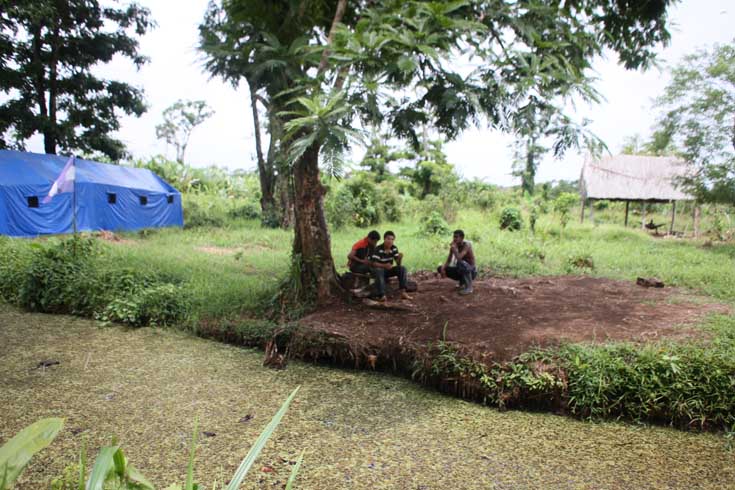 Ministerio de Relaciones Exteriores y Culto
said later Thursday that the photo came from Repretel, the television
network.
There are not a lot of
recreational opportunities for Sandinista youths camping out on Calero.
|
|
| Officials irked by Sandinista campout in
disputed territory |
|
|
By
the A.M. Costa Rica staff
Young Nicaraguans are camping on the disputed Isla Calero-Isla Portillos region of northern Costa Rica. The youngsters do not appear to be armed, but they are believed to be there under the direction of the central government in Managua. The Ministerio de Relaciones Exteriores y Culto lodged a strong protest with the Nicaraguan embassy in San José Wednesday and reminded the diplomats there that the International Court of Justice has specifically forbidden Nicaraguans from entering the area. Costa Ricans can enter only to do environmental remediation. The Nicaragua youngsters do not appear to be doing damage, although Costa Rica said that they took actions against the plant life. There are one long tent and two dome tents. The youngsters do not appear to be aggressive. They gave interviews to television reporters Wednesday. The area is hot and filled with bugs and also snakes. The foreign ministry here called the encampment a provocation and said that the activity can only harm relations between the two countries and its peoples. Nicaraguan troops invaded the area in October 2010. The goal was to construct a new, wider and shorter mouth to the Río San Juan so the area could be developed. This channel is about half finished. Costa Rica went to the International Court of Justice in The Hague because that entity is charged with overseeing the border treaty between the two countries. March 8, 2011 the court issued a preliminary ruling that said only Costa Ricans could enter the area and only to correct environmental damage. |
 Ministerio de Relaciones Exteriores y Culto
photo
Current campers seem to have
better equipment than the soldiers who were there more than a year ago.There have been several invasions of Sandinista youth groups since, but the latest appears to be ready to stay longer. The Nicaraguan central government claims the land is national territory. The final ruling from the court is not expected for some time, and there is no guarantee that Nicaragua will abide by any decision. Costa Rica has declined to use force. The invasion might be a protest against the Ruta 1856 that Costa Rica is constructing along the south bank of the Río San Juan to open up the northern area to land traffic. Nicaragua claims the construction is causing erosion to drop dirt into the river, which is Nicaragua territory. It has complained to the international court. The new highway was built on no-bid direct contracts, and each day there is a new story in the Spanish-language press about corruption involving the project. |
Man made pollutants may be driving the expansion of the Earth’s tropical belt seen here in red. |
 University
of Calfornia-Riverside graphic
|
| Pollution may be making the tropical zone
wider to the north |
|
|
By
the University of California-Riverside news staff
Black carbon aerosols and tropospheric ozone, both manmade pollutants emitted predominantly in the Northern Hemisphere’s low- to mid-latitudes, are most likely pushing the boundary of the tropics further poleward in that hemisphere, new research by a team of scientists shows. While stratospheric ozone depletion has already been shown to be the primary driver of the expansion of the tropics in the Southern Hemisphere, the researchers are the first to report that black carbon and tropospheric ozone are the most likely primary drivers of the tropical expansion observed in the Northern Hemisphere. Led by climatologist Robert J. Allen, an assistant professor of Earth sciences at the University of California, Riverside, the research team notes that an unabated tropical belt expansion would impact large-scale atmospheric circulation, especially in the subtropics and mid-latitudes. “If the tropics are moving poleward, then the subtropics will become even drier,” Allen said. “If a poleward displacement of the mid-latitude storm tracks also occurs, this will shift mid-latitude precipitation poleward, impacting regional agriculture, economy, and society.” Study results appear in the May 17 issue of Nature. |
Observations show that the tropics
have widened by 0.7 degrees latitude
per decade, with warming from greenhouse gases also contributing to the
expansion in both hemispheres. To study this expansion, the researchers
first compared observational data with simulated data from climate
models for 1979-1999. The simulated data were generated by a
collection of 20 climate models called the Coupled Model
Intercomparison Project version 3. “Both black carbon and tropospheric ozone warm the tropics by absorbing solar radiation,” Allen explained. “Because they are short-lived pollutants, with lifetimes of one - two weeks, their concentrations remain highest near the sources: the Northern Hemisphere low- to mid-latitudes. It’s the heating of the mid-latitudes that pushes the boundaries of the tropics poleward.” Allen further explained that with an expansion of the tropics, wind patterns also move poleward, dragging other aspects of atmospheric circulation with them, such as precipitation. Black carbon aerosols are tiny particles of carbon produced from biomass burning and incomplete combustion of fossil fuels. Most of the world’s black carbon production occurs in the Northern Hemisphere, with Southeast Asia being a major producer. The same is true of tropospheric ozone, a secondary pollutant that results when volatile organic compounds react with sunlight. |
|
|
|
|
|
|
|
Food |
|
Jo
Stuart |
| What we published this week: | Monday | Tuesday | Wednesday | Thursday | Friday | Earlier |
| The contents of this page and this Web site are copyrighted by Consultantes Río Colorado 2012 and may not be reproduced anywhere without permission. Abstracts and fair use are permitted. Check HERE for details | ||||||
| A.M.
Costa Rica's Fifth news page |
 |
||||||||
| San José, Costa Rica, Thursday, May 17, 2012, Vol. 12, No. 98 | |||||||||
|
|
|
|
|
|
|
Food |
|
Jo
Stuart |
 |
| U.N.
Assembly chief cites Central American trafficking Special
to A.M. Costa Rica
Senior United Nations officials Wednesday drew the world’s attention to threats posed by transnational organized crime and drug trafficking in Central America and called for concerted global efforts to combat the scourge, which they said is spreading to other continents. “Countries in Central America face a tide of violence, born of transnational organized crime and drug trafficking,” the president of the General Assembly, Nassir Abdulaziz Al-Nasser, said at the opening of the Assembly’s thematic debate on “Security in Central America as a Regional and Global Challenge – How to Improve and Implement the Central American Security Strategy.” “Human trafficking, migrant smuggling, and kidnapping have also attached themselves to the underbellies of Central American societies. Highly sophisticated criminal threats in the region are eroding economic development, corrupting legal and political processes, and undermining public confidence,” said Al-Nasser. “In a word, these threats risk unravelling gains made in development in the region, and leading to social and political upheaval,” he added. The overall objective behind the debate is to highlight the Central American governments’ individual and collective fight against transitional organized crime, its focus in the framework of U.N. policies and actions, as well as the importance of cooperation with and support of the donor community. In June last year, the region’s heads of state adopted a so-called Central American Regional Security Strategy. In his opening remarks, Secretary-General Ban Ki-moon pointed out that countries in the region – especially in the northern triangle of El Salvador, Guatemala and Honduras – face rising levels of violence fueled by transnational organized crime and drug trafficking. “Caught between drug producing countries in the south and some of the major consumer countries in the north, proximity has encouraged criminality,” said Ban. He highlighted the fact that Central America has become the region with the highest homicide rates in the world – 39 murders per 100,000 citizens in Guatemala, 72 per 100,000 in El Salvador, and 86 per 100,000 in Honduras. “In countries of the region, as many as one out of every 50 20-year-old males will be murdered before they reach the age of 32. That is 400 times higher than in countries with low homicide rates,” said Ban. “This is more than a spate of killings, it is a crisis – bringing with it great fear and instability to societies. Beyond these appalling numbers, other crimes have emerged – kidnappings, migrant smuggling and human trafficking.” He also noted that the narcotics problem was not confined to Central America, pointing out that the region is a bridge to North America, and that the Americas are, in general, a staging post to Europe, through trafficking routes in West and Central Africa. “All of this underscores the need to go beyond a regional approach. Our world is interconnected. Our challenges are linked. Our solutions must be, too,” said Ban. “That is why, last year, I established the Task Force on Transnational Organized Crime and Drug Trafficking. Our approach is rooted in the rule of law and respect for human rights.” The Task Force was set up in March 2011 to integrate responses to transnational organized crime into the United Nations' peacekeeping, peace building, security and development activities, with the U.N. Office on Drugs and Crime and the U.N. Department of Political Affairs as co-chairs. In his remarks, Al Nasser urged member states and the U.N. to continue to work towards greater unity and political commitment to tackle the security challenges in Central America. “Our duty is to help tear down the complex web of crime in Central America, and to achieve security – one of the keystones of democracy – for the region, and for the world,” he said. Al-Nasser announced that he will convene a debate on “Drugs and Crime as a Threat to Development” on the occasion of the U.N. International Day against Drug Abuse and Illicit Trafficking. That will be in June. President Laura Chinchilla has been urging the United Nations to consider the problem. Cannes Film Festival opens with usual lavish ceremony By
the A.M. Costa Rica wire services
The 65th annual Cannes Film Festival got under way Wednesday with a lavish red carpet ceremony at the Riviera resort. The movie “Moonrise Kingdom” kicked off the 12 days of screenings, deal making and parties. The film, which features American actors Bill Murray and Bruce Willis, is among 22 vying for the coveted Palme D 'Or prize. Actress Eva Longoria was among the stars making up the annual gathering, which showcases dozens of films hoping to gain recognition. Cannes also features staged pranks by some movies seeking to generate attention for their films. The Cannes Film Festival wraps up on May 27. U.S. Senate rejects budgets, including one like Obama's By
the A.M. Costa Rica wire services
As expected, the U.S. Senate Wednesday rejected five separate budget plans for 2013, including one that mirrors a budget blueprint offered by President Barack Obama. The lawmakers unanimously turned down the plan submitted by Republicans and based on the president's budget, 99-to-zero. Obama's Democratic Party called the vote a political stunt, saying it was unnecessary since last year's deal to raise the debt ceiling contained spending caps. The chamber also rejected four other proposals submitted by Republicans. The votes followed a day of debate in which senators from both sides accused each other of being irresponsible when it comes to government spending and cutting the deficit. The Republican plans are meant to highlight the fact that the majority Democrats have not come up with a budget plan of their own. Some Democrats have criticized their party for the failure to produce a budget. But others argue that last year's debt-limit agreement, the law known as the Budget Control Act, erases the need for a separate budget resolution. With the upcoming November presidential election, pressure is building on lawmakers and the Obama administration to curb a crippling trillion-dollar budget gap and decrease the $15 trillion national debt. |
|
||||
|
|
|
|
|
|
|
Food |
|
Jo
Stuart |
| What we published this week: | Monday | Tuesday | Wednesday | Thursday | Friday | Earlier |
| The contents of this page and this Web site are copyrighted by Consultantes Río Colorado 2012 and may not be reproduced anywhere without permission. Abstracts and fair use are permitted. Check HERE for details | ||||||
| A.M.
Costa
Rica's sixth news page |
|
|||||||||
| San
José,
Costa Rica, Thursday, May 17, 2012, Vol. 12, No. 98 |
||||||||||
|
|
|
|
|
|
|
Food |
|
Jo
Stuart |
 |
Latin America news |
 Judicial Investigating Organization photo
Judicial agent leads away
Santa Ana man accused ofhaving a hydroponic setup to grow marijuana. Santa Ana man
facing
marijuana-growing count By
the A.M. Costa Rica staff
Judicial police detained a 26-year-old man in Santa Ana Tuesday night and said that they found a marijuana-growing operation in an apartment rented by the suspect. Agents found 468 plants of various sizes and 811 grams of plant parts and 33 grams ready for market. The man was detained as he left the apartment about 9 p.m. He was not identified immediately. Agents said there may be more arrests. Burglary tips include dog, alarm, good locks By
the A.M. Costa Rica staff
The Fuerza Pública has come out with a set of suggestions so that citizens can avoid home robberies. Chief among them is that someone always should be in the home and that a dog would be a good idea. The police agency also suggested alarms and keeping bills and other types of mail out of the hands of passers-by who might learn about the family from them. The agency seems to stress efforts to prevent break-ins and burglaries because armed home invasions are far more violent and nearly impossible to stop. Crooks sometimes chain a front gate to a vehicle and pull it down then crash through an exterior door. The circumstances that open the way for a crime frequently are the doing of the victims, said the agency. One recent home invasion took place because the resident left open the front door. Included on the list are contacts and relationships with neighbors and a watchful eye on strangers in the area. The agency also suggests not leaving items like clothing, bikes and similar objects in view from the street. It also suggested a good survey of the home to locate and eliminate possible points of entry. The recommendations are high on getting good locks, using chain locks and cleaning up possible hiding places around the home or in the yard. The recommendations also promoted exterior lighting. The suggestions made no mention of defensive weapons. |
|
Latin
American news feeds are disabled on archived pages.
|
|
| Costa Rican News |
AMCostaRicaArchives.com |
Retire NOW in Costa Rica |
CostaRicaReport.com |
|
|
|
|
|
|
|
Food |
|
Jo
Stuart |
| What we published this week: | Monday | Tuesday | Wednesday | Thursday | Friday | Earlier |
| The contents of this page and this Web site are copyrighted by Consultantes Río Colorado 2012 and may not be reproduced anywhere without permission. Abstracts and fair use are permitted. Check HERE for details | ||||||