|
 |
Your daily |
 |
|
|
|
|
|
|
|
|
|
|
|
|
||||||||||||||
|
|
||||||||||||||
|
|
|
|
|
|
|
|
| What we published this week: | Monday | Tuesday | Wednesday | Thursday | Friday | Earlier |
|
|
 |
| A.M. Costa Rica Second newspage |
 |
||||||||
| Home |
Tourism |
Calendar |
Classifieds |
Entertainment |
Real
estate |
Rentals |
Sports |
About us |
|
|
|
|||||||||
 |
| Costa Rica Expertise Ltd http://crexpertise.com E-mail info@crexpertise.com Tel:506-256-8585 Fax:506-256-7575 |
 |

Click HERE for
great
hotel discounts
|
|
but bug is moving south By the A.M. Costa Rica staff
and wire service reports The swine flu situation appears to be stabilizing. Costa Rica continues to have just one confirmed case of the disease and two persons are hospitalized as probable victims. Meanwhile directors of Saint Clare private elementary and high school in San Juan de la Unión have changed their minds and are resuming classes today. The school had canceled classes through Wednesday, but a student thought to have contracted swine flu was cleared by local health officials. The Ministerio de Salud stressed that the transmission of cases in Costa Rica is closely linked to persons who have traveled to México or are family members or close friends of those who have. And, the ministry said, the cases that have come up appear to be light. The individuals in the hospitals are an 11-year-old with asthma and a 53-year-old diabetic, the ministry said. The ministry said its physicians have reviewed 425 cases of persons with symptoms similar to that of swine flue. Some 369 cases have been discounted and seven cases continue to be probable. Attendants are awaiting laboratory results for the others. Health officials said they recommend Costa Ricans not to travel to countries where there are confirmed flu cases. They also said that they were expecting an increase in the seasonal flu because the country is entering the rainy season. This happens every year, they said. Health officials met with managers of airlines and of Juan Santamaría airport Monday to discuss tightening security over incoming passengers. Once again health officials urged anyone with symptoms to remain home and not go to work or school. The World Health Organization says there is some concern the swine flu A-H1N1 virus may start moving from the Northern Hemisphere to the Southern Hemisphere, where the regular winter flu season is approaching. Keiji Fukuda, the organization's assistant director general, said most swine flu cases are still in North America, but there have been some incidents of the virus going south, and some travel-related infections in Europe and Asia. The virus has spread to Colombia with the first confirmed case in South America. "We have concerns about the infection traveling to the Southern Hemisphere, because that part of the world will be heading into the winter months, and the winter months are when influenza viruses usually thrive, and so you typically see epidemics and outbreaks of influenza occur during those colder months," Fukuda said. Meanwhile, Mexico's Health Secretary Jose Cordova says most economic activity in his country will resume Wednesday, and said the outbreak there is waning. Fukuda stressed it is critical for countries everywhere to remain alert and keep monitoring the situation. He hailed the fact this level of surveillance is unprecedented. "At this point in history, this is the best surveillance we have ever had," he said. During a Geneva-based news conference, Fukuda said there were just more than 1,000 confirmed cases worldwide in a total of 20 countries, with 26 deaths, but cautioned that the numbers are constantly changing. One death is in the United States, the rest in México. He made clear that if the World Health Organization raises its alert level from phase five to phase six, it will not be a statement about the severity of the virus, but would mean there is clear evidence of community level transmission in another region of the world outside North America. Another decline expected in foreign direct investment Special to A.M. Costa Rica
Last year’s slump in companies investing in businesses abroad is likely to fall further before recovering in two years, hitting developing countries particularly hard in the meantime, the chief of the United Nations Conference on Trade and Development warned Monday. The global meltdown in economic and financial markets slashed foreign direct investment by some 15 per cent in 2008, and Supachai Panitchpakdi, the secretary general of the conference, said the trend may continue downward this year. “Very little has been said about the impact of the crisis on investment,” said Supachai at the start of a week-long conference on foreign direct investment trends in the developing world. “You cannot have recovery without going into new investment, new employment,” he added, underscoring the need to clean up the financial sector around the world to support new rounds of investment. He also warned participants of the first meeting of conference's new Investment, Enterprise and Development Commission that the decline in direct investment will be far deeper this year. According to the the conference's World Investment Prospects Survey 2009-2011, some 80 per cent of executives of transnational corporations surveyed anticipated cutbacks in investment in the short-term but a return to more healthy flows in 2011. “There are indications that a deep decline will take place with a great degree of variation between countries and regions,” said Supachai. Among the signals are the declining profits reported by businesses and limits on resources as banks struggle to cope with heavy losses and continue to rid themselves of toxic assets. “No new borrowing, no new flows of funding mean little new investment internationally,” he added. Despite the bleak situation, there are opportunities for investment now for firms that have cash, as asset prices are cheap, and new, energy- and environment-related industries can be expected to develop, he stressed. Country fails to make list of turtle friendly fishing By the A.M. Costa Rica staff
Costa Rica's shrimp industry may be in trouble again. The Department of State certified 39 countries and one economy as fishing in a way that does not endanger sea turtles. Costa Rica was not on the list, meaning it might not be able to export to the United States. Costa Rica has been on and off the list, and shrimp fishermen are encouraged to use turtle excluders on their trawl nets. The excluders allow turtles to swim to safety when caught in a shrimp net. The department said it makes certifications annually on May 1 and bases them in part on the results of verification visits State Department and National Marine Fisheries Service teams make to exporting countries. Another round of phones released for those eligible By
the A.M. Costa Rica staff
The telephone company is releasing 60,000 GSM cell lines to those customers who are on a waiting list. The telephone lines will be available through Friday, said the Instituto Costarricense de Electricidad. Those eligible have numbers between 9035780 and 9103471. Those with the lucky numbers can obtain their lines through agencies of the company, through authorized stores or online at the company's Web site, www.grupoice.com, it said. Applicants have to have paperwork that is outlined online.
|
|||||||||||||||||||||||||||||||||||||
| Home |
Tourism |
Place
classified ad |
Classifieds |
Entertainment |
Real estate |
Rentals |
Sports |
About us |
|
| What we published this week: | Monday | Tuesday | Wednesday | Thursday | Friday | Earlier |
| The contents of this page and this Web site are copyrighted by Consultantes Río Colorado 2001, 2002, 2003, 2004, 2005, 2006, 2007 and 2008 and may not be reproduced anywhere without permission. Abstracts and fair use are permitted. Check HERE for details | ||||||
 |
| A.M. Costa Rica third newspage |
 |
||||||||
| Home |
Tourism |
Calendar |
Classifieds |
Entertainment |
Real
estate |
Rentals |
Sports |
About us |
|
|
|
|||||||||
|
800 new IRS
international agents to be hired
Obama seeks to tighten tax pinch on expats and U.S. firm |
|
|
By the A.M. Costa Rica staff
President Barack Obama said Monday he wants to crack down on U.S. companies and wealthy investors who avoid federal taxes through offshore business dealings. Obama unveiled a plan that aims to boost U.S. tax revenue by $210 billion over the next 10 years and preserve American jobs. The proposals, which must be approved by the U.S. Congress, would have an impact on U.S. companies, like Intel Corp., doing business here and expats who will be looked at closer by the U.S. Internal Revenue Service. Some 800 new international agents would be hired. Obama said the U.S. tax code is cheating the United States out of good-paying jobs and badly needed funds. "It is a tax code that makes it all too easy for a small number of individuals and companies to abuse overseas tax havens to avoid paying any taxes at all," the president said. "And it is a tax code that says you should pay lower taxes if you create a job in Bangalore, India, than if you create one in Buffalo, New York." Appearing with Treasury Secretary Timothy Geithner, the president said he wants U.S. businesses to remain engaged and competitive on the world stage, but that offshore tax havens must be eliminated. Costa Rica has been called a tax haven, although that term seldom is defined. Obama said that he wanted foreign banks to provide the U.S. government with Form 1099s for its U.S. customers. This is a form that U.S. banks now supply routinely. In a separate release, the U.S. Department of the Treasury outlined a number of specific steps the president was proposing. Currently, wealthy Americans can evade paying taxes by hiding their money in offshore accounts with little fear that either the financial institution or the country that houses their money will report them to the Internal Revenue Service, the Treasury Department said. In addition to initiatives taken within the G-20 to impose sanctions on countries judged by their peers not to be adequately implementing information exchange standards, the Obama administration proposes a comprehensive package of disclosure and enforcement measures to make it more difficult for financial institutions and wealthy individuals to evade taxes, it added. The Treasury Department said that the administration estimates this package would raise at least $8.7 billion over 10 years by: • Withholding taxes from accounts at institutions that don’t share information with the United States: This proposal requires foreign financial institutions that have dealings with the United States to sign an agreement with the Internal Revenue Service to become a “qualified intermediary” and share as much information about their U.S. customers as U.S. financial institutions do, or else face the presumption that they may be facilitating tax evasion and have taxes withheld on payments to their customers. In addition, it would shut down loopholes that allow qualified intermediary to claim they are complying with the law even as they help wealthy U.S. citizens avoid paying their fair share of taxes. There was no explanation on how the U.S. government would withhold taxes from the funds of innocent third parties. • The Obama administration proposes tightening the reporting standards for overseas investments, increasing penalties and imposing negative presumptions on individuals who fail to report foreign accounts, and extending the statute of limitations for enforcement. • As part of the Obama administration’s budget, the Internal Revenue Service will hire nearly 800 new employees devoted to international enforcement, increasing its ability to crack down on offshore tax avoidance. A White House fact sheet said that the effective U.S. tax rate on U.S. multinationals was 2.3 percent in 2004, the last year for which data is available. That number came from estimating that U.S. multinationals earned about $700 billion offshore and paid just $16 billion in taxes, according to the Treasury Department. However, the companies are not obligated to pay U.S. taxes on much of this foreign earnings. Opponents, including the U.S. Chamber of Commerce |
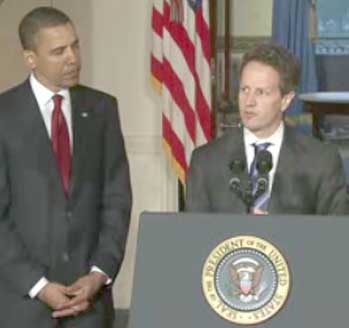 White House photo
Barack Obama with Treasury Secretary Timothy Geithner announce
the proposed changes in the tax codeand some members of Congress, said that attacking corporations is popular politically. The United States tax code covers citizens who live abroad. Many expats in Costa Rica hold a majority interest in local corporations. Under U.S. law they have to report corporate bank accounts they control. But many do not because the rules are not well known and the forms are complex. U.S. citizens could earn $87,600 tax free in 2008, but they would still have to pay Social Security and Medicare taxes. Many do not bother to do that. Costa Rica does not levy a capital gains tax, but the United States does. A U.S. citizen who makes a big real estate profit is subject to U.S. taxation, although most do not pay. Some run the money through a Costa Rican corporation. The rules for corporations are far more complex. The White House said that a January General Accounting Office report found that of the 100 largest U.S. corporations, 83 have subsidiaries in tax havens. The fact sheet named three small, low-tax countries: Bermuda, the Netherlands, and Ireland but did not define tax haven. Obama mentioned that in the Cayman Islands, one address alone houses 18,857 corporations, very few of which have a physical presence in the islands. He called this a tax scam several times. However, it is not unusual for a corporation to have incorporated in one jurisdiction and do business in others. Delaware, the home state of Vice President Joe Biden, is famous for being what is called a corporate haven. The state also does not levy an income tax on companies. More than half of U.S. publicly traded companies are incorporated there. The companies appoint someone, probably a lawyer, to receive documents on behalf of the corporation. These are called registered agents. The Delaware Division of Corporations says more than 850,000 business entities have made Delaware their legal home. Some are calling the Obama plan a new tax because the proposals seek to change the law to exact tax even from individuals and corporations that are now legally exempt. The fact sheet said the president seeks to reduce the amount of taxes lost overseas through unintended loopholes that allow companies to legally avoid paying billions in taxes, as well as the illegal use of hidden accounts by well-off individuals. Costa Rica found itself labeled a tax haven April 2 when the Organisation for Economic Co-operation and Development put it on its so-called black list with three other small countries. Guillermo Zúñiga, minister of Hacienda, quickly announced that lawmakers would be given a bill to end bank secrecy. In other words, bank records of individuals and corporations would become open to tax collectors here and elsewhere in the world. Curiously the Cayman Islands were not on the black list. Zuñiga, in a press release, said that Costa Rican tax authorities can only open bank accounts with the authorization of a judge and that the lifting of bank secrecy for tax purposes would be a very valuable tool to fight tax fraud. He noted that the Arias administration had a program to fight tax fraud. |
 |
 |
| Home |
Tourism |
Place
classified ad |
Classifieds |
Entertainment |
Real estate |
Rentals |
Sports |
About us |
|
| What we published this week: | Monday | Tuesday | Wednesday | Thursday | Friday | Earlier |
| The contents of this page and this Web site are copyrighted by Consultantes Río Colorado 2001, 2002, 2003, 2004, 2005, 2006, 2007 and 2008 and may not be reproduced anywhere without permission. Abstracts and fair use are permitted. Check HERE for details | ||||||
| A.M. Costa Rica fourth news page |
 |
||||||||
| Home |
Tourism |
Calendar |
Classifieds |
Entertainment |
Real
estate |
Rentals |
Sports |
About us |
|
|
|
|||||||||
|
Chemical firm faces $6.2
million in damages over big fire
|
|
|
By the A.M. Costa Rica staff
The nation's environmental watchdog wants to charge a chemical company 3.5 billion colons for an explosion and fire that leveled a storage facility in Moín in December 2006. The company is Químicos Holanda, a subsidiary of Brenntag Latino América. The estimated damage in dollars is $6.2 million. The explosion and fire killed two persons and burned others. But it also dumped large quantities of petroleum and chemical products on the ground. Some 20,000 persons in the area were left without water for two months as a result of the disaster because the water supply was polluted. |
The assessment of damage that was
determined this week includes
restoration of water supplies and cleanup of various water courses. More than 360 persons had to be housed in shelters after the Dec. 13, 2006, blaze. There also were fish kills. The blaze raged for 12 hours and sent thick, black smoke into the air and all over the neighborhoods. More than 20 large tanks exploded. There is an assessment for air quality, too. The company will be brought before the Tribunal Ambiental Administrativo later this year, and it can dispute the assessments at that time. The study of damages was coordinated by a special commission set up by the government with members from many agencies. |
 |
|
| News from
the BBC up to the minute |
BBC sports news up to the minute |
| BBC news and sports feeds are disabled on archived pages. |
|
| Home |
Tourism |
Place
classified ad |
Classifieds |
Entertainment |
Real estate |
Rentals |
Sports |
About us |
|
| What we published this week: | Monday | Tuesday | Wednesday | Thursday | Friday | Earlier |
| The contents of this page and this Web site are copyrighted by Consultantes Río Colorado 2001, 2002, 2003, 2004, 2005, 2006, 2007 and 2008 and may not be reproduced anywhere without permission. Abstracts and fair use are permitted. Check HERE for details | ||||||
| A.M. Costa Rica fifth news page |
 |
||||||||
| Home |
Tourism |
Calendar |
Classifieds |
Entertainment |
Real
estate |
Rentals |
Sports |
About us |
|
|
|
|||||||||
|
Foreign films winning praise
at New York cinema festival By the A.M. Costa Rica wire services
The Tribeca Film Festival was created to promote New York artists following the Sept. 11, 2001, terrorist attacks, but critics say many of the most compelling entries during the event's eight-year history have been foreign documentaries and dramas. Organizers believe a strong slate of foreign films each year echoes the multi-cultural spirit of the city. The Tribeca Film Festival was trimmed down this year as a result of the economic downturn, showing 86 features instead of the 120 last year. Films from 36 countries are among the works being screened, with many of those movies competing in Tribeca's two main categories, World Narrative and World Competition. Hollywood actor Robert DeNiro and his partner Jane Rosenthal launched the festival shortly after the Sept. 11 terrorist attacks. The pair wanted to bring both money and people back to lower Manhattan, and established the Tribeca Film Festival as a way of promoting local and foreign artists. Tribeca is a trendy neighborhood, located just blocks from the site of the World Trade Center attacks. Even with a scaled-back festival, organizers said it's essential to keep the event's mix of homegrown artists and foreign newcomers. Genna Terranova is the festival's senior programmer. Some of this year's most anticipated films include "About Elly," an Iranian drama about a group of old college friends who reunite for a weekend adventure on the sea, but lies and deception quickly lead to a catastrophe. Asghar Farhadi took the best director prize at the Berlin Film Festival this year. Another film earning critical acclaim is "Fixer: The Taking of Ajmal Naqshbandi." The documentary examines the 2007 kidnapping and beheading by the Taliban of the 24-year-old translator and intermediary hired by foreign journalists in Afghanistan. Directed by an American, Ian Olds, the movie is being shown in English, Dari, Pashto and Italian subtitles. As in previous years, Latin American films are making a strong showing at the festival. Ms. Terranova said one highlight was the Brazilian movie, "Garapa," directed by Jose Padilha. "It's a documentary about hunger in Brazil. He follows three families, with a 16-mm. black and white camera. He sort of lives with this family. It's a tough film," Ms. Terranova said. Because many foreign, small budget and independent films often have a hard time finding large audiences or a distributor in the United States, the festival's programmers say that promoting those works is part of what makes Tribeca a special outlet for artists from all around the world. |
| Home |
Tourism |
Place
classified ad |
Classifieds |
Entertainment |
Real estate |
Rentals |
Sports |
About us |
|
| What we published this week: | Monday | Tuesday | Wednesday | Thursday | Friday | Earlier |
| The contents of this page and this Web site are copyrighted by Consultantes Río Colorado 2001, 2002, 2003, 2004, 2005, 2006, 2007 and 2008 and may not be reproduced anywhere without permission. Abstracts and fair use are permitted. Check HERE for details | ||||||
| A.M. Costa Rica sixth news page |
 |
||||||||
| Home |
Tourism |
Calendar |
Classifieds |
Entertainment |
Real
estate |
Rentals |
Sports |
About us |
|
|
|
|||||||||
| Latin
American news digest |
European economic news is worse than was predicted By the A.M. Costa Rica wire services
Europe has received more bad economic news, with the 27-member European Union announcing the business downturn would be far worse this year than its earlier predictions. The European Union's economy is expected to shrink by 4 percent this year — more than twice what was estimated in January. And that is only part of the grim news that was delivered by the European Commission, the bloc's executive arm. Unemployment in the 27-member EU is expected to reach 11.5 percent by 2010 — the highest level since World War II. And as governments invest heavily in economic stimulus plans, their deficits are expected to soar to about 7.5 percent of gross domestic product, more than twice the limit allowed under EU rules. But EU economic commissioner Joaquin Almunia tried to offer a bright side to the gloomy news he delivered to reporters in Brussels. "Some positive signals have appeared in the last weeks, including the evolution of the financial markets, improvement in business expectations and some real indicators, such as export data in Asia, pointing, all of them, to a stabilization of the economy in the second part of this year and a gradual recovering in 2010," Almunia said. But the economic situation is likely to get worse in Europe before it gets better. The European Union predicts the German economy, Europe's largest, is likely to contract by 5.4 percent this year, a larger decline than the EU average. The Latvian economy is expected to be hit even harder, shrinking 13.1 percent in 2009, while Ireland's economy is expected to shrink by 9 percent. The European Union predicts the bloc may begin to slowly recover next year, but only if the banking system and international trade pick up. |
Latin American news feed is
disabled on archived pages. |
| Home |
Tourism |
Place
classified ad |
Classifieds |
Entertainment |
Real estate |
Rentals |
Sports |
About us |
|
| What we published this week: | Monday | Tuesday | Wednesday | Thursday | Friday | Earlier |
| The contents of this page and this Web site are copyrighted by Consultantes Río Colorado 2001, 2002, 2003, 2004, 2005, 2006, 2007 and 2008 and may not be reproduced anywhere without permission. Abstracts and fair use are permitted. Check HERE for details | ||||||