|
 |
Your daily
English-language |
 |
|
|
|
|
|
|
|
|
|
|
|
|
|||||||||||||||
|
|
|||||||||||||||
 |
|
Second news page |
 |
|
|
|
|
|
|
|
|
|
|
 |
| Costa Rica Expertise Ltd http://crexpertise.com E-mail info@crexpertise.com Tel:506-256-8585 Fax:506-256-7575 |
 |
 A.M. Costa Rica/Saray
Ramírez Vindas
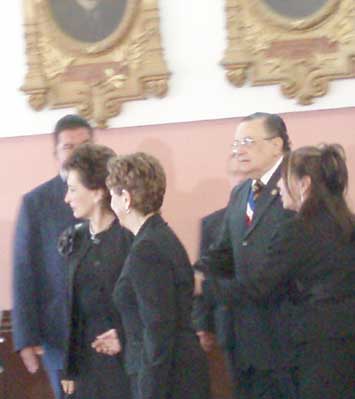
Pacheco, preceded by his wife and surrounded by security agents, enters the legislative chamber. Pacheco says he was
prudent and responsible By the A.M. Costa Rica staff
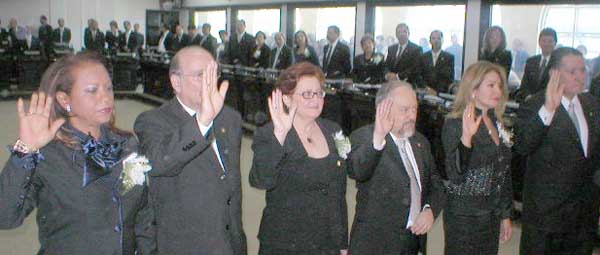
President Abel Pacheco said lack of financial resources and the unexpected increase in the price of petroleum were burdens for his administration and that he suffered the personal cost of these reverses instead of pushing the country into a financial catastrophe. Pacheco, who has less than a week in office, outlined his achievements and reverses in a state of the nation talk to the newly sworn -in Asamblea Legislativa Monday. He cited the failure of the proposed tax plan as a major reason he did not have the money to do more. His talk was titled "A responsible and prudent government." During the four years Pacheco said he had to govern in a precarious fiscal climate and in a difficult international context. If the price of petroleum had maintained 2002 levels, the country would have saved some $900 million during the years 2003, 2004 and 2005. With that kind of money, Pacheco said he would have been able to pay down a fourth of the external public debt. Pacheco, of course, has been criticized strongly over the condition of the national roads and highways, too. Pacheco warned the new lawmakers that they should not require incoming president Oscar Arias Sánchez to navigate the same waters that his government did. He urged them to approve the tax package that has been in the hopper since 2002. The past legislature already approved the massive package once, but the Sala IV constitutional court said its procedures were faulty. Pacheco in his 30-minute talk cited an investment of $650 million in foreign direct investment as an accomplishment. He said the money came even though the investments were not attracted by low salaries but by the high productivity of the Costa Ricans. Pacheco noted that his government managed to obtain approval for a free trade treaty with Canada and the Caribbean nations. He said that despite pressures from one side or the other he preserved the economic stability and with prudence he was able to maintain the social peace. By delaying for months sending the text of the free trade treaty with the United States to the Asamblea Legislativa, Pacheco delayed until the Arias administration any street protests and strikes by those who oppose the agreement. In an indirect reference to two previous presidents who face corruption allegations, Pacheco said no one could find a crooked five colons in his pocket. Pacheco was accompanied by his cabinet ministers. Surfers' missionary dies after mishap with bike By the A.M. Costa Rica staff
Alex Castro, who worked with a religious mission to surfers in Jacó, died without regaining consciousness in Hospital México Sunday. Castro, a 29-year-old Costa Rican, was hit by a car in downtown Jacó not far from the Christian Surfers mission where he worked April 23. He was riding a bike after dark. Castro was well-known in San José where he was brought up. He lived in Jacó for four years, said friends. Services are today at 3 p.m. in the Oasis de Esperanza church in Moravia. 10,000 cell lines on sale By the A.M. Costa Rica staff
The Instituto Costarricense de Electricidad will be putting 10,000 cell lines for TDMA service on sale starting today. The company requires a lot of documentation to obtain the telephone lines, and that is explained on the telecommunication company's Web page |
|
||||||||||||||||
 |
 |
|
on our real estate page HERE! |
 |
|
Third news page |
 |
|
|
|
|
|
|
|
|
| San José,
Costa Rica, Tuesday, May 2, 2006, Vol. 6, No. 86 |
||||||
 |
|
||||
| Maid said that U.S. citizen in Alajuelita shot himself |
|
|
By the A.M. Costa Rica staff
Police officials still are uncertain if the death of a U.S. citizen in Aurora de Alajuelita over the weekend was a murder or a suicide. The dead man was identified as Harvey Philip by Adriana Diaz Acevedo, a Fuerza Pública officer in the police delegación in Aurora. Police were called Sunday about 10:30 a.m. and when officers arrived an employee at the home, Lourdes Lobo Arias, told them that Philip, who was about 70, |
had shot himself
in the patio of the house, said Officer Diaz. The weapon involved was a .22-caliber handgun, the officer said. The case is being handled by the Judicial Investigating Organization, and an autopsy has been ordered. A curious factor is that a young man died in the same section of Alajuelita about 4 a.m. Sunday morning. The man, identified as Francisco Javier Sánchez, 21, was found by police. He died later at a hospital from a knife wound. |
 |
|
|
|
Fourth news page |
|
|
|
|
|
|
|
|
|
| San José,
Costa Rica, Tuesday, May 2, 2006, Vol. 6, No. 86 |
||||||
 |
| Morales nationalizes Bolivia's natural gas operations |
|
|
By the A.M. Costa Rica wire services
LA PAZ, Bolivia — President Evo Morales has signed a decree to nationalize the country's energy industry and ordered troops to immediately occupy natural gas fields to ensure production. Morales issued the decree in southern Bolivia Monday at the San Alberto gas field, which is operated by Brazil's state-owned Petrobras company. Morales said this was a historic day in which Bolivia retakes absolute control of its natural resources. The president said foreign energy companies will have to sign new operating contracts within 180 days or |
leave the country and
turn over
most production control to Bolivia's state-owned oil company, known as
YPFB. Monday's decree is expected to affect foreign companies such as Spain's Repsol, French group Total, the U.S. company ExxonMobil, British Petroleum as well as Petrobras. Officials from Petrobras could not be reached for comment as Monday was a holiday in Brazil. In the United States, an ExxonMobil spokesman Bob Davis said the company is monitoring the situation. Bolivia has the second-highest natural gas reserves in South America after Venezuela. |
| Drug trafficking and terrorism linked, U.S. expert says |
|
|
Special to A.M. Costa Rica
The world's terrorist organizations often rely on the proceeds from drug trafficking to achieve their goals, according to Michael Braun, chief of operations for the U.S. Drug Enforcement Administration. Briefing reporters on the 2006 International Drug Enforcement Conference to be held next week in Montreal, Braun said that to be successful in fighting terrorism, law enforcement agencies worldwide also must fight the narcotics industry. The U.S. State Department, he said, has identified 42 global terrorist organizations, with at least 18 of these groups involved in some aspect of drug trafficking activity to fund their operations. That means, he said, law enforcement authorities are fighting terrorist groups that "tax a farmer who is growing poppy or cocoa or marijuana, [or] perhaps, to the other extreme, a terrorist organization that is involved in virtually every aspect of drug trafficking activity." Braun said most global terrorist groups are driven by "ideological reasons, whether that be political, religious," or other factors. But, to exist, these groups need to have money for their operations, "to strike out against us," said Braun, who was joined in the Washington, D.C., briefing by Raf Souccar, assistant commissioner for the Royal Canadian Mounted Police. Braun said drug trafficking groups use myriad ways to finance their operations, such as smuggling aliens or being involved in weapons trafficking. |
"But I firmly believe
that there's nothing out there that's going to
provide the kind of money that drug trafficking does, that global drug
trafficking does at that kind of a scale," said Braun. He said U.S. citizens spend an estimated $64 billion to $65 billion for illegal drugs. Millions of dollars of that amount, if not more, he said, end up in the "war chests of terrorist organizations that are hell-bent on destroying our way of life and the way of life found in any free and democratic society on the face of the earth." Even with these alarming statistics, Braun said the United States has achieved success in fighting its own drug problem. The official said the United States has between 45 percent and 50 percent fewer people "abusing drugs in our country" as there were in 1979 at the height of the U.S. drug problem. "There is this notion out there that we're losing the war on drugs, [but] we absolutely are not losing the war on drugs," Braun asserted. During the briefing, Braun also discussed drug traffickers who operate in such Latin American countries as Venezuela, Mexico, Colombia and in the Caribbean and Afghanistan, where 80 percent of the world's heroin is produced, Braun said. Braun said the United States has achieved some "really phenomenal successes" in working with the Afghan counter-narcotics police to bring heroin traffickers to justice. |
 |
 |
 |
|
|
|
|
|
|
|
|
| What we published this week: | Monday | Tuesday | Wednesday | Thursday | Friday | Earlier |
|
|