|
| A.M.
Costa Rica Your daily English-language news source Monday through Friday |
||
 |
 |
 |
|
|
 |
||||||||||||||||||||||
|
|
|||||||||||||||||||||
 |
||||||||||||||||||||||
 |
||||||||||||||||||||||
|
|
|||||||||||||||||||||
 |
| What we published this week: | Monday | Tuesday | Wednesday | Thursday | Friday | Earlier |
|
|
|
|
|
|
|
Food |
|
Jo
Stuart |
|
Abstracts and fair use are permitted. Check HERE for more details |
 |
| A.M. Costa Rica's Second news page | |||||||||
| San José, Costa Rica, Wednesday, April 10, 2013, Vol. 13, No. 70 | |||||||||
|
|
|
|
|
|
|
Food |
|
 |
 |
|
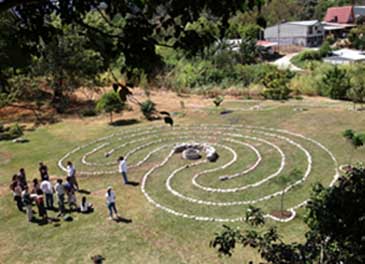 Ministerio de Cultura photo
The
meditation area, called the labyrinth of water, features
a fountain in the center. Place for
meditation ready
for inauguration Monday By
the A.M. Costa Rica staff
Fátima de Desamparados will have a new space for residents to reflect and meditate thanks to a water garden the culture ministry will inaugurate Monday. The new garden is called “Labyrinth of Water”and will be in the Parque La Libertad. It was constructed using a design of concentric geometry that extends 150 linear meters. There is a meditation area and a water fountain is the central focus, a release said. The water from the fountain is pure spring water from the eastern hill of Parque La Libertad that will be used for irrigation. "It is a space of peace and tranquility, surrounded by gardens,” said Dora María Sequeira, park director. “It is a very beautiful place to sit a while and think and enjoy the nature that surrounds us, with the exciting sound of water." According to Ms. Sequeira, the idea for a meditation garden came from the culture minister, Manuel Obregón. Architect Ronald Esquivel, who has designed many of the mazes in Costa Rica, drew out plans for this project and chose the water theme. "This type of space provides a concentrated energy which favors the feeling of personal space that is safe and free of externalities," said the park release. The inaugural ceremony Monday will feature music from singer Marianela Ortiz as well as an aerial dance by Danzaire. It begins at 11 a.m. in Parque La Libertad. Entrance is free. Free concert in Santa Ana features symphonic orchestra By
the A.M. Costa Rica staff
The Orquesta Sinfónica Nacional will present a free concert tonight on the Santa Ana football field as part of the X Festival Nacional de las Artes. For the occasion, organizers will transform the field with a large stage that will house the musicians. The national orchestra will entertain the crowd with a varied musical repertoire that includes “Obertura Festiva” by Costa Rican composer Vinicio Meza, “Suite Estancia” by Argentinean Alberto Ginastera and “New World Symphony,” the third and fourth movement, by Czech Antonín Dvorak. Eddie Mora of Costa Rica will serve as the guest director for the orchestra. "In this presentation for the national art festival we will play varied universal works,” said Mora. “It is a combination that the audience can enjoy, because it is a very energetic and active program. This is part of a larger project, that consists and will culminate with a record with Costa Rican music under my leadership." This is the first time the orchestra will play “Festive Overture.” Meza, the piece's composer, premiered the work in 2012. He also plays clarinet for the group. “This piece has a truly festive feel,” he said. “It is like a semblance of marching bands, at least in principle, which is also called as a fanfare. I am very proud this music will be performed by the national symphony orchestra to be shared with the public." The concert will take place on a stage located in the southern sector of the Santa Ana football field, opposite the church at 7 p.m. It is free and open to the public. Stargazing session planned at university in Cartago By
the A.M. Costa Rica staff
The technical university in Cartago is sponsoring a stargazing program Saturday to mark the International Day of Astronomy. The event includes discussions, observations with a solar telescope during the day and night viewing. The evening starts at the university's Centro de Investigación en Computación at 10 a.m. with discussions, including one on the solar system. There is a lunch break and food is for sale. The afternoon includes the use of the solar telescope from 1 to 2 p.m. and additional discussions and lectures until 5 p.m. By that time the sky will be darkening, and the center of activity moves to the football field where the night sky will be viewed, said the university. There is no charge and registration is not required. Ad rates to be increased By the A.M. Costa Rica staff
A.M. Costa Rica will be instituting a small display advertising rate increase April 15. Classified advertising rates will remain unchanged. The increases are made necessary by increases in costs that the newspaper must pay. This includes higher utility costs, mandatory increases in employee salaries, higher rents and higher costs for editorial and professional services. Existing advertising agreements will not be affected, and the advertising staff will continue to accept business at the old rate until April 15.
|
||||||||||||||||||||||||||||||||||||||||||||||||||||||||||||||||||||
 |
|||||||||||||||||||||||||||||||||||||||||||||||||||||||||||||||||||||
|
|
|
|
|
|
|
Food |
|
| What we published this week: | Monday | Tuesday | Wednesday | Thursday | Friday | Earlier |
| The contents of this page and this Web site are copyrighted by Consultantes Río Colorado S.A. 2013 and may not be reproduced anywhere without permission. Abstracts and fair use are permitted. Check HERE for details | ||||||
A.M. Costa Rica Third News Page |
A.M.
Costa Rica advertising reaches from 12,000 to 14,000 unique visitors every weekday in up to 90 countries. |
| San José, Costa Rica, Wednesday, April 10, 2013, Vol. 13, No. 70 | |
|
|
|
|
|
|
|
Food |
|
| Health officials to use cell phones to
help smokers trying to quit |
|
|
By
the A.M. Costa Rica staff
Health officials are turning to cell telephones to encourage smokers to kick the habit. Costa Rica is the first of some eight countries that are adopting a program supported by the International Telecommunications Union. The idea is to use text messaging to support those who are trying to quit. Smoking is the first ill that will be considered, but health officials also are talking about sedentary lifestyles, alcohol and bad diet. They call these non-transmissible diseases. Government officials say that a new law that cracked down on smokers provided the incentive to expand into the cell telephone market. There are more cell phones in the world than humans, noted one official. The Ministerio de Salud plans to open an Oficina Nacional de Control de Tabaco at the end of the month that will monitor tobacco use. That, the Instituto sobre Alcoholismo y |
Farmacodependencia and the
Panamerican Health Organization will create messages to fortify the
will of those who are trying to stop smoking, said the ministry. The text messages will be planned to coincide with the stage of withdrawal of each smoker. The Ministerio de Ciencia, Tecnología y Telecomunicaciones also is involved in the project. Various officials signed an agreement Tuesday that will put the plan into operation. The World Health Organization is involved, too. The anti-tobacco law went into force a year ago, and it is this law that prohibits most smoking in many private and public areas. The email program, known as m-Salud, will target smokers from 18 to 35, said the agencies. Health officials have to put together the employees and the technical systems to execute the project, so they anticipate that the first test messages will be going to smokers who volunteer in August. |
Emergency officials are doing this work on the Río Grande de Paquera on the Nicoya peninsula. |
 Comisión Nacional de
Prevención de Riesgos y Atención de Emergencias photo
|
| Road and bridge projects in race against
upcoming rainy season |
|
|
By
the A.M. Costa Rica staff
Road and emergency officials are in another race against time to finish projects before the rainy season hits hard. On the Nicoya peninsula, the Comisión Nacional de Prevención de Riesgos y Atención de Emergencias is clearing the channel of the Río Grande de Paquera in anticipation of heavy downpours. Among other storms, Tomas in 2010 caused flooding that endangered about 600 nearby residents. The floods also left sediment that the commission hopes to eliminate. The work covers 3.4 kilometers of the riverbed and cost 116 million colons or about $232,000. The job also protects new bridges that have been placed near the mouth of the river. |
Ruta 32 that runs north from San
José to the Caribbean coast is close to being finished. The
Consejo Nacional de Vialidad replaced concrete with asphalt and put
security lines on the major highway in a four-step project that caused
woes for motorists. In another project, the so-called Puente Blanco on Ruta 415 in the center of Turrialba at the central park is being repaired. That community is no stranger to devastating flooding. New concrete will go down and the bridge approaches will be repaired. This is a 15 million-colon job, about $30,000. In Barva de Heredia a one-lane bridge on Ruta 126 over the Quebrada Seca is being removed and will be replaced by a four-lane structure. The project is scheduled for 120 days, and some motorists will have to use alternate routes, said the Ministerio de Obras Públicas y Transportes. |
 |
| You need to see Costa Rican tourism information HERE! |
|
|
|
|
|
|
|
Food |
|
| What we published this week: | Monday | Tuesday | Wednesday | Thursday | Friday | Earlier |
| The contents of this page and this Web site are copyrighted by Consultantes Río Colorado S.A. 2013 and may not be reproduced anywhere without permission. Abstracts and fair use are permitted. Check HERE for details | ||||||
 |
|
||||
| A.M. Costa Rica's Fourth News page | |||||
| San José, Costa Rica, Wednesday, April 10, 2013, Vol. 13, No. 70 | |||||
|
|
|
|
|
|
|
Food |
|
| Beer festival organizers seek to transform the drinking
culture here |
|
|
By
the A.M. Costa Rica staff
Costa Rica Craft Brewing, the Cartago firm that produces several types of beer favored by expats, plans its second annual beer brewing festival in conjunction with the Club de Cerveceros Caseros y Artesanales de Costa Rica. Costa Rica is a land dominated by one major brewer, and Costa Rica craft brewing has made inroads into the market with its distinctive products. Peter Gilman, the brewery's general manager said in a release that the beer festival, which will be at Avenida Escazú April 20, is trying to reshape the beer culture in the way that an influx of imported wines did for that market in the last 10 years. The company also has announced plans to move to Santa Ana this year. The announcement promises that there will be many types of beer available at the festival, including beer made from wheat, toasted malts and even some made from mango and other organic products. There even is a brew that has been aged in oak casks for a year, said the release. The event will include some discussion and lecture sessions. There is a 15,000-colon fee for attending. The release also mentioned two other microbrewers that have gone into operation. They were identified as Treintaycinco and Costa Rica Meadery, |
 which makes a drink from honey.
Two brewpubs will show their products. They were identified as Volcano
Brewing from Arenal and Bribri Springs from the Caribbean coast. Other
microbrews are in the process of opening, said the release.
Gilman noted beer's rich history and said that his firm seeks to replace the culture that emphasized drinking to excess with a respect for beer that emphasizes appreciation of the product. The beer festival has its own Web site. |
|
|
|||||||||||||||||||||||||||||||||||
|
||||||||||||||||||||||||||||||||||||
|
|
|
|
|
|
|
Food |
|
| What we published this week: | Monday | Tuesday | Wednesday | Thursday | Friday | Earlier |
| The contents of this page and this Web site are copyrighted by Consultantes Río Colorado S.A. 2013 and may not be reproduced anywhere without permission. Abstracts and fair use are permitted. Check HERE for details | ||||||
| A.M.
Costa Rica's Fifth news page |
 |
||||||||
| San José, Costa Rica, Wednesday, April 10, 2013, Vol. 13, No. 70 | |||||||||
|
|
|
|
|
|
|
Food |
|
 |
|
| Pakistan may have OK'd use of unmanned drones By
the A.M. Costa Rica wire services
The use of unmanned drones to strike terrorists is coming under increasing scrutiny. Those in favor say the U.S. drone strikes have been highly effective, but critics suggest they could violate international law. The New York Times claimed Sunday it had uncovered a secret deal between the U.S. and Pakistan over the use of drones in Pakistani airspace. Unmanned drones are being used with increasing frequency in fighting terrorist groups like al-Qaida. A recent analysis by the New America Foundation estimated drone strikes in Pakistan and Yemen since 2004 have killed up to 3,238 militants and as many as 368 civilians. Christopher Coker of the London School of Economics is author of "Warrior Geeks: How 21st Century Technology Is Changing The Way We Fight And Think About War." “There are six American bases, four in the United States, one in Germany and one in South Korea, and that’s where most of the drone strikes are launched from. And they have chaplains and psychologists now in the room monitoring. They have machines monitoring stress levels, also monitoring concentration levels," said Coker. "And there is, of course, a chain of command. So you spend about eight hours looking at the screen day after day and occasionally you get the command to actually fire.” The New York Times newspaper alleged Sunday that Pakistan is allowing U.S. drones in its airspace in return for targeted killings of Pakistan’s enemies by the drones. The Pakistani government strongly denied the allegations. The U.S. government did not comment. The drone strikes have prompted street protests in Pakistan. Arif Niazi is a lawyer in Islamabad. "These ongoing attacks are blatant aggression, an intrusion into my country and a violation of its sovereignty," said Niazi. Marco Roscini, an expert on international law at the University of Westminster, says the legality of current drone strikes is murky. “There is a huge need for clarification and there’s a huge need for transparency," said Roscini. "You know that most of the strikes are now allegedly carried out by the CIA and their covert operations. So we don’t know why, who or when an individual is put on the targeted list.” The decision on whom to target is a key distinction between CIA drone strikes and the military, says Coker of the London School of Economics. “The military can only actually take out someone if they know 100 percent that it’s a bad guy," he said. "The CIA will take you out on the basis that your behavior leads them to suspect that you may be a bad guy.” Supporters of drone strikes point to the killing of numerous high-profile targets, such as last year's strike in Pakistan that killed the then number two in al-Qaida, Abu Yahya al-Libi. At his nomination hearing before the Senate Intelligence Committee in February, CIA Director John Brennan was questioned about the use of drones to kill U.S. citizens suspected of joining terror groups. “I think any Americans who did that, should know well, that they are in fact part of an enemy against us, and the United States will do everything possible to destroy that enemy to save American lives," said Brennan. With most NATO ground forces withdrawing from Afghanistan at the end of 2014, analysts says drones could play a bigger role in the West’s fight against al-Qaida and other terrorist groups. Newtown families pressure U.S. lawmakers on firearms By
the A.M. Costa Rica wire services
U.S. lawmakers faced intense pressure Tuesday from the White House and families of Newtown, Connecticut, shooting victims, to clear the way for votes on new gun control legislation. Family members whose loved ones were gunned down at a Newtown elementary school last year spent the day on Capitol Hill making personal appeals to lawmakers. About a dozen Newtown residents flew to Washington on Air Force One after President Obama delivered a speech Monday challenging Senate Republicans to drop threats to block gun legislation. Obama seeks debate and votes on all the key objectives he laid out last January, including renewal of an expired assault weapons ban and universal background checks for all gun buyers. After meeting with police and other law enforcement officials Tuesday, Vice President Joe Biden said Congress lags far behind the American people, who polls show support stronger gun laws. He had scathing criticism for Republicans threatening to block forward movement, saying the situation embarrasses the United States in the eyes of the world. "The tragedy that traumatized the nation and caught the attention of the entire world and after all the thinking and the debate and the discussion with overwhelming majorities of the American people thinking that the proposal the president put forward made absolute sense, the climax of this tragedy could be we're not even going to get a vote? Imagine how that looks," Biden said. Biden said the National Rifle Association, which is lobbying heavily against stronger gun laws, is trying to scare Americans into believing the federal government aims to take away their guns. Attorney General Eric Holder rejected a key NRA assertion that President Obama seeks to remove the right of citizens to gun ownership protected by the Second Amendment of the U.S. Constitution. "Contrary to what a few have said, this plan which President Obama announced in January, is consistent with the Second Amendment, and will not infringe in any way on the rights of gun owners," Holder said. White House press secretary Jay Carney challenged Republicans opposing an expansion of background checks for gun purchasers to be willing to make their position clear in an open vote. "If they are opposed to background checks they should stand up and say so and vote no. The American people demand at least that," Carney said. The White House push on gun control continues on Wednesday. First Lady Michelle Obama speaks in Chicago about the impact of gun violence on children and communities. Washington prepares for rally by illegal immigrants, backers By
the A.M. Costa Rica wire services
Jaime Contreras hasn’t eaten much lately. He’s been too busy preparing for Wednesday’s “All in for Citizenship” rally expected to draw tens of thousands of immigration activists to the West Lawn of the U.S. Capitol. Contreras, vice president of SEIU 32BJ, the local chapter of the powerful Service Employees International Union, says the rally is a call to action for Congress to stop treating the 11 million undocumented immigrants in the U.S. like second class citizens. “We’re going to have tens of thousands of people in front of the nation’s capital, sending a message, reminding our elected leaders that last November, our community spoke loud and clear that we voted and we voted for immigration reform,” he said. The Hispanic community was a massive force in the 2012 elections, an increasingly powerful electorate whose demands for immigration reform have become difficult for lawmakers to ignore. It’s not the first time activists have rallied for an overhaul of the U.S. immigration system. Similar marches took place in 2006, only to have a reform bill collapse in the Senate in 2007. This time is different, according to Contreras. “Republicans have come to a realization that the immigrant community is growing, that it’s vibrant, a hard working community that contributes to the country just like everybody else,” he said. “And for the first time, we have Republicans and Democrats trying to figure out who’s taking the credit.” Chief among the movement’s demands is a path to legalization for illegal aliens and an end to the deportations that have divided hundreds of thousands of families in recent years. They’re issues that stir strong emotions on both sides, and counter-protests are planned for Wednesday. Jim McDonald, a resident of Arlington, Virginia, will be part of the opposition. He identifies himself as an interested American. “I’m an interested American because it’s outrageous that we’ve got people demanding citizenship that aren’t even supposed to be in the country illegally and they’re going to be on Capitol Hill doing it. It's a personal affront to me,” he said. McDonald plans to carry photos he took at the border between the U.S. state of Arizona and Mexico, a frontier he describes as porous. Border security is a key point of the Congressional debate over immigration reform. Sen. Marco Rubio of Florida, who is part of the bi-partisan team drafting a reform bill, is pushing for assurances that the border be secured before undocumented immigrants can begin gaining citizenship. The Obama administration says the southwestern border is tighter than it’s ever been. Among the thousands who will be rallying on Capitol Hill are immigrants brought to the U.S. illegally by their parents. Their plight has transformed the conversation from strictly a policy issue to a personal dilemma. Contreras, who gained citizenship in 1996 while serving in the U.S. Navy, understands the dilemma. His parents brought him to the U.S. in 1988, when a war was raging in their home country, El Salvador. “They brought me here because they didn’t want me to get killed,” he said. “I think any parent who does that for their kids should not be a criminal. And any kid who comes here at no fault of their own should not be a criminal.” Still, McDonald and others like him aren’t swayed. “I don’t think it’s my problem to straighten out what their parents did. The parents should be responsible for what to do with their kids. It’s their problem. It’s not our problem as a nation to resolve that kind of an issue,” he said. The senators tasked with resolving the issue are expected to present their draft legislation to Congress next week. Restructuring science courses urged by curriculum panel By
the A.M. Costa Rica wire services
Next Generation Science Standards call for introducing lessons on climate science to young teens in middle school, and ensuring that all students learn about evolution. A distinguished team of scientists and educators says the United States must significantly change the way American students learn science or the country will soon be unable to compete or lead in the global economy. The group spelled out what those changes should be in a new set of national guidelines, officially released Tuesday. Those so-called Next Generation Science Standards call for introducing lessons on climate science to young teens in middle school, and ensuring that all students learn about evolution, among hundreds of recommendations. They emphasize hands-on learning and critical thinking, rather than memorizing facts. Each state will decide whether to adopt the guidelines for its schools. More than half of the states had educators involved in their development, and have committed to giving serious consideration to incorporating them into their curricula. The guidelines drew a hostile response from groups critical of mainstream scientific thinking on topics such as climate change and evolution, but the scientific community has welcomed them. Sarah Shanley Hope, with a group called the Alliance for Climate Education, said "This is a big step forward for giving students access to the science most relevant to them today and for our shared future.” Preliminary study says blacks more at risk for Alzheimers By
the A.M. Costa Rica wire services
The largest study to date looking for genetic causes of Alzheimer's in African Americans may offer new clues about why blacks in the United States are twice as likely as whites to develop the deadly, brain-wasting disease. The findings, published in the Journal of the American Medical Association Tuesday, show that mutations in two genes that play a role in whites also contribute to Alzheimer's risk in blacks. One of those, known as ABCA7, may double the risk in blacks who have the mutation versus those who don't. Although many genes have been found to raise the risk of Alzheimer's, most studies have been conducted in largely white populations, and few studies have looked specifically at genes that drive Alzheimer's in blacks. Part of that is because very few African Americans take part in gene studies looking at Alzheimer's risk. The latest findings will need to be confirmed by other research teams, and critics say the study is incomplete until that work is done. To get enough participants for the newly published study, researchers combined genetic information from 18 different Alzheimer's disease centers funded by the U.S. National Institutes of Health. They gathered information on 6,000 African Americans, 2,000 of whom had late-onset Alzheimer's disease, the most common form that occurs in older people. The team then looked for genes that were most strongly associated with Alzheimer's. The strongest link was with a variant of a gene called apolipoprotein E or APOE, a gene that contains instructions for making a protein that carries cholesterol and is well-known risk factor for Alzheimer's. The team found that a variant of this gene called APOE-e4 doubled the risk of Alzheimer's in blacks, in much the same way it does in whites. But the study also turned up another gene that has only been weakly associated with Alzheimer's in whites. This gene, called ABCA7, which also plays a role in the production of cholesterol and fats, appears to have a much stronger effect in blacks. "In whites, it increases risk by 10 to 20 percent, but in African Americans, it increases risk by about 70 to 80 percent. It has a way larger effect size in African Americans,'' said Christiane Reitz of Columbia University Medical Center, who conducted the genetic analyses on the study. ABCA7 is also involved in cholesterol metabolism, as are several of the genes which have been found in the past five years or so to be linked with Alzheimer's in whites. "That seems to be a pathway that is involved in Alzheimer's disease,'' Ms. Reitz said. Ms. Reitz said a variant form of APOE called APOE-e4 has the biggest effect, increasing the risk of Alzheimer's by about 200 percent. ABCA7 raised the risk by about 80 percent, and most other genes discovered so far increase risk by 10 to 20 percent. Like other risk genes for the age-related form of Alzheimer's, the gene explains only part of the risk and likely will not lead to any new treatments soon. The physician said it is clear that hundreds of genes are at work in Alzheimer's disease. "ABCA7 and APOE are not the only genes involved in Alzheimer's disease in African Americans,'' Ms. Reitz said, adding that it would take tens of thousands of participants to detect some of the other risk genes. "What the study did show us is at least one gene which seems to have a major effect, and that's important to know.'' The next step is to study how the ABCA7 gene works in the brain, and the team still needs to validate the results of this study in another independent population of blacks, something that may be challenging. According to Neil Buckholtz, director of the division of neuroscience at the National Institute on Aging, the study represented all of the well-characterized genetic samples of blacks in the United States. Allan Levey, director of Emory University's Alzheimer's Disease Research Center, said the study was significant for being the first large-scale genetic study done in African Americans. But he said a major limitation is that the study was not replicated in another population of blacks to confirm the findings, which is considered necessary to ensure its validity. "Had this same study been done in whites, it would never have been published here,'' said Levey, referring to JAMA, a highly-regarded medical journal. Troy Duster, a sociologist at the University of California, Berkeley and author of "Backdoor to Eugenics'' and contributor to "Whitewashing Race: The Myth of a Color-Blind Society,'' says the findings are too preliminary and the effect sizes too small to draw any definitive conclusions about differences in the risk of Alzheimer's between blacks and whites. Without a replicating study in other groups who identify as African-American and as white, "it is impossible to interpret whether this small difference has significant meaning, or points to different etiologies (or the need for different treatments) in different groups,'' he said. Heather Snyder, director of medical and scientific operations at the Alzheimer's Association, which funded two of the study authors, said the findings should spur new research into the potential reasons for this link between ABCA7 and Alzheimer's in African Americans. "Really, that all requires more funding for Alzheimer's disease research,'' Ms. Snyder said. |
|
||||||||||||||||||||||||||||||||||||||||||
|
|
|
|
|
|
|
Food |
|
| What we published this week: | Monday | Tuesday | Wednesday | Thursday | Friday | Earlier |
| The contents of this page and this Web site are copyrighted by Consultantes Río Colorado S.A. 2013 and may not be reproduced anywhere without permission. Abstracts and fair use are permitted. Check HERE for details | ||||||
| A.M. Costa
Rica's sixth news page |
|
||||||||
| San José, Costa Rica, Wednesday, April 10, 2013, Vol. 13, No. 70 | |||||||||
|
|
|
|
|
|
|
Food |
|
 |
|
Traffic
cop faces claim that he kicked a vehicle By
the A.M. Costa Rica staff
A traffic policeman appears to have lost his temper when a motorist failed to stop. After chasing the fleeing car, the officer located it stopped and then began to kick the vehicle, said the Judicial Investigating Organization. The policeman, 36, is being held on an allegation of abuse of authority and damage. Agents said that the motorist was accompanied by a woman and a 2-year-old who began to cry at the activities of the traffic policemen. The officer sought to stop the vehicle because the driver did not have a marchamo or road tax sticker and the date was Jan. 1. Agents detained the officer Tuesday at 6 a.m. when he reported for work in Santa Ana. Exxon loses court case over gasoline additive By
the A.M. Costa Rica wire services
A jury in New Hampshire has ordered the oil giant Exxon-Mobil to pay $236 million to clean up groundwater polluted with a gasoline additive. It took the jurors less than two hours Tuesday to find Exxon liable for damages. New Hampshire sued Exxon and more than 20 other defendants for contaminating groundwater with MTBE, a gasoline additive that cuts emissions from cars. Lawyers for the state say the companies knew MTBE was likely to pollute and is hard to clean up. Exxon says it will appeal. Suits against the other companies were settled out of court or dropped. Navy said it now has a laser weapon that works By
the A.M. Costa Rica wire services
The U.S. Navy says it has developed a laser weapon designed to ward off attack from both air and sea threats. The Navy released a demonstration video Monday, showing the new weapon shooting down an unmanned drone. The weapon eventually will be capable of disabling small enemy vessels and surveillance drones. Officials say the cost of the laser will be less than $1 per shot since it runs on electricity, far less than the thousands of dollars it costs to fire one missile. The laser will be mounted on an amphibious transport docking ship that will be deployed to the Persian Gulf in 2014. |
| Costa Rican News |
AMCostaRicaArchives.com |
Retire NOW in Costa Rica |
CostaRicaReport.com |
|
|
|
|
|
|
|
Food |
|
| What we published this week: | Monday | Tuesday | Wednesday | Thursday | Friday | Earlier |
| The contents of this page and this Web site are copyrighted by Consultantes Río Colorado S.A. 2013 and may not be reproduced anywhere without permission. Abstracts and fair use are permitted. Check HERE for details | ||||||