|
|
A.M. Costa Rica
Your daily English-language news source Monday through Friday |
||
 |
 |
 |
|
|
 |
|

|
|||||||||||||||||||||
 |
||||||||||||||||||||||
 |
||||||||||||||||||||||
|
|
|||||||||||||||||||||
 |
 |
| What we published this week: | Monday | Tuesday | Wednesday | Thursday | Friday | Earlier |
|
|
|
|
|
|
|
Food |
|
Jo
Stuart |
|
|
| A.M. Costa Rica's Second news page | |||||||||
| San José, Costa Rica, Wednesday, March 28, 2012, Vol. 12, No. 63 | |||||||||
|
|
|
|
|
|
|
Food |
|
Jo
Stuart |
 |
 |
 |
|
Our
readers' opinions
Internet
hookup not reliable,and managers care less Dear A.M. Costa Rica: I totally agree with the comments about Amnet. For over six years that I have been in this Sabana Oeste area, Internet service has been very unreliable, and a technician who once came to my house told me that the server for this area is totally outdated and it appears six years later we have the same server. Quite often Internet is either too slow or out. When I talked to them 1 ½ years ago they told me if I upped the speed to 3, the service would be much better but we saw no improvement. Then we had them run a second line thinking it would come from a different server but no such luck. Now both the lines have same problems even with the speed of 5 by 1 Mgb. In fact, it is 7:30 p.m. on March 22, and we have been down for almost three hours. When the service is down and you call them to get information, they either don’t pickup the phone or put you on hold forever. Really frustrated I once called the customers service and told them that the Internet service was terrible and I would like to switch to Radiográfica Costarricense S.A., he said you mean you want to switch to Amnet, I said no, I have Amnet now. He replied, just disconnect the modem and bring it to our office and your service will be discontinued. You would think the management should be aware of these problems but it appears they are sleeping on the wheels waiting for, like many of us are, another company to enter the market and take over their customers. Abdul
Mohamed
Sabana Oeste Appeal to consumer agency will accomplish nothing Dear A.M. Costa Rica: I’m sure anybody and everybody who has the misfortune of being a customer of Amnet or Cable Tica can identify with William Ruzicka’s complaints about his lousy service and frustrating experiences. Neither company has the personnel, the expertise or the equipment to deliver what they’re advertising. In fact, if truth be told, both companies are perpetrating a disservice on the people of Costa Rica by promising one level of service and continually failing to provide what they promise. Somewhere in the maze of government agencies in San José, there is one that should be monitoring the quality of the service these companies are providing to their long suffering customers. But I’ll be damned if anybody can tell me which agency is charged with this duty. All I know is that they’re not doing it, and I have a hard time believing that they care much about it. (They’re probably not being paid enough to care). Mr. Ruzicka suggested that anybody who shares his frustration with these companies should consider filing a claim with the Dirección de Apoyo al Consumidor. I can tell you from personal experience that this will accomplish nothing. You’ll be lucky if you get a hearing inside of two years, and even if you prevail as the complainant, as I did nine years ago against a corrupt importer, the person/company found at fault can just ignore the courts findings and directives. The agency has no real enforcement power, and so if someone ignores them, the case goes to court and the waiting game starts all over again. And for some reason known only to them, this agency will not allow a consumer to recover legal fees from the company they’re complaining about. So unless the claim is in the thousands of dollars, it’s not worthwhile to file a complaint. The only possible remedy for these many shortcomings on the part of the cable companies would be a government intervention, and the odds of that happening/creating any meaningful change are just about zero. The only other option is to dump cable in favor of a satellite dish, and we all know what happens to the quality of a satellite signal when it rains. This is the tradeoff we all make for living in the Third World. There’s no getting around it. While we’re talking about T. V., I want to voice my own frustration over the continually dwindling amount of English language programming on cable. CINECANAL and FX both recently went to all Spanish formats, as have many other cable channels over the last few years. Clearly, someone at a very high level in the cable industry is making these decisions, and the message to their English-speaking clients is clear as a bell, (unlike their broadcast signals). They don’t care about us or our business! At this rate, we’ll soon find English programming only on ABC/NBC/CBS. I’m told that we may see some improvement overall when the companies go digital, but based on how poorly they’re handling their high-speed Internet connections, it may be some time before Costa Rican television enters the 21st century. Time to read a book, I suppose. Dean
Barbour
Manuel Antonio
|
|||||||||||||||||||||||||||||||||||||||||
 |
||||||||||||||||||||||||||||||||||||||||||
|
|
|
|
|
|
|
Food |
|
Jo
Stuart |
| What we published this week: | Monday | Tuesday | Wednesday | Thursday | Friday | Earlier |
| The contents of this page and this Web site are copyrighted by Consultantes Río Colorado 2012 and may not be reproduced anywhere without permission. Abstracts and fair use are permitted. Check HERE for details | ||||||
 |
 |
|
| A.M. Costa Rica Third
News Page |
|
| San José, Costa Rica, Wednesday, March 28, 2012, Vol. 12, No. 63 | |
|
|
|
|
|
|
|
Food |
|
Jo Stuart |
This is not your grandfather's streetcar. The modernistic vehicle is superimposed on a photo of Avenida 2 between Parque Central and the Teatro Popular Melico Salazár |
 Municipalidad de San José graphic
|
| Price tag still unknown for plan to put
streetcars in San José |
|
|
By
Shahrazad Encinias Vela
of the A.M. Costa Rica staff San José will have a public metro system that will reduce inner city traffic. That is if all continues to go well, said Mayor Johnny Araya Monge Tuesday. The mayor was at a presentation about a study made to analyze the possible streetcar project at the Municipalidad of San José. The 10-kilometer metro system, approximately 6.2 miles, is a project to encourage better living in the city, he said. Although there is no set budget or ball park figure for the project yet, leaders in the transportation industry are optimistic and supportive that system will add to the modernity of San José. Araya was joined by Fabrice Delloye, the ambassador of France in Costa Rica, Rodrigo Rivera Fournier, vice minister of Obras Públicas y Transporte, Miguel Carabaguíaz, executive director of the Instituto Costarricense de Ferrocarriles. Vice President Luis Liberman joined the panel later. The tram or streetcar system is supposed to run from east to west, from the Estación del Atlántico near Parque Nacional to a station in Pavas. The proposed route is supposed to run from Avenida 3, Paseo de las Damas, cross the Calle 11 bridge and pass by Parque Morazán. From there it will hook onto Calle 5, head south and make a right onto Avenida Segunda. It will then connect to Paseo Colón crossing the Calle 14 intersection. From Paseo Colón the route will head toward the Bulevar las Américas where it passes by the north side of Parque la Sabana and the Estado Nacional. It will then pass by the south end of the park to the Bulevar de Pavas and continue past the U.S. Embassy until the terminal in Pavas. However, the route is subject to change, officials said. The city has just initiated phase two of the process, which is the part where the consulting companies figure out preliminary design and evaluation. This phase is where the construction cost, tram rate, and route will be established. This phase ends at the end of May or early June. It won't be until phase two is complete that a cost will be known, said officials. |
“We should have patience for the
cost . . . . It's too premature to know numbers,” said Liberman. France is a proud sponsor according to Delloye. The French government has donated 360 million colons to the project. The consultation companies running the projects, SYSTRA and EGIS, are both from France. Since Nov. 3 last year, the consulting firms have done research to complete phase one, defining the project. Their staffers did a survey where they talked to more than 8,800 bus patrons on 150 different bus routes, and counted cars during peak hours between 6 a.m. to 5 p.m. The analyses resulted in the firm's confidence that a metro system is necessary for two main reasons. The first is for the need for interurban transportation. The second is for better access to work. There also will be an estimated 150,000 passengers per day on the tram, the firms reported. San José has catered more toward business and work rather than a place to live, and it is a commuter city, said Araya. He added that it's time for the city's orientation to change. This new tram system in San Jose will “modernize aesthetically and culturally” said Rivera, the vice minister. “Costa Rica pertains to the modern world . . . . It's evident Costa Rica deserves a tranvía,” said Delloye, using the Spanish word for streetcar. The tram system will work as a branch of the rail institute, so there will be no competition between the means of public transportations, said Carabaguíaz. Instead rail service and the tram system will compliment each other, said Araya. The new system shouldn't take away from the train system money because the tram system is supposed to be urban, unlike the rail system that functions more for residents outside the metro area, said Carabaguíaz. “This project compliments the effort that INCOFER does,” said Carabaguíaz, using the acronym for the institute. |
| Government signs contract for new route
in northern zone |
|
|
By
the A.M. Costa Rica staff
Government officials signed off Tuesday on a two-year project to build a more direct highway across the northern part of the country. The project had been announced. The new route will be 27 kilometers between Bajos de Chilamate in the canton of Sarapiquí and Vuelta Kooper in San Carlos. The project is being financed by the Corporación Andina de Fomento for about half the cost. The contractor will be Constructora Sánchez Carvajal. The current route between the two points is about 87 kilometers or about 54 miles. So the route will save motorists 37 miles. More than that, the new highway provides quicker access both east and west for commerce and agricultural products and forms part of the Red Internacional de Carreteras |
 Ministerio de Obras Públicas y
Transportes graphic
Yellow and black line shows the
new route.Mesoamericanas. The government is in the process of expropriating the necessary properties. The construction firm is expected to begin in May. |
 |
| You need to see Costa Rican tourism information HERE! |
|
|
|
|
|
|
|
Food |
|
Jo
Stuart |
| What we published this week: | Monday | Tuesday | Wednesday | Thursday | Friday | Earlier |
| The contents of this page and this Web site are copyrighted by Consultantes Río Colorado 2012 and may not be reproduced anywhere without permission. Abstracts and fair use are permitted. Check HERE for details | ||||||
|
A.M. Costa Rica's
Fourth News page |
 |
||||
| San José, Costa Rica, Wednesday, March 28, 2012, Vol. 12, No. 63 | |||||
|
|
|
|
|
|
|
Food |
|
Jo
Stuart |
| Costa
Rica products linked to weight loss |
|
| Green coffee is bitter, but study says it
takes off the weight |
|
|
By
the American Chemical Society news staff
Scientists today reported striking new evidence that green, or unroasted, coffee beans can produce a substantial decrease in body weight in a relatively short period of time. In a study presented at the 243rd National Meeting & Exposition of the American Chemical Society, Joe Vinson and colleagues described how a group of overweight or obese people who consumed a fraction of an ounce of ground green coffee beans each day lost about 10 percent of their body weight. “Based on our results, taking multiple capsules of green coffee extract a day — while eating a low-fat, healthful diet and exercising regularly — appears to be a safe, effective, inexpensive way to lose weight,” Vinson said at the society meeting being held in San Diego, California. He is with the University of Scranton in Pennsylvania. The study involved 16 overweight or obese people aged 22 to 26 years who took capsules of the extract or capsules containing a placebo, an inactive powder, for a total of 22 weeks. The subjects alternated between a low dose and a higher dose of the extract. The low dose consisted of 700 miligrams of the coffee extract, and the high dose was 1,050 miligrams. It was a so-called cross-over study in which people cycled through the two doses and the placebo, each for six weeks. Such studies have advantages because each person serves as his or her own control, improving the chances of getting an accurate result, researchers said. All of the participants were monitored for their overall diet and exercise over the study period. “Their calories, carbohydrates, fats and protein intake did not change during the study, nor did their exercise regimen change,” Vinson said. |
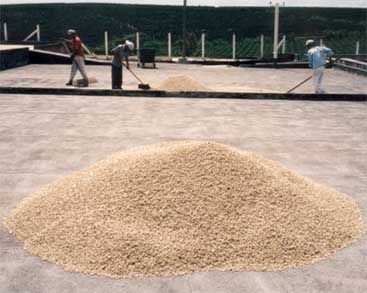 Green
coffee dries in the sun on a Costa Rica plantation.
Participants lost an average of 17 pounds during the 22 weeks of the study. It included an average of a 10.5 percent decrease in overall body weight and a 16 percent decrease in body fat. Vinson noted that weight loss might have been significantly faster, except that participants received the placebo and the lower dose of green coffee extract for part of the study period. Vinson pointed out that previous studies have shown weight loss with green coffee. But this was the first to use higher amounts of the coffee extract and the first to measure the response to various doses. Based on those studies, Vinson believes that green coffee beans’ effects likely are due to a substance called chlorogenic acid that is present in unroasted coffee beans. Chlorogenic acid breaks down when coffee beans are roasted, usually at a temperature of 464 to 482 degrees F. Roasting gives coffee beans their distinctive color, aroma and flavor. Green coffee beans, in contrast, have little aroma and a slightly bitter taste. |
| Study links chocolate consumption to
lower body weight |
|
|
By
the University of California at San Diego news service
Katherine Hepburn famously said of her slim physique: “What you see before you is the result of a lifetime of chocolate.” New evidence suggests she may have been right. Beatrice Golomb, associate professor in the Department of Medicine at the University of California, San Diego, and colleagues presented new findings that may overturn the major objection to regular chocolate consumption: that it makes people fat. The study, showing that adults who eat chocolate on a regular basis are actually thinner than those who don’t. The work is being published online in the Archives of Internal Medicine. The authors dared to hypothesize that modest, regular chocolate consumption might be calorie-neutral – in other words, that the metabolic benefits of eating modest amounts of chocolate might lead to reduced fat deposition per calorie and approximately offset the added calories, thus rendering frequent, though modest, chocolate consumption neutral with regard to weight. To assess this hypothesis, the researchers examined dietary and other information provided by approximately 1,000 adult men and women from San Diego for whom weight and height had been measured. The findings were even more favorable than the researchers conjectured. They found that adults who ate chocolate on more days a week were actually thinner and had a lower body mass index than those who ate chocolate less often. The size of the effect was modest but the effect was significant –larger than could be explained by chance, the authors said. This was despite the fact that those who ate chocolate more often did not eat fewer calories, they ate more. Nor did they exercise more. Indeed, no differences in behaviors were identified that might explain the finding as a difference in calories taken in versus calories expended. “Our findings appear to add to a body of information |
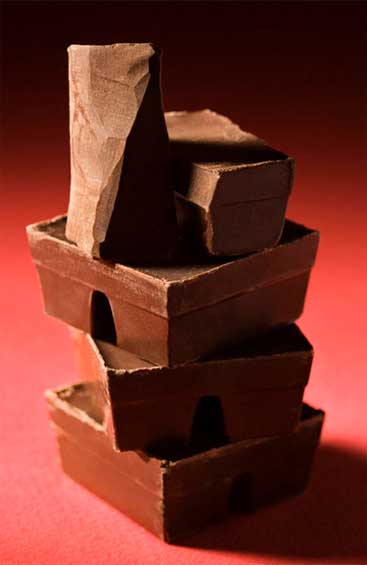 Eat
some and be thin!
suggesting that the composition of calories, not just the number of them, matters for determining their ultimate impact on weight,” said Professor Golomb, who also is a physician. “In the case of chocolate, this is good news – both for those who have a regular chocolate habit, and those who may wish to start one.” |
|
|
|
|
|
|
|
Food |
|
Jo
Stuart |
| What we published this week: | Monday | Tuesday | Wednesday | Thursday | Friday | Earlier |
| The contents of this page and this Web site are copyrighted by Consultantes Río Colorado 2012 and may not be reproduced anywhere without permission. Abstracts and fair use are permitted. Check HERE for details | ||||||
| A.M.
Costa Rica's Fifth news page |
 |
||||||||
| San José, Costa Rica, Wednesday, March 28, 2012, Vol. 12, No. 63 | |||||||||
|
|
|
|
|
|
|
Food |
|
Jo
Stuart |
 |
| Pope's
message rejected by Cuban vice president By
the A.M. Costa Rica wire services
Cuba's vice president says there will be no political reform in Cuba, despite calls by Pope Benedict XVI for more freedom and openness in the communist-ruled country. The vice president, Marino Murillo, made his remarks as the pope arrived Tuesday in the capital, Havana, for a meeting with President Raúl Castro and possibly with Fidel Castro, the long-time Cuban leader and elder brother of Raúl. "In Cuba, there will be no political reforms. In Cuba we are talking about the actualization of the Cuban economic model that will make our socialism viable. This has to do with the well being of our people," said Murillo. On Monday, the pontiff urged thousands of people at a Mass in the city of Santiago to help build a renewed and open society. Pope Benedict traveled to Havana after paying homage Tuesday to the patron saint of Cuba, the Virgin of Charity of el Cobre. The pope visited the shrine holding the Virgin of Charity of el Cobre to mark the 400th anniversary of its discovery by fishermen. The doll-sized wooden statue is revered in Cuba and within the Roman Catholic Church. Pope Benedict told an audience he has prayed for the needs of those who suffer and who are deprived of freedom, as well as those who are separated from their loved ones or are undergoing times of difficulty. The pontiff is scheduled to preside over an outdoor Mass today in Havana's Revolution Plaza. The pope is on a three-day visit to Cuba, where his aim is to renew the faith in what was once an atheist state. Pope Benedict is not expected to meet with Cuban dissidents, including the Ladies in White, a group of wives and mothers of the 75 dissidents who were jailed in a 2003 crackdown on government opponents. Conservative on High Court skeptical on Obamacare By
the A.M. Costa Rica wire services
President Barack Obama’s signature health care law appeared to be in legal jeopardy Tuesday, following oral arguments before the Supreme Court of the United States over whether the law is constitutional. The case now before the high court represents a major legal and political showdown over health care reform that the president signed into law two years ago despite strong objections from opposition Republicans. In the second of three days of oral arguments before the Supreme Court, the nine justices considered a key part of the health care law known as the individual mandate. The mandate requires all Americans to buy health insurance, beginning in 2014 or face a penalty. Supporters say the mandate is necessary to spread the costs of covering millions of previously uninsured citizens. Opponents regard the mandate as an unconstitutional overreach by the federal government. During Tuesday’s oral arguments, conservative-leaning justices on the high court seemed skeptical that the individual mandate should be allowed under the U.S. Constitution. Justice Antonin Scalia is one of the high court’s leading conservative thinkers. “The federal government is not supposed to be a government that has all powers, that it is supposed to be a government of limited powers and that is what all this questioning is about," he said. "What is left? If the government can do this, what else can it not do?” Scalia is one of four justices on the nine-member court who consistently take conservative positions. Four other justices, all appointed by Democratic presidents, have a more liberal voting record. They generally were more open to the idea that the health care law is constitutional. Among them is Justice Stephen Breyer. “It shows there is a national problem and it shows there is a national problem that involves money, cost and insurance,” said Breyer. The key vote in many Supreme Court cases is often cast by Justice Anthony Kennedy, who often is referred to as the swing justice by legal experts who follow the Supreme Court. Kennedy also seemed skeptical about the power of Congress to compel everyone to buy health insurance. “When you are changing the relation of the individual to the government in this what we can stipulate is, I think, a unique way, do you not have a heavy burden of justification to show authorization under the Constitution?” he said. As the oral arguments continued before the high court, demonstrators on both sides of the issue marched outside the court for a second day. The case is being closely watched by members of Congress. Sen. Marco Rubio, a Republican from Florida, is among those hoping that the high court will strike down the Obama health care law. “We are hopeful that the Supreme Court will see it the way we do and that this law violates simple and basic constitutional principles,” said Rubio. The health care law has been controversial from the beginning. The law passed Congress two years ago, supported only by Democrats. And public opinion surveys show the country remains sharply divided over the issue. The Supreme Court is expected to issue a ruling on the constitutionality of the health care law sometime before the end of June, and many experts say the decision will have an impact on this year’s presidential and congressional elections. |
|
||||
|
|
|
|
|
|
|
Food |
|
Jo
Stuart |
| What we published this week: | Monday | Tuesday | Wednesday | Thursday | Friday | Earlier |
| The contents of this page and this Web site are copyrighted by Consultantes Río Colorado 2012 and may not be reproduced anywhere without permission. Abstracts and fair use are permitted. Check HERE for details | ||||||
| A.M.
Costa
Rica's sixth news page |
|
|||||||||
| San José, Costa Rica, Wednesday, March 28, 2012, Vol. 12, No. 63 | ||||||||||
|
|
|
|
|
|
|
Food |
|
Jo
Stuart |
 |
Latin America news |
for New York competition Special
to A.M. Costa Rica
A 15-year-old Costa Rican pianist, Josue Gonzalez Aguilar, will compete at the Sixth New York International Piano Competition, which will be held at The Manhattan School of Music from June 18 through June 22. Twenty-two other pianists, ages 16-21, will gather from across the globe for the week-long event, which includes four rounds plus a series of master classes and seminars. Unique to the New York International Piano Competition is its policy of no elimination. Each contestant will perform in all four rounds and be judged by a jury. Every participant will return home either as a prize winner or finalist award recipient. The level of competition has been uniformly high over the event’s 10 year history, the organizers said. Monetary awards total $40,000. Israeli composer Avner Dorman has been commissioned by the organizers, the Stecher and Horowitz Foundation, to compose a required piece for this year’s competition that will be learned and performed by all contestants. The Stecher and Horowitz Foundation, a non-profit organization, is an outgrowth of the Stecher and Horowitz School of the Arts which was founded in 1960 in Cedarhurst, New York. Gonzalez started with his piano career at the age of 7. He has performed many times in Costa Rica and internationally. He was admitted to study in Moscow Central School of Music of Conservatory Tchaikovsky. Nanotechs to meet president By
the A.M. Costa Rica staff
The Instituto Tecnológico de Costa Rica will be graduating its first class in nanotechnology today, the university said Tuesday. The academic option is the only one in Central America, the school said. Greeting the graduates will be President Laura Chinchilla, who is reported to see the career field as a way to increase the country's competitivity. The term refers to manipulations of matter at the atomic or molecular level and building very tiny devices. The meeting with the president will be at 5 p.m. in Casa Presidencial. |
|
Latin
American news feeds are disabled on archived pages.
|
|
| Costa Rican News |
AMCostaRicaArchives.com |
Retire NOW in Costa Rica |
CostaRicaReport.com |
|
|
|
|
|
|
|
Food |
|
Jo
Stuart |
| What we published this week: | Monday | Tuesday | Wednesday | Thursday | Friday | Earlier |
| The contents of this page and this Web site are copyrighted by Consultantes Río Colorado 2012 and may not be reproduced anywhere without permission. Abstracts and fair use are permitted. Check HERE for details | ||||||








 James
DeRoy
James
DeRoy