|
 |
Costa Rica Your daily |
 |
|
|
|
|
|||||||||||||||||||||||||||
|
|
|||||||||||||||||||||||||||
 |
 |
|
|
|
|
|
|
|
|
| What we published this week: | Monday | Tuesday | Wednesday | Thursday | Friday | Earlier |
|
|
 |
| A.M. Costa Rica Second newspage |
 |
||||||||
| Home |
Tourism |
Calendar |
Classifieds |
Entertainment |
Real
estate |
Rentals |
Sports |
About
us |
|
| San José, Costa Rica, Wednesday, March 17, 2010, Vol. 10, No. 53 | |||||||||
 |
| Costa Rica Expertise Ltd http://crexpertise.com E-mail info@crexpertise.com Tel:506-256-8585 Fax:506-256-7575 |
 |
 Click HERE for
great
hotel discounts
|
|
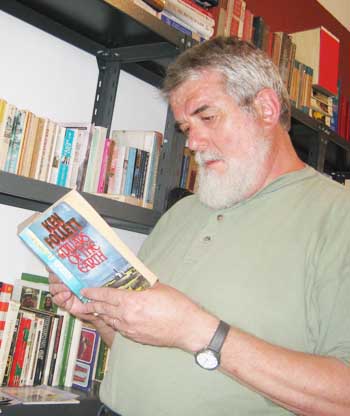 A.M. Costa Rica/Manuel
Avendaño Arce
Larue Goldfinch in his Driftwood Books.
Man behind new bookstore
is former literature professor By the A.M. Costa Rica staff
The man behind the new bookstore in Escazú Centro is a former professor of literature who has turned his avocation into an occupation. The owner is Larue Goldfinch, and the store is Driftwood Books. Unlike some stores opened by expats, Driftwood also contains literature from Holland and France and books in English and Spanish. There also are children's books. The owner comes from Georgia, but he has been in Costa Rica for nearly 30 years where he was a university professor and director of two bilingual high schools. The name of the store comes from Goldfinch's observation that books travel from hand to hand like wood floating on the sea, he said. The store is open Monday through Thursday from 3 p.m. to 6 p.m. The store offers used books and has a swap program. The store is on the square in Escazú Centro one block north of Banco Nacional in the Centro Comercial Plaza Escazú Road death puts focus on traffic law changes By the A.M.
Costa Rica staff
There is a growing wave of opposition to liberalizing the nation's penalty against drunk driving. The death Sunday of a dentist has galvanized the protests. The dentist, Cristopher Lang Arce, 31, was standing by his bike on the Autopista Florencio del Castillo in La Unión when a vehicle struck him. The operator of the vehicle fled but was later detained to face a drunk driving allegation. The motorist is Alberto Rivera Sanabria, who is the son of a former member of the legislature and an official in the first Óscar Arias Sánchez administration. Lang was a competition bicyclist and had just participated in an event. It was shortly after 7 a.m., and Rivera was said to be returning from a late party. The traffic law passed more than a year ago sought jail time for drunk drivers. But subsequent changes mandate jail time only if someone is injured or the motorist is a repeat offender. Our
reader's opinion
What is the reason behindthe devaluation of dollar Dear A.M. Costa Rica: In the past three to four months the value of the U.S. dollar vs. the Costa Rican colon has declined over 10 percent. We have had two articles that I have seen regarding this, one in A.M. Costa Rica and the other in another online paper. There were no details and no explanations at that time except to say that as things return to "normal" in the States the dollar would most likely return to its former levels. Considering that the dollar has actually advanced against almost all other major currencies throughout the world in the past three to four months, what is the explanation here? Is there truly a scientific basis or financial basis for these fluctuations, which truly seem random or at the very least, opposite of common sense. This is causing a great deal of consternation and confusion among not only local expats but also those considering moving to Costa Rica. They have lost 10 percent of their purchasing power in the past couple of months. Anyone have a clue? Randy Berg
Grecia EDITOR'S NOTE: Among other things, Costa Rica keeps exporting products to the United States and collects dollars. But Costa Ricans are buying less in the way of dollar-denominated imports.
|
|||||||||||||||||||||||||||||||||||||||||||||
 |
||||||||||||||||||||||||||||||||||||||||||||||
| Home |
Tourism |
Place
classified ad |
Classifieds |
Entertainment |
Real
estate |
Rentals |
Sports |
About
us |
|
| What we published this week: | Monday | Tuesday | Wednesday | Thursday | Friday | Earlier |
| The contents of this page and this Web site are copyrighted by Consultantes Río Colorado 2001, 2002, 2003, 2004, 2005, 2006, 2007 and 2008 and may not be reproduced anywhere without permission. Abstracts and fair use are permitted. Check HERE for details | ||||||
| This
space available |
 |
|
| A.M. Costa Rica third newspage |
 |
||||||||
| Home |
Tourism |
Calendar |
Classifieds |
Entertainment |
Real
estate |
Rentals |
Sports |
About
us |
|
|
|
|||||||||
 |
| There are two typical paths to Costa Rican citizenship |
|
|
By Dennis Rogers
Special to A.M. Costa Rica One way expat residents might avoid paying the Caja Costarricense de Seguro Social for health care is to take out Costa Rican nationality. There are two ways to qualify: marry a citizen or live legally in the country for seven years. One problem with the later approach is that Costa Rica asks new citizens to surrender their previous nationality. Despite changes in the immigration law to crack down on marriages of convenience, the process to get citizenship by marriage is easier than ever. An applicant can’t have legal residency or work for two years after the nuptials, but then it’s a rather easy bureaucratic procedure to obtain nationality, certainly more straightforward than getting permanent residency from the Dirección General de Migración. All an applicant needs is: A letter, and the government gives the format. A certified copy of the current passport. A showing that the applicant is of good character and hasn’t been in trouble in Costa Rica. Actually workers at the Registro Civil will look up the applicant's police record and don’t seem to care about any dark side to pre-Costa Rica activities. They will similarly check on the marriage once they learn who the spouse is. Applicants also have to show that they have been residents in the country full time with the entrance/exit registers obtained from immigration. Then five passport photos are required. “Any document that is deteriorated, illegible, dirty, blurry, with corrections, strikethroughs, marks, or erased sections” will not be accepted, the rules say. Lines are relatively short and the functionaries pleasant. Then workers will sit on the application for a year or two to verify the individual's identity and to make sure he or she does not get in any trouble in the meantime. An applicant for citizenship as a spouse does not have to give up the present citizenship. Then it’s just a matter of learning the words to the national anthem. To get residency based on time living here is rather more complicated, since it is based on a 1950 law less concerned with the interests of a Costa Rican spouse then on weeding out undesirables. Both permanent residents |
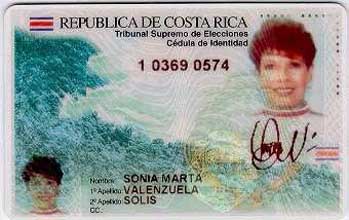 Citizen's cédula de Identidad
issued by Registro Civil
and temporary residents like pensionados and rentistas are eligible. U.S. citizens have to be here legally seven years. An applicant needs the above documents as well as: a certified copy of the birth certificate; additional documents about previous and present legal residency status, proof of income to show financial solvency; and two character witnesses. The big one for expats though, is that applicants must “demonstrate that you know how to speak, read, and write the Spanish language and have a familiarity with Costa Rican history and values.” This is achieved by passing the school-leaving exams at sixth grade level for Spanish and social studies, or having other studies certified by the education ministry. Once that’s all taken care of the applicant must “renounce present citizenship;” “reside in Costa Rica in a stable and regular manner;” and “swear to uphold the constitutional order.” The requirement to give up previous citizenship is about to be challenged with a Sala IV appeal by a woman in Playas del Coco. The appeal is expected to challenge the unequal status the present law creates for the two routes to nationality, by marriage and by residency. Giving up citizenship probably is something U.S. citizens will want to consider long and hard. For more information or to start the process, applicants should go to the Sección de Opciones y Naturalizaciones in the Registro Civil, part of the Tribunal Supremo de Elecciones, in San José. |
| Those taking naturalization test need to do a little studying |
|
|
Special to A.M. Costa Rica
Those expats interested in Costa Rican citizenship but not married to a citizen face a major barrier in the naturalization exam. Essentially, it’s the school-leaving test for sixth graders, in Spanish and social studies. The Spanish test includes two parts: writing and reading comprehension. The writing test is a short essay, not fewer than 200 words, about one of four themes given at the time of the exam. In an hour and a half, the applicant should produce a structured composition with introduction, body, and conclusion; correct use of capital letters, accents and tildes, spelling of the tricky letters c, s, and z, b and v, etc., block and cursive letters, verb-subject and number-adjective agreement, and punctuation. English speakers actually can have fewer problems with some of these themes than native speakers, who sound out spelling and accents. The essay counts for 60 percent of the score. The reading comprehension section is 40 percent. The supplicant will read aloud a short passage, then answer several questions for an interviewer. The whole section should not last more than 10 minutes. A passing score is 70 out of 100. A reasonably competent speaker of Spanish as a second language should be able to manage the literacy test, as most of the themes touched are really little different from English. Social studies requires a bit more attention to the facts. Most adult Costa Ricans would have trouble with this test, as it’s largely the sort of history students memorize and then forget. Section one is geography, with questions on the country’s location, boundaries, political and administrative divisions, protected areas, physical features and climate. |
Section two is history, with
pre-Columbian societies, the Spanish
conquest, the process of colonization, independence, and the events of
the latter half of the 19th century including the annexation of
Guanacaste and the inevitable Juan Santamaría story. Section three is “Costa Rica in the 20th Century.” (Apparently nothing has happened in the last 10 years.) The first half of the century with social changes in the 1940s culminating in the civil war of 1948; the 1950-1982 period of state-dominated development and the current governmental structure. Then present-day Costa Rica with reference to the “values” part of the requirement of the naturalization law. Students should know the social values, symbols like the national bird and flower, civic culture, Costa Rican identity, and civil rights. Much of this material is dogmatic in nature, and there is even a section under values called that. Even with a good knowledge of Costa Rican history, it would be necessary to see the textbook to know the official version. This book is available from the Dirección de Gestión y Evaluación de Calidad, the division of the education ministry in charge of these matters. That is where registration takes place in any case. One can register at any time. The test is given four times per year. The next one is June 27 at the Liceo Luis Dobles Segrega near La Sabana in San José. Requirements to register are a copy of one’s identification, a “timbre de archivo” for 20 colons (one of those postage stamp things), 4,500 colons deposited in the Banco Nacional for each test, and a passport photo. The Gestión y Evaluación office is at Avenida 10, Calle Central y Primera. More details are HERE. |
 |
| You need to see Costa Rican tourism information HERE! |
| Home |
Tourism |
Place
classified ad |
Classifieds |
Entertainment |
Real
estate |
Rentals |
Sports |
About
us |
|
| What we published this week: | Monday | Tuesday | Wednesday | Thursday | Friday | Earlier |
| The contents of this page and this Web site are copyrighted by Consultantes Río Colorado 2001, 2002, 2003, 2004, 2005, 2006, 2007 and 2008 and may not be reproduced anywhere without permission. Abstracts and fair use are permitted. Check HERE for details | ||||||
| A.M. Costa Rica fourth news page |
 |
||||||||
| Home |
Tourism |
Calendar |
Classifieds |
Entertainment |
Real
estate |
Rentals |
Sports |
About
us |
|
| San José, Costa Rica, Wednesday, March 17, 2010, Vol. 10, No. 53 | |||||||||
| Scientist study deaths of brown
pelicans at Río Tarcoles |
||
|
Special to A.M. Costa Rica
A team of ornithologists and other scientists is investigating a mysterious die off of pelicans in the Río Tárcoles estuary. Reports from the scene suggest 50-100 died along the river and near the mouth. Local tour guide Luis Campos said a similar loss took place last year at the same time. The Tárcoles drains most of the Central Valley and has a major pollution load, but because the brown pelican feeds in deep water that is apparently not |
a direct factor.
Speculation has some sort of red tide event poisoning
the birds, but ornithologist Julio Sánchez of the Museo nacional
said a
scientific team is checking on the situation. Other fish-eating birds like frigatebirds, gulls, terns, and cormorants have not been affected, said Campos. Brown pelicans nest on several colonies around Guanacaste and the Gulf of Nicoya, with most breeding activity this time of year. Many young in the nest will likely perish. |
|
| Dole and Austrian chain donate mobile
medical unit |
||
|
Special To A.M. Costa Rica
Dole Food Company, Inc. said Tuesday that it inaugurated this week a mobile medical unit, which now offers some rural communities of the Atlantic Coast of Costa Rica access to preventive medicine and specialized health attention. This mobile medical unit consists of a container divided into three fully-equipped medical rooms, which provide patients with a wide range of medical services such as: general medicine, gastroscopy, ultrasound scan, ophthalmology, pediatrics, blood donation, osteoporosis analysis, vaccination campaigns and laboratory exams. The unit was donated to the Club Leones de Costa Rica in Pococí, which is now responsible, with Dole’s support, for managing the unit, coordinating the medical staff’s planning and organizing health campaigns. "Even though Costa Rica’s social security system is well developed and has local clinics in most of the communities of the Atlantic zone, this mobile medical unit will be an additional tool to bring specialized medical services to remote areas, services that are mainly provided in urban areas. We expect this new unit to treat over 10,000 people per year," said Danilo Román, general manager, Standard Fruit de Costa Rica. This unit was financed by Dole and Spar, an Austrian supermarket chain, through an extra contribution made by consumers during a campaign run in Austria between February and May 2009. |
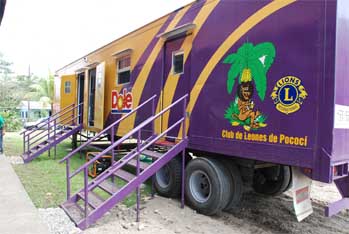 Photo: Business Wire
Mobil medical unit donated by Dole and Spar
"After the school was built in Ecuador in 2008 together with a Norwegian customer, this joint initiative with Spar further demonstrates the common interest of Dole and its customers in supporting the communities living in production areas. Dole will continue to develop similar partnerships whether in the social or environmental area," said Sylvain Cuperlier, vice president, director of worldwide corporate social responsibility for Dole. Dole, with 2009 net revenues of $6.8 billion, is the world’s largest producer and marketer of high-quality fresh fruit and fresh vegetables, and is the leading producer of organic bananas. Dole markets a growing line of packaged and frozen fruit and is a produce industry leader in nutrition education and research. |
|
| Home |
Tourism |
Place
classified ad |
Classifieds |
Entertainment |
Real
estate |
Rentals |
Sports |
About
us |
|
| What we published this week: | Monday | Tuesday | Wednesday | Thursday | Friday | Earlier |
| The contents of this page and this Web site are copyrighted by Consultantes Río Colorado 2001, 2002, 2003, 2004, 2005, 2006, 2007 and 2008 and may not be reproduced anywhere without permission. Abstracts and fair use are permitted. Check HERE for details | ||||||
| A.M. Costa Rica fifth news page |
 |
||||||||
| Home |
Tourism |
Calendar |
Classifieds |
Entertainment |
Real
estate |
Rentals |
Sports |
About
us |
|
|
|
|||||||||
 |
| Students
want the right to photocopy their texts By the A.M. Costa Rica staff
First the bar owners and radio stations did not want to pay music producers for using their songs. Now students will be going to the Asamblea Legislativa today demanding the right to photocopy textbooks. There is a proposed bill that would allow students to do this. The 10 a.m. protest is being supported by the Partido Acción Ciudadana. Although most intellectual property laws allow students and teacher to make limited copies of articles and book chapters, the wholesale coping of texts is considered theft. In most cases not a lot of money is saved by photocopying because the copying charge can be significant. Texts frequently are priced high because the sales potential is limited. The issue of the bar owners appears to have been settled when President Óscar Arias signed a decree that exempted the country from several sections of international intellectual property treaties. Many Costa Ricans believe that paying for radio or music in a commercial setting or forbidding the copying of texts is something that stems from the free trade treaty with the United States. But the concepts are enshrined in international pacts that long predate the one with the United States. Firemen have new center for administrative duties By the A.M. Costa Rica staff
Firemen now have a new administrative center north of the La Coca Cola bus terminal at Avenida 2 and Calle 18. The Cuerpo de Bomberos spent 424 million colons to renovate an existing building, some $800,000. Ranking officers in the three-story structure will supervise the 63 fire stations and their personnel in the country. The fire-fighting agency has been separated from the Instituto Nacional de Seguros, the former insurance monopoly, as part of the plan to open that market to private firms. Government officials, including President Óscar Arias Sánchez, held an inauguration ceremony there Tuesday although the structure has been in use for some time.
|
|
 |
| Home |
Tourism |
Place
classified ad |
Classifieds |
Entertainment |
Real
estate |
Rentals |
Sports |
About
us |
|
| What we published this week: | Monday | Tuesday | Wednesday | Thursday | Friday | Earlier |
| The contents of this page and this Web site are copyrighted by Consultantes Río Colorado 2001, 2002, 2003, 2004, 2005, 2006, 2007 and 2008 and may not be reproduced anywhere without permission. Abstracts and fair use are permitted. Check HERE for details | ||||||
| A.M. Costa Rica sixth news page |
 |
||||||||
| Home |
Tourism |
Calendar |
Classifieds |
Entertainment |
Real estate |
Rentals |
Sports |
About us |
|
|
|
|||||||||
Latin American news Please reload page if feed does not appear promptly |
Juárez
residents upset with Calderón on crime By the A.M. Costa Rica staff
Mexican President Felipe Calderón visited Mexico's most violent city Tuesday, where he was met by a crowd of angry protesters. Calderón spoke with community leaders in the border area of Ciudad Juárez, where gunmen shot and killed three people linked to the U.S. consulate Saturday. The demonstrators complained about the acceleration of violence, despite Calderon's effort to fight the drug war with military troops. The Mexican leader said the fight against organized crime should be shared with the United States. Juárez has been on the front line of President Calderon's war on drug cartels. More than 15,000 people have been killed in drug-related violence in Mexico in recent years. Separately, the governor of Texas has boosted police presence along the Mexican border. Gov. Rick Perry released a statement Tuesday calling on Washington to immediately provide additional resources to prevent violence from spilling over from Mexico into neighboring border communities in Texas. The governor says that since January of 2009, a reported 4,700 homicides have been committed in Juárez, making it one of the most violent cities in the world. Juárez is across the border from El Paso, Texas. Four held in bank stickup By the A.M. Costa Rica staff
Investigators have detained four persons as suspects in the robbery of the Banco Lafise in San Rafael de Escazú Jan. 29. The Poder Judicial said that one of the suspects, identified by the last names of Flores Alfaro, is being investigated for robberies at HSBC in Alajuela and Tibás and of Banco de Costa Rica in Alajuela. The other three men were identified by the last names of Molina Corella, Durán Martínez and Leiva Mata. In all cases the robberies were by armed individuals. |
| Latin American news feeds are disabled on
archived pages.
|
|
| Home |
Tourism |
Place
classified ad |
Classifieds |
Entertainment |
Real
estate |
Rentals |
Sports |
About
us |
|
| What we published this week: | Monday | Tuesday | Wednesday | Thursday | Friday | Earlier |
| The contents of this page and this Web site are copyrighted by Consultantes Río Colorado 2001, 2002, 2003, 2004, 2005, 2006, 2007 and 2008 and may not be reproduced anywhere without permission. Abstracts and fair use are permitted. Check HERE for details | ||||||