|
 |
Your daily |
 |
|
|
|
|
|
|
|
|
|
|
|
|
||||||||||||
|
|
||||||||||||
 |
| A.M. Costa Rica Second newspage |
 |
||||||||
| Home |
Tourism |
Calendar |
Classifieds |
Entertainment |
Real
estate |
Rentals |
Sports |
About us |
|
|
|
|||||||||
 |
| Costa Rica Expertise Ltd http://crexpertise.com E-mail info@crexpertise.com Tel:506-256-8585 Fax:506-256-7575 |
 |

Click HERE for
great
hotel discounts
|
|
Our readers' opinions
Writer had a valid point,long-time resident says Dear A.M. Costa Rica: I have to agree with Pamela Cohen. This administration seems to only want to exploit residents and doesn’t seem to welcome them or care much about the serious issues and problems they are having with the government. If the government continues to treat residents poorly, I can see many of them leaving for Panama or Nicaragua, two countries which are currently aggressively promoting their countries as laying out the red carpet to foreign residents interested in living in their countries and greatly helping their economies. As the global economy worsens, I can see many, many, more countries competing for foreign residents and their pension dollars. Foreign residents are a gold mine for any country. Nearly all of their income comes from abroad and they spend it generously in their host countries, often distributing their money directly into their local communities, local businesses and hiring local workers who can really use it. In particular, I feel it is very insensitive for the government to increase the monthly requirement for pensionados. Most pensionados can only use their Social Security to establish their pensionado status, and nearly all of them have income from investments and other sources which is often much higher than their Social Security payment, but not accepted by the government rules to qualify for this higher limit. Foreign residents also maintain a standard of living here which guarantees they will spend more than their Social Security check. So why put up roadblocks? I remember some 18 years or so ago, when the government offered a very attractive package to pensionados, allowed them to bring in a tax-free car and their personal effects, etc. You would think that an intelligent policy for this administration facing pressing economic problems would be to create “NEW” incentives for pensionados to move here, not the reverse. Perhaps reenact some of the old laws which first attracted retirees to Costa Rica, such as tax-free importation of their personal effects and a car. Edward Bridges
Desamparados Expat residents are urged to accept unconditionally Dear A.M. Costa Rica: In response to the “Gringa” lady from Grecia regarding the Casa Presidencial’s request for assistance in teaching Ticos English, I want to say that it is precisely this “me first” attitude of foreigners looking for Pura Vida that has contributed to the shifting attitude of Ticos. How dare you issue conditions to the host country that you wish to make your home for your own participation in the improvement of the lives of Costa Ricans? It seems obvious to me you are devoid of love for the Costa Rican people. If you cannot offer assistance unconditionally in the easiest way you can, why should they want you here at all? It gives me great pleasure to work with the daughter of my friend here, his wife, the housekeeper, and the neighbor next door on my computer translation software to help them learn English. They have a genuine desire to learn, and my Spanish is improving in the process. Everybody benefits. I don’t mean to be too harsh, but I would ask that you make an objective re-appraisal of your motives for being here. Perhaps you will see once again the innate generosity and kindness of the Costa Rican people as one of those reasons. Our lives as “guests becoming citizens” should reflect an attitude of sharing in a positive way in the future for all Costa Ricans. There are too many exploiters whose selfish motives have brought us to this negative place in our relationships. I encourage you and all others who genuinely love this country to give unconditionally all that you can. Phil Gallant
La Fortuna She had to wait, too, and its no big deal Dear A.M.Costa Rica: In reference to Ms. Pamela Cohen's letter to the editor, which I read with amusement, I have to say that I am a "native English" speaker who came to this country 15 years ago. So you have to wait for your residency, big deal. You get to wait in the most beautiful country in Central America. So they change laws. It's Costa Rica's right to change laws. Where I come from English is against the law on public signs. Immigrants have to have their kids educated in French. That is not the direction I would like to see Costa Rica go. I thinks it's a great idea asking for volunteers. I applaud the effort of the Casa Presidencial for trying to help Ticos learn English. And yes, I had to wait for my residency too. I survived it and so will Ms. Cohen. Relax, chill out and Pura Vida! Maureen Fullerton
Candelaria de Palmares
|
| A.M. Costa Rica third newspage |
|||||||||
| Home |
Tourism |
Calendar |
Classifieds |
Entertainment |
Real
estate |
Rentals |
Sports |
About us |
|
|
|
|||||||||
|
Government outlines its plan
to boost medical tourism
|
|
|
By José Pablo Ramírez Vindas
and the A.M. Costa Rica staff The government has a multi-pronged plan to promote medical tourism here. Accreditation of medical facilities is one goal. Only two hospitals now, Hospital Clinica Biblica in San José and Hospital CIMA in Escazú, are certified with the international division of Joint Commission Resources. More than 220 public and private health care organizations in 33 countries have been accredited by this organization, which basically sets the standard in international health care. The government has promised to work so other hospitals and clinics can obtain this accreditation. By contrast, health and tourism officials noted Thursday, three hospitals in México are accredited, but there are none in Central America except in Costa Rica. They said that other health organizations are in the process of seeking accreditation, including Hospital Clinica Católica. Officials also promised to work with insurance companies elsewhere, principally in the United States, so that their customers would be covered for health treatments here. In addition, the government said it would approach large employers in the United States to interest them in sending employees here for health treatment. Health care in Costa Rica is about a quarter of what it would in the United States because of less administrative costs and a generally lower cost of living and salaries. The Instituto Costarricense de Turismo expects that by next year, the income from treating foreign patients will approach $100 million annually. |
Officials frequently refer to the
high level of health care possible
here and that Costa Rica is a short distance from the United
States.
Big providers of medical care to U.S. citizens are India and The
Philippines. CNN did a segment on medical tourism over the weekend but
did not mention Costa Rica. Costa Rican officials have turned their attention to other forms of tourism because the usual flood of visitors has been diminished due to economic concerns elsewhere. The government also promised to provide incentives for would-be physicians and nurses. This is an about face in a country that was worried about an oversupply of physicians just two years ago. The Caja Costarricense de Seguro Social is unable to accommodate all the students local medical schools turn out. Maria Luisa Ávila, the minister of Salud, said that her health ministry was responsible for fielding complaints from medical tourists and assuring high-quality cases. She also said that in Costa Rica there are persons who offer treatment but who have no degrees. She encouraged medical tourists to stick with accredited institutions. In fact, it is a Costa Rican who is more likely to become involved with an unlicensed practitioner. Most do not advertise and rely on word of mouth. They have small offices in many towns. Frequently television stations will send in a reporter with a hidden camera, but officialdom seems slow to respond. Some have elaborate, faked certificates on their walls. Sometimes the local, unlicensed dentist will be working in his garage. As part of its medical tourism strategy, the government also said it would seek outside investments for medical centers and other infrastructure. |
|
Environmental sweep of
pineapple-growing areas delayed
|
|
|
By the A.M. Costa Rica staff
The Tribunal Ambiental Administrativo has called off its foray into the pineapple-growing regions of the Caribbean and northern zone. Investigators and judges were going to begin a sweep today. The tribunal said it delayed the investigation because it wanted to have experts from the Instituto Costarricense de Acueductos y Alcantarillados with the investigative teams. |
The main focus of the sweep is to
take samples from rivers and streams
to see if there is chemical contamination, and the most competent
persons to conduct such analyses are employees of the water company's
Laboratorio Nacional de Aguas. There has been a long-running dispute in the northern zone over groundwater contamination by pineapple growers with their insecticides and chemical fertilizers. The tribunal said that the sweep would be rescheduled. |
|
Puntarenas pair involved in
investigation of money laundering operation
|
|
|
By the A.M. Costa Rica staff
Investigators have opened a money laundering case against an insurance agent and another man. A video store also is involved. As cases go, this one in El Roble Puntarenas is not large. Agents estimated that about 400 million colons a year were laundered by the operation or about $715,000. |
The Fiscalía de Crimen
Organizado and the Judicial Investigating
Organization conducted four raids in Puntarenas Thursday. Those being investigated in the case are men with the last names of Monge Sequeira and Jiménez Chavarria, said the Poder Judicial. During the raids, investigators confiscated three automobiles and a Harley Davidson motorcycle, they said. |
 |
 |
| You need to see Costa Rican tourism information HERE! |
| A.M. Costa Rica fourth news page |
 |
||||||||
| Home |
Tourism |
Calendar |
Classifieds |
Entertainment |
Real
estate |
Rentals |
Sports |
About us |
|
|
|
|||||||||
|
Obama administration moves to
reduce Latin stress
|
|
|
By the A.M. Costa Rica wire services
The Obama administration has begun moving on several fronts to repair strained U.S. relations with Latin America. President Barack Obama met Saturday at the White House with Brazilian President Luiz Inacio da Silva, and he is sending Vice President Joe Biden and Secretary of State Hillary Clinton on Latin American missions to prepare for the mid-April Summit of the Americas in Trinidad and Tobago. U.S. ties with Latin America came under stress during the Bush administration, which was largely preoccupied with the conflicts in Iraq and Afghanistan and had contentious relations with several left-leaning governments in the region, notably Venezuela and Bolivia. But the Obama administration said it is intent on trying to repair frayed regional ties based on what it says should be reciprocal dialogue and respect. As an overture to President Obama's White House meeting Saturday with Brazil's President Lula, the administration announced a mission to Chile and Costa Rica by Vice President Biden and a Mexico trip by Secretary Clinton, both later this month. At a State Department briefing, Thomas Shannon, assistant secretary of State for Western Hemisphere affairs, cast the upcoming hemispheric summit in Trinidad and Tobago, which Obama will attend, as an opportunity for a fresh start |
in relations, based on what he
termed "a spirit of engagement and constructive dialogue." He said that efforts at outreach will apply to, among others, the Bolivian government of President Evo Morales, which has expelled two U.S. diplomats in recent months amid accusations they interfered in Bolivian politics. "We need a full diplomatic dialogue and a high-quality dialogue. And regrettably up to this point, as we have sought to engage the Bolivians around the issues that have provoked their own actions, we have yet to receive what we consider to be a coherent or consistent response. However we will continue to approach the Bolivians in the hope that we can address the underlying issues that have affected the relationship," he said. The State Department said Friday that Secretary Clinton will visit Mexico City and Monterrey starting March 25 for talks focusing on key issues in the U.S.-Mexican agenda including the Merida Initiative, under which the United States is helping Mexico combat violent drug traffickers. For his part, Biden will travel to Chile for a regional conference on progressive governance hosted by Chilean President Michelle Bachelet that will also include the presidents of Argentina, Brazil and Uruguay. Later in Costa Rica, Biden will be hosted by President Oscar Arias, who has invited leaders of other Central American states for a joint meeting with the Vice President in San Jose. The Biden visit already had been announced. |
|
Visit by Mrs. Clinton to
México to back Calderón on drugs
|
|
|
By the A.M. Costa Rica wire services
Secretary of State Hillary Clinton will travel to Mexico later this month on a trip aimed in part at underscoring U.S. support for the government of Mexican President Felipe Calderón and its crackdown on drug gangs. Mrs. Clinton is to visit Mexico City and Monterrey on the two-day trip beginning March 25. Drug-related violence in Mexico is believed to have killed more than 7,000 persons since the beginning of last year. But the Obama administration is stressing its support for the Calderón government and its ability to control the country's territory, and says travel by Americans to their southern neighbor is still relatively safe. The State Department said Friday Mrs. Clinton will visit Mexico at the invitation of Mexican Foreign Minister Patricia Espinosa for talks on issues of mutual concern including global economics and the Merida initiative, under which the United States is providing Mexico with aid and expertise to combat the drug cartels. The drug violence, which has been concentrated in Mexican towns along the U.S. border, has generated concern among would-be American travelers to Mexico, accentuated by cautionary State Department travel alerts about the situation. But under questioning Friday, Gordon Duguid, State Department deputy spokesman, said the United States has confidence in the Calderón government's ability to deal with the situation and said recent violence, to some extent, reflects the success of its efforts against drug gangs. "These cartels wanted to have things their own way. And the president has refused to accept that and has taken them |
on, and they have
responded with violence. Some of the violence is between the gangs
themselves, and some of it is against the police and the other law
enforcement authorities. So while we are concerned about the violence
in these localized areas, we congratulate the Mexican government for
taking on the problem," he said. Duguid said Secretary Clinton's stop in Monterrey, a major industrial city near the U.S. border, shows that the Obama administration does not consider the city unsafe. The State Department's most recent travel alert for Mexico, issued last month as many American college students began spring-break vacations at Mexican beach resorts, urged common-sense precautions such as limiting travel to well-known tourist sites and avoiding areas where prostitution and drug-dealing might occur. In its annual report on the global drug trade, also issued last month, the State Department said Mexico is the main transit point for cocaine entering the United States and also a major source of other drugs including heroin and methamphetamines. It cited an increase in criminal activity by Mexican drug cartels on U.S. soil, and said most military-style weapons being used by Mexican gangs were either purchased or stolen in the United States. The U.S. Congress has authorized $300 million for Merida initiative funding to Mexico this year, $150 million less than the Bush administration's original request. However spokesman Duguid said the amount is ample, and the new administration is prepared to move forward with the aid program at that funding level. |
 |
|
| News from
the BBC up to the minute |
BBC sports news up to the minute |
| BBC news and sports feeds are disabled on archived pages. |
|
| A.M. Costa Rica fifth news page |
|
||||||||
| Home |
Tourism |
Calendar |
Classifieds |
Entertainment |
Real
estate |
Rentals |
Sports |
About us |
|
|
|
|||||||||
|
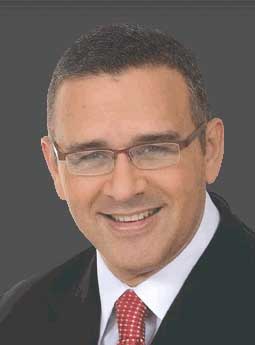 Mauricio Funes
Opposition candidate
is winner in El Salvador By the A.M. Costa Rica wire services
Left-leaning Mauricio Funes appears to have won the presidential election in El Salvador. He defeated former national police chief Rodrigo Ávila. Ávila conceded late Sunday and promised a constructive opposition by the former government party. Funes, a former television journalist and former rebel, ran on the ticket of the Frente Farabundo Martí para la Liberación Nacional. He got 1,255,216 or 51.4 percent of the vote with 92 percent of the voting locations reporting. Ávila got 1,188,168 or 48.6 percent, according to the Tribunal Supremo Electoral. Ávila's Partido Alianza Republicana Nacionalista had been in power for 20 years. It is known as ARENA. Incumbent President Elias Antonio Saca is barred from seeking another five year term. El Salvador is wracked by poverty. Many people depend heavily on remittances from family members in the United States. Tom Shannon, U.S. assistant secretary of State, said Friday in Washington that the United States supports the democratic process in El Salvador and will work with whomever is elected. El Salvador has been under conservative rule since the end of a civil war in 1992. The 12-year conflict involved the government and both leftist and right-wing guerrillas. Some 75,000 people died in the conflict before it ended with the signing of peace accords. The United Sates supplied massive financial and military support for the government during the conflict. |
| A.M. Costa Rica sixth news page |
|
||||||||
| Home |
Tourism |
Calendar |
Classifieds |
Entertainment |
Real
estate |
Rentals |
Sports |
About us |
|
|
|
|||||||||
| Latin
American news digest |
Brazilian
child-abduction case has high profile in Washington By the A.M. Costa Rica staff and wire
services
The poster child for parental abduction now is an 8-year-old New Jersey boy who is the subject of a custody battle in Brazil. Last week the U.S. House of Representatives called on Brazil via a unanimous resolution to honor its treaty obligations under the Hague Convention and immediately return Sean Goldman to his father in the United States. The case generated a protest at the White House Saturday while the Brazilian president, Luiz Inacio da Silva, was visiting President Barack Obama. The case is similar to a handful of Costa Rican cases in which woman have fled the jurisdiction of a U.S. court to bring children here. Costa Rica has awarded refugee status to one such fugitive mom. The New Jersey boy, Sean Goldman, had a Brazilian mother, who, along with her parents, took the boy to Brazil in 2004. The father, David Goldman, has been seeking the child's return since. The case was the topic of a Dateline NBC segment, and a Web site has been set up for the case. Under questioning Friday, Thomas Shannon, U.S. assistant secretary of State, expressed hope for an early resolution of an emotionally charged custody dispute. Both governments have said they consider the decision of the Brazilian woman to move the child to Brazil to have been a violation of the 1980 Hague Abduction Convention, and Shannon said he hopes this view is quickly upheld by the Brazilian court system. "Obviously we've made it very clear that from our point of view, this is a case that falls within the purview of the Hague Convention, and that Sean Goldman should be returned to his father," he said. "The government of Brazil believes the same thing, and has said so publicly. Currently this case rests with the federal courts of Brazil. We're hopeful that the appropriate decision will be rendered, and this is an issue of great importance to us," Shannon said. The child's mother died in Brazil last year but family members caring for him now in Rio de Janiero said he has completely adapted to society there, and should be legally considered a naturalized Brazilian citizen. |
|
Latin American news feed is disabled on archived pages. |
|
|
|
|
|
|
|
|
| What we published this week: | Monday | Tuesday | Wednesday | Thursday | Friday | Earlier |
|
|