 |
 |
Costa Rica Your daily |
 |
|
|
 |
|
|
||||||||||||||||||||||||
 |
|||||||||||||||||||||||||
|
|
||||||||||||||||||||||||
 |
|
|
|
|
|
|
|
|
| What we published this week: | Monday | Tuesday | Wednesday | Thursday | Friday | Earlier |
|
|
 |
 |
|||||||||
| A.M. Costa Rica's Second news page | |||||||||
| Home |
Tourism |
Calendar |
Classifieds |
Entertainment |
Real
estate |
Rentals |
Sports |
About
us |
|
| San José, Costa Rica, Tuesday, March 8, 2011, Vol. 11, No. 47 | |||||||||
 |
| Costa Rica Expertise Ltd http://crexpertise.com E-mail info@crexpertise.com Tel:506-256-8585 Fax:506-256-7575 |
 |
 |
|
 Ministerio de Gobernación,
Policía
y Seguridad Pública photo These are the weapons confiscated by
police.
Small arsenal confiscated
by police in Paso Canoas By the A.M. Costa Rica staff
Fuerza Pública officers and the agency's dog unit are continuing the search for drugs or guns in a section of Paso Canoas. Police detained five men in the area Sunday night and confiscated six firearms, including an Uzi submachine gun as well as ammunition. Police responded to calls from the area that two suspicious cars containing armed men wearing masks were circulating there. The first detainees were a Costa Rican man and a Colombian man who carried a total of three firearms, including a 12-gauge shotgun. Later they stopped a car in the same area and detained two more Costa Ricans and a man who probably is from Panamá, they said. Police on a later patrol found weapons near the site of the arrests. One of them was the Uzi. Police are searching the area because they said they do not know why the men were there or what they were doing. They are seeking more weapons and perhaps drugs. The location in on the border with Panamá. Early morning outages predicted by phone firm By the A.M. Costa Rica staff
The Instituto Costarricense de Electricidad will be working mornings starting today and for the next two weeks. The goal is to improve the Internet and the bandwidth provided mobil devices, said the company. Each day the company will be working at various points in the Central Valley until about 4 a.m. Among the jobs is providing new cables for some cell telephone towers. Much of the work will be for the GSM cell service, the company said. They said there may be service interruptions. Kidnapped youth sought by police near San Carlos By the A.M. Costa Rica staff
Police and investigators in Monterrey de San Carlos are seeking the trail of a group of ex-employees who are suspected of kidnapping the 17-year-old son of the farm owner. Fuerza Pública officers spent much of the afternoon searching the sprawling farm. There is a report that the kidnappers already have contacted the family for ransom in dollars. The kidnappers are believed to be Nicaraguan workers who used to work on the cattle operation. Our reader's opinion
Fast, fair justice is not seenin the Costa Rican system Dear A.M. Costa Rica: I find it ironic, may be even a little hypocritical, that Costa Rica wants fast and honest justice from the International Court in the Hague. Perhaps the reason they are praying for their desire outcome and fair treatment is because they should know that in their court system they'll never see fast and common sense justice. Just talk to the many people who have been involved in court cases in the Costa Rican justice system for years or decades. President Laura Chinchilla repeatedly says she wants Costa Rica to be a First World country. I'm sorry but one of the things Costa Rica will need is an honest and effective justice system. Being on Twitter, Facebook and loving the Chinese will not be enough. Good luck, Costa Rica David Dufford
Moravia
|
|||||||||||||||||||||||||||||||||||||||||||||||||||||||
 |
||||||||||||||||||||||||||||||||||||||||||||||||||||||||
| Home |
Tourism |
Place
classified ad |
Classifieds |
Entertainment |
Real
estate |
Rentals |
Sports |
About
us |
|
| What we published this week: | Monday | Tuesday | Wednesday | Thursday | Friday | Earlier |
| The contents of this page and this Web site are copyrighted by Consultantes Río Colorado 2011 and may not be reproduced anywhere without permission. Abstracts and fair use are permitted. Check HERE for details | ||||||
 |
| A.M. Costa
Rica's Third newspage |
|
||||||||||
| Home |
Tourism |
Calendar |
Classifieds |
Entertainment |
Real
estate |
Rentals |
Sports |
About
us |
|||
| San José, Costa Rica, Tuesday, March 8, 2011, Vol. 11, No. 47 | |||||||||||
 |
| Volcanoes can be reborn quickly, new study reports |
|
|
By the A.M. Costa Rica staff
Just because the local volcano appears to be dormant, it could come to life quickly, according to a new study. Costa Rica has many volcanoes that are not popping out fiery rocks like Arenal or bubbling and throwing off steam and gases like Póas, Turrialba and Irazú. Until now, scientists used to think that a supposedly dormant volcano would take a long time to come back to life, perhaps centuries. Not so, said two scientists in an article published in an online science journal, Nature. They are Alain Burgisser of the Institut des Sciences de la Terre d’Orléans in France and George W. Bergantz of the Department of Earth and Space Sciences, University of Washington, in Seattle. The article is titled "A rapid mechanism to remobilize and homogenize highly crystalline magma bodies." |
They say in an abstract of the
article that convection from below of
hot magma can liquify the volcano's solidified magma chamber much
faster than had been suspected. The hot magma rises to the top
and
mixes with the solidified material in the same way soup boils. They calculated the speed with which the Pinatubo volcano in the Philippines and the one at Montserrat erupted. They then fashioned a mathematical model. It calculated that these volcanoes went from dormant to active in just a few months. The bottom line is that other supposedly dormant volcanoes can come back to life in a few months, they said. Generally volcanoes emit small earthquakes as fresh magma begins to enter from below the solidified chamber of the volcano. That fact allows scientists to measure the time between the first arrival of hot magma and the first eruption. The work of the two scientists is expected to play a role in volcano disaster planning. |
| Libertarians propose reforms with emphasis on collections |
|
|
By the A.M. Costa Rica staff
The libertarian party came out with its own tax reform package Monday with the emphasis on improving tax collection. The political party also said it sought a constitutional amendment to prevent the executive branch from paying current expenses with borrowed money. Costa Rica's financial situation is in trouble with tax collections estimated to be just 64 percent, according to the Contraloríaa General de la Republica. Another estimate said that the country fails to collect about $1 billion each year. That is why the national budget is financed heavily by borrowing, a situation everyone agrees cannot be sustained. The Partido Movimiento Libertario is the political group farthest to the right in the Asamblea Legislativa. |
Lawmakers in a press
conference
said that President Laura Chinchilla had withdrawn her tax package to
restructure it with the help of government and non-government advisers. Ms. Chinchilla sought a 14 percent value-added tax as well as changes in the law to extend the tax to many items not covered by the current 13 percent sales taxes. These included visits to private doctors and dentists, rents, professional services and even tuition at private schools. Danilo Cubero Corrales, head of the party in the legislature, said that more tax would generate less money in the pockets and increase poverty, cause less investments, less savings and would make Costa Rica less competitive. The political party proposed strengthening property rights, a simplification of approval procedures, the constitutional amendment and a complete overhaul of the national budget. |
 |
 |
 |
| You need to see Costa Rican tourism information HERE! |
| Home |
Tourism |
Place
classified ad |
Classifieds |
Entertainment |
Real
estate |
Rentals |
Sports |
About
us |
|
| What we published this week: | Monday | Tuesday | Wednesday | Thursday | Friday | Earlier |
| The contents of this page and this Web site are copyrighted by Consultantes Río Colorado 2011 and may not be reproduced anywhere without permission. Abstracts and fair use are permitted. Check HERE for details | ||||||
 |
| A.M.
Costa Rica's Fourth news page |
 |
||||||||
| Home |
Tourism |
Calendar |
Classifieds |
Entertainment |
Real
estate |
Rentals |
Sports |
About
us |
|
| San José, Costa Rica, Tuesday, March 8, 2011, Vol. 11, No. 47 | |||||||||
 |
 |
| Internet filter law moving toward final
legislative approval |
||
|
By the A.M. Costa Rica staff
A proposed law that would require filters on public Internet computers to protect minors is moving to a final vote in the Asamblea Legislativa. This is the proposal, 17.164, that has been before lawmakers in one form or another for several years. The current version requires Internet cafe operators to post signs telling youngsters what dangers lurk on the Internet and in chat rooms. It also requires filters on 80 percent of the public computers. The proposal does not specify a brand of filters but the law requires one that blocks pornography, obscene language, sites that promote aggression and physical, sexual and emotional violence, sites with information on how to build explosive devices, those that promote war, those that promote racism, xenophobia or other forms of |
discrimination and programs or
information
that can be used to look at, download, distribute, acquire or exchange
pornography in general and infantile pornography in particular. The state is supposed to provide the filters at no or low cost, and the Superintendencia de Telecomunicaciones is placed in charge of Internet cafes to make sure the operators obey the law. Carlos Avendaño Calvo spoke in favor of the measure in the legislature Monday. He belongs to the Partido Restauración Nacional. He said the law had teeth in that Internet cafe operators who violate the law can be fined from 220,000 colons ($443) to 1 million, about $2,014 at the current exchange rate. The proposal also said the place can be shut down. Avendaño said that he expected the proposal to be approved in the second and final vote within a few days. |
|
| U.S. prosecutors indict 10 as e-mail
scamming suspects |
||
|
By the A.M. Costa Rica staff
Those scamsters who flood computer inboxes promising wealth to the unwary are facing criminal actions in the United States. The U.S. Attorney's Office in Los Angeles said Monday that 10 defendants have been indicted on federal charges of running an advance fee scheme that targeted victims in the United States with promises of millions of dollars in inheritances – but only if they paid money up front to facilitate the transfer of the promised bequests. Three of the defendants accused in the scheme that took in more than $1.5 million from victims around the United States were arraigned Monday morning in U. S. District Court, where they pleaded innocent and were ordered to stand trial later this year. The lead defendant is a Nigerian national, the U.S. |
Attorney's Office said. This type of
crime is called the Nigerian 419 scam, which references the section of
the Nigerian criminal code that deals with fraud. The senders of the e-mails falsely claimed to have control of millions of dollars in inheritance money in Nigeria, and they falsely told victims they would receive inheritance money if the victims paid a variety of advance fees for “taxes” or “documentation,” according to court documents, the U.S. Attorney's Office said. The criminals claimed to be attorneys, bankers, diplomats or other government officials, all of which was designed to convince victims they were dealing with legitimate professionals. The indictment alleges that the accused lured victims, mostly elderly, by initially demanding relatively small amounts of money. Once the victims paid the modest amounts, they were asked to wire increasingly larger amounts – as much as $35,000, according to the court documents. |
|
| Home |
Tourism |
Place
classified ad |
Classifieds |
Entertainment |
Real
estate |
Rentals |
Sports |
About
us |
|
| What we published this week: | Monday | Tuesday | Wednesday | Thursday | Friday | Earlier |
| The contents of this page and this Web site are copyrighted by Consultantes Río Colorado 2011 and may not be reproduced anywhere without permission. Abstracts and fair use are permitted. Check HERE for details | ||||||
| A.M. Costa Rica's fifth news page |
|
|||||||||
| Home |
Tourism |
Calendar |
Classifieds |
Entertainment |
Real
estate |
Rentals |
Sports |
About
us |
||
| San José, Costa Rica, Tuesday, March 8, 2011, Vol. 11, No. 47 | ||||||||||
 |
| Mexican police chief reported fleeing to U.S. By the A.M. Costa Rica wire services
A 20-year-old Mexican woman who volunteered to be the police chief of a violent border town has been fired for apparently abandoning her post after it was reported that she received death threats. Officials say Marisol Valles took leave March 2 to attend to personal matters and was due to return to work Monday in the town of Praxedis G. Guerrero. But the town's mayor fired her when she failed to show up for work without giving any notice. Local media say Ms. Valles fled Mexico and is seeking asylum in the United States after being threatened by drug gangs. Mexican authorities do not know her whereabouts, and there is no U.S. government confirmation of the media reports about her disappearance. Ms. Valles is a criminology student and the mother of an infant son. She was sworn in last October in Praxedis G. Guerrero, one of Mexico's most dangerous drug towns. The town of nearly 10,000 people is in Mexico's Chihuahua state, an area plagued by drug violence. When she accepted the job last year, Ms. Valles said she took the post because she wanted people to live without fear. Mexico's government has struggled to deal with the threat that drug cartels pose to the underpaid, untrained and often corrupt local police forces. Mexican military forces have been engaged in a brutal struggle against violent drug cartels. At least 34,000 people have been killed in Mexico's drug war since President Felipe Calderón took office in late 2006 and began cracking down on the cartels. Oil workers kidnapped in eastern Colombia By the A.M. Costa Rica wire services
Authorities in Colombia say 23 oil workers have been kidnapped in the eastern part of the country. Reports say the workers were employees of a subcontractor for Canada's Talisman Energy. A company spokesman tells Colombia's RCN radio most of the workers were local hires. Colombian authorities say Fuerzas Armadas Revolucionarias de Colombia rebels could have been responsible for the kidnapping. This is Colombia's largest rebel group and has been fighting the government since the 1960s. Colombia, the United States and the European Union have designated the group as a terrorist organization. Carnival is in full swing through the rest of today By the A.M. Costa Rica wire services
Thousands of Brazilians and foreign tourists are partying in the streets of Rio de Janeiro, where the city's famed Carnival festivities are in full swing. Carnival parades have been taking place since Sunday, with fireworks and cheers of revelers who have been celebrating for days. Several processions have been staged, featuring extravagant floats with celebrities and scantily dressed bejeweled dancers from several competing samba schools. Last month, a massive fire swept through the city's warehouse district, destroying thousands of elaborate costumes and floats that had taken nearly a year to make. The cause of the blaze is not known. Three samba schools that had been affected worked round-the-clock to make the replacement props and costumes in time for the festivities. An estimated 750,000 visitors are expected in Rio during the five-day festival that ends Tuesday. Festivities also are taking place in Haiti, which canceled its street party last year after a deadly earthquake. Parades through the city center pass buildings ruined by the Jan. 12, 2010, quake, while debris still clutters the streets. Hundreds of thousands of people still live in tent cities around the capital, Port-au-Prince. |
|
 |
| Home |
Tourism |
Place
classified ad |
Classifieds |
Entertainment |
Real
estate |
Rentals |
Sports |
About
us |
|
| What we published this week: | Monday | Tuesday | Wednesday | Thursday | Friday | Earlier |
| The contents of this page and this Web site are copyrighted by Consultantes Río Colorado 2011 and may not be reproduced anywhere without permission. Abstracts and fair use are permitted. Check HERE for details | ||||||
| A.M.
Costa
Rica's sixth news page |
|
|||||||||
| Home |
Tourism |
Calendar |
Classifieds |
Entertainment |
Real estate |
Rentals |
Sports |
About us |
||
| San
José,
Costa Rica, Tuesday, March 8, 2011, Vol. 11, No. 47 |
||||||||||
 |
Latin American news Please reload page if feed does not appear promptly |
into full service tonight By the A.M. Costa Rica staff
With luck and favorable weather, workmen will complete painting lines and installing lane markers today on Ruta 32 that connects San José with the Caribbean coast. The road will be closed from 9 a.m. to 3 p.m. That is a change in time from last week. This is the last section of the highway to be repainted. There are two stretches remaining that still have to be painted. One is where the highway leaves San José, and the other is near Matina. Work continues of two other highways. The management of the Autopista del Sol said that repairs on a closed section of that road would take longer than expected. The firm said that workers for a contractor hired by the government did not work weekends, and the highway's concessionaire expected consecutive days of work. The highway had been closed for two weeks while efforts are made to repair places where the highway slumped and where there now is a bailey bridge in place. The bridge is being removed, and the highway is being repaired. Part of the roadway slipped downhill. This is the San José-Caldera highway. Traffic is being detoured onto the Interamericana Norte. The infamous bridge over the Río Virilla on the Autopista General Cañas will be closed this weekend while workmen try to fix the crumbling concrete on the new deck for the bridge. Traffic has been restricted there since right after Christmas. The bridge deck was replaced as were rebars. But within a few days of reopening the bridge to full use, the concrete began to flake off. Police thwart armed robbery of expensive racing bike By the A.M. Costa Rica staff
A man with a knife confronted a cyclist in San Josécito de Alajuelita Sunday and stole his racing bike, but the Fuerza Pública said it tracked a suspect down and recovered the bike. They said the man also is linked in an attack a week earlier on a cyclist where the victim was threatened with a knife and hit with a rock. That bike was valued at 1 millions colons, just over $2,000. The bike Sunday had a value of about 350,000 colons, police said. That's about $705. The bike robbery suspect was identified as an 18 year old with the last names of Arauz Alvarado, said police. Robbing expensive bikes is the new target of choice by crooks. Competition cyclists have expensive bikes and usually ride into unfamiliar areas. The murder of Mauricio Castro Hidalgo served as a wake-up call to police and sports cyclists. Castro and companions were confronted by robbers Jan. 30 as they practiced on a back road near Linda Vista de la Unión. |
| Latin American news feed is disabled on
archived pages.
|
|
| Home |
Tourism |
Place
classified ad |
Classifieds |
Entertainment |
Real
estate |
Rentals |
Sports |
About
us |
|
| What we published this week: | Monday | Tuesday | Wednesday | Thursday | Friday | Earlier |
| The contents of this page and this Web site are copyrighted by Consultantes Río Colorado 2011 and may not be reproduced anywhere without permission. Abstracts and fair use are permitted. Check HERE for details | ||||||
 |
 |
| A.M.
Costa Rica: Food, festivals, arts, entertainment |
|
|
|
|
|
|
|
|
|
| San José, Costa Rica, Wednesday, March 9, 2011, Vol. 11, No. 48 | ||||||
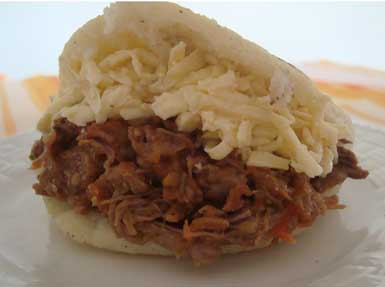 Arepa with cheese and carne mechada
Here's how to prepare arepas,
the signature dish of Venezuela By Derek Marin
Caracas Arepas & Juice Bar Most people identify foods with a particular country. Pizza for Italy, tacos for Mexico and gallo pinto is 100 percent Costa Rican. Well, if you ever want to impress a Venezuelan, you should tell them how much you love their famous arepas. Arepas are as important as gallo pinto and casados are for Costa Ricans. So what exactly is an arepa? It's a warm circular corn patty that is usually stuffed with delicious foods such as pulled beef, cheeses, ham, salami, avocado, fried egg, tuna, or if you want, just a slab of butter. Two make a perfect lunch. One makes a perfect mid-afternoon snack. Lucky for you, they are easy to make and the ingredients readily accessible: * Pre-cooked white corn meal (look for the yellow colored packet called harina pan) * Vegetable oil * Water * Salt Pour 1/4 of a kilo of the corn meal into a bowl. Slowly pour an equal amount of luke warm water into the bowl and move the cornmeal around with your hands (feel free to add a bit more water). Add a teaspoon of salt and a few tablespoons of oil. Start running your hands through this corn dough so that it smooths out. Try to squash all the little corn balls that inevitably form. Take a ball of about 150 grams into your hands and mold into a flat, circular patty. A good size is about 5 inches in diameter and about 1 inch thick. When both sides of the patty are flat, place on a grill, or pan, at low to medium heat. Make sure the pan has a bit of oil on it so that the arepa does not stick. Cook on both sides for about six minutes. It is ready when the outside is a bit toasty and the inside is soft and gooey. When the arepa is cooked, just slice open like pita bread, stuff with cheese and you have got yourself an arepa de queso. You should get about four arepas out of that corn dough mixture. However, if cooking isn’t your thing or if you'd like to try one made by a Venezuelan first, come visit my restaurant in downtown San José, Caracas Arepas & Juice Bar. We have got 12 different kinds of arepa stuffings, such as the popular carne mechada, and we also make great Venezuelan smoothies like the tres en uno, which has orange juice, beets and carrots. Happy arepa making! *Mr. Marin is from Boston where his Venezuelan parents live. His Web site is www.caracasarepas.com  American Checmical Society photo
The best way to preserve the CO2 is down the side!After intensive research, hic!,
champagne secret is revealed By the American Chemical Society news
service
In a study that may settle a long-standing disagreement over the best way to pour a glass of champagne, scientists in France are reporting that pouring bubbly in an angled, down-the-side way is best for preserving its taste and fizz. The study also reports the first scientific evidence confirming the importance of chilling champagne before serving to enhance its taste, the scientists say. Their report appears in ACS’ bi-weekly Journal of Agricultural and Food Chemistry: “On the Losses of Dissolved CO2 during Champagne Serving.” Gérard Liger-Belair and colleagues note that tiny bubbles are the essence of fine champagnes and sparkling wines. Past studies indicate that the bubbles — formed during the release of large amounts of dissolved carbon dioxide gas — help transfer the taste, aroma, and mouth-feel of champagne. Scientists long have suspected that the act of pouring a glass of bubbly could have a big impact on gas levels in champagne and its quality. Until now, however, no scientific study had been done. The scientists studied carbon dioxide loss in champagne using two different pouring methods. One involved pouring champagne straight down the middle of a glass. The other involved pouring champagne down the side of an angled glass. They found that pouring champagne down the side preserved up to twice as much carbon dioxide in champagne than pouring down the middle — probably because the angled method was gentler. They also showed that cooler champagne temperatures (ideally, 39 degrees F) help reduce carbon dioxide loss. Quest for perfect loaf of bread becomes a year-long effort By the A.M. Costa rica wire services
Few things in life are as simple or complex as bread. The same four essential ingredients — flour, water, yeast and salt — can yield 10,000 different combinations. That's what author William Alexander discovered when he embarked on a year-long odyssey to re-create the perfect loaf of peasant bread. In the process, he says, he learned an important lesson about baking and life. For most of his life, William Alexander didn't really care much about bread. "As a kid I never liked bread," he says. "I grew up in the 1950 and 1960s with this horrible cellophane-wrapped pre-sliced white bread. It wasn't until just a few years ago that I tasted real bread. I never knew bread could be this good; the crust was this dark brown, sweet crust that turned chewy in your mouth. And the crumbs, rather than being like dense and mushy like white bread, it was this open-celled, almost honey-combed crumb. It just had a wonderful yeasty smell, just a delicious flavor." Alexander, who had never baked before, says he knew the only way to have this kind of bread again was to learn how to make it himself. He started, literally, from the ground up. "I planted my own wheat and harvested and threshed and winnowed and ground that wheat into flour," he says. "I even built a hole in my backyard, took mud that came out of that hole and made a clay oven to bake the bread." Alexander baked a loaf every week for a year. He says it was an exciting learning experience. "What happened was with each failed loaf, a new questions arose. When the bread didn't rise, I started wondering what yeast was, so I went to visit a yeast factory." Alexander chronicles those experiences in his book, "52 Loaves: One Man's Relentless Pursuit of Truth, Meaning and a Perfect Crust." "I wanted to go to a place where bread mattered to people," he says. "There had recently been riots in Morocco due to the cost of wheat going up, so I traveled there to bake alongside Arab women in a large village oven. It was the largest oven I'd ever seen. They all brought their own bread there. They would put a mark on it so they would know their family's bread and leave it with the baker. Then they would come back later in the day." In the course of his bread quest, Alexander won second place in the New York State Fair bread competition. He enrolled in a bread-making seminar in Paris, and spent a few days at an abbey in Normandy, France, where he taught the monks how to make the traditional abbey bread. "That was about three quarters into my year of baking," he adds. "When I found a medieval abbey in France that said they had been baking for 1,300 years, but had lost the last monk who knew how to bake bread, I volunteered to come over and bake some bread for them. They came back and said, 'Sure, that sounds like a good idea, but could you train a monk to bake while you are here?' I suddenly realized I was in this absurd situation: I am an amateur baker, I hadn't been in a church in years, I barely speak French, and found myself going over to try to restore the lost 1,300-year-old tradition of baking at the abbey." When Alexander's year long bread making adventure came to its end, he realized that the perfect loaf of bread he was after was whatever loaf he was baking at the time. This was not Alexander's only attempt to produce his own food. In his previous book, "The $64 Tomato," he chronicled the joys and frustrations of growing his own vegetables.
Chayote: The all-purpose MesoAmerican treat By Saray Ramírez Vindas From the A.M. Costa Rica archives The chayote looks like a big, wrinkled green or
white pear. But it really is a gourd and a type of squash.
You can eat it creamed, buttered, fried, stuffed, baked, frittered, boiled, mashed and pickled, food experts note. And in Costa Rica it is the all-purpose veggie. The chayote (Sechium edule) has a long history associated with the pre-Columbian peoples of Central America, and you can’t be here for long without finding one on your plate. The vegetable can weight up to a pound, and there is a big seed inside that is not eaten. Once the skin and seed are removed, the white flesh remains and is the part that is eaten. The vegetable is so much a part of Costa Rica that to visit or live here without trying it is like never trying gallo pinto or Cerveza Imperial. Perhaps the best way to eat chayote is chopped up in a mixture of other foods, a picadillo with sausage, chicken, carrots, corn, potatoes, onions and other MesoAmerican staples. The final dish, eaten with small tortillas, not only is tasty but also colorful. Plus the dish always is a success because proportions of various ingredients are highly variable. Use what you have! The recipe for picadillos is not exact. Mostly anything goes. You need: 5-6 chayotes
2-3 carrots 1 full sausage two ears corn kernels (or small can) 2-3 medium potatoes 2 heads of garlic 5-6 sprigs of basil Chop up in small pieces the chorizo or sausage
and brown in a fry pan along with chopped garlic.
Peel and cut up chayote, carrots and potatoes into small pieces and boil until tender. Drain and set aside. Do the same with corn: Boil the kernels gently. Chop up basil, too, and add to the nearly browned sausage. Put all ingredients into one big pot, put on heat and stir. Arrange attractively with garnishes of carrots or other handy vegetables. Don’t forget the basil. Serve with warmed small tortillas or rice a su gusto. Originally published March
28, 2003.
 The finished masterpiece
Lobster and vanilla simply cry out for some champagne Special to A.M. Costa Rica
La Luz executive chef Carlos Zuñiga spent 20 years learning to cook in U.S. East Coast restaurants. Lobster was plentiful, and some of the recipes were quite exotic. When he returned to Costa Rica, he brought the recipes with him. Champagne Vanilla Lobster is one of four lobster tail specials (the others include Rockefeller, Fra Diablo, and Orillineta) all served Valentine's Day Weekend at La Luz Restaurant in The Alta Hotel, Alto de las Palomas, Santa Ana. More information about dining there is HERE! Champagne Vanilla Lobster
A sauce of vanilla bean and champagne with lobster over fettuccini pasta. Ingredients ½ cup champagne 1 vanilla bean (split down the middle) ½ cup cleaned spinach leaves 3 tablespoons cream 1 tablespoon butter 2 lobster tails ¼ pound fettuccini (white or spinach) 2 tablespoons scallions Instructions 1.Simmer champagne and vanilla bean. Reduce the liquid. Add the spinach leaves. 2.Add cream and cook. 3.Whisk in the butter. Season with pepper. Salt to taste (we try not to use too much). 4.Discard the vanilla bean. 5.Add the lobster tails until cooked (will vary with size). 6.Cook the pasta in boiling water. 7.Remove the lobster tail and add the pasta. Stir. Warm pasta but don’t cook. 8.Place pasta and sauce in center of plate. Turn lobster tail inside out and place on top of pasta. Garnish plate with scallions. Researchers find that wine tastes better when the light is correct By the University of Mainz news service
The background lighting provided in a room has an influence on how wine tastes. This is the result of a survey conducted by researchers at the Institute of Psychology at Johannes Gutenberg University Mainz, Germany. Several sub-surveys were conducted in which about 500 participants were asked how they liked a particular wine and how much they would pay for it. It was found that the same wine was rated higher when exposed to red or blue ambient light rather than green or white light. The test persons were even willing to spend in excess of one euro more on a specific bottle of Riesling when it was offered in red instead of green light. "It is already known that the color of a drink can influence the way we taste it," says Daniel Oberfeld-Twistel of the General Experimental Psychology division. "We wanted to know whether background lighting, for example in a restaurant, makes a difference as well." The survey showed, among other things, that the test wine was perceived as being nearly 1.5 times sweeter in red light than in white or green light. Its fruitiness was also most highly rated in red light. Accordingly, one conclusion of the study is that the color of ambient lighting can influence how wine tastes, even when there is no direct effect on the color of the drink. "The extreme lighting conditions found in some bars can undoubtedly influence the way a wine tastes," concludes Oberfeld-Twistel. He also recommends that serious wine tasting should be conducted in a neutral light color environment. Perhaps a partial explanation of why lighting influences the way humans taste wine is that in pleasant lighting conditions, individuals also regard the wine as being more pleasant too. Additional research is planned.  The many seeds can be removed easily Agricultural officials try to boost unappreciated papaya By
the A.M. Costa Rica staff
Agricultural officials are trying to give a boost to the unappreciated papaya to increase local consumption and exports. The Ministerio de Agricultura y Ganadería is promoting the fruit for its health benefits and said that there are about 1,000 hectares (about 2,500 acres) planted of the fruit in the country. Most of the production is in Pococí, Guácimo, La Fortuna de San Carlos, Paquera, Parrita and Orotina, the ministry said. The fruit has an unusual taste that grows on consumers like a good scotch whiskey. Pineapple and mango seem to be more preferred in a fruit plate, but papaya does not have the sharp taste. Dried papaya can be a sweet treat. The ministry touts the vitamins C and A that are contained within the fruit. The Universidad de Costa Rica has produced a new variety, payapa perfecta, that does not have a strong odor, and the tall papaya trees usually produce fruit of about the same size, perfect for marketing. The flavor is supposed to be better, too. Most papaya grown here is of this variety. The tree actually is a big herb. The fruit sells cheaply in the marketplace, and the ministry notes that it has been lauded for its aid to digestion. Papaya also can be used as a meat tenderizer. Some Costa Ricans wrap meat in papaya leaves. Commercially it is a powder sold as a tenderizer. The seeds can be eaten. Some cooks grind them and serve them like pepper for their sharp taste. Papaya now is exported to Canada, and the ministry hopes to increase exports to Europe. Papaya is believed to be native to Central America. Mexican residents were eating the fruit long before the rise of the great civilizations. Now the fruit is produced all over the tropical world. In Spanish it is called melón zapote, mamao, naimi, capaídso, fruta bomba, lechosa, mamón, mampucha, pucha and paque. In some countries papaya is not a word for mixed company, so substitutes have been created.  Photo courtesy of Henry
Karczynski
These vanilla pods still are on
the vineRare vanilla spice from Quepos produced in fully organic setting By Donna Norton Special to A.M. Costa Rica The farm got international notice when it was the recipient of the periodic "Longest Vanilla Bean" award in August 2008. An independent vanilla Web site awarded this honor to the farm, proclaiming it to be the ultimate organic vanilla producer. The farm produced beans from 9.5 to 10.5 inches or from 24.5 cm to 26.5 cm. The award is a way of highlighting top vanilla producers. Karczynski, a soft-spoken man and a U.S. expatriate with an MBA from Illinois, found his calling as a farmer while serving in the Peace Corps. "Happiness and success are not defined by one´s amount of financial wealth," he said. "I enjoy what I do, and I am fortunate that it also affords me and my family a living." After purchasing degraded pasture land in Quepos 23 years ago, Karczynski transformed the farm using agroforestry, permaculture and tropical biodynamic cultural practices. Permaculture is an approach to designing human settlements and perennial agricultural systems that mimic the relationships found in natural ecologies. The plantation is now also visited by students, researchers and practitioners of sustainable development, said Karczynski. The farm markets its spices under the Rainforest Spices label. The plantation offers a tour for visitors. The vanilla vines grow on a host tree and the dangling pods are filled with tiny edible seeds, said Karczynski. He notes that vanilla is the second most expensive spice in the world. The plant is a type of orchid. The pods have no flavor when they are picked, and it is the curing process that turns them into the highly demanded spice. On his Web site Karczynski notes that "the pod can be chopped finely or processed in a blender and used to flavor cakes, puddings, ice cream, milkshakes and many everyday sweet dishes. The whole pod can also be used to flavor custards and other liquids, taken out, dried carefully and used again up to three or four times. To flavor milk, allow one bean per 500 ml, bring to a boil and allow to stand for an hour. His two and a half hour spice plantation tour is topped off with a session of tasting of gourmet pastries and drinks made by his pastry chef. At the tasting, exquisite spice drinks and desserts are brought to the tourists one after the other while they relax at Villa Vanilla´s secluded mirador overlooking mountains and rainforest. A naturally sweet Ceylon cinnamon tea, vanilla/lime cheesecake, vanilla and/or cinnamon ice cream, and even farm grown and processed chocolate (cacao) for cookies and chocolate drinks are some of the offerings. According to Karczynski, his Villa Vanilla plantation is one of two places in the world, the other being India, where these types of quality organic spices can be purchased, and even ordered via his Web site, www.rainforestspices.com. Karczynski discovered on the farm ancient cacao artifacts used as tools in cracking cacao beans, including a large, egg-shaped stone, metate and mano in Spanish, and a rock mortar and pestle. Villa Vanilla actually uses the large rock mortar and pestle artifact to help in the production of cacao nibs, edible pieces of pure cacao. It is clear that the pre-Colombian native inhabitants valued cacao plants, too.  Two
large shrimp crown lasaña de chile pimienton.
Heredia' chef's signature dish is lasagna without the pasta Special
to A.M. Costa Rica
Chef Ruben Naranjo at the recently remodeled Bar Restaurant Alex Seth Friends in Santa Barbara de Heredia has as his signature dish lasaña de chile pimienton. A former soccer player turned chef (he was formerly with the Hotel Parador in Manuel Antonio), Ruben said “Well, this lasagna does not have cheese or pasta, so it is a bit different. In fact it is based on sweet red chiles, avocados and shrimp.” Directions: Wash two sweet red chiles and bake in preheated oven for 25 minutes until skin is blistered. Immerse in cold water and remove skin, reserve. Take a ripe, large Haas avocado and cut into small cubes and put in mixing bowl with the juice of two Mesino limes (yellow flesh without seeds), white onion finely chopped, cilantro, the skin of half a tomato finely chopped with salt and pepper to taste. Take eight pinky shrimp and two jumbo prawns and clean and place in bowl. Take a frying pan and saute the shrimp in olive oil with a bit of finely chopped white onion, a tablespoon of brandy and a tablespoon of white wine until liquid burns off. Set aside. Assemble the lasagna on a plate by placing one red chile on bottom and spooning on the guacamole mix with four pinky shrimp; make another layer and on top put a red chile or two with nothing on it. Take the two jumbo prawns and skewer them to the top with toothpicks and green pimiento olives. Great as an appetizer or side dish. A.M. Costa Rica invites recipes from chefs at other food establishments and from readers. Photos are great, too. Send them to editor@amcostarica.com.  Ministerio de Agricultra y Gandería
photo
White layer around the seed is
what the fuss is all about.Seasonable fruit makes inroads in commercial production here By
the A.M. Costa Rica staff
Some 400 producers of mamón chinos have about 800 hectares (nearly 2,000 acres) planted in the fruit. The country has become the largest exporter of the product in Central America, according to the Ministerio de Agricultura y Ganadería. Seven years ago the ministry was encouraging the planting of the fruit in the southern zone as a barrier to citrus diseased that might come in from Panamá. Now that area and the Caribbean coast
There are two types of mamón chino in the country. The more traditional one is called chupachupa. This is not a freestone variety, and some say the fruit is not sweet. A new variety is a freestone, and the edible pulp pulls from the pit easily. The ministry had distributed more than 40,000 saplings of this type over the last five years, and officials are encouraging farmers to substitute the more marketable variety for what they might now have. The fruit is about as big as a golf ball, but a lot easier to nibble. Vendors sell both the red and yellow varieties from July through November. The mamón chino is called rambutan in Asia. The Latin name is Nephelium lappaceum. The spiky, red or yellow fruit is held between the fingers and the top is bitten just enough to remove the hard outer shell. Inside is a sweet, pulpy mass surrounding a big seed. The seed is edible but usually should be roasted first. It is the pulp that the casual nibbler seeks. Throughout the downtown and elsewhere in Costa Rica mamón chino-lovers can be seen walking along chomping at the fruit. Purdue University reports that the roasted seeds are said to be narcotic. The fruit can be made into a syrup or canned, but most are eaten fresh. Costa Rican officials fear that the introduction of the citrus disease leprosis will cause great economic loss to the country. So they have established a line of control along the frontier of Panamá and seek to eradicate completely citrus trees inside this area adjacent to the border. The mamón chino is one of the alternatives, the ministry said. The fruit can be grown from seed, but someone doing this runs the risk of lavishing effort on male trees that do not produce fruit. Montero recommends that farmers use cuttings and grafting to maintain a high quality of fruit.  Cardiologists do not recommend the editor's bacon and garlic Cartago potato medley. For recipe, see below. Cartago shows off complexities of its cusine with contest By the A.M. Costa Rica staff There is a lot more to the Provincia de Cartago
than potatoes, and
cooks of the communities have joined together to prove that.
The event last month was another of the culture ministry's efforts to capture the nation's traditions. When most Costa Ricans think of Cartago, the words chilly and potatoes leap to their minds. The province, centered around the Canton of Cartago is generally higher than communities in the Central Valley. Cartago itself at 1,435 meters is 274 meters (about 900 feet) higher than the bulk of San José. That may be bad for sunbathing, but the weather is great for temperate vegetable crops, including the potato, carrot, onions and even the chayote. And these work their way into the area's traditional menus. There are seven other cantons, La Unión, Jiménez, Turrialba, Oreamuno, Alvarado, El Guarco and Paraíso. Each has developed their own variations on food. After all, they have had plenty of time. Cartago was founded in the middle of the 16th century, and Spanish settled in the region due to the healthy climate. The city was the nation's capital until 1823. The region is also known for its conservatism,
so one can expect that
the Spanish tradition will be a strong influence on the local foods.
Garlic Cartago potatoes By popular demand (Well, we got some e-mails, anyway), we include the editor's famous garlic potato medley shunned by cardiologists the world over. Ingredients: 2 cans of Imperial (or similar) beer half pound bacon (200 grams más o menos) 1 large onion 12 toes of garlic (more or less) 12 small (golf ball size potatoes or six tennis ball size) Cartago potatoes cup of olive oil Whatever extra seasonings you like such as Italian or Mexican or maybe you like parsley, thyme, bay leaves, or cilantro. Procedure Open and start drinking the first can of beer. Cut into smaller pieces and start frying bacon in large fry pan. In a few minutes combine chopped onion and chopped garlic in the frying pan. Put in the seasoning you like now. Add about half the oil. Keep heat moderate to let the tastes meld. Don't forget the beer. Wash and clean the small Cartago potatoes. Nuke them in a microwave for from 5 to 7 minutes. Then chop them into sixths or eighths. Don't forget the beer. Put the potatoes in the same frying pan with the onions, bacon, and garlic for a few minutes. Sprinkle with the rest of the oil. Then after a few minutes transfer the entire dish to a metal or glass baking dish and stick in a pre-heated oven. Depending on the time for dinner, cover with foil to keep garlic, onions and bacon from burning. Make sure to remove the foil during the last 10 minutes to make the potatoes slices crisp. Reward yourself with the second beer. (This is really a beer-type dish. But port after dinner goes well, too.) Serve with beer and meat of your choice, perhaps a pork roast.  A.M. Costa Rica/Saray Ramírez
Vindas
Vitamin on the half shell to eat out of hand or in drinks.From left, a seedy grandilla, a naranjilla
with dark interior, a guava,
starfruit and a piece of snowy white guanabana A few thousand colons provides
a bounty of delicious fruits By Saray Ramírez Vindas
of the A.M. Costa Rica staff Delights from star fruit to guavas to the prickly guyabana and the delicate naranjilla are on the market now, and you can get your daily dose of vitamin C with little trouble. In water, milk or cocktails, the fruits give up their delicious tastes. The rainy season brings pure water to revitalize the earth and improve the environment. It also gives a boost for some fruits. And this is a good time to explore fruity options. Costa Rica has a long list of delicious tropical varieties rich in vitamins A, B1, B2, B6, and C. Blending fruits with water to make a refresco is common in Costa Rican homes. Water is preferred for its lower costs, but the daring can try milk and even cream for some of the fruit. Watch out for seeds if a blender is to be used. A reporter went to the Mercado Central with a few thousand colons to seek out fresh fruit. Another option is the ferias del agricultor, but many markets are just one day a week. At the central market there were at least guayabas, maracuyas, carambolas, naranjillas and guanabanas. Here is what they are: The guayabas or guavas are 1,100 colons a kilo, about $1.93. The baseball-size green fruit has five small protrusions on the flower end. Some fruits have up to 500 seeds but they can be eaten. They are Mexican or Central American natives now found all over the world. The carambola is the starfruit now grown locally and available in most North American supermarkets but not at 600 colons a kilo, or a bit more than $1. The whole fruit, including skin, can be eaten. The maracuyá is the passion fruit or what is called grandilla here in Costa Rica. They are available for 850 colons a kilo, about $1.50. The fruit can be several colors, but most here are yellow. There are plenty of seeds. They can be eaten but some folks like to strain them for juice. The naranjillas (1,500 colons per kilo) are like tiny oranges, with lots of seeds and a dark interior. They can be eaten out of hand, and the juice is green. Unripe fruits are sour but can be eaten with sprinklings of salt. The guanabana is the soursop, a giant fruit that frequently is cut up to be sold. It runs 1,200 a kilo ($2.10) at the market. The creamy meat of the plant is eaten out of hand or juiced. The black seeds, about the size of those in a watermelon, are not eaten. Each of these fruits can be the subject of its own monograph. But the wise shopper will try new fruits and in different ways. Some can end up in jam as well as drinks. Others can be reduced to a sweet syrup. Some fruits have a reputation as a medicine or a cure. But that is a whole different article. Pigs with the right genes sought for the best tasting meat By the University of the West of England Press Office How can pigs be produced that provide healthy
and yet good tasting meat?
Meat eating quality and healthiness are closely
related to the amount and type of fat. During the last decade there has
been extensive selection towards leaner genotypes which has resulted in
reduction of not only undesirable subcutaneous fat, but also in a
dramatic decrease in desirable intramuscular fat (commonly known as
“marbling” fat).
Intramuscular fat has the key input in meat tenderness and juiciness and a low level of intramuscular fat is associated with dry and unpalatable pork. The challenge which the pig producing industry is facing now is how to increase intramuscular fat without increasing subcutaneous fat? A project which has recently started at the Institute of Biosensing Technology in collaboration with the Centre for Research in Biomedicine at the University of the West of England (UWE) aims to identify the genes controlling subcutaneous and intramuscular fat deposition. The end-aim of this work is to provide data which could form a basis for developing a genetic test for intramuscular fat and which could assist pig breeders in genetic selection. The project is undertaken by Duncan Marriott, a doctoral student with a amster's degree in meat science and five years experience as a research technician at the University of Bristol's School of Clinical Veterinary Science. “Pigs need to be leaner to produce healthy meat
but to carry
sufficient intramuscular fat to maintain good eating quality," Marriott explaind. "The project will be conducted on a number of commercial pig breeds, which differ in intramuscular fat content. My challenge is to identify the genes controlling both the intramuscular and subcutaneous fat content in different breeds.”  A.M. Costa Rica
photo
The first step is to half the palm nutsEditor's favorite soup is easy
and very much Costa Rican By Jay Brodell
editor of A.M. Costa Rica Here's the lowdown on the editor's favorite soup. One serving is about a zillion calories, so Weight Watchers can tune out now. The beauty of pejibaye soup is that it is easy to make, tastes great and is uniquely Costa Rican. The fruit have been grown here since long before Columbus. Pejibayes are those palm nuts found in the vegetable sauna at the grocery. They range from orange to green and resemble large, bobbing acorns. When they are hot, they are easier to peel. Purdue University in Indiana says that one average pejibaye fruit contains 1,096 calories. They are the perfect junk food: low in protein, high in fat. Of course they're high in fat, they are the product of a palm tree. One palm tree can produce more than 140 pounds of nuts in a year. So they are far from endangered. The biggest challenge in making pejibaye soup is in forcing yourself not to eat the peeled halves. They make a nice hor d'oeuvre topped with mayonnaise. Another challenge might be in getting someone else to peel and halve the fruit. There is a pit that must be removed. (Hey, Honey, can you give me a hand for a minute . . . . ?) The soup is a snap. Drip a little oil in a saucepan and make tender chopped onions, garlic and maybe even jalapeños. Then drop in about a dozen pejibaye halves . Or two dozen. It really makes no difference because you can cut the soup with milk or cream to make it the consistency you desire. Add a cup or two of water and begin breaking up the pejibaye. Or you could run the whole mixture through a blender. Add milk or cream to reach the consistency of soup. Serve hot and season to taste. A little experimentation will show that the pejibaye mixture is perfect for a sauce over traditional foods. And they say fermented pejibaye will knock your socks off.  A.M. Costa Rica
photo
A quick snack of green mango
Time for a sour green fruit
that's loaded with vitamin C By the A.M. Costa Rica staff
Among the more underrated offerings of the Costa Rican produce markets is the green mango. Most expats know about ripe mangos and have enjoyed the drippy, juicy fruit with its unique flavor. They may also have used it in blended drinks or as a flavor for ice cream or soda. Less respected is the green mango. This can be found prepared in the little baggies offered by street vendors. Included in the bag with the strips of mango is a bit of lemon and salt. Nice vendors also will add special ingredients, like chili, upon request. This is street finger food. The long mango strips are bitter and an acquired taste. And that's about all the average Tico sees of green mangos. The inhabitants of India and some Asian countries have a 4,000 to 5,000 year head start on using the fruit. Chutney, the condiment identified with the British Empire and India, has a mango base. Green mangos can hold their own in any taste test, and the addition of sea salt, chili, chilero or black pepper can cater to the desires of the consumer. A real treat is a green mango salad. There are an infinite number of recipes. The basic salad contains either grated or strips of mango. From there on in, the choices are many. One version uses baked coconut and various nuts, bean sprouts and basil. Those who want to add fire to the sour treat can create a mango-jalapeño salad, heavy on lime or lemon and pepper. The fruit is so accommodating that a chef can hardly go wrong. The salad can become a main course with the addition of chicken or shrimp. The mango also contains all sorts of healthful compounds, including vitamin C and fiber. The only downside is the large seed in the middle that sometimes can be a challenge. Freestone versions of the fruit exist, but they are foreign to Costa Rica.
Take the Chinese liquor plunge and drink that mystery elixir By Arron O'Dell
Special to A.M. Costa Rica China is a country known for the Great Wall, temples, big cities, big culture, a billion people and their seeming love to eat anything. If it grows out of the ground, walks, crawls, slithers, swims, flies or does any combination, the people of China have found a way to kill it, cook it, eat it and enjoy it. However, the liquor traditions of China seldom come up in conversation. There are more Chinese than you can shake a stick at around the globe and not one beer that is popular around the world. This is the sort of thing not to be taken lightly. There must be a good reason for it. Most Chinese joints here don't even sell an Asian beer and, if they do, it's almost always Thai or Japanese. You will never here a Chinese expat say something like "Yeah, this Pilsen is okay but you should try this beer I use to drink back home." What the Chinese did bring with them was liquor, high octane, burn-on-the-way-down, glorious liquor. You haven't seen the stuff at Hipermás, any of the big mercados or your local super, because it is not there. You cannot find it in any of the places you frequent for your standard shopping needs. The only way to track down Chinese liquor is to search out the small shops around town with the Chinese characters on the front. These shops are here. You can find them. When you fall into one of these places you hit gold because of the strange and exotic smells. A good shop will have two or three shelves of bottles in a variety of shapes sizes with red and gold labels and writing that means nothing unless you read Mandarin. My friend and I have found the best way to pick the best one is by style. The first bottle we took home was chosen this way and still remains a favorite. It was a short and fat bottle shaped like an oversize pineapple hand grenade with a colorful label. When my friend saw it, he said something like 'I've got to have that bottle. It looks cool!' He was that excited about this new elixir we had found. With bottle in hand we quickly made our way to the closest place to home that sold beer and yanked several six packs off the shelf and darted home at a near run. With two open cans and empty shot glasses in front of us we stared admiring the bottle for a moment. Then with stupid giddy expressions on our faces we poured. After the straight shot, we felt compelled to try it every way we could come up with until there was no more. We sipped it, drank it on ice, with soda, chased it, used it as a chaser for beer. This tasting was was done very scientifically. It was very similar to Jägermeister without the bite on the front, and for 2,000 colons it was a superb deal. Somewhere around around the bottom of the bottle it occurred to us it might be nice to have a name to put to this wonderful concoction. We studied every character that The People's Republic of China felt necessary to put on the ornate paper label on that fine, cheap bottle, and all of it was in some form of Chinese. When we inquired of the proprietor of the local Chinese restaurant, he told us that it was an “export-only” liquor from mainland China. How fortunate for us that they chose to export this fine elixir! |
|||||||||
| These spaces are reserved for the country's better restaurants |
|||||||||
Take your gourmet cooking to
the
next level!
5234-cb17
World's finest 5-star restaurant secret
recipes
Discover the secret recipes from the world's finest restaurants and
cook 5-star dinners at home for a fraction of the cost! Make your
friends and family go all wild and gaga over your food at the next
bash, party or gathering. HERE!5232-cb15
Top ten candy recipes.
Learn how to cook some of the best tasting candy recipes in less than
an hour. Any recipe can be fixed in less than an hour with no more than
eight ingredients! All of these candy recipes have been perfected to a
point where even people who dislike major ingredients in some candies
can't get enough of our unique taste and flavors! HERE!5233-cb16
Make your own GREAT beer!
Did you know that it REALLY is pretty easy to make a great tasting home
brewed beer in your own kitchen? You might find it hard to
believe
after the bad experiences you might have had or heard about from your
friends. Learn how to brew your own beer with the BeerEasy.com video
training series. Training includes videos on extract brewing, all grain
brewing, original home brewing recipes, Brew your own beer today for a
lot less than what C ervercería Costa Rica charges for Imperial
Visit BeerEasy.com!5235a-cb18
Food- and entertainment-related events and
times are eligible for placement here at the usual classified rates.
See how to place a classified HERE!
|
|||||||||
| The
plantain is a fruit that has triple flexibility in kitchen |
|
|
By the A.M. Costa Rica staff
The culinary landscape of pre-conquest America lacked some of the foods taken for granted today. There was no sugar. That was imported by Columbus on his second voyage. The delicious mango did not grow here. And the banana did not come to the Americas until the 16th century. Even the ubiquitous rice plant is a colonial import. Despite being imported, these plants flourished here. And no Costa Rican meal is complete without rice. The plantain, called plátano, also makes up a flexible part of the diet. The flexibility is in the use of green plantains as a starchy potato or rice substitute and the use of the mature fruit in ways to take advantage of its sweetness. The plantain is larger than the typical table banana. Its uses differ depending on the maturity. The green plátano can be cooked like a potato, grated into flour or fried to make chips. The patacone, a double-fried disc of plantain traditionally is decorated with refried beans, mayonnaise and avocado dip. Compared to the rest of the world, Costa Rica is fairly conservative in using the plátano. Asian cooks are far more creative. For most, the mature, almost black-skinned plátano comes fried as one of the regulars in the luncheon casado. They are called maduros and give off their sweetness when fried in hot oil. Nutritional content varies slightly depending on the maturity of the plantain. A green plantain, about 220 grams or about half a pound, is about 360 calories with no calories from fat. A ripe fruit is slightly less, about 340 calories. The 2 gram sugar content of the green fruit increases to about 10 grams in the mature plantain. Both are reported to be a good source of potassium, dietary fiber, vitamin A and vitamin C. The non-fat label is a bit misleading because many of the great plantain recipes call for deep frying. A good source of recipes is the Turbana cooperative Web site. The company features dishes for all three plátano stages. |
 Typical display of green plátanos
Among these are plantain pancakes, mashed green plantains, fried plantains and several desserts. Those who love patacones should know that some gourmet stores sell a press to make uniform discs. Others sell a product to fabricate a small plátano shell into which condiments can be spooned. At home, the once-fried quarters of plantain can be pressed with the bottom of a bottle or some other hard object. They need to be reduced to about a quarter inch before deep frying again. |
| Chemical
seen leaching from polycarbonate bottles to humans |
|
|
By the Harvard School of Public Health
news service
Researchers have found that persons who drink from polycarbonate bottles have a higher level of chemical bisphenol A , which is used in producing the containers. Exposure to bisphenol A, used in the manufacture of polycarbonate and other plastics, has been shown to interfere with reproductive development in animals and has been linked with cardiovascular disease and diabetes in humans. The researchers were led by Jenny Carwile, a doctoral student in the department of epidemiology at Harvard School of Public Health, and Karin B. Michels, an associate professor of epidemiology. Researchers recruited Harvard College students for the study in April 2008. The 77 participants began the study with a seven-day washout phase in which they drank all cold beverages from stainless steel bottles as a control. Participants provided urine samples during the washout period. They were then given two polycarbonate bottles and asked to drink all cold beverages from the bottles during the next week. Urine samples were also provided during that time. The results showed that the participants' urinary bisphenol A concentrations increased 69 percent after drinking from the |
polycarbonate bottles. The study
authors noted that concentrations in
the college population were similar to those reported for the U.S.
general population. Previous studies had found that bisphenol A
could
leach from polycarbonate bottles into their contents. This study is the
first to show a corresponding increase in urinary concentrations in
humans. One of the study's strengths, the authors note, is that the students drank from the bottles in a normal setting. Additionally, the students did not wash their bottles in dishwashers nor put hot liquids in them. Heating has been shown to increase the leaching of Bisphenol A from polycarbonate. Canada banned the use of bisphenol A in polycarbonate baby bottles in 2008 and some polycarbonate bottle manufacturers have voluntarily eliminated the chemical from their products. With increasing evidence of the potential harmful effects of Bisphenol A in humans, the authors believe further research is needed on the effect of Bisphenol A on infants and on reproductive disorders and on breast cancer in adults. In addition to polycarbonate bottles, which are refillable and a popular container among students, campers and others and are also used as baby bottles, bisphenol A is also found in dentistry composites and sealants and in the lining of aluminum food and beverage cans. In bottles, polycarbonate can be identified by the recycling number 7. |
| Scientists
find mechanism that makes broccoli a cancer fighter |
|
|
By the American Chemical Society
Scientists are reporting discovery of a potential biochemical basis for the apparent cancer-fighting ability of broccoli and its veggie cousins. They found for the first time that certain substances in the vegetables appear to target and block a defective gene associated with cancer. Their report, which could lead to new strategies for preventing and treating cancer, appears in the Journal of Medicinal Chemistry. Fung-Lung Chung and colleagues showed in previous experiments that substances called isothiocyanates found in broccoli, cauliflower, watercress, and other cruciferous vegetables appear to stop the growth of cancer. But nobody knew exactly how these substances work, a key to developing |
improved strategies for
fighting cancer in humans. The scientists studied the effects of certain naturally-occurring isothiocyanates on a variety of cancer cells. They found that I isothiocyanates are capable of removing defective protein in a certain gene but apparently leave the normal ones alone. Drugs based on natural or custom-engineered isothiocyanates could improve the effectiveness of current cancer treatments or lead to new strategies for treating and preventing cancer. The tumor suppressor gene p53 appears to play a key role in keeping cells healthy and preventing them from starting the abnormal growth that is a hallmark of cancer. When mutated, p53 does not offer that protection, and those mutations occur in half of all human cancers, they said. |
|
|
|
|
|
|
|
|
| What we published this week: | Monday | Tuesday | Wednesday | Thursday | Friday | Earlier |
| The contents of this page and this Web site are copyrighted by Consultantes Río Colorado 2001, 2002, 2003, 2004, 2005, 2006, 2007 and 2008 and may not be reproduced anywhere without permission. Abstracts and fair use are permitted. Check HERE for details | ||||||









 James
DeRoy
James
DeRoy


