|
 |
A.M. Costa Rica Your daily English-language news source Monday through Friday |
 |
|
|
 |
|||||||||||||||||||||||||||||||||||||||||||||||||||||||||||||||||||||||||||||||||||||||||||||||||||
|
|
||||||||||||||||||||||||||||||||||||||||||||||||||||||||||||||||||||||||||||||||||||||||||||||||||
 |
|||||||||||||||||||||||||||||||||||||||||||||||||||||||||||||||||||||||||||||||||||||||||||||||||||
 |
|||||||||||||||||||||||||||||||||||||||||||||||||||||||||||||||||||||||||||||||||||||||||||||||||||
|
|
||||||||||||||||||||||||||||||||||||||||||||||||||||||||||||||||||||||||||||||||||||||||||||||||||
 |
| What we published this week: | Monday | Tuesday | Wednesday | Thursday | Friday | Earlier |
|
|
|
|
|
|
|
Food |
|
Jo
Stuart |
|
Abstracts and fair use are permitted. Check HERE for more details |
 |
| A.M. Costa Rica's Second news page | |||||||||
| San José, Costa Rica, Thursday, March 7, 2013, Vol. 13, No. 47 | |||||||||
|
|
|
|
|
|
|
Food |
|
 |
 |
|
Oil firm loses its
appeal
against ban on drilling By
the A.M. Costa Rica staff
The Sala IV constitutional court has rejected an appeal against a petroleum drilling ban. The measure appears to be related to the efforts of Mallon Oil Co. Costa Rica S.A., to drill exploratory wells in the northern zone. The Poder Judicial released just a short statement saying the court had rejected the appeal of unconstitutionality. The appeal was against the three-year moratorium that President Laura Chinchilla decreed in August 2011. Mallon, a Denver, Colorado, firm, has been fighting for more than 10 years to exercise a concession that he received to explore for petroleum. Now Costa Rica imports all its petroleum via the state-owned refinery company. Ms. Chinchilla issued the decree, in part, because she wanted to fight climate change with lower hydrocarbon emissions. The decree also said there was an environmental danger to drilling. Third suspect in murder remanded to detention By
the A.M. Costa Rica staff
A man who was detained Monday in Talamanca for his connection with a robbery of a small store in Las Delicias, Panamá, early Saturday morning has been remanded to prison for six months. The robbery resulted in a shootout that fatally wounded 17-year-old Ayad Said Alsur, daughter of the store owners. The Poder Judicial identified the detained man by the last names López Gutiérrez. The arrest was based on an identification by the victim’s father and owner of the store that López was one of the persons who held up the business, said the Poder Judicial. The owner also recognized the clothes the suspect was wearing as ones taken from his business, a release said. The robbers wore masks. Lopéz was ordered held for six months pre-trial detention, the amount of time requested by public prosecutors in Bribri. The suspect, who is Panamanian, was also found Monday with the possession of a gun that was supposedly stolen during the armed robbery of Hotel Samasití on the Caribbean coast, said the Poder Judicial. Two other men suspects in the robbery were picked up Sunday and have been ordered held for two months of pre-trial detention. New French ambassador received by foreign minister By
the A.M. Costa Rica staff
Jean-Baptiste Chauvin, the new French ambassador, presented his credentials to Enrique Castillo Barrantes, the foreign minister, Wednesday. Chauvin has a degree in public administration and holds a master's degree in modern literature. He has held various positions in the foreign service of his country in Perú, Venezuela, Colombo, Toronto, and Mexico. The new ambassador of France along with the new Ambassador of Honduras, Juan Alberto Lara, will together give their credentials to President Laura Chinchilla Friday afternoon. Another quake in Pacific By
the A.M. Costa Rica staff
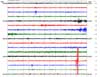
Another earthquake took place at 9:56 p.m. Wednesday off the central Pacific coast. That has been the site of a handful of quakes over the last five days. The Laboratorio de Ingenieria Sismica estimated the epicenter to be 28.1 kilometers (about 17.4 miles) south southwest of Pasito de Savegre de Aguirre outside of Quepos. The magnitude was estimated at 4.2.
|
|||||||||||||||||||||||||||||||||||||||||||||||||||||||||||||||||
 |
||||||||||||||||||||||||||||||||||||||||||||||||||||||||||||||||||
|
|
|
|
|
|
|
Food |
|
| What we published this week: | Monday | Tuesday | Wednesday | Thursday | Friday | Earlier |
| The contents of this page and this Web site are copyrighted by Consultantes Río Colorado S.A. 2013 and may not be reproduced anywhere without permission. Abstracts and fair use are permitted. Check HERE for details | ||||||
A.M. Costa Rica Third News Page |
A.M.
Costa Rica advertising reaches from 12,000 to 14,000 unique visitors every weekday in up to 90 countries. |
| San José, Costa Rica, Thursday, March 7, 2013, Vol. 13, No. 47 | |
|
|
|
|
|
|
|
Food |
|
| Spheres festival planned for this month
in central Pacific |
|
|
By
the A.M. Costa Rica staff
The Municipalidad de Osa is getting ready for the eighth Festival de las Esferas later this month. This is an entertainment and cultural event set against the backdrop of the pre-Columbian stone sphere in that part of Costa Rica. The event is March 19 to 24 in Palmar Norte, Palmar Sur, Ciudad Cortés and also on the famous Finca 6 where the Museo Nacional is developing a museum specifically for the stone spheres. For the first time there will be a foot race as part of the program. The recreational race will be March 24 at 4 p.m., and participants will travel between Finca 6 and Palmar Sur. The residents of Rey Curré also will present the Juego de los Diablitos. That will be March 23 at 2 p.m. This is a shortened version of the confrontation between the devils and the bull, representing a cultural statement about the invasion of the Spanish in colonial times. There are seminars every day on biology and archaeology as well as tours. There also are workshops and musical events. Costa Rica just received word that the spheres have been advanced to candidate status for inclusion in the World Heritage cultural list of the U.S. Educational, Scientific and Cultural Organization. This is expected to give a boost in tourism to the area as well as open the door to additional funding. The stone spheres are the local stones that were shaped by pre-Columbian people, probably the ancestors of the individuals living in the area now. The use is uncertain but local archaeologist think the spheres, which range in size, |
 Finca 6 is one of the locations specifically included in the U.N. announcement. The event also is sponsored by the Asociación de Desarrollo Integral de Palmar Sur. |
| More speed trap cameras might be going
into service this year |
|
|
By
the A.M. Costa Rica staff
Highway officials say they will have a final decision April 15 on a proposal to place more traffic surveillance cameras on four major highways. They said that the plan will reduce accidents by 60 percent and deaths by 90 percent. The proposal is being put forward by Radiográfica Costarricense S.A., which will provide the electronic hookups. Initially the project will place 18 cameras on the General Cañas highway from San José to the airport, on the Florencio del Castillo highway, on the Circunvalación and on the main highway in Alajuela. Eventually the Consejo Nacional de Vialidad plans to install |
150 cameras in the first four
years beginning with the initial batch going into operation in
December. Eventually some 150 will be in service by March 2017,
according to the plan. The cameras mainly will monitor speed and there by reduce accidents, according to the plan. The road agency put cameras into service on key routes in 2011, but the project was defeated by a number of court actions. Not the least of the arguments was that speeding tickets were being awarded to the owners of vehicles whose license plates had been photographed by the automatic cameras. The agency stopped the use of the cameras at the end of that year and have repeatedly promised to put them back into service. |
 |
| You need to see Costa Rican tourism information HERE! |
|
|
|
|
|
|
|
Food |
|
| What we published this week: | Monday | Tuesday | Wednesday | Thursday | Friday | Earlier |
| The contents of this page and this Web site are copyrighted by Consultantes Río Colorado S.A. 2013 and may not be reproduced anywhere without permission. Abstracts and fair use are permitted. Check HERE for details | ||||||
 |
|
||||
| A.M. Costa Rica's Fourth News page | |||||
| San José, Costa Rica, Thursday, March 7, 2013, Vol. 13, No. 47 | |||||
|
|
|
|
|
|
|
Food |
|
 University of Lincoln photo
Liolaemus nigriceps is
among the species facing problemsResearch
suggests lizards
endangered with live births By
the University of Exeter news service
Climate change could lead to dozens of species of lizards becoming extinct within the next 50 years, according to new research. Globally it has been observed that lizards with viviparous reproduction are being threatened by changing weather patterns. These are creatures where the mother retains embryos within her body. A new study suggests that the evolution of this mode of reproduction, which is thought to be a key successful adaptation, could, in fact, be the species’ downfall under global warming. Researchers from the University of Exeter and the University of Lincoln investigated the hypotheses that historical invasions of cold climates by Liolaemus lizards – one of the most diverse groups of vertebrates on earth – have only been possible due to their evolution to live birth from laying eggs. Remarkably, however, once these species evolve live births, the process is mostly irreversible and they remain restricted to such cold climates. By analyzing this evolutionary transition in the lizards’ reproductive modes and projecting the future impact of climate change, the scientists discovered that increasing temperatures in the species’ historically cold habitats would result in their areas of distribution being significantly reduced. As a consequence, if global warming continues at the same rate, lizards that give live birth are facing extinction in the next few decades. Dave Hodgson, from Biosciences at the University of Exeter, said: “Climate change must not be underestimated as a threat to modern patterns of biodiversity. Our work shows that lizard species which birth live young instead of laying eggs are restricted to cold climates in South America: high in the Andes or towards the South Pole. As the climate warms, we predict that these special lizard species will be forced to move upwards and towards the pole, with an increased risk of extinction.” Lead author Daniel Pincheira-Donoso from the University of Lincoln’s School of Life Sciences is one of the few people in the world who works on the ecology and evolution of these lizard species. He said: “Lizards’ reproduction is largely linked to climatic temperatures and viviparous species are usually found in cold environments. When reptiles initially moved to colder areas they needed to evolve emergency measures to succeed in these harsh places, and we believe viviparity is one of these key measures. However, this transition is mostly one-directional and unlikely to be reversed. Rapid changes in the environment’s temperature would demand rapid re-adaptations to secure the species’ survival. Through the research we found that over the next 50 years nearly half of the area where these species occur may disappear, causing multiple extinctions due to climate change.” Overall the conclusion is that although viviparity allowed lizards in the past to invade and adapt to live in cold environments, and was therefore a key trait for evolutionary success, it will now ultimately lead to multiple events of extinction. Pincheira-Donoso said: “These lizards are one of the most diverse groups of animals, and are able to adapt to remarkably diverse conditions. Unfortunately, a reduction in cold environments will reduce their areas of existence, which means that their successful evolutionary history may turn into a double-edged sword of adaptation. Their extinctions would be an atrocious loss to biodiversity.” The paper "The evolution of viviparity opens opportunities for a lizard radiation but drives it into a climatic cul-de-sac" is published in the peer-reviewed journal Global Ecology and Biogeography and was funded by the Leverhulme Trust. New medical device firm is now open for business Special
to A.M. Costa Rica
MicroVention, Inc., a wholly owned subsidiary of Terumo Corp,, has inaugurated its new manufacturing facility in Coyol Free Zone in Alajuela. The new plant represents MicroVention’s first manufacturing facility outside the United States and the first Neurovascular manufacturing facility in Costa Rica, the company said. Casa Presidencial said the investment was about $8 million. This new facility will support the growth and expansion of products offered under the MicroVention and Terumo brand and the company is hiring approximately 150 persons with plans to expand in the coming months/years. The new facility is 7,500 square meters or 80,000 square feet and will encompass a 2,300 square meter clean room, about 25,000 square feet. Approximately 12,000 people currently work in the Life Sciences Sector in Costa Rica with 41 medical device companies producing orthopedic, cardiovascular, women´s health devices, and medical supplies. MicroVention will be the first company specializing in the neurovascular segment in Costa Rica. MicroVention has been recruiting its first employees, specifically in the areas of engineering, quality, production and administration. Tokyo‐based Terumo Corp.is one of the world’s leading medical device manufacturers with $5 billion in sales and operations in more than 160 nations. Founded in 1921, the company develops, manufactures and distributes medical devices including products for use in cardiothoracic surgery, interventional procedures and transfusion medicine. The company also manufactures a broad array of syringe and hypodermic needle products for hospital and physician office use. MicroVention, Inc. is a U.S. subsidiary of Terumo Corp. with its corporate headquarters in Tustin, California, and other manufacturing and administrative facilities in Santa Ana and Aliso Viejo, California, |
|
|||||||||||||||||||||||||
|
||||||||||||||||||||||||||
|
|
|
|
|
|
|
Food |
|
| What we published this week: | Monday | Tuesday | Wednesday | Thursday | Friday | Earlier |
| The contents of this page and this Web site are copyrighted by Consultantes Río Colorado S.A. 2013 and may not be reproduced anywhere without permission. Abstracts and fair use are permitted. Check HERE for details | ||||||
| A.M.
Costa Rica's Fifth news page |
 |
||||||||
| San José, Costa Rica, Thursday, March 7, 2013, Vol. 13, No. 47 | |||||||||
|
|
|
|
|
|
|
Food |
|
 |
|
 Venezuelan Asamblea Nacional video photo
Casket carrying Hugo
Chávez is surrounded by supporters.Funeral for Chávez is Friday as his allies
begin to gather
By
the A.M. Costa Rica wire services
Crowds of grieving Venezuelans sobbed and threw flowers as his coffin made its way through the streets of Caracas Wednesday. A somber Vice President Nicolas Maduro, Chavez's hand-picked successor, walked next to the hearse. Several close Chavez allies, including the presidents of Argentina, Bolivia and Uruguay, already are in Venezuela for Friday's funeral. Chavez, 58, died Tuesday of cancer. The United Nations Security Council held a moment of silence Wednesday for Chávez. Cuba, home of Chavez's mentor, Fidel Castro, is observing two days of official mourning. Chinese and Iranian leaders also expressed their sorrow. The U.S. Embassy in Caracas is closed until after the funeral. The U.S. delegation to the funeral has not yet been announced. President Barack Obama said he reaffirms his support for the Venezuelan people and is committed to polices promoting democracy and human rights. Chávez, a staunch socialist, was elected president in 1998. He earned the enmity of the United States and others for such policies as nationalizing major companies and courting world leaders such as Castro, Iran's Mahmoud Ahmadinejad and Libya's Moammar Gadhafi. The country's opposition accused him of being a dictator. But millions of poor Venezuelans revered him for using the country's vast oil wealth to give them access to low-cost food, free medical care and other social programs. However, experts say Chávez failed to control crime or use oil wealth to enrich the overall economy. Nicolas Maduro, the Venezuelan vice president, said: "We now have to be united more than ever with major discipline and collaboration. We are going to grow. We are going to be dignified, inheritors and children of a great man. He was and will always be Comandante Hugo Chavez. Glory and honor Comandante Hugo Chávez. Long live Chávez!'' Said Latin America analyst Sean Burges, Australian Center for Latin American Studies: "It’s definitely going to be the economy. Nobody knows what’s going on with the oil company and how much it’s producing. There are balance payments problems. There are production problems. There are supply problems. And these are all things that even if Chávez had stayed in power, he was going to have to deal with in the next four years. So it’s going to be a really titanic exercise in economic management and rationalization." "Irrespective of what happens, I think some of the social policies and the political, dynamic changes Chávez brought in, those are going to be around forever." U.S. is expected to send delegation to the funeral By the A.M.
Costa Rica wire services
The United States is expected to send a delegation to Hugo Chavez's funeral later this week in a move that could send a conciliatory message to Venezuela now that its stridently anti-American leader has died. Senior U.S. officials also said on Wednesday that Washington had no immediate plans to respond in kind to Venezuela's expulsion of two U.S. military attaches, which was announced on Tuesday by Vice President Nicolas Maduro just hours before he told the world of Chavez's death. Maduro, Chavez's chosen successor, said on Tuesday that one of the expelled U.S. diplomats tried to stir up a military plot against Chávez. He also said Chavez's cancer was an attack by Venezuela's enemies, an accusation the United States dismissed as absurd. A senior State Department official said the United States was reviewing its response to Venezuela's expulsion of the two military officials and said it had the right to reciprocate in kind but for now it would not be doing so. The U.S. Embassy in Caracas has been without an ambassador since 2010, when Chávez rejected the U.S. appointee. That led Washington to revoke the credentials of Venezuela's ambassador. U.S. President Barack Obama issued a statement shortly after Chavez's death was announced, expressing an interest in a constructive relationship in the post-Chávez era. But analysts said Washington would be challenged to figure out a way to engage with Venezuelan leaders and the opposition without appearing to meddle in the South American oil-producing nation. A senior State Department official said the United States would like a more functional relationship with the Venezuelan government going forward. The official said it was too early to tell how the situation would evolve but said the United States was expected to send a delegation to Chavez's funeral, which will be held Friday. Details of who will be included in the delegation will be announced by the White House. There have been no signs of security threats in Venezuela since Chavez's death, the official said. "We have no indication right now that there is any threat to our personnel or Americans in Venezuela," the official said. "After you have the kind of broadside that Vice President Maduro launched against the United States yesterday we obviously have security concerns and will remain very vigilant." Iran may lose key supporter for Americas in Venezuela By
the A.M. Costa Rica wire services
Venezuela’s President Hugo Chávez, who died Tuesday, developed a close relationship with the leaders of Iran, despite Western sanctions on Tehran because of its controversial nuclear program. Chávez and Iranian leader Mahmoud Ahmedinejad visited each other and called themselves allies, friends and even brothers. It was a friendship that was watched closely by many countries, especially the United States. The relationship between Iran and Venezuela began in the 1960s, in the early days of OPEC, the Organization of Petroleum Exporting Countries. But it was during Hugo Chavez’s presidency that strong ties were formed. Iran’s nuclear program was a catalyst. Iran says its nuclear aims are peaceful. The West fears it is developing weapons. In the face of international sanctions, Iran turned to Venezuela, one of its few allies, to break its diplomatic isolation, find new strategic resources, and undermine U.S. influence. “In Venezuela, the PDVSA, the national oil company of Venezuela, continues to have relations with Iran in ways that break the embargo, that is the sanctions that the United Nations has imposed because of the Iranian nuclear program,” said Christopher Sabatini, with Americas Society/Council of the Americas. Since the 1980s, the Iranian-backed Hezbollah faction in Lebanon has expanded its operations in Latin America, primarily fundraising, through ties to the illegal trade in drugs and pirated goods. The U.S. considers Hezbollah a terrorist organization. In Latin America, Chávez’s Venezuela and other anti-American governments opened their arms to Hezbollah and Iran. “State sponsors of terrorism - Iran is included in that list. And so we are looking at how Iran is gaining influence in the Americas, through instruments of, in particular, economic power,” said Celina Reauyo, National Defense University. The two countries also signed bilateral accords and created committees on cultural and educational cooperation. Some regional analysts saw them as another Iranian tool for gaining influence in the region. "If you recall the attacks in 1992 and 1994 on the Israeli Embassy and the Jewish cultural center there had been cultural cooperation for 10 years before the attacks. There was a cultural center run by Iranian diplomats, who were doing the same sorts of things: bilateral accords and intercultural exchanges,” said Joseph Humire, of the Atlas Economic Research Foundation. The attack was in Buenos Aires, Argentina. While close ties between Tehran and Caracas have been useful to both countries, with Chavez’s death, that much-watched political romance, may well be set to change, as Tehran loses a key supporter. Arkansas abortion law is the most restrictive By
the A.M. Costa Rica wire services
Lawmakers in the southern U.S. state of Arkansas have adopted the country's most restrictive state ban on abortion, making the medical procedure illegal after 12 weeks of pregnancy. The law passed Wednesday by a wide margin in the state's Republican-controlled House, over the veto of Gov. Mike Beebe, a Democrat. The state Senate voted to override the veto on Tuesday. Arkansas' new law overrides limits established and upheld in the U.S. Supreme Court decisions, which give a woman the right to an abortion until the fetus is viable outside the womb -- a development that normally occurs about 24 weeks into pregnancy. Several other states have enacted abortion bans after 20 weeks of pregnancy. State abortion proponents say they will immediately file a lawsuit to overturn the new legislation. In a statement Tuesday, Beebe said the override blatantly contradicts the U.S. Supreme Court precedent set in the landmark 1973 ruling known as Roe versus Wade. He also warned that the state will waste money trying to defend the new legislation. House passes resolution to keep U.S. running By
the A.M. Costa Rica wire services
The U.S. House has approved a continuing resolution to fund the government for the rest of the fiscal year and avoid a government shutdown. The House passed the $982 billion budget measure Wednesday with a tally of 267 in favor and 151 against. The measure would keep in place the $85 billion in automatic government spending cuts known in Washington as the sequester. The House bill would provide the Pentagon with new flexibility within the law, however, to better manage some of its budget cuts. Rep. Debbie Wasserman Schultz, a Democrat from Florida, deplored what she called the meat ax cuts that remained in the continuing resolution. Rep. Tom Latham, a Republican from Iowa, said the resolution, though, was the best alternative that gives government offices certainty about their funding. The measure is now expected to be taken up in the Senate, which is likely to modify the bill. The passage comes just days after U.S. Homeland Security Secretary Janet Napolitano warned travelers to get to U.S. airports early because government spending cuts are creating long security and customs lines. Ms. Napolitano said Monday that several busy airports, including those in Atlanta, Chicago and Los Angeles, now have very long lines after the mandatory spending cuts took effect last Friday. The cut in airport services is just one result of the $85 billion in government spending cuts that took effect Saturday after Congress and the White House failed to reach a budget agreement. Heart disease is preventable with simple steps, experts say By
the A.M. Costa Rica wire services
Coronary heart disease is the number one killer, worldwide, of men and women over the age of 60. But people of all ages succumb to heart attacks each year. And while death rates have declined in the U.S. and many western European countries, mortality is on the rise in the developing world. Yet most heart disease is preventable. No one would have guessed that Barbara Teng would have a heart attack. She was not overweight. She did not smoke. But she also did not exercise. “In 2004, the week after I turned 49, when I was on a business trip in Chicago, I had a major heart attack," she said. And that changed her life. She now exercises daily, monitors her heart health, and speaks at events held by Sister to Sister, a heart health program for women. Susan Gurley, the organization's director, says the message is urgent. "Heart disease is 82 percent preventable and it is the leading cause of death for women," she said. It's also a leading cause of death for men. The World Health Organization reports that more people die each year from heart disease than from any other cause. WHO says more than 60 percent of deaths from cardiovascular disease take place in low and middle-income countries. It says the heart disease pandemic is on the rise. Dr. Patrice Desvigne-Nickens is with the National Heart, Lung and Blood Institute. She says the key to staying healthy is knowing your numbers. "Your weight, your blood cholesterol, blood sugar and your blood pressure are important numbers that can help you take action and reduce your risk," she said. She says a healthy lifestyle can prevent heart disease. "And the steps to take are simple: don’t smoke, maintain a healthy weight, exercise, know your numbers and talk to your physician and control these risks," she said. African-Americans are at higher-than-average risk for heart disease and stroke, according to Michelle Magee, a physician. "There's a very high prevalence of uncontrolled hypertension and also unrecognized hypertension so people don't even know they have it, which increases the risk for heart disease and stroke," she said. In the nation's capital, Medstar Washington Hospital Center is trying to reach this population. Neighborhood barbers develop relationships with their clients. With the right training, they can play an important role in community health, for example helping their clients monitor their blood pressure. These programs operate on the premise that if people realize they are at risk for heart disease, they'll make lifestyle changes: lose weight, exercise, eat the right foods and keep in touch with a doctor. |
|
|||||||||||||||||||||||||||||||||||||||||||||||||||||||
|
|
|
|
|
|
|
Food |
|
| What we published this week: | Monday | Tuesday | Wednesday | Thursday | Friday | Earlier |
| The contents of this page and this Web site are copyrighted by Consultantes Río Colorado S.A. 2013 and may not be reproduced anywhere without permission. Abstracts and fair use are permitted. Check HERE for details | ||||||
| A.M. Costa
Rica's sixth news page |
|
||||||||
| San José, Costa Rica, Thursday, March 7, 2013, Vol. 13, No. 47 | |||||||||
|
|
|
|
|
|
|
Food |
|
 |
|
Not all children are dependents Most U.S. taxpayers know that you can claim your children as dependents on a tax return to lower your tax bill. Many taxpayers in the United States can also claim their step-children if they pay to support them. Taxpayers in the United States can often claim many different kinds of relatives as dependents, and in certain situations even non-relatives. For those outside of the United States, there is an additional factor to consider, the Citizen or Resident Test. What this says is that nobody can be claimed as a dependent on a U.S. tax return unless they are a citizen or a resident of the United States, Canada, or Mexico. To determine who you may claim as a dependent, it may be helpful to see a tax professional that specializes in tax returns for U.S. citizens living abroad. When a U.S. citizen lives abroad, they must still usually file a tax return with the Internal Revenue Service. The United States taxes its citizens on all of their income, even if it is earned while living abroad. A U.S. citizen may move to a country like Costa Rica and marry a local with children from a previous relationship. Unfortunately, the U.S. taxpayer cannot claim his new step children as dependents. The taxpayer will usually be able to claim the dependent if they adopt the child, however that is not a decision to be taken lightly. Hiding foreign income increases likelihood of IRS audit In 2007, a whistleblower at a major bank in Switzerland disclosed to the Internal Revenue Service millions of dollars in assets belonging to U.S. citizens that were never properly disclosed. This led, in 2009, to one of the biggest settlements in IRS history. Since then, the IRS has been especially vigilant in seeking out foreign income and assets of U.S. citizens. If you are a U.S. citizen, you must disclose many of your foreign assets and report your foreign earned income even if you don't live in the United States. There are tax professionals that specialize in helping U.S. citizens abroad meet their IRS obligations. The IRS is unlikely to send an agent to Costa Rica to perform an audit. However, the IRS routinely conducts audits by mail. Failure to disclose foreign income or assets can cause the IRS to assess significant penalties. If you receive such a letter from the IRS, you should contact a tax professional to help navigate the waters of an IRS audit. The IRS will not have to rely on whistleblowers for long. The United States is aggressively pursuing exchange of information treaties with countries around the globe, and has instituted sweeping laws to penalize foreign banks that do not disclose information to the IRS. Going forward, the IRS will have information on most U.S. citizens with foreign holdings. This is a public service column prepared by tax professionals for U.S. expats in Costa Rica. |
| Costa Rican News |
AMCostaRicaArchives.com |
Retire NOW in Costa Rica |
CostaRicaReport.com |
|
|
|
|
|
|
|
Food |
|
| What we published this week: | Monday | Tuesday | Wednesday | Thursday | Friday | Earlier |
| The contents of this page and this Web site are copyrighted by Consultantes Río Colorado S.A. 2013 and may not be reproduced anywhere without permission. Abstracts and fair use are permitted. Check HERE for details | ||||||
| A.M. Costa Rica Seventh Newspage |
|
| San José, Costa Rica, Thursday, March 7, 2013, Vol. 13, No. 47 | |
|
By
the A.M. Costa Rica wire services
For years, the United States has used drone aircraft to attack suspected terrorists in other nations. Now, America’s top law enforcement official has not entirely ruled out a president ordering drone strikes on U.S. soil. Attorney General Eric Holder testified before the Senate Judiciary Committee amid a firestorm on Capitol Hill over presidential authority in times of crisis. Democratic Sen. Patrick Leahy posed this question: “Can you agree there is no scenario where it would be appropriate to use an armed drone on U.S. soil to strike an American citizen?” Holder’s response was less than definitive. “The government has no intention to carry out any drone strikes in the United States," he said. "It is hard for me to imagine a situation in which that would occur. We have within the United States the ability to use our law enforcement capacity.” The “no intention” assertion does not satisfy Republican Rand Paul, who took to the Senate floor moments later. Paul noted that Holder speaks for President Barack Obama on legal matters. “The president says, ‘I have not killed anyone yet,'" said Paul. "He goes on to say, ‘I have no intention of killing Americans, but I might.’ Is that enough? Are we satisfied by that?” In a letter to Sen. Paul made public Tuesday, Holder said the only conceivable scenario where a president might order a military strike on U.S. soil would be an extraordinary circumstance like the 2001 al-Qaida terrorist attacks on New York and Washington. At the hearing, the attorney general repeatedly said it would not be appropriate to order a strike on a terror suspect spotted eating in a café or walking down a street. Holder said regular law enforcement can be used to apprehend suspects in non-emergency situations. Lawmakers urged the Obama administration to fully disclose its thinking on this issue. “American citizens have a right to understand when their life can be taken by their government, absent due process," said Sen. Chuck Grassley, a Republican. That sentiment was echoed by Sen. Dianne Feinstein, a Democrat who serves on the Judiciary Committee and is chairwoman of the Senate Select Committee on Intelligence. “Our job is vigorous oversight of the intelligence community," she said. "We cannot do this unless we see the legal underpinnings for certain kinds of activities, particularly clandestine activities.” Holder said he expects President Obama to personally address the topic in coming months. Administration officials are already on record defending drone strikes outside the United States, including the killing of U.S. citizens believed to be plotting attacks from afar. Concern over the drone program has delayed Senate confirmation of President Obama’s pick to head the CIA, former counterterrorism advisor John Brennan.  A.M. Costa Rica file photo
Rodeo is among the most
dangerous sportsHealth is key concern at livestock show By
the A.M. Costa Rica wire services
Rodeo, which features bull riding, steer wrestling and bucking broncos, is considered one of the world's most dangerous sports. The bigger, better organized events, though, tend to have fewer casualties among humans and animals. At the annual Houston Livestock Show and Rodeo, the biggest event of its kind in the world, safety is a chief concern. During the three-week rodeo, both riders and animals can count on expert medical teams. The humans find care at this clinic inside the stadium. The medical team includes several doctors as well as licensed medical therapists, massage therapists, athletic trainers and radiology technicians, all under the direction of Kelly Larkin. "We cover all the bases of the medical care for the cowboys. We do preventative medicine beforehand, and then we are here with medical care down on the floor when they have injuries,” said Ms. Larkin. The preventive care mostly consists of taping limbs and parts of the body that have suffered previous injury. “A lot of times the cowboys know what works best for them and, historically, they have been taping their knee for a long time from a prior injury,” said Ms. Larkin. Lesha Roberts, another physician, said bruises and strains are the most common problems she sees. “Mostly soft tissue injury. We have not seen a lot of fractures. We had a fracture Tuesday night of the thumb, but not anything real severe,” said Ms. Roberts. Doctors say preventive measures and the use of protective apparel, like helmets, have reduced serious injuries, but they still are more common than in any other sport. Ms. Roberts has ordered an X-ray for Bull rider Sean Coleman from South Dakota. He may have a fractured rib, but plans to compete for the prize money anyway. “It's going to hurt, that's obvious, but they give $50,000 away, so you just have to fight through that,” said Coleman. Animals also can suffer injuries at these events, but at a much lower rate than the cowboys who compete with them. Rodeo Houston's chief veterinarian, Gregg Knape, said participating animals are highly prized. “These are very valuable animals. They are worth thousands of dollars. And we take care of the animals, and the owners take good care of these animals, because they mean a lot to them. And their concern is for their health as much as their ability to perform,” said Knape. Although some animal rights groups have complained about exploitation of rodeo animals, Knape said he thinks horses and bulls enjoy the competition. “For eight seconds they are going to do their best to get that rider off. And then after the eight seconds, they are going to run right back to their pen and go right back to eating hay,” he said. Knape said there are about 26,000 animals at the Houston Livestock Show and Rodeo, and when it ends March 17, almost all of them will leave here as healthy as they were when they arrived. |
|
| What we published this week: | Monday | Tuesday | Wednesday | Thursday | Friday | Earlier |
| The contents of this page and this Web site are copyrighted by Consultantes Río Colorado S.A. 2013 and may not be reproduced anywhere without permission. Abstracts and fair use are permitted. Check HERE for details | ||||||