|
|
||||
 |
 |
 |
||
|
|
|
|
||||||||||||
|
|||||||||||||
 |
|||||||||||||
|
|
|||||||||||||
|
|
||||||||||||
| What we published this week: | Monday | Tuesday | Wednesday | Thursday | Friday | Earlier |
|
|
|
|
|
|
|
Food |
|
|
Abstracts and fair use are permitted. Check HERE for more details |
A.M. Costa Rica's Second news page |
|
|
|
San
José, Costa Rica, Tuesday, Feb. 24, 2015, Vol. 15, No. 38
|
||
|
|
|
|
|
|
|
Food |
|
|
|
 |
|
Our reader's opinion
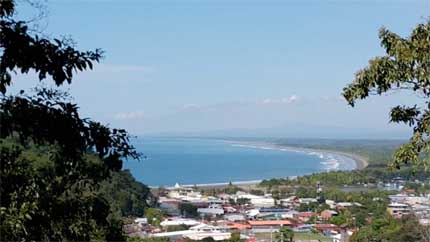
Targeted expats need to have cautionDear A.M. Costa Rica: Reading the story about the two expats being singled out for criticism in a public document, allegedly written by the mayor of the Talamanca canton, for their active participation in the life of a community where they are legal residents, pay taxes, and contribute in numerous other ways to that community's quality of life, particularly in regards to protecting the environment, was more than disturbing, given that it comes on the heels of two pretty high profile murders in recent years of people, one an expat and the other a Tico, who dared to speak up and question the varied powers that be, especially in relation to environmental issues. I also took the story personally because Carol Meeds is a friend of mine whose professional background and experience make her more than qualified to speak out on issues pertaining to the environment. She was one of the first people to point out to me that much of the rapid, most often expat driven construction, development, and related deforestation in and around Puerto Viejo was occurring with little to no real regard for the environmental impact those activities were having. One needn't be a trained environmentalist, biologist, or scientist to see that unfortunately reality. All one has to do is use your senses. For example, for years as one walked along the beach or the road just beyond the landmark bar and restaurant long known as Stanford's, the stench of raw sewage and grey water flowing from an oversized outflow pipe from the back side of town right into the lagoon where hundreds of people swim and frolic was enough to gag the proverbial maggot. I've not been back to Puerto Viejo in three years, but friends tell me that maggot still gags and the construction of buildings whose waste waters flow into that pipe and into the lagoon continues largely unabated. Along with this apparent attack by a government official, I think it is also important to note that Ms. Meeds' activism and speaking out on behalf of the environment have also resulted in her incurring the wrath and animosity of many expats who, through the years, have revealed themselves to be more interested in cashing in on Costa Rica's pura vida mystique than they are in protecting and preserving the country's authentic pura vida traditions and customs. This is all so sad because it is just further proof, at least to me, that the wonderfully funky little town at the end of what was once little more than a long dirt road to nowhere that I landed in16 years ago has, like so many other once beautiful and special places, been discovered and with that discovery has come the sounding of the death knell for the very things that made it so special in the first place. To Carol Meeds and Philippe Vangoidsenhoven, I say, "Ten cuidado." You are swimming with some pretty mean and hypocritical fish in those warm Caribbean waters. Michael Cook
Provincetown, Massachusetts  Artist Efrén
Alpízar, did this work for 'Cuento con patas y cola,'
which was published by the Editorial UNED. Children's
artists featured in exhibit
By the A.M. Costa Rica staff
The Biblioteca Nacional is mounting an exhibit of illustrations from children's books. The display opens Wednesday at the national library on Avenida 3 opposite Parque Nacional. The works of some 20 illustrators will be displayed, the library said. The 26 works come from “El Jardín de versos,” “Sibö y los sapitos traviesos,” “Guardianes del laberinto” and “Cuento con patas y cola,” all popular books. The illustrators whose works will be displayed are César Acuña, Efrén Alpízar, Ruth Angulo, Raúl Angulo, Laura Astorga Monestel, Álvaro Borrasé, Roxana Brizuela, Jeannina Carranza, Priscilla Coto, Héctor Gamboa, Josué Garro, Adrián González, Wen Hsu, Jonathan Mariño, Carlos Kidd, Nela Marín, Ana Luisa Núñez, Josefa Richard and Carolina Valencia, the library said in a release. The exhibit will run until March 24. Police frustrate one window breaking By the A.M. Costa Rica staff
Window-breaking thieves continue to prosper along the Circunvalación in Hatillo. These are the crooks that target woman drivers and smash the passenger side window to steal purses. Police on motorcycles managed to run down one suspect about 9:20 p.m. Sunday in Hatillo 8. A crook smashed the window of a car while the woman driver was stopped at a traffic light in Hatillo 8. The police officers on motorcycles were able to capture the 20-year-old suspect and said they recovered the woman's possessions. This type of crook is called a quiebravidrio, the Spanish for window breaker." The crimes can happen anywhere traffic is halted. There was a run of such crimes at traffic jams in Escazú two years ago. Usually the window breakers are assisted by spotters who direct them to vehicles where the occupants have left something of value on the empty front passenger seat. Police have been staking out likely window-breaking locations. Hatillo with its proximity to lower income housing has been where the most frequent attacks take place. Traffic police zero in on drag racing By the A.M. Costa Rica staff
The Policía de Tránsito is outlining all the actions it took in 2014 to prevent drag racing, and officers promise more coordinated action with other agencies this year. Drag races are in the news because one vehicle went out of control and killed an 81-year-old pedestrian earlier this month. That mishap took place in Pavas not far from the U.S. Embassy. Mario Calderón, director of the traffic police, said his agency's efforts are mainly preventative. Officers arrive at a location known for drag racing and begin inspecting vehicles for compliance with the law. No one died as a result of drag racing in 2014, but there was at least one death in 2014, also a pedestrian.
|
|||||||||||||||||||||||||||||||||||||||||||||||
|
|
|
|
|
|
|
|
Food |
|
| What we published this week: | Monday | Tuesday | Wednesday | Thursday | Friday | Earlier |
| The contents of
this Web site are copyrighted by Consultantes Ro Colorado S.A 2015
and may
not be reproduced anywhere without permission. Abstracts and fair use are permitted. Check HERE for details |
||||||
A.M. Costa Rica Third News Page |
|
| San José, Costa Rica, Tuesday, Feb. 24, 2015, Vol. 15, No. 38 | |
|
|
|
|
|
|
|
Food |
|
| Lawmakers give first approval to controversial Ruta 32
widening loan |
|
|
By the A.M. Costa Rica staff
Lawmakers passed on first reading Monday a bill that allows the government to accept a $395 million loan from the Republic of China. The loan is designed to finance reconstruction from two to four lanes some 107 kilometers of Ruta 32 from Limón to Río Frio. There were 45 votes in favor and six against. One of those opposed to the plan was Ottón Solís of the Partido Acción Ciudadana. Organizations and agencies outside the legislature have expressed concern about the loan because there still is no plan. In addition, the government will have to expropriate more right-of-way. A Chinese company, China Harbour Engineering Co., will be contracted to do the job without competitive bidding. Lawmakers are expected to give final approval Wednesday. President Luis Guillermo Solís favors the plan. The loan from the Import-Export Bank of China is for 20 |
 Partido Liberación Nacional photo
Proponents of the highway
plan celebrate the victory.years. The highway widening had strong support among truckers and Limón residents. Many showed up Monday to show support and to celebrate when the bill received approval. The highway job is a key element in improving the nation's transportation infrastructure. It will link the Limón and Moín docks with the center of the country with access to Nicaragua. |
 Consejo Nacional de Viliadad photo
Work
continues at the slide area that closed the Interamericana Sur.
|
|
| Officials say temporary lanes on Interamerican will be ready
Thursday |
|
|
By the A.M. Costa Rica staff
Highway officials say that two lanes are expected to be opened Thursday at a place where a slide closed the route. The location is in La Congreja on the Interamericana Sur at kilometer marker 37. Workers have been trying to shore up the highway where one lane simply dropped down a cliff. In doing so the Consejo |
Nacional de
Vialidad said that engineers found deposits of clay.
That soil material is slippery when wet, so the job was to remove much
of the clay and install drainage so that the soil under the highway
would not become soaked. Traffic is being detoured around the location now. Workers have dug into the adjacent mountain to obtain space for a second lane. The work is being done 24 hours a day, said the Consejo. |
| You need to see Costa Rican tourism information HERE! |
 |
|
|
|
|
|
|
|
Food |
|
| What we published this week: | Monday | Tuesday | Wednesday | Thursday | Friday | Earlier |
| The contents of
this Web site are copyrighted by Consultantes Río Colorado S.A.
2015 and may
not be reproduced anywhere without permission. Abstracts and fair use are permitted. Check HERE for details |
||||||
 |
 |
||||
| A.M. Costa Rica's Fourth News page | |||||
| San José, Costa Rica, Tuesday, Feb. 24, 2015, Vol. 15, No. 38 | |||||
|
|
|
|
|
|
|
Food |
|
| Researchers
say Pacific coral stopped growing for 2,500 years |
|
|
By the Georgia Institute of Technology news
staff
A new study has found that La Niña-like conditions in the Pacific Ocean off the coast of Panamá were closely associated with an abrupt shutdown in coral reef growth that lasted 2,500 years. The study suggests that future changes in climate similar to those in the study could cause coral reefs to collapse in the future. The study found cooler sea temperatures, greater precipitation and stronger upwelling — all indicators of La Niña-like conditions at the study site in Panamá — during a period when coral reef accretion stopped in this region around 4,100 years ago. For the study, researchers traveled to Panamá to collect a reef core, and then used the corals within the core to reconstruct what the environment was like as far back as 6,750 years ago. “Investigating the long-term history of reefs and their geochemistry is something that is difficult to do in many places, so this was a unique opportunity to look at the relationship between reef growth and environment,” said Kim Cobb, an associate professor at the Georgia Institute of Technology. “This study shows that there appears to have been environmental triggers for this well-documented reef collapse in Panamá.” The study was sponsored by the Geological Society of America, the American Museum of Natural History and the Smithsonian Institution’s Marine Science Network. The study is scheduled for publication in the journal Nature Climate Change. The study was a collaboration with the Florida Institute of Technology, with Cobb’s lab providing an expertise in fossil coral analysis. Climate change is the leading cause of coral-reef degradation. The global coral reef landscape is now characterized by declining coral cover, reduced growth and calcification, and slowdowns in reef accretion. The new study provides data to assist scientists in understanding how changes in the environment trigger long-term changes in coral reef growth and ecosystem function, which is a critical challenge to coral-reef conservation. “Temperature was a key cause of reef collapse and modern temperatures are now within several degrees of the maximum these reefs experienced over their 6,750 year history,” said Lauren Toth, the study’s lead author, who was a graduate student at Florida Tech during the study. “It's possible that anthropogenic climate change may once again be pushing these reefs towards another regional collapse.” For the study, the research team analyzed a 6,750-year-old coral core from Pacific Panamá. The team then reconstructed the coral’s past functions, such as growth and accretion |
 Georgia
Institute of Technology/Lauren Toth
Exposed coral in Panamá
during a La Niña event in 2010. (accumulation of layers of coral), and compared that to surrounding environmental conditions before, during and after the 2,500-year hiatus in vertical accretion. “We saw evidence for a different climate regime during that time period,” Cobb said. “The geochemical signals were consistent with a period that is very cool and very wet, with very strong upwelling, which is more like a modern day La Niña event in this part of the Pacific.” In Pacific Panamá, La Niña-like periods are characterized by a cold, wet climate with strong seasonal upwelling. Due to limited data at the site, the researchers cannot quantify the intensity of La Niña events during this time, but document that conditions similar to La Niña were present at this site during this time. “These conditions would have been for quite an extended time, which suggests that the reef was quite sensitive to prolonged change in environmental conditions,” Cobb said. “So sensitive, in fact, that it stopped accreting over that period.” Future climate change, similar to the changes during the hiatus in coral growth, could cause coral reefs to behave similarly, the study authors suggest, leading to another shutdown in reef development in the tropical eastern Pacific. “We are in the midst of a major environmental change that will continue to stress corals over the coming decades, so the lesson from this study is that there are these systems such as coral reefs that are sensitive to environmental change and can go through this kind of wholesale collapse in response to these environmental changes,” Cobb said. Future work will involve expanding the study to include additional locations throughout the tropical Pacific. |
Here's reasonable medical care
Costa Rica's world class medical specialists are at your command. Get the top care for much less than U.S. prices. It is really a great way to spend a vacation. See our list of recommended professionals HERE!amcr-prom
|
|
|||||||||||||||||||||||||||||||||||||||||||||||||||
|
|
|
|
|
|
|
Food |
|
| What we published this week: | Monday | Tuesday | Wednesday | Thursday | Friday | Earlier |
| The
contents of
this Web site are copyrighted by Consultantes Río Colorado S.A.
2015 and may
not be reproduced anywhere without permission. Abstracts and fair use are permitted. Check HERE for details |
||||||
|
A.M. Costa Rica's Fifth
news page
|
||
 |
 |
|
| San José, Costa Rica, Tuesday, Feb. 24, 2015, Vol. 15, No. 38 | |||||||
|
|
|
|
|
|
|
Food |
|
 |
|
Republicans in Senate mull solution to budget impasse By the A.M. Costa Rica wire services
The Republican-controlled Senate is considering a possible solution to a political impasse that could lead to a partial government shutdown over President Barack Obama's executive actions on immigration policy. After repeated attempts failed to pass a measure by the House of Representatives, senior Senate Republicans are pushing a new strategy that does not directly link the president's immigration policy to funding for the Department of Homeland Security. Homeland Security funding runs out Friday at midnight. Senate Republicans have introduced a $40 billion measure passed by the Republican-controlled House of Representatives that would fund Homeland Security through the end of the fiscal year while overturning Obama's orders. But Senate Democrats who support the president's actions on Monday blocked the bill from advancing to a final vote for the fourth time since the bill was introduced. After the vote, Senate Majority Leader Mitch McConnell introduced a separate bill that would overturn Obama's decisions without attaching it to the spending bill. Several Republican senators are also calling for a vote on a bill that would temporarily fund Homeland Security for two or three months. Speaking to a state governors meeting at the White House Monday, Obama said a partial shutdown of the agency would mean the unpaid workers would include more than 100,000 border patrol, port inspection and airport security agents. If the funding is not approved before Friday's deadline, most of the Homeland Security's 230,000 would keep working, but would not be paid until a bill is passed. Obama's executive orders, which he announced last November, would prevent the deportation of as many as 5 million people who are in the country illegally. The orders angered Republicans, who believe Obama's actions go beyond his presidential authority. But House Democratic Leader Nancy Pelosi said the president’s immigration actions are similar to those taken by previous U.S. presidents, including Republicans. The president's actions included expansion of a program that protects young immigrants from deportation if they were brought to the United States illegally by their parents. The program was to begin receiving applications on Wednesday, but a Texas-based federal judge issued a preliminary injunction last week sought by 26 states that halted the president's orders. Malls increase security after threat by terrorists By the A.M. Costa Rica wire services
The Mall of America in Minnesota and the Edmonton Mall in Edmonton, Canada, both issued statements saying they were increasing security after al-Qaida-linked al-Shabab released a video Saturday appearing to call for attacks on Western shopping malls. The terrorist threat specifically mentioned shopping areas in the United States, Canada and Britain, including the Mall of America. White House spokesman Josh Earnest said Monday there is no evidence of a credible threat to Mall of America, but he said Americans should remain vigilant. State Department spokeswoman Jen Psaki called the al-Shabab video propaganda and said U.S. intelligence agencies do not have any information to corroborate that any individuals are trying to carry out the al-Shabab threat. "Our view is it's propaganda. Of course we need to remain vigilant as always is the case, but the point of this video was to instill fear," Ms. Psaki said. She also said the U.S. Federal Bureau of Investigation and the Department of Homeland Security have increased their collaboration with mall owners over the past months to prevent such attacks. "In recent months, the FBI and DHS have worked closely with our state and local counterparts and members of the private sector to include mall owners and operators to prevent and mitigate these types of threats," said Ms. Psaki. Sunday U.S. Homeland Security Secretary Jeh Johnson said authorities are taking the threat seriously. He said the global terrorist threat has evolved into militant groups "publicly calling for independent actors in their homelands to carry out attacks." The Mall of America is one of the largest malls in the United States. Minnesota is home to a sizable Somali immigrant population. A Minnesota man was recently indicted on charges of conspiring to support the Islamic State extremist group and lying to federal agents investigating recruitment by militant groups. Prosecutors say dozens of people from Minnesota, many of them Somali-Americans, have traveled or attempted to travel overseas to support groups such as Islamic State or al-Shabab since 2007. U.S. law enforcement officials have been concerned about the potential for radicalization among members of immigrant communities. New technique separates non-ferrous metals easily By the A.M. Costa Rica wire services
According to the Environmental Protection Agency, the United States throws 14.8 million tons of scrap metal into landfills every year. One of the main reasons is the difficulty of large-scale separation of non-ferrous metals. Scientists at the University of Utah now say they have solved that problem. Recycling metals is much cheaper than extracting them from the ore. But chopping up old cars, appliances or industrial equipment results in a mixture of different metal parts. Iron and steel are easily separated with strong magnets, while others, such as copper, aluminum and titanium, either end up in landfills or are shipped to countries with cheap labor to pick out the different metal by hand. Researchers at the University of Utah now say they have developed a method for mechanically separating light metals with high degree of accuracy. Don Eggert of O2M Technologies, which partnered with the school in developing the technology, said the system is based on the fact that all metals react to a strong magnetic field. “When the metal falls through the field, even it’s non-ferrous, it’s not attracted to the magnet, but the magnet causes there to be an electric current inside the metal and that causes the metal to have a magnetic field itself, which interacts with the magnetic field that it’s falling through and pushes it to the side,” said Eggert. Eggert said rapid change in the frequency of the magnetic field results in metal pieces falling into different bins. “So, for example, if we want to separate aluminum and copper we hit the right frequency for it and the aluminum would push more away from the magnet than the copper will," he said. "So the copper falls straight down, the aluminum falls into a different bucket.” This is just one of the technologies for separating different metals, but Eggert says it is much cheaper to build since it requires only one large circular magnet and a frequency controller. “What we have calculated so far is that the expense to value ratio -- that is how quickly you can pay back the cost of the technology over time - we’re currently estimating it to be less than one year.” At the moment, the separator works only with pellets up to one centimeter wide. Researchers are now building a bigger magnet with a wider cut to accommodate larger metal parts. They hope to have it installed at a metal shredding facility sometime this year, where they will be able to test it in a real-life environment. World Health promotes use of single-use syringes By the A.M. Costa Rica wire services
The World Health Organization is launching a global campaign to stop the use of dirty syringes and needles that are responsible for millions of life-threatening infections each year. The new World Health initiative aims to prevent unsafe injections by promoting so-called smart syringes that cannot be used more than once. Injections are supposed to cure illnesses and save lives. And, in most cases, they do. But, the World Health Organization warned many of the 16 billion injections administered every year spread disabling, often deadly infections because of the re-use of contaminated syringes and needles. World Health reports around 10 percent of injections used for immunizations and procedures such as blood transfusions and injectable contraceptives are generally safe. The problems lie with the remaining 90 percent that inject medicine through the muscle or skin. A great many of these injections are not necessary or could be replaced by oral medication, the agency said. Worse still, Gundo Aurel Weiler, coordinator of World Health's Department of HIV/AIDS, warned these injections often are not safe and are driving the spread of deadly infectious diseases worldwide. “We do know that 1.7 million hepatitis B infections are probably attributable to unsafe injections and more than 300,000 hepatitis C infections every year. So, this is a major contribution to the viral hepatitis epidemics," Weiler noted. "In 2000, there was an estimate that around 10 percent of new HIV infections were attributable to unsafe injections, now for 2010, this has been reduced to less than 1 percent…so there is a clear reduction of HIV transmission attributable to unsafe injection also due to the promotion of safe injection policies.” Despite this progress, Weiler noted an estimated 33,800 people a year still are contracting HIV through unsafe injections. He said deadly infections are transmitted when a dirty syringe or needle is used on more than one person. Such risks mainly exist in developing countries, but unsafe injections occur all over the world. World Health said the solution for millions of people in rich and poor countries alike is the same. It said millions of people could be protected from infectious diseases by switching to new smart syringes that can be used only once. Several models are available. One causes the plunger to break after the injection. Other models have a metal clip that blocks the plunger from moving back or a needle that retracts into the syringe barrel at the end of the injection. Lisa Hedman in World Health's Department of Essential Medicines and Health Products said the agency is not recommending any particular device because not all injections are the same. She said different devices are needed for different applications. “There are a number of technologies out there and the reason for that is in fact that there really is not a one-size fits all solution, but it is really a broad category of saying let us bring safety to all of the devices that are out there to make sure that they cannot be reused and that they are fit for the purpose that they were intended,” she said. Previous WHO-led injection safety campaigns between 2000 and 2010 have made considerable progress. They have resulted in a seven-fold decrease in the re-use of injection devices in developing countries. The goal of this new initiative is to get all countries to exclusively use the new smart syringes by 2020, except in a few special circumstances. World Health is calling on manufacturers to beef up production of these devices. Syringes without safety features cost three to four cents each in developing countries. The new smart syringes cost at least twice that much. But, World Health believes the price will go down as demand increases. Indonesian leader rejects plea for death row inmates By the A.M. Costa Rica wire services
An Indonesian court has rejected a desperate appeal for clemency by two Australian drug traffickers on death row, in a case that has soured relations between Indonesia and Australia. President Joko Widodo has refused to grant clemency for the two prisoners. The Jakarta court on Tuesday ruled he was within his right to do so and that it could not overturn that decision. Australia's government has put increasing diplomatic pressure on Indonesia to spare the two Australians, Myuran Sukumaran and Andrew Chan, who are set to be executed by a firing squad. President Widodo today insists his government will go ahead with the execution of the two Australians and nine others on death row, and warned foreign governments against trying to delay the matter. "Do not intervene in executions. This is Indonesia's judicial and political sovereignty," said Widodo. The president said he has taken calls from the leaders of France and Brazil, who also have citizens on death row. The two Australians originally were scheduled to be killed in February, but have delayed the move for up to a month because of what they say are logistical reasons. The prisoners headed a group of nine Australians, known as the Bali Nine, arrested 10 years ago after attempting to smuggle more than eight kilograms of heroin to Australia from Indonesia. Lawyers for the two Australians said they plan to appeal the Tuesday court decision. “According to the judge, the president's rejection of clemency petition is not an administrative act so this court does not have the jurisdiction to accept our case,” said Todung Mulya Lubis, a lawyer for the two men. “We plan to appeal today's court decision. We have two weeks to file an appeal. If the law is respected, the execution should be postponed until the legal process is over.” The case threatens to worsen relations between Australia and Indonesia, which were already damaged after it was revealed in late 2013 that Australia had been spying on top Indonesian leaders. Australia has said it would consider recalling its ambassador to Indonesia in protest if the executions take place. Brazil and the Netherlands have already pulled their ambassadors after Indonesia executed two of their citizens on drug offenses last month. Brazil took the further step of refusing to allow Indonesia's new ambassador to take part in a credentials ceremony, prompting the Southeast Asian country to recall him back to Jakarta in protest. Indonesia was also re-evaluating the purchase of fighter jets and rocket launchers from Brazil due to the diplomatic row, the Jakarta Post reported earlier today, quoting Indonesian Vice President Jusuf Kalla. Crazy idea for movie plot results in multiple Oscars By the A.M. Costa Rica wire services
"Birdman" won the top prize at the 87th Academy Awards, a night of firsts for many of the nominees and the show's host which proved predictable as heavy favorites won in all the major categories. A story about a former movie superhero who reinvents himself on Broadway, "Birdman" earned a total of four Oscars, for best director, best picture, best cinematography and original screenplay. Co-writer and director, Mexican filmmaker Alejandro Inarritu said the film was based on an improbable story. “The idea was really crazy. A script that started with a middle-aged man, interior dressing room, cross-legged floating, can go anywhere, and we are here. I don’t know how that happened, but it happened," he said during his acceptance speech. It was the first Academy Award for Inarritu, 51, whose film stars Michael Keaton as a washed-up, former superhero actor trying to make an improbable comeback with his own Broadway play. First-time host Neil Patrick Harris opened the night with a quip about the lack of diversity among the nominees for the film industry's highest honors and later came out in his underwear in a spoof of best picture favorite "Birdman.'' Each of the eight best picture nominees went home with at least one award, but it was a disappointing night for Richard Linklater's "Boyhood" an unprecedented endeavor to depict the simple story of a boy growing up over 12 years, all with the same actors. It won one Oscar for its six nods. Wes Anderson's colorful caper, "The Grand Budapest Hotel'' proved popular among the 6,100 members of the Academy of Motion Picture Arts and Sciences who vote for the Oscars, winning four awards on its nine nominations. The independent film "Whiplash" about an aspiring jazz drummer and his tough mentor from young director Damien Chazelle, won three Oscars for best supporting actor, film editing and sound mixing. "Ida," a Polish drama, won the Oscar for Best Foreign Language Film - the country's first Academy Award. Directed by Pawel Pawlikowski, the stark black-and-white film was considered a favorite to win the honor. The film follows a novice nun in 1962 Poland who discovers she was born Jewish. Pawlikowski pushed the 45-second acceptance speech limit to thank "my Polish friends who are in front of the TV, the crew who were in the trenches with us and who are totally drunk now, and you were fantastic.'' Eddie Redmayne won the Oscar for best performance by an actor in a leading role for "The Theory of Everything" in which he portrayed physicist Steven Hawking. Hawking is battling the degenerative neurological disease ALS. As he held up the Oscar statuette, Redmayne dedicated the Oscar to the scientist and his family, and others battling ALS. “I will be its custodian. And I promise you I will look after him. I will polish him, I will answer his beck and call, I will wait on him hand and foot," an elated Redmayne promised. Five-time nominee Julianne Moore won best actress for her portrayal of a woman suffering from early onset Alzheimer's in ''Still Alice." Moore said that the film is shedding light on another medical condition, Alzheimer’s disease. “And people with Alzheimer’s deserve to be seen so that we can find a cure," she said. Patricia Arquette won the Oscar for best performance by an actress in a supporting role for "Boyhood" in which she played a single mother struggling to bring up two children. It was the first Oscar win for Ms. Arquette, 46, who swept the movie awards this season for playing the ups and downs of an every day mom in the independent coming-of-age drama. The star-studded awards ceremony's first Oscar statuette went to actor J.K. Simmons for best actor in a supporting role for his performance in "Whiplash". It was the first Academy Award for Simmons, 60, who played Fletcher, a sharp-tongued brutally demanding jazz teacher at an elite music school who pushes a drummer to the edge. He had been a favorite to win for the film, after sweeping the supporting actor category in all the major awards shows before Sunday. The son of a university professor of music, Simmons has previously said that he believes his obtaining the role was an instance of kismet or fate. It was a night during which the controversy over the lack of diversity among the nominees was front and center. Host Harris opened the telecast with the quip: "Tonight we honor Hollywood's best and whitest, I mean brightest.'' But the race theme resonated in a more serious way too, when Common and John Legend got a standing ovation and brought many in the audience to tears with their performance of "Glory'' from the 1960s civil rights drama "Selma.'' It won best song, delivering the sole victory to "Selma,'' about the late civil rights leader Martin Luther King. The film at the center of the diversity debate, sparked by the exclusion of minority actors from the four acting categories. Legend said the anthem has inspired people in protest marches over continuing civil rights abuses. Best documentary went to ''Citizenfour," director Laura Poitras' feature about National Security Agency whistleblower Edward Snowden, the former government contractor who detailed the secret mass surveillance programs. "The subject of 'Citizenfour,' Edward Snowden, could not be here for some treason," Harris joked. The Oscars are presented by the Academy of Motion Picture Arts and Sciences and are the highlight of the year for the movie industry. Academy officials say the presentation is seen in more than 100 countries. |
|
||||||||||||||||||||||||||||||||||||||||||||||||||||||
|
|
|
|
|
|
|
Food |
|
| What we published this week: | Monday | Tuesday | Wednesday | Thursday | Friday | Earlier |
| The
contents of
this Web site are copyrighted by Consultantes Río Colorado S.A.
2015 and may
not be reproduced anywhere without permission. Abstracts and fair use are permitted. Check HERE for details |
||||||
| A.M. Costa Rica's sixth news page |
|
||||||||
| San José, Costa Rica, Tuesday, Feb. 24, 2015, Vol. 15, No. 38 | |||||||||
|
|
|
|
|
|
|
Food |
|
||
|
By the Yale University news staff
Much of the damage that ultraviolet radiation does to skin occurs hours after sun exposure, a team of Yale-led researchers concluded in a study that was published online by the journal Science. Exposure to ultraviolet light from the sun or from tanning beds can damage the DNA in melanocytes, the cells that make the melanin that gives skin its color. This damage is a major cause of skin cancer, the most common form of cancer in the United States. In the past, experts believed that melanin protected the skin by blocking harmful ultraviolet light. But there was also evidence from studies suggesting that melanin was associated with skin cell damage. In the current study, Douglas E. Brash, clinical professor of therapeutic radiology and dermatology at Yale School of Medical, and his co-authors first exposed mouse and human melanocyte cells to radiation from a ultraviolet lamp. The radiation caused a type of DNA damage known as a cyclobutane dimer, in which two DNA fragments attach and bend the DNA, preventing the information it contains from being read correctly. To the researchers' surprise, the melanocytes not only generated this damage immediately but continued to do so hours after ultraviolet exposure ended. Cells without melanin showed damage only during the UV exposure. This finding showed that melanin had both carcinogenic and protective effects. “If you look inside adult skin, melanin . . . does act as a shield,” said Brash. “But it is doing both good and bad things.” President signs San Ramón highway bill By the A.M. Costa Rica staff
President Luis Guillermo Solís went to San Ramón Monday to sign into law a bill that creates a trust for building the San José-San Ramón highway. The ceremony took place in front of the local church. The trust is expected to hold some $473 million that will allow the government to enlarge the existing Autopista General Cañas to eight lanes from San José to Juan Santamaría airport and four lanes from there to San Ramón. The road will have four toll stations for a total cost of 3,500 colons, officials estimated. |
| Costa Rican News |
AMCostaRicaArchives.com |
Retire NOW
in Costa Rica |
CostaRicaReport.com |
| Fine Dining
in Costa Rica |
The CAFTA Report |
Fish
fabulous Costa Rica |
|
|
|
|
|
|
|
Food |
|
| What we published this week: | Monday | Tuesday | Wednesday | Thursday | Friday | Earlier |
| The
contents of
this Web site are copyrighted by Consultantes Río Colorado S.A.
2015 and may
not be reproduced anywhere without permission. Abstracts and fair use are permitted. Check HERE for details |
||||||
| From
Page 7: More carbon neutral firms sought By the A.M. Costa Rica staff
The economics ministry is seeking to increase the number of private firms that are officially carbon neutral. The ministry said Monday that business leaders in conjunction with the government were promoting an Alianza para la Carbono Neutralidad. Among other goals is to increase the importance of the carbon neutral designation. So far some 21 firms have been certified as carbon neutral, said the Ministerio de Economía, Industria y Comercio. Part of the plan is to offer training so that employees of firms can calculate the emissions of carbon dioxide. The Instituto de Normas Técnicas de Costa Rica is a private firm that eventually calculates the emissions from a firm. |