|
|
A.M.
Costa Rica
Your daily English-language news source Monday through Friday |
 |
| (506) 2223-1327 |
|
Email us |
 |
|
|
||||||||||||||||||
|
|||||||||||||||||||
|
| ||||||||||||||
| What we published this week: | Monday | Tuesday | Wednesday | Thursday | Friday | Earlier |
|
|
|
|
|
|
|
Food |
|
|
Abstracts and fair use are permitted. Check HERE for more details |
|
|||
|
San
José, Costa
Rica,
Thursday, Feb.
9, 2017, Vol.
17, No. 29
|
|||
|
|
|
|
|
|
Food |
|
|
Agents wrap up prison
smuggling case
By the A.M.
Costa Rica staff
Police conducted raids and made arrests Wednesday as they wrapped up a case involving two groups, mostly of women, who are accused of smuggling drugs into prisons. Only one man was detained in the case. The prisons involved were La Reforma in Alajuela, Leticia in Guápiles and El Roble in Puntarenas. The Poder Judicial said that a woman headed each of two groups and that they recruited others to smuggle the drugs to prisoners. Costa Rican prisons are susceptible to smuggling because visitors mingle freely with prisoners. The women are accused of hiding the drugs, both cocaine and marijuana, on their bodies. Six of those accused already were in prison after having been caught smuggling drugs, said the Poder Judicial. Three persons were detained during raids in Cinco Esquinas de Tibás and Curridabat. One man was already in prison on an unrelated case, the Poder Judicial said. The case involved activities from March to January Park closing threat is discounted By the A.M.
Costa Rica staff
Parque Nacional Manuel Antonio, the crown jewel of the country’s national parks, remains open despite a warning from health authorities. That announcement comes from the Minsterio de Ambiente y Energía, which runs the park system through a subsidiary agency. Word got out that the Ministerio de Salud has issued a warning and a threat to close the park, so the environmental ministry responded. The issue is an order that the park install facilities for the handicapped. The environmental ministry said health officials are seeking a nature trail suitable for the disabled as well as maintenance of the drinking and waste water systems. The environmental ministry said that these projects are underway.
|
||||||||||||||||||||||||||||||||||||||||||||
|
|
|
|
|
|
|
Food |
|
| What we published this week: | Monday | Tuesday | Wednesday | Thursday | Friday | Earlier |
| The contents of this
Web site are copyrighted by Consultantes Ro Colorado
S.A 2017 and may not be reproduced anywhere without
permission. Abstracts and fair use are permitted. Check HERE for details |
||||||
 |
A.M. Costa Rica Third News Page |
 |
|
San
José, Costa
Rica,
Thursday, Feb.
9, 2017, Vol.
17, No. 29
|
||||||
|
|
|
|
|
|
Food |
|
| Researchers
study the link between protein and fat in San José women |
|
|
By the University of Colorado
news staff
Obesity in Latin America is increasingly concentrated among women of low socioeconomic status, but surprisingly little is known about what such women eat or how their diets compare to others. Yet in a study published recently in the American Journal of Human Biology, researchers at the The University of Colorado’s Anschutz Medical Campus, in collaboration with colleagues at the Boulder campus and the University of Costa Rica, tested an explanation for greater obesity among these women: limited access to dietary protein leads them to consume a lower proportion of protein in the diet, driving higher calorie intake and obesity. The study examined elements of the protein leverage hypothesis in a sample of Costa Rican women. "Studies conducted in a laboratory setting show that when people eat a diet with a lower proportion of protein, they tend to consume more calories," said lead author Traci Bekelman, a post-doctoral fellow in pediatrics at the university’s School of Medicine. "We tested out this relationship between protein and calories in a real world setting in order to provide insight into rising obesity among the poor in Latin America." According to the report, the majority of research on the dietary causes of obesity has focused on carbohydrates and fats. This study suggests that explanations for obesity, especially among populations with limited access to food, should not overlook the potential role of protein. The protein leverage hypothesis predicts that protein intake is more tightly regulated by the body than intake of other macronutrients. If one does not eat enough protein, in grams, to achieve the body's intake target, an appetite for protein drives individuals to keep eating and could result in excess calorie intake and obesity. Consistent with expectations, researchers found that obesity was higher and the proportion of protein in the diet was lower among low socioeconomic status women compared to others. They also found an association between the proportion of protein in the diet and total calorie intake. As the proportion of protein in the diet increased, total calorie intake decreased. Researchers also looked at the relationship between the proportion of protein in the diet and calorie intake within different socioeconomic groups. They expected that the |
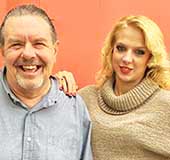
 Wikipedia
Commons photo
Jorge Enrique Jiménez Martínez, the well-known
Heredia artist, is known for his sculptures of plump
Costa Rican women.relationship would be strongest for women of low socioeconomic status because the protein leverage hypothesis should be most relevant to populations on low protein diets, but they found this relationship to be strongest for women of middle- and high-socioeconomic status. They found no relationship among women of low socioeconomic status. "One possible explanation for this unexpected finding is that women of low socioeconomic status cannot afford to continue eating until they reach the body's protein intake target," Bekelman said. According to the report, researchers were surprised to find that over half the women in the full sample did not meet their protein requirements, revealing a potential public health issue, especially because the protein deficit is among women of childbearing age. The cross-sectional study used a random sample of 135 women from San José whom researchers placed into one of three socioeconomic categories. Researchers interviewed the participants over a nine-month period to collect information on their body mass index and what they ate and drank. |
 |
| |
 |
| |
 |
| |
 |
| |
| You need to see Costa Rican tourism information HERE! |
|
|
|
|
|
|
|
Food |
|
| What we published this week: | Monday | Tuesday | Wednesday | Thursday | Friday | Earlier |
| The contents of this
Web site are copyrighted by Consultantes Río
Colorado S.A. 2017 and may not be reproduced
anywhere without permission. Abstracts and fair use are permitted. Check HERE for details |
||||||
A.M. Costa Rica's Fourth News page |
|
San
José, Costa
Rica,
Thursday, Feb.
9, 2017, Vol.
17, No. 29
|
||||||
|
|
|
|
|
|
Food |
|
| Scientist
unravel the secrets of quinoa and hope to make
improvements |
|
|
By the King Abdullah University
of Science & Technology news staff Quinoa could hold the key to feeding the world's growing population because it can thrive in harsh environments and grows well on poor quality, marginal lands. Researchers have now completed the first high-quality sequence of the Chenopodium quinoa genome, and they have begun pinpointing genes that could be manipulated to change the way the plant matures and produces food. This project brought together 33 researchers from four continents, including 20 people from seven research groups to produce an article that will be published in Nature and will be featured on the cover of the Feb. 16 issue. "Quinoa was the staple grain' that fueled the ancient Andean civilizations, but the crop was marginalized when the Spanish arrived in South America and has only recently been revived as a new crop of global interest," said Mark Tester, who led the project team. "This means quinoa has never been fully domesticated or bred to its full potential even though it provides a more balanced source of nutrients for humans than cereals." He is a professor of plant science at the King Abdullah University of Science & Technology in Saudi Arabia. As a first step toward improving understanding of how quinoa grows, matures and produces seeds, Tester's team decided to sequence its genome. They used a combination of techniques, including cutting-edge sequencing technologies and genetic mapping, to piece together full chromosomes of C. quinoa. Their resulting genome is the highest-quality quinoa sequence to date, and it is already yielding insights into the plant's traits and growth mechanisms. "One problem with quinoa is that the plant naturally produces bitter-tasting seeds," said Tester. "This is due to the accumulation of chemical compounds called saponins in the |
 King
Abdullah University of Science &
Technology/Linda Polik
The fabled quinoa plantseeds. We've pinpointed one of the genes that we believe controls the production of saponins in quinoa, which would facilitate the breeding of plants without saponins to make the seeds taste sweeter." There is immense potential for the genome sequence to help scientists understand quinoa and therefore modify it for more widespread, commercial use. For example, breeders could use this genetic information to learn how to control plant size to favor shorter, stockier plants that are less likely to fall over. These more stable plants could support bigger seed heads and be grown closer together in large fields. "We already know that the quinoa plant family is incredibly resilient," said Tester. "It can grow in poor soils, salty soils and at high altitudes. It really is a very tough plant. Quinoa could provide a healthy, nutritious food source for the world using land and water that currently cannot be used, and our new genome takes us one step closer to that goal." |
Here's reasonable
medical care
Costa Rica's world class medical specialists are at your command. Get the top care for much less than U.S. prices. It is really a great way to spend a vacation. See our list of recommended professionals HERE!amcr-prom
|
|
||||||||||||||||||||||||||||||||||
|
|
|
|
|
|
|
Food |
|
| What we published this week: | Monday | Tuesday | Wednesday | Thursday | Friday | Earlier |
| The
contents
of
this Web site are copyrighted by Consultantes Río
Colorado S.A. 2016 and may not be reproduced anywhere
without permission. Abstracts and fair use are permitted. Check HERE for details |
||||||
|
A.M. Costa Rica's Fifth news page |
 |
|
|
San
José, Costa
Rica,
Thursday, Feb.
9, 2017, Vol.
17, No. 29
|
|||||||
|
|
|
|
|
|
Food |
|
|
|
|
Sessions wins
confirmation
from a divided U.S. Senate By the A.M. Costa Rica wire
services
The U.S. Senate confirmed President Donald Trump’s attorney general nominee Wednesday after more than a day of heated debate and a dramatic confrontation that led to the suspension of a prominent Democrat from floor deliberations. The 52-47 vote made Jeff Sessions, a long-serving Republican senator from Alabama, America’s top law enforcement officer and the sixth Trump cabinet pick approved in the fledgling administration. "This is a special honor," Sessions told his colleagues in a farewell speech after the vote. "I hope and pray I can be worthy of the trust you've given me. I'll do my best to do that." “We all know him to be a man of deep integrity, a man of his word, and a man committed to fairness, to justice, and most importantly to the rule of law,” said the chairman of the Senate Judiciary Committee, Republican Chuck Grassley of Iowa. An early and ardent Trump supporter during last year’s tumultuous campaign, Sessions pledged to put the law above politics as attorney general. “You simply have to help the president do things that he might desire in a lawful way, and have to be able to say no,” the nominee said at his confirmation hearing last month. Ahead of Wednesday’s vote, Democrats said they were unconvinced. “We have a president who wants to bring back torture,” said Sen. Dianne Feinstein, the top Democrat on the Judiciary Committee. “And we have a nominee for attorney general who is anything but independent. He was part and parcel of the Trump campaign apparatus. “There’s attack after attack after attack on minorities, on immigrants, on Muslims, on women, on his critics, on judges, on the press, and even on truth itself,” Sen. Feinstein added. “Now more than ever, it is important that the Department of Justice be independent from the president.” Republicans noted that Trump is hardly the first president to name backers and close confidants to his administration. “This idea that Senator Sessions was close to President Trump during the campaign and that’s somehow a disqualifier makes absolutely zero sense to me,” said Sen. Lindsey Graham, a Republican of South Carolina. “That’s exactly the kind of people you’d expect a president to pick: someone who has been on their team, someone they know.” Sessions served in the Senate for 20 years and also was attorney general for the state of Alabama as well as a federal prosecutor. In 1986, then-president Ronald Reagan tapped him to be a federal judge, but the Senate voted down his nomination amid allegations of racial bias in his past. Echoes of that debate more than 30 years ago reverberated Tuesday, when Sen. Elizabeth Warren, a Democrat of Massachusetts, read a letter from the late wife of slain civil rights leader Martin Luther King Jr. opposing Sessions for the federal bench. “Mr. Sessions ignored allegations of similar behavior by whites, choosing instead to chill the exercise of the franchise by blacks,’” Sen. Warren said, reading the letter word-for-word. Senate Majority Leader Mitch McConnell, a Kentucky Republican, interrupted her remarks moments later. “The senator has impugned the motives and conduct of our colleague from Alabama,” McConnell said. “Objection is heard, the senator will take her seat,” said the presiding officer, Sen. Steve Daines of Montana, another Republican. Sen. Warren challenged the finding, forcing a vote on the dispute by the full Senate. A unified Republican caucus voted that she broke Senate rules on decorum and therefore was barred from speaking further on the nominee. “We have rules around here, and the rules are very clear that you don’t impugn another senator,” said Idaho Republican James Risch. “Let us not go down this path,” said Sen. Patrick Leahy of Vermont. “It’s not good for democracy. And it sure as heck is not good for free speech.” Republicans stood their ground, saying America benefits when congressional debate is free of personal attacks. Coalition of Jews and Muslims praise Trump’s anti-hate vow By the A.M. Costa Rica wire
services
A member of a new U.S. coalition of prominent American Jews and Muslims says President Donald Trump’s administration has expressed a strong commitment to fight hate crimes against religious minorities, a pledge that earned the president rare praise from leaders of the two minority groups. Muslim-Jewish Advisory Council member Robert Silverman, who is Jewish, told a Persian show that his group received assurances of the civil rights commitment from a very senior member of the new U.S. administration at a meeting in Washington Feb. 1. The 38-member coalition, formed last November, aims to coordinate a strategy to fight anti-Muslim bigotry and anti-Semitism in the United States and to protect the rights of the country’s other religious minorities. The body comprises 19 American Muslim and 19 American Jewish community and religious leaders, business executives and former U.S. lawmakers. The council members held their closed-door meeting with the Trump administration official as part of their first Washington advocacy day, which also included talks with current members of Congress from both the Republican and Democratic parties. The council’s main priority was to seek federal action to reverse an increase in U.S. hate crimes against Jews and Muslims, action that it says should include federal prosecutions of such crimes. The latest Federal Bureau of Investigation data on U.S. hate crimes, released in November, showed that anti-Muslim crimes rose 67 percent, to 257 incidents, from 2014 to 2015; anti-Jewish crimes rose 9 percent to 664 incidents during the same period. In a follow-up telephone interview, Silverman, who also serves as director of Muslim-Jewish relations for the American Jewish Committee, said he was extremely reassured by the council’s recent meeting with the Trump appointee. Mexican wall under design, U.S. president tells chiefs By the A.M. Costa Rica wire
services
U.S. President Donald Trump said Wednesday the design of a wall to stem the flow of illegal immigrants into the U.S. from Mexico is underway. “The wall is getting designed right now. We will have a wall. It will be a great wall and it will do a lot of — will be a big help,” Trump said without offering specifics during a speech in Washington before the Major Cities Chiefs Police Association. Trump repeated his vow to build a wall along the U.S. border with Mexico as a way to “stop the drugs from pouring into our country” and cited Israel as a country that has successfully erected walls along its borders. “Do walls work? Just ask Israel. They work if it's properly done,” Trump said. Israel began building a system of barriers in 2002, during the peak of the second Palestinian uprising that saw suicide bombers detonating explosives in public places in Israeli cities. After a series of terrorist attacks, Israel built a barrier along and inside the West Bank that was designed to regulate the entrance of Palestinians into Israel. Israel has also erected fences along the borders it shares with Egypt and Lebanon, and along its boundary with the Gaza Strip. There has been a significant drop in terrorist attacks by West Bank Palestinians since March 2002. And while Israeli security officials credit the barriers for the decline, attacks continued to drop when the second Palestinian uprising weakened in 2004 and the militant group Hamas imposed a moratorium on suicide bombings. The Israeli military also regularly arrests suspected militants on the other side of the West Bank barrier and the country continues to benefit from security support from the Western-supported Palestinian Authority. Last week, Israeli Prime Minister Benjamin Netanyahu tweeted in support of Trump's proposed wall. “President Trump is right. I built a wall along Israel's southern border. It stopped illegal immigration. Great success. Great idea,” Netanyahu wrote. An Israeli company that helped construct Israel's West Bank barrier is reportedly seeking to build the wall along the U.S.-Mexican border for the Trump administration. Magal Security Systems described its high-tech border fence at a Jan. 31 border security conference in northern Virginia that was attended by officials from the U.S. Department of Homeland Security, according to Bloomberg News. Ban of non-profits in politics may be a battle in the making By the A.M. Costa Rica wire
services
During last week’s National Prayer Breakfast, President Donald Trump vowed to destroy the Johnson Amendment, a 62-year-old provision in the U.S. tax code that prevents certain tax-exempt organizations, secular and religious, from political campaigning. His remarks have sparked debate over the line between church and state in America. The U.S. Internal Revenue Service grants tax-exempt status to religious, charitable, scientific and other non-profit organizations. “The theory of tax exemption for a broad range of organizations in the U.S. is that they have a public function, that they serve the good of the community at large,” said Barry Lynn, executive director of Americans United for Separation of Church and State, a Washington, D.C.-based religious liberty watchdog group. “And religious institutions have been included within that range of good, non-governmental agencies that are deserving of a tax exemption.” Many of these groups rely heavily on donations from private individuals and foundations. Being designated tax-exempt by the IRS lends them legitimacy, increasing the confidence of would-be donors, who are allowed to deduct contributions to tax-exempt groups from their annual tax returns. The Johnson Amendment was a change to the tax code introduced by then-sen. Lyndon B. Johnson in 1954 in an effort to disempower two secular, tax-exempt nonprofit groups that were spending big money to block his re-election. The amended tax law prohibits tax-exempt nonprofit organizations from participating in political campaigning. That means they cannot collect money for political campaigns or tell members who to support or oppose in elections. They may, however, speak freely about political matters outside of their organizations. “The amendment was based on the flagrant violation of the principle that charities and foundations ought to serve the public good and not be indistinguishable from a political committee or a partisan party apparatus,” said Lynn. The Johnson Amendment does not specifically target churches or religious organizations, but they are among the amendment’s most vocal opponents. “What we’ve seen in the last 35 or so years, basically since the 1980 election, is that the traditional attitude of evangelical churches, something known as quietism, that is, staying out of politics, changed,” said Michael Dorf, an expert in constitutional law and professor at Cornell Law School. “And the emergence of the Religious Right has meant that people on the conservative side of the American ideological spectrum now perceive the Johnson Amendment to be an impediment to political activity by people that are most likely to support their causes.” Conservative Christian groups argue the Johnson Amendment violates the Constitution. “The First Amendment of our Bill of Rights, the first right granted expressively and clearly by our founding fathers was the right to the free exercise of religion, and I think it’s important to note that it’s not just somewhere in the Bill of Rights, it’s at the beginning, the first right to be protected,” said Jordan Sekulow, executive director of the American Center for Law & Justice, a conservative, Christian-based social activist organization that opposes the Johnson Amendment. He argues that the Constitution does not specifically call for separation of church and state, and the two entities have been intertwined since the time of the nation’s founding. “Really, at the heart of it, it’s a restriction of free speech. What it means is that from the pulpit, your pastor cannot tell you who to vote for, even if everybody in the church is asking the pastor who to vote for,” said Sekulow. Repealing the Johnson Amendment, he argues, would not suddenly turn all churches into political action groups, but it would allow clergy to speak openly about political and social issues that affect people of faith. But some analysts say the debate is, at its heart, more about money than anything else, as repealing the Johnson Amendment would allow religious groups to step into the political arena. As the law stands now, individuals may not deduct from their tax returns any donations to politicians or political campaign groups. If the Johnson Amendment were repealed, though, it would open a new loophole in the law, encouraging individuals to make political contributions through religious groups and realizing tax benefits for doing so. U.S. citizen wins the election as head of troubled Somalia By the A.M. Costa Rica wire
services
Somali lawmakers elected a new president Wednesday, choosing a former prime minister who is a dual U.S.-Somali citizen. The new president, Mohamed Abdullahi Mohamed, better known as Farmajo, was declared the winner after two rounds of voting by the Somali parliament in Mogadishu. Farmajo won the largest share of votes in the second round, far outdistancing incumbent leader Hassan Sheikh Mohamud and former president Sheikh Sharif Sheikh Ahmed. Mohamud conceded defeat after the vote count, and the crowd inside a venue at Mogadishu's international airport erupted into cheers. Witnesses say celebratory gunfire broke out in the streets of the Somali capital. The new president was quickly sworn in and pledged to improve security, fight corruption and assist the poor. Farmajo, 54, has spent much of his adult life in the city of Buffalo, New York, where he raised a family and held various jobs in the the New York state government. But he maintained contact with Somali politics and served eight months as Somali prime minister during 2010 and 2011, at the height of the insurgency by Islamist militant group al-Shabab.  U.S.
Fish and Wildlife Service photo
Polar bears bask in the Alaska winter sun.Jet streams
getting the blame
for unusually warm Arctic
By the A.M. Costa Rica wire services
For the second consecutive year, the northern reaches of the planet are experiencing unprecedented waves of warm air. And climate researchers say they've never seen anything like it. One expert is Mark Serreze, the director of the National Snow and Ice Data Center, based in Denver, Colorado. The center does all kinds of things, from helping the Navy spot and avoid sea ice, to monitoring the temperatures, weather systems and extent of the sea ice covering the Arctic and Antarctic throughout the year. The weather pattern of the past two years, according to Serreze, is "unprecedented in my memory." The unprecedented part is what Serreze calls "pulses of extremely warm air over the Ocean, extreme to the point where at the North Pole it's getting near to the freezing point." The cause is "an unusual jet stream pattern that has helped to guide lots of very strong storms into the Arctic, coming in from the Atlantic." Jet streams are narrow bands of air that move extremely fast around the globe. The polar jets are the strongest, circling the globe between nine and 12 kilometers above sea level. They can move at more than 100 kilometers per hour. This winter and last, those polar jets are doing what they always do, picking up a lot of hot moist air from the tropics and pushing it up into the arctic. That's how weather works, Serreze says, moving warm, moist energetic air from the lower latitudes near the equator to higher latitudes at the poles to cool down and release all that energy. The difference here, he says, is the Arctic experiencing an unusually strong jet stream, combined with unusually strong storms. That combination is creating these pulses of very warm weather. Serreze says the research community is now trying to decide what is going on, and theories generally are falling into two camps. One camp argues that this is just one expression of natural variability. Serreze says this may be a weather pattern like El Niño "where weather patterns get stuck for a while." If that's the case, this unusual phenomenon may persist for a few years, and then fade away, to return from time to time. The other camp is arguing that "the lack of sea ice in critical areas is what is driving this unusual jet stream pattern . . . ." If that scenario is correct, Serreze says it is worrisome. If a lack of sea ice is causing this jet stream, and the jet stream is raising temperatures, then it becomes a negative feedback loop. Serreze is quick to point out that there's no real consensus on the cause, because "the reality is that we are seeing these changes unfolding faster than we have the ability to understand them." He also points out that even with these pulses of warm air, it is still really cold up North, and plenty of ice is still forming, but it's not as much and not as thick as usual. That means we "start next melt season with thinner ice," that is easier to melt. "We could be setting ourselves up for a very, very low ice flow . . . and it could hasten an ice-free Arctic Ocean," Serreze said. The timing on that is unclear, he says, though the world could be looking at an ice-free Arctic in the summer months, well before 2100, and perhaps in the next 20 to 30 years. |
|
||||||||||||||||||||||||||||||||||||||||||||||||||||
|
|
|
|
|
|
|
Food |
|
| What we published this week: | Monday | Tuesday | Wednesday | Thursday | Friday | Earlier |
| The
contents
of
this Web site are copyrighted by Consultantes Río
Colorado S.A. 2017 and may not be reproduced anywhere
without permission. Abstracts and fair use are permitted. Check HERE for details |
||||||
| A.M. Costa Rica sixth news page |
|
San
José, Costa
Rica,
Thursday, Feb.
9, 2017, Vol.
17, No. 29
|
|||||||||
|
|
|
|
|
|
Food |
|
|||
|
The bombeta was not a
bomb
By the A.M. Costa Rica staff
The thought probably has occurred at least once to every motorist inconvenienced by construction on the Río Virilla bridge, but it seems that officials are under enough stress to expect threats. So when workmen came across a paper-wrapped package with a fuse Friday, the higher command seemed to panic. The Ministerio de Obras Públicas y Transportes finally issued a statement Wednesday that the package would not cause any damage to the bridge, known as the Platina. Later, the director of Inteligencia y Seguridad Nacional, Mariano Figueres, confirmed that the device was basically a big firecracker made from black power. This is the type of device that is used to kick off church festivals early in the morning. Such devices are called bombetas. They are not to be confused with professional fireworks and certainly not with dynamite, which is in an entirely different category. Officials now are saying the device was left as a joke, but it also could have just fallen from a passing vehicle. The bridge has been under construction for nearly two weeks, and traffic has been reduced to two lanes. Police pursuit ends in presumed suicide By the A.M. Costa Rica staff
Law officers say they caught up with a gunman after a chase Wednesday and that the man killed himself to end a standoff. The case began in Manuel Antonio on the central Pacific coast when a man fired shots through a window at a sleeping woman about 1:30 a.m. The woman suffered bullet wounds to the leg. Investigators attributed this to a romantic dispute. The gunman fled, but Fuerza Pública officers spotted a suspect in a taxi near Pérez Zeledón. The man fled and took over another taxi at gunpoint before finally being stopped by police. One officer suffered a bullet wound. That is when the standoff began. The dead man was identified by the last name of Mesén, |
| Costa
Rican
News |
AMCostaRicaArchives.com |
Retire NOW
in Costa Rica |
CostaRicaReport.com |
| Fine
Dining
in
Costa Rica |
The
CAFTA Report |
Fish
fabulous Costa Rica |
|
|
|
|
|
|
|
Food |
|
| What we published this week: | Monday | Tuesday | Wednesday | Thursday | Friday | Earlier |
| The
contents
of
this Web site are copyrighted by Consultantes Río
Colorado S.A. 2017 and may not be reproduced anywhere
without permission. Abstracts and fair use are permitted. Check HERE for details |
||||||
From Page 7:
|
||||