|
|
A.M. Costa Rica
Your daily English-language news source Monday through Friday |
||
 |
 |
 |
|
|
 |
||||||||||||||||||||||
|
|
|||||||||||||||||||||
 |
||||||||||||||||||||||
 |
||||||||||||||||||||||
|
|
|||||||||||||||||||||
 |
| What we published this week: | Monday | Tuesday | Wednesday | Thursday | Friday | Earlier |
|
|
|
|
|
|
|
Food |
|
Jo
Stuart |
|
Abstracts and fair use are permitted. Check HERE for more details |
 |
| A.M. Costa Rica's Second news page | |||||||||
| San José, Costa Rica, Monday, Jan. 28, 2013, Vol. 13, No. 19 | |||||||||
|
|
|
|
|
|
|
Food |
|
 |
 |
|
of turtles in the Pacific By
the A.M. Costa Rica staff
The Sistema Nacional de Áreas de Conservación has filed a formal complaint over the deaths of turtles and other marine creatures off the coast of southwest Costa Rica. The complaint was to the Tribunal Ambiental Administrativo. The executive board of the Sistema Nacional de Áreas de Conservación was the complainant Friday, four days after the Servico Nacional de Guardacoastas found dead turtles floating in the Pacific. The agency said it was seeking a joint investigation with the Tribunal Ambiental. A press release announcing the complaint did not report the scope of the deaths, although it did report that other sea creatures were found dead. Residents of the area and environmentalists blame illegal fishing. There are fishing boats and shrimp trawlers offshore. The Sistema Nacional de Áreas de Conservación noted that the coast guard retrieved some dead turtles for analysis but said that the results have not yet been reported. The autopsies are being done by the Centro de Conservación de la Tortuga Marina de Osa. A.M. Costa Rica has been reporting on the deaths of turtles since Wednesday morning. The Servicio Nacional de Salud Animal also is investigating. Four in Playas del Coco held in drug allegations By
the A.M. Costa Rica staff
Anti-drug police have detained four persons in twin raids at homes in Playas del Coco in Guanacaste. Two men and two women were held. The Ministerio de Gobernación, Policía y Seguridad Pública said the raids were the result of eight complaints at the Pacific beach town. The two men have prior contact with the judicial system in matters of drug use, officers said. Confiscated were 226 doses of crack cocaine, five hits of cocaine, marijuana and money believed to have come from illegal sales. Three quakes take place in southern part of country By
the A.M. Costa Rica staff
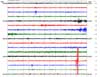
Sunday it was the southern part of the country near the border with Panamá that experienced quakes. The Laboratorio de Ingenieria Sismica reported a 4.0 magnitude quake at 3:28 a.m. some 12.9 kilometers (eight miles) northeast of San Vito de Coto Brus. At 11:34 a.m. a 3.6 quake took place, when the epicenter was estimated to be 12.8 kilometers west northwest of Laurel de Corredores. At 5:13 p.m. there was a 3.5 quake reported with an epicenter 6.9 kilometers (about four miles) north of San Vito. Venezuela seems to block online paper about Cuba Special
to A.M. Costa Rica
The Inter American Press Association has questioned the blockade of the online newspaper Diario de Cuba in Venezuela, calling it a suspicious act of censorship that restricts the right of the people to access differing sources of information. The newspaper, http://www.diariodecuba.com, mainly dedicated to covering from Spain what occurs in Cuba of international interest, reported on its Web site that since Jan. 14 the users of Venezuela’s chief national telecommunications company have had difficulty in accessing the media outlet. Clients of other privately-owned Internet provider companies also warned the newspaper of the problem. Claudio Paolillo described as highly suspicious “the blockade of this news media outlet which has been reporting, through opinion pieces and news items, on the situation regarding Venezuelan politics and the health of President Hugo Chávez.” He is chairman of the journalism organization's Committee on Freedom of the Press. Paolillo, editor of the Montevideo, Uruguay, weekly Búsqueda, added, “It was curious to learn what are the underlying reasons of the state and privately owned Internet service companies from blocking access to Diario de Cuba,” as there has been no awareness of any initiation of administrative or legal action in Venezuela against this newspaper.”
|
|||||||||||||||||||||||||||||||||||||||||||||||||||
 |
||||||||||||||||||||||||||||||||||||||||||||||||||||
|
|
|
|
|
|
|
Food |
|
| What we published this week: | Monday | Tuesday | Wednesday | Thursday | Friday | Earlier |
| The contents of this page and this Web site are copyrighted by Consultantes Río Colorado S.A. 2013 and may not be reproduced anywhere without permission. Abstracts and fair use are permitted. Check HERE for details | ||||||
A.M. Costa Rica Third News Page |
Your ad could be here |
| San José, Costa Rica, Monday, Jan. 28, 2013, Vol. 13, No. 19 | |
|
|
|
|
|
|
|
Food |
|
| Humble dung beetle found to be a
celestial navigator |
|
|
By
the A.M. Costa Rica staff
The next time that expats are outside finding their direction by the stars, they might not be alone. Researchers at a South African university report that dung beetles also use the Milky Way to ensure they keep rolling their balls in a straight line and don’t circle back to competitors at the dung pile. Costa Rica has an incredible 175 species of dung beetles, according to a research report by the Instituto Nacional de Biodiversidad. The beetles, Scarabeidae, are the little insects that roll dung into round balls. They also are known as scarab beetles, and some species were sacred in ancient Egypt. Scientists from South Africa and Sweden have published findings showing the link between dung beetles and the spray of stars which comprises our galaxy, according to Wit University in Johannesburg, South Africa. "Although their eyes are too weak to distinguish individual constellations, dung beetles use the gradient of light to dark provided by the Milky Way to ensure they keep rolling their balls in a straight line and don’t circle back to competitors at the dung pile," said the university in a description of the research. Marcus Byrne of the university and his team previously proved that dung beetles use the sun, the moon and polarized light for orientation, the Wit summary noted, adding that in their experiments, they gave the beetles caps which blocked light from reaching their eyes. The team also discovered that the beetles climb on top of their dung balls to perform an orientation dance during which they locate light sources to use for orientation, it said. Further experiments, conducted under the simulated night sky of the Wits Planetarium, have shown that the beetles also use |
 Wit
University/Marcus Byrne
Dung beetle wears a small
cap that researchers used to blockout starlight. the band of stars that make up the Milky Way. The scientists suspect the beetles have a hierarchy of preference when it comes to available light sources, according to the university. So if the moon and the Milky Way are visible at the same time, the beetles probably use one rather than the other, it noted. A few other animals have been proven to use stars for orientation, but the dung beetle is the first animal proven to use the galaxy, the university said. The Instituto Nacional de Biodiversidad has a collection of a number of dung beetle specimens. The insects are monitored closely because they are indications of biodiversity and changes brought about by climate. |
| Arrest made in case of online money
transfers from state bank |
|
|
By
the A.M. Costa Rica staff
Judicial investigators have made an arrest in what appears to be the theft of money involving online financial transactions. The 36-year-old man faces allegations stemming from complaints by two men and a women. The Judicial Investigating Organization said the first word of the possible crime came from workers at a private bank who noticed something amiss in their accounts. The bank workers said that three incoming transactions that took place online seemed suspicious. |
Money was transferred to the private
bank from three accounts at a state bank, judicial agents said. The workers at the private bank were able to freeze activity in the suspicious account. Agents detained the suspect when he showed up at the office of the private bank in Desamparados to complain that he could not get money out of his account, the Judicial Investigating Organization said. Agents said that the victims appear to have been scammed by a fake Web page purporting to be that of the state bank. |
 |
| You need to see Costa Rican tourism information HERE! |
|
|
|
|
|
|
|
Food |
|
| What we published this week: | Monday | Tuesday | Wednesday | Thursday | Friday | Earlier |
| The contents of this page and this Web site are copyrighted by Consultantes Río Colorado S.A. 2013 and may not be reproduced anywhere without permission. Abstracts and fair use are permitted. Check HERE for details | ||||||
 |
|
||||
| A.M. Costa Rica's Fourth News page | |||||
| San José, Costa Rica, Monday, Jan. 28, 2013, Vol. 13, No. 19 | |||||
|
|
|
|
|
|
|
Food |
|
 |
| Constitutional court declines to decide
extradition appeal |
|
|
By
the A.M. Costa Rica staff
The Sala IV constitutional court has sidestepped a unique argument raised to keep a U.S. citizen from being extradited on a fraud charge. The court basically said that the arguments should be decided in a criminal court. Lawyer Arcelio Hernández Mussio argued that his client was involved in telemarketing here and that he should face justice in Costa Rica, not the United States. The client is Gregory Scott Garrett, also known as John White. He worked with USA Beverages Inc., Twin Peaks Gourmet Coffee, Inc., and a string of other companies that took money from U.S. citizens with the promise that they would be able to start a vending business. The scams were run out of Escazú, Santa Ana and also in offices in the Sabana Office Center, although the scammers gave would-be customers the impression that the businesses were located in the United States, the U.S. Justice Department has said. |
Earlier the lawyer said that what
Garrett did here is not a crime under Costa Rican law. At best it is a
civil violation, he said. A summary of the Sala IV decision came from the Poder Judicial Friday. Under a new policy, the Poder Judicial did not name the persons involved in the case but Hernández confirmed that the decision involved Garrett. "Basically the constitutional court did not want to give an opinion about my argument that the facts for which extradition was granted took place in Costa Rica, and therefore would not qualify for extradition according to article 2 of the extradition law, which requires that the acts for which extradition is requested take place outside of Costa Rica, with those exact words," said the lawyer. The U.S. Justice Department said that the long-running business opportunity frauds frequently preyed on elderly U.S. citizens. Eight other persons have been convicted in the United States because they worked in the telemarketing operation here. Hernández also argued in the past that Garrett was just an employee and not a principal of the scheme. |
| Judicial agents detain vendor in case of
Alajuela gas explosion |
|
|
By
the A.M. Costa Rica staff
Judicial agents have detained the man who sold a tank of liquid petroleum gas that exploded a week ago at a small eating place in Barrio el Carmen in Alajuela. Six persons, including a 3-year-old suffered serious burns and other injuries in the blast. Subsequently three of the women died. Judicial agents and fire fighters began an investigation to see |
what had taken place. The Cuerpo de
Bomberos said later Jan, 21 that the tank containing the gas appeared
to have ruptured. The suspect in the case is a 62-year-old man who sells the gas in tanks. He was detained by judicial agents as he drove on a delivery route Friday afternoon. Agents said that some of the tanks the man was carrying had been damaged and some were rusty. Fire fighters have warned about using tanks that have dents or rust for fear of a leak. |
| Fragile and timid recover depends on
leaders IMF chief says |
|
|
By
the A.M. Costa Rica wire services
International financial leaders have wrapped up the World Economic Forum meeting in Switzerland with warnings that much remains to be done to stabilize the global economy. International Monetary Fund chief Christine Lagarde, speaking Saturday in Davos, said the fund outlook for a fragile and timid recovery depends on leaders in the top economies of Europe, the United States and Japan making the right decisions. She warned against complacency among the 17 European nations using the euro, while noting that two major European economies, Italy and Spain, have survived the worst of the European crisis. "And clearly, two major players have recovered significantly in terms of access to financial markets and financing -- Italy and Spain -- one of which, the former, will be facing a political election come February. So it is not a stable landscape |
and walk in the park for the year
2013, but it's a lot better than what they have had in 2012." Ms. Lagarde also voiced interest in dramatic policy moves by Japan this week to stimulate its stalled economy by doubling its inflation target to 2 percent — a move similar to that undertaken in recent years by the U.S. central bank, the Federal Reserve. "We are very interested by those policies. We certainly would like them to be complemented just as in the United States with a mid-term plan that includes how the debt will be reduced going forward." Japan has so far brushed aside criticism that aggressive Bank of Japan policy changes could trigger competitive currency devaluations. Saturday, Japan's minister of economic and fiscal policy, Akira Amari, defended the inflation goals and denied the existence of a deliberate policy to drive down the value of the yen. He said the focus of the new policies is on ending deflation and said it is up to markets to decide exchange rates. |
|
|
|
|
|
|
|
Food |
|
| What we published this week: | Monday | Tuesday | Wednesday | Thursday | Friday | Earlier |
| The contents of this page and this Web site are copyrighted by Consultantes Río Colorado S.A. 2013 and may not be reproduced anywhere without permission. Abstracts and fair use are permitted. Check HERE for details | ||||||
| A.M. Costa
Rica's Fifth news page |
 |
||||||||
| San José, Costa Rica, Monday, Jan. 28, 2013, Vol. 13, No. 19 | |||||||||
|
|
|
|
|
|
|
Food |
|
 |
|
|
| Obama
administration mounts firearms control campaign By
the A.M. Costa Rica wire services
The Obama administration is once again going to the American people to win support for one of its initiatives. The president and other White House officials are mounting a public campaign for passage of gun control legislation, evidenced by U.S. Education Secretary Arne Duncan's appearance at a rally in Washington Saturday. The march for stricter gun control laws concluded with a gathering at the Washington Monument, where Duncan called on Congress to approve President Barack Obama's initiatives to curb gun violence. “We will do everything in our power to make sure that we pass legislation that makes our children and our families, our communities safer,” Duncan told the crowd. He said the administration’s agenda is focused on gun safety, not on taking away Americans’ constitutional right to own guns. The education secretary’s speech at the rally was part of the White House strategy to take its case to the public. Vice President Joe Biden, whose recommendations formed the basis of Obama’s gun initiative, has made several public appearances in the past few days on behalf of the effort. Friday, Biden held a discussion of the issue with private citizens and local officials in Richmond, Virginia. The vice president also appeared on the Internet for what was called a hangout to discuss gun violence. “If we can do something that, even if it only impacts on saving one life of a child or an individual out there, it is worth doing, but I think we can do a lot more than that.” One piece of the administration’s agenda is a proposal to ban military-style assault weapons, like the ones used to kill 20 children and six adults at a school in Connecticut in December. Sen. Dianne Feinstein, a Democrat, has introduced a bill to ban assault weapons. “Weapons designed originally for the military to kill large numbers of people in close combat are replicated for civilian use," said Ms. Feinstein. "They fall into the hands, one way or another, of grievance-killers, of gangs, of those who are mentally unstable or ill.” Lawmakers, including Ms. Feinstein, have conceded that passing gun control legislation will be difficult. Most Republicans in Congress, and even some Democrats, oppose it. Many lawmakers support the powerful gun rights organization, the National Rifle Association. Wayne LaPierre, who leads the NRA, recently said law-abiding citizens should be allowed to have as much firepower as criminals. “We believe we deserve and have every right to the same level of freedom that our government leaders keep for themselves," LaPierre said. "And the same capabilities and the same technologies that criminals use to prey upon us and our families. That means we believe in our right to defend ourselves and our families with semiautomatic firearms technology.” Despite the difficult odds facing passage of an assault weapons ban, other administration initiatives to reduce gun violence stand a better chance of passage. Experts say proposals to strengthen background check requirements, better track and regulate the sale of guns and keep weapons away from the mentally ill are popular with the public. The Senate Judiciary Committee holds its first hearing on gun violence next week. Cuba hooks its Internet to a cable and the world By
the A.M. Costa Rica wire services
The Cuban government announced it is conducting tests on an undersea fiber-optic cable connecting Cuba with Venezuela and Jamaica and, through them, the world. The report in the state newspaper Granma said the ALBA-1 cable, in the works since 2007, has been operational since August when Cuba began studying voice traffic related to international telephony. Then, this month, it started testing the quality of Internet traffic on the system. Until now, Cuba has only had satellite-based Internet largely because of restrictions under the 50-year-old U.S. trade embargo. The global Internet monitoring group Renesys first broke news of the cable’s activation in a blog post that sparked an international buzz and seemingly forced Granma to confirm the report. Doug Madory of Renesys says he has sifted through Cuba’s Internet traffic for the past six years and has never seen speeds like he’s seeing now. The latency, or lag time, is way down. “Now it’s down to sometimes below 200 miliseconds, which has never occurred in Cuba. Ever,” he said. That doesn’t mean Cubans will be streaming movies uninterrupted anytime soon. Madory says latency is still pretty high because of various factors, like antiquated equipment. And even if the speed improves further, that doesn’t mean access will. “How much this helps the people of Cuba is an entirely different matter,” Madory says. If you’re Cuban, you’re not allowed to get on the Internet without government permission. There’s a local intranet in schools and state-run computer centers, but connection to the World Wide Web is mostly limited to government officials. There are ways around the restrictions. Some government workers quietly pad their salaries by renting out time on their home computers, but the price is prohibitive for most Cubans. Immigration reform gains strength in both parties By
the A.M. Costa Rica wire services
A push for U.S. immigration reform and Senate action on President Barack Obama’s cabinet picks highlight what promises to be a busy week in U.S. politics. President Obama travels Tuesday to Las Vegas, Nevada, to rally public support for reforming America’s oft-criticized immigration system. Nevada is one of many states with a substantial Hispanic population that overwhelmingly backed Obama’s re-election last year. The president restated his commitment to immigration reform in his inaugural address last week. “Our journey is not complete until we find a better way to welcome the striving, hopeful immigrants who still see America as a land of opportunity, until bright young students and engineers are enlisted in our workforce rather than expelled from our country," he said. U.S. lawmakers are working to forge a bipartisan bill that would provide a path to legalization for millions of foreign nationals who entered the United States illegally, and, at the same time, strengthen U.S. border security. Sen. John McCain, a Republican, said, “We can not go on forever with 11 million people living in this country in the shadows in an illegal status. We cannot forever have children who were born here, who were brought here by their parents when they were small children to live in the shadows, as well. So I think the time is right.” Also, this week, the Senate is expected to vote overwhelmingly to confirm one of its own, Sen. John Kerry, as America’s top diplomat. Kerry would succeed departing Secretary of State Hillary Clinton. And, the Senate will begin formal consideration of a more-controversial Cabinet pick: President Obama’s nominee for Secretary of Defense, former Republican Senator Chuck Hagel. |
|
|
|
|
|
|
|
|
Food |
|
| What we published this week: | Monday | Tuesday | Wednesday | Thursday | Friday | Earlier |
| The contents of this page and this Web site are copyrighted by Consultantes Río Colorado S.A. 2013 and may not be reproduced anywhere without permission. Abstracts and fair use are permitted. Check HERE for details | ||||||
| A.M. Costa
Rica's sixth news page |
|
||||||||
| San José, Costa Rica, Monday, Jan. 28, 2013, Vol. 13, No. 19 | |||||||||
|
|
|
|
|
|
|
Food |
|
 |
Latin America news |
 Casa Presdiencial photo
President Chinchilla chats with
Raúl CastroPresident
Chinchilla meets
with Cuba's Raúl Castro By
the A.M. Costa Rica staff
President Laura Chinchilla met with Cuba's president, Raúl Castro Sunday during a gathering of national leaders in Santiago, Chile. The meeting was historic because Costa Rica has spent decades without diplomatic relations with Communist Cuba. Former president Óscar Arias Sánchez renewed relations March 18, 2009. Foreign minister Enrique Castillo visited the island nation earlier this month. Casa Presidencial said the meeting involved discussion over education, culture, health and environment. Raúl Castro is the brother of Fidel Castro. Cuba will preside at this year's meeting of the Cumbre de la Comunidad de Estados Latinoamericanos y el Caribe, which met in Chile over the weekend. Costa Rica will preside in 2014. Costa Rica has been a refuge for many Cubans who fled their home country due to its repressive policies. Recently Cuba has said that its citizens could travel to other countries without any official permission. Of course, only the elite have the money for tourism. Correos makes investment in new vehicles and motos By
the A.M. Costa Rica staff
Correos de Costa Rica has purchased 15 panel trucks, three all-terrain vehicles and 50 motorcycles so employees can deliver the mail. The cost was about 200 million colons or about $400,000. The national postal service is under going a transformation to compensate for the loss of business to email and private carriers and economic problems related to the economic downturn. Correos delivered 30,000 U.S. passports on behalf of the U.S. Embassy last year in a program similar to the secure delivery of Costa Rican passports and cédulas for foreign residents. The postal service also started a program to let customers purchase items overseas for delivery in Costa Rica, something private firms have been doing for years. Within the country the postal service said it had a 26 percent increase in package deliveries. |
|
Latin
American news feeds are disabled on archived pages.
|
|
| Costa Rican News |
AMCostaRicaArchives.com |
Retire NOW in Costa Rica |
CostaRicaReport.com |
|
|
|
|
|
|
|
Food |
|
| What we published this week: | Monday | Tuesday | Wednesday | Thursday | Friday | Earlier |
| The contents of this page and this Web site are copyrighted by Consultantes Río Colorado S.A. 2013 and may not be reproduced anywhere without permission. Abstracts and fair use are permitted. Check HERE for details | ||||||
| A.M. Costa Rica Seventh Newspage |
 |
| San José, Costa Rica, Monday, Jan. 28, 2013, Vol. 13, No. 19 | |
|
leveling completely at the 2000 level By
the Research Council of Norway news service
Global warming less extreme than feared? Policy makers are attempting to contain global warming at less than 2 degrees C. New estimates from a Norwegian project on climate calculations indicate this target may be more attainable than many experts have feared. Internationally renowned climate researcher Caroline Leck of Stockholm University has evaluated the Norwegian project and is enthusiastic. “These results are truly sensational,” says Ms. Leck. “If confirmed by other studies, this could have far-reaching impacts on efforts to achieve the political targets for climate.” After Earth’s mean surface temperature climbed sharply through the 1990s, the increase has leveled off nearly completely at its 2000 level. Ocean warming also appears to have stabilized somewhat, despite the fact that carbon dioxide emissions and other human factors thought to contribute to global warming are still on the rise. It is the focus on this post-2000 trend that sets the Norwegian researchers’ calculations on global warming apart. Climate sensitivity is a measure of how much the global mean temperature is expected to rise if humans continue increasing emissions of greenhouse gases into the atmosphere. Carbon dioxide is the primary greenhouse gas emitted by human activity. A simple way to measure climate sensitivity is to calculate how much the mean air temperature will rise if the level of overall carbon dioxide emissions were to double compared to the world’s pre-industrialized level around the year 1750. If humans continue to emit greenhouse gases at the current rate, there is a risk of doubling that atmospheric carbon dioxide level in roughly 2050. A number of factors affect the formation of climate development. The complexity of the climate system is further compounded by a phenomenon known as feedback mechanisms, that is how factors such as clouds, evaporation, snow and ice mutually affect one another. Uncertainties about the overall results of feedback mechanisms make it very difficult to predict just how much of the rise in Earth’s mean surface temperature is due to manmade emissions. According to the Intergovernmental Panel on Climate Change, the climate sensitivity to double atmospheric carbon dioxide levels is probably between 2 and 4.5 degrees C, with the most probable being 3 degrees C of warming. In the Norwegian project, however, researchers have arrived at an estimate of 1.9 degrees C as the most likely level of warming. “In our project we have worked on finding out the overall effect of all known feedback mechanisms,” says project manager Terje Berntsen, who is a professor at the University of Oslo’s Department of Geosciences and a senior research fellow at the Center for International Climate and Environmental Research – Oslo. The project has received funding from the Research Council of Norway’s Large-scale Programme on Climate Change and its Impacts in Norway. “We used a method that enables us to view the entire earth as one giant laboratory where humankind has been conducting a collective experiment through our emissions of greenhouse gases and particulates, deforestation, and other activities that affect climate.” For their analysis, Berntsen and his colleagues entered all the factors contributing to human-induced climate forcings since 1750 into their model. In addition, they entered fluctuations in climate caused by natural factors such as volcanic eruptions and solar activity. They also entered measurements of temperatures taken in the air, on ground, and in the oceans. The researchers used a single climate model that repeated calculations millions of times in order to form a basis for statistical analysis. When the researchers applied their model and statistics to analyze temperature readings from the air and ocean for the period ending in 2000, they found that climate sensitivity to a doubling of atmospheric carbon dioxide concentration will most likely be 3.7 degrees C, which is somewhat higher than the intergovernmental panel prognosis. But the researchers were surprised when they entered temperatures and other data from the decade 2000-2010 into the model; climate sensitivity was greatly reduced to 1.9 degrees C. This maximum of 2.9 degrees C global warming is substantially lower than many previous calculations have estimated. Thus, when the researchers factor in the observations of temperature trends from 2000 to 2010, they significantly reduce the probability of the most dramatic climate change forecast up to now. “The Earth’s mean temperature rose sharply during the 1990s. This may have caused us to overestimate climate sensitivity. “We are most likely witnessing natural fluctuations in the climate system – changes that can occur over several decades – and which are coming on top of a long-term warming. The natural changes resulted in a rapid global temperature rise in the 1990s, whereas the natural variations between 2000 and 2010 may have resulted in the leveling off we are observing now.” The project’s researchers may have shed new light on another factor: the effects of sulphur-containing atmospheric particulates. Burning coal is the main way that humans continue to add to the vast amounts of tiny sulphate particulates in the atmosphere. These particulates can act as condensation nuclei for cloud formation, cooling the climate indirectly by causing more cloud cover, scientists believe. According to this reasoning, if Europe, the U.S. and potentially China reduce their particulate emissions in the coming years as planned, it should actually contribute to more global warming. But the findings of the Norwegian project indicate that particulate emissions probably have less of an impact on climate through indirect cooling effects than previously thought. Hackers breach U.S. agency site By
the A.M. Costa Rica wire services
International computer hacking group Anonymous is threatening to release secret U.S. government information after hijacking the website of the U.S. Sentencing Commission, an independent agency of the nation's judicial branch. The group says it took over the website to avenge the death of Internet activist Aaron Swartz, who committed suicide two weeks ago. Hackers took control of the commission's site early Saturday, replacing it with a message warning that "a line was crossed" with Swartz's death. The 26-year-old computer prodigy, who helped create RSS feeds and the social news site Reddit, had been set to go on trial later this year on federal charges that he stole millions of scholarly articles from the online archive and journal distribution service JSTOR. He had downloaded the articles to make them free to the public online and could have served 35 years in prison. Swartz's family said in a statement that his death is the "product of a criminal justice system rife with intimidation and prosecutorial overreach." JSTOR did not press charges against Swartz once it reclaimed the articles from him. But U.S. Attorney Carmen Ortiz reportedly would not drop the case. She is quoted as saying "stealing is stealing, whether you use a computer command or a crowbar, and whether you take documents, data or dollars." Brazilian club fire kills 232 By
the A.M. Costa Rica wire services
Brazilian officials say 232 people are dead and more than 100 injured after a fire swept through a nightclub crowded with university students in the southern city of Santa Maria. Authorities said the fire broke out early Sunday at a club known as Kiss and that while the cause of the blaze has not yet been confirmed, a flare or firework that was part of the band's pyrotechnic display is the likely cause. Witnesses reported that the fire broke out after band members lit flares. Many of the victims died of asphyxiation or from being trampled as panicked revelers pushed and shoved to escape the building. A recount lowered the toll from the 245 earlier believed to have been killed. The fire ranks among the deadliest ever in a nightclub, comparable to a blaze in China in 2000 in which 309 people died and one in 2004 in a Buenos Aires club in which 194 were killed. Brazilian President Dilma Rousseff cut short a visit to Chile early Sunday to return home following the fire. Gov. Tarso Genro of Rio Grande do Sul is quoted in a Twitter message as saying all possible measures were being taken. He and other officials were coordinating rescue efforts as family members gathered at hospitals in hope of getting news about their loved ones. |
|
| What we published this week: | Monday | Tuesday | Wednesday | Thursday | Friday | Earlier |
| The contents of this page and this Web site are copyrighted by Consultantes Río Colorado S.A. 2013 and may not be reproduced anywhere without permission. Abstracts and fair use are permitted. Check HERE for details | ||||||