|
 |
Your daily |
 |
|
|
|
|
|
|
|
|
|
|
|
|
||||||||||||||
|
|
||||||||||||||
 |
| A.M. Costa Rica Second newspage |
 |
||||||||
| Home |
Tourism |
Calendar |
Classifieds |
Entertainment |
Real
estate |
Rentals |
Sports |
About us |
|
|
|
|||||||||
 |
| Costa Rica Expertise Ltd http://crexpertise.com E-mail info@crexpertise.com Tel:506-256-8585 Fax:506-256-7575 |
 |

Click HERE for
great
hotel discounts
|
|
Esparza tourism project
has $1 million budget By the A.M. Costa Rica staff
The tourism and agricultural ministries are investing $1 million to create a 6.2 acre fairgrounds in Esparza, Provincia de Puntarenas. Carlos Ricardo Benavides, the tourism minister, praised the project as a boost to rural tourism and a place where tourism products can be on display. The money comes from a tax assessed on tourism businesses in the Port of Caldera. This was a stipulation in the law that regulates the activities of the Instituto Costarricense de Puertos de Pacifico. Although Esparza is some distance from San José the location is convenient for tourists who come by ship to Caldera. The law specifies that the tax be invested in the cities of Puntarenas and Esparza. The Ministerio de Agricultura y Ganadería provided the land. Officials said that the structures on the land would be ready in 2010. The money is being handled by a trust. Among the structures is an arena that can be used for many activities, Benavides said. Police chase nets four suspected in home invasion By the A.M. Costa Rica staff
Bandits invaded a home in Esparza Saturday but Fuerza Pública officers on the ground and security ministry pilots in the air managed to run down four suspects and take them into custody after a prolonged chase. The home invasion was in the La Karen subdivision in Esparza where bandits burst in with guns in hand and threatened the occupants, including children there. The Fuerza Pública said that the bandits got away with 4 million colons (about $7,300) cell phones and a gold chain, said the Ministerio de Gobernación, Policía y Seguridad Pública. Police set up roadblocks between Esparza and San Ramón after being alerted to the crime. That is why a vehicle did a u-turn when it reached the roadblock. This prompted a police chase. In the section known as El Empalme near San Ramón the vehicle overturned and four persons inside took off on foot. Officers called in two helicopters of the Servicio de Vigilancia Aérea and the Unidad Especial de Apoyo and the canine unit. Police eventually captured four men, identified as Dominicans with the last names of Gómez, Martínez, Pérez and Rodríguez, the ministry said. Found in the vehicle were .38 caliber pistols, they added. Spring break is coming, and U.S. issues warning By the A.M. Costa Rica staff
With the Super Bowl on the schedule for Sunday, can spring break be far behind? That's the period from February to early April when college students get off a week or more and travel to warmth and surf. Costa Rica gets a small share of the vacationers. The U.S. State Department already has issued a warning to the young travelers. "The most common cause of death of Americans overseas, other than natural causes, is by motor vehicle accidents," said the department in a release. But it also listed a number of other dangers faced by vacationing young Americans. These include robberies, drug arrests, water accidents, sexual assaults and excessive alcohol use. The State Department encouraged students to make sure their medical insurance covered them overseas and said that common sense is the best prevention. Tamarindo and other Pacific surfing sites are attractions here for students. Speaker will explain unique breathing method By the A.M. Costa Rica staff
Paul J. Tank, identified as the creator of a unique breathing technique, will be the attraction Tuesday at the Speaker's Forum in Los Anonos, Escazú. "In this evening, you will experience the unique breathing technique and learn about the two other keys for profound health, abundant energy and longevity," organizers promised. The event begins at 6:30 p.m. Information is available at 2289-6333 and 8821-4708. Entry is 1,000 colons or about $1.80. High court orders demolition By the A.M. Costa Rica staff
The Sala IV constitutional court has ordered the destruction of a cabina that intrudes on the protective zone of Laguna de Muelles in Caño Negro. The decision said that the Tribunal Ambiental Administrativo issued the order in 2005 but that the Ministerio de Ambiente, Energía y Telecomunicaciones failed to follow through. The latest case was brought by a woman with the last name of Corte in support of the Asociación para la Protección y Conservación y Sanidad de los Recursos Naturales de Caño Negro.
|
|||||||||||||||||||||||||||
 |
 |
| A.M. Costa Rica third newspage |
|||||||||
| Home |
Tourism |
Calendar |
Classifieds |
Entertainment |
Real
estate |
Rentals |
Sports |
About us |
|
|
|
|||||||||
|
Lawmaker wants to protect
Spanish language from English
|
|
|
By the A.M. Costa Rica staff
A Costa Rican lawmaker has joined the push to reinforce the Spanish language and promote the languages of native groups as the dominant tongues here. The lawmaker, Lesvia Villalobos of the Partido Acción Ciudadana, allies herself with similar efforts in Quebec, France and even in the United States where nationalistic sentiments push for language purity. The lawmaker who represents Heredia has introduced a bill in the Asamblea Legislative that would require, among other things, that menus be written in Spanish or a native language, although other languages could be used, too. Crème brûlée would presumably become crema catalana, and steak houses would serve bistec neoyorquino. Sushi could be rollos de arroz con pescado crudo. The main thrust of the bill are official documents, which the proposal would require to be written in Spanish and/or a native language. Included are magazines and publications of the administration, including those designed for the use of tourists, although other languages could be included, under the terms of the proposal. The lawmaker was said to be interested in rescuing Spanish before the onslaught of English, particularly in advertising and in the media. The bill also would require Spanish on signs and advertising as well as the listing of instructions and ingredients on packages. |
Much of what the
bill requires already is law. The Costa Rican Constitution in its
Article 76 specifies without other explanation that Spanish is the
nation's official language. There is no mention of native languages. Foreign food products have paste-on Spanish translations of ingredients, thanks to consumer laws, and most menus are in Spanish even if there also are versions in other languages. However, television presenters frequently giggle a "Goodbye" or an "Oh, my God" during talk shows. Many popular songs are in English. And English dominates the codes of computer software. The country is moving toward more bilingualism, according to President Óscar Arias Sánchez, who supports training in foreign languages. And more language mixing is a strong possibility. Language protectionism is evident in the United States where there is a push to counter Mexican and Asian immigration with a declaration that English is an official language. The United States does not have an official language, although some states do. There also has been a counter effort to make life easier for speakers of other languages. Voting rights laws require ballots to be produced in foreign languages when there is a significant percentage of speakers of that tongue. Written driving tests are in many languages in some states. Quebec has had French as an official language since 1974, and in France there are periodic denouncements of the invasion of English. |
|
Downtown raid nets 25
possible illegal residents and cocaine
|
|
|
By the A.M. Costa Rica staff
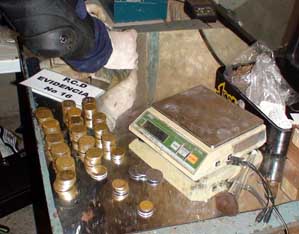
A law enforcement task force descended on night clubs, bars and a hotel Friday night and early Saturday. In the sweep they discovered a kilo of cocaine and at least 25 persons who are believed to be in the country illegally. The establishments in the sweep read like a list of where North American tourists probably should not go: El Molino Rojo, Arcadas, Flamingo, Atlantis, Le Femme Internacional, Alto Scorpio, La Verbena, Aloha Disco Club and Las Tangas. The majority of the establishments are between Avenida 4 and 12 and Calle 2 and 8. In all, the identities of 200 persons were checked, and 25 were found to be without documents showing that they are legal in Costa Rica. The Bar La Verbena was closed down for paperwork irregularities. Police said they also found 67 doses of crack cocaine there. Participating in the sweep were the Fuerza Pública, Policía |
de Migración, the
Fiscalía de Narcotráfico, the Sección de
Estupefacientes of the Judicial Investigating Organization and police
and other representatives of the Municipalidad de San José. Three persons, all women, were detained to face allegations that they were selling cocaine. They were identified by the last names of Guevara Villegas, Rodríguez Mayorga and Álvarez Salazar. Investigators said they found the kilo of cocaine at the Hotel El Scorpio, Avenida 8 between Calles 4 and 6. They said the women used the hotel as a base and distributed drugs nearby. The most unusual find of the evening was in the Aloha Disco Club, on Avenida 12 between calles 6 and 8. When police and investigators entered, patrons, mostly female Dominicans and Nicaraguans, tried to hide in the rest rooms or flee the establishment. Police said they blocked the way. But in the deserted kitchen an immigration officer detected noise and opened a small closet to find a woman and a 17-year-old youth hidden in the tight quarters. The woman, identified by the last names of Severino Cepeda, was suffering from a panic attack due to the closeness of the closet, police said. |
 |
 |
| You need to see Costa Rican tourism information HERE! |
| A.M. Costa Rica fourth news page |
 |
||||||||
| Home |
Tourism |
Calendar |
Classifieds |
Entertainment |
Real
estate |
Rentals |
Sports |
About us |
|
|
|
|||||||||
|
Bolivians pass revised
constitution, television exit polls say
|
|
|
By the A.M. Costa Rica wire services
Voters in Bolivia have approved constitutional changes that would give the indigenous majority more political leverage and allow President Evo Morales to run for a second term later this year. Television exit polls indicated the new constitution passed Sunday with about 60 percent of the vote. Official results were pending. Bolivian President Evo Morales told a cheering crowd in La Paz that a new country is being founded for all Bolivians. President Morales is Bolivia's first native president and is popular among the poor. The revised constitution would create a new Congress with seats reserved for Bolivia's smaller native groups. It also calls for the land holdings of the white and mixed-race farmers of the gas-rich eastern provinces to be limited. |
People in the eastern provinces
opposed the new constitution, saying it does not recognize their
demands for greater autonomy. The new constitution would allow Morales to seek a second, five-year term in a general election in December. He was elected in 2005. The constitution would also embrace indigenous faiths, recognizing and honoring the Andean earth deity, Pachamama, in the predominantly Roman Catholic country. Morales is among a group of socialist leaders in South America who have reformed their constitutions in recent years to extend their rule and exert greater control over natural resources. In 1999, Venezuelan President Hugo Chavez won approval for a new constitution and Ecuador's Rafael Correa did the same last year. |
|
Hemispheric press group
exploring freedom violations in Nicaragua
|
|
|
Special to A.M. Costa Rica
An international mission is in Nicaragua through Tuesday to investigate violations of freedom of the press and free speech in the Central American country. Participants come from the Inter American Press Association, a hemispheric group. The delegation, headed by the organization’s president, Enrique Santos Calderón, is acting on a decision taken in October to conduct an on-site investigation into complaints it had received about press freedom abuses. While the Inter American Press Association has not yet |
received a
response to its request for a meeting sent to the office of Nicaragua’s
president, Daniel Ortega, Santos Calderón said, “We trust that
we will
be able to speak with the president to hear his views and ask him about
some situations which from our perspective have thrown a shadow over
freedom of the press in the region.” As customary for this type of visit the delegation will meet with senior officials of the branches of government, political leaders, representatives of civic and human rights associations, and journalists and news media executives. Accompanying Santos Calderón, editor of the Bogotá, Colombia, newspaper El Tiempo, are U.S. and Latin American news executives. |
| News from
the BBC up to the minute |
BBC sports news up to the minute |
| BBC news and sports feeds are disabled on archived pages. |
|
| A.M. Costa Rica fifth news page |
|
||||||||
| Home |
Tourism |
Calendar |
Classifieds |
Entertainment |
Real
estate |
Rentals |
Sports |
About us |
|
|
|
|||||||||
|
cut flow to poorer nations By the A.M. Costa Rica wire services
Many developing countries face a dearth of effective and affordable medicines — a gap that has been partly met by exporting unused medications from richer nations. But a European Union directive now bans member states from exporting unused medications. The directive went into effect in France this year and is creating difficulties for some charities. For years, the Paris-based Order of Malta has been sending unused medicines to developing countries, many of them in Africa. The Christian charity receives about 1,500 tons of unused medications every year. The group says pharmaceutical experts are careful to discard those that have expired or are inappropriate, and it only responds to specific requests by hospitals or other clinics in developing countries. Alain de Tonquedec, a spokesman for Order of Malta, says the top demands are for medicines that treat digestive and cardiovascular problems, which are leading causes of death in Africa. The charity also sends medicines that help treat blood problems for women after they have given birth. Local dispensaries run by the charity in various developing countries sell the drugs at cut-rate prices and use the profits to buy new medicines. But De Tonquedec says a new European measure that took effect here Jan. 1 prohibits the charity from exporting unused — and free — medicines, which are valued at about $2.5 million. De Tonquedec says the measure aims to bar bad medicines from reaching needy patients in poor countries. Some unprofessional associations had been exporting medicines that had expired or did not match the needs. For example, weight loss medicines have been sent to countries where people faced malnutrition. But the measure also means reputable groups no longer have access to free medicines. De Tonquedec estimates that about one million people benefit from the low-cost drugs. De Tonquedec says another French charity, Doctors Without Borders, faces the same predicament. He says the Order of Malta is committed to meeting the needs of poor patients. But that means it must now raise millions of dollars now needed to buy the medicines. |
|
|
|
|
|
|
|
|
| What we published this week: | Monday | Tuesday | Wednesday | Thursday | Friday | Earlier |
|
|