|
 |
Your daily |
 |
|
|
|
|
|
|
|
|
|
|
|
|
|||||||||||
|
|
|||||||||||
 |
| A.M. Costa Rica Second newspage |
 |
||||||||
| Home |
Tourism |
Calendar |
Classifieds |
Entertainment |
Real
estate |
Rentals |
Sports |
About us |
|
|
|
|||||||||
 |
| Costa Rica Expertise Ltd http://crexpertise.com E-mail info@crexpertise.com Tel:506-256-8585 Fax:506-256-7575 |
 Click HERE
for great
hotel discounts
|
|
Quintavalle to stay
out of prison in fraud case By the A.M. Costa Rica staff
Matteo Quintavalle will continue in liberty subject to signing in twice a month with prosecutors. That was the decision confirmed Tuesday by a Pavas judge. Prosecutors want the Italian jailed. He is facing fraud allegations leveled mostly by North Americans. Meanwhile, he and his defense team are trying to reach an agreement with his accusers over the estimated $12.5 million that was given him. Quintavalle canceled a conciliation hearing Tuesday with his creditors, according to the Poder Judicial. The man was a high-profile sports promoter and hotel owner before North Americans began to complain. New stadium to get help from Chinese experts By the A.M. Costa Rica staff
The Chinese know the way to a Costa Rican's heart. The People's Republic will send engineers and other specialists to determine the feasibility of a new stadium for soccer-loving Costa Rica. Both governments signed a letter of understanding to that effect Friday. Rodrigo Arias Sánchez, minister of the Presidencia, said that a committee would be formed to make decisions on a new Estadio Nacional and to speed up the processing of the paperwork. The stadium is the result of a visit by Óscar Arias Sánchez to the People's Republic in October. The nation broke with Taiwan last year to form ties with the People's Republic. Rights study faults Morales and use of communal justice Special to A.M. Costa Rica
Lashing, crucifixion and other forms of corporal punishment would be legal in a new constitution proposed by the government of Bolivian President Evo Morales, according to the Human Rights Foundation. Since 2005, Bolivia has seen a dramatic increase in such disturbing practices, including lynchings and torture, meted out under an informal system known as “communal justice.” Cases include death sentences for women accused of adultery and the beating, stoning, hanging, and burning of an elected official accused of corruption, the foundation said. “Communal justice entirely disregards due process. In theory, it enables indigenous communities to address their needs in a fair and disinterested manner. In practice, it is judicial terror. It is breathtaking that the Morales government wishes to enshrine such arbitrary and barbaric practices and make them legally unappealable,” said Thor Halvorssen, president of the Human Rights Foundation. The organization published a report on Bolivia’s communal justice system. “Communal justice” is an Inca practice derived from ancient custom law that currently allows local leaders to impart justice directly for crimes perpetrated by members of their indigenous communities, bypassing the Bolivian legal system. The practice sometimes involves communal leaders engaging in rituals such as consulting coca leaves. It came to the attention of the international press in June 2004, when a group of people in La Paz kidnapped and killed a town mayor. The Morales government proposes to make communal justice the only system of law available to indigenous communities — with no right to appeal and no due process guarantees for the accused, said the foundation. “This system would allow the government to subjugate Bolivia’s population under the threat of an instant trial with deadly consequences,” said Halvorssen. Morales and representatives of his government have stated that they support lashings as a symbolic way of promoting communal justice. Twenty-eight reported cases include instances of women buried alive for adultery and additional episodes of angry mobs raiding town halls and police headquarters to take justice into their own hands, the foundation said. The government’s deputies have introduced communal justice into the proposed new constitution, which will effectively grant the practice constitutional status should the new constitution be approved in referendum.
|
| This
space is available for your commercial message |
 |
 |
| A.M. Costa Rica third newspage |
 |
||||||||
| Home |
Tourism |
Calendar |
Classifieds |
Entertainment |
Real
estate |
Rentals |
Sports |
About us |
|
|
|
|||||||||
 |
| U.S.
uses creativity to bring back perpetual tourist fugitive |
|||
|
By the A.M. Costa Rica staff
There is more than one way to snag a fugitive. The U.S. government had been in pursuit of Richard D. Pate since late 2005 when the 50-year-old man is believed to
U.S. officials did not find out about this decision until January 2007, according to the Lone Star Fugitive Task Force in Texas. |
Pate is believed to have returned to
his home in Atenas confident that he would not have to face trial in
the United States. However, officials had one more trick up their sleeves. Investigators subsequently filed a federal unlawful-flight-to-avoid-prosecution complaint and warrant against Pate, seeking to have Pate’s passport revoked on the basis of the federal warrant, said the task force. As a result, U.S. State Department officials revoked Pate’s passport, giving Pate no status to remain legally in the country, the task force said. Costa Rican law enforcement officials were then able to arrest Pate in Atenas and hold him as a violator of the local immigration laws. They did so Dec. 5. The Dirección General de Migración y Extranjería determined that Pate had no legal right to remain in the country and officials ordered his deportation. Pate arrived at the Miami International Airport and was remanded into the custody of the Dade County Sheriff’s Office pending extradition to Williamson County. Pate was living in Costa Rica as a perpetual tourist, an individual who renews his tourist visa by traveling outside the country every 90 days. Many fugitives choose this status because in order to gain other forms of residency a criminal background check is required. |
||
| Coast
guard seeks ship's physician after Windstar tumble |
|
|
By Elise Sonray
of the A.M. Costa Rica staff The physician on a Windstar cruise vessel fell off the boat Tuesday morning about 25 miles (41 kilometers) out from Flamingo, Costa Rica, said Fuerza Pública officials. The man, Manuel De León, was 30 years old and from the Philippines, said officials. “They think he fell somewhere between 4 a.m. and 6 .a.m. Tuesday,” said Manuel Silva, chief of the Servicio Nacional de Guardacostas in Flamingo. Silva explained that the event was recorded on the ship's security cameras. “It is not known if he jumped or fell,” said Silva. According to reports the man had not been drinking, said Silva. The coast guard received the report from the MSY Windstar at 6 a.m.. A vessel with four coast guard officers began a search, at 7:35 a.m. with no results. At 1:30 p.m. an airplane from Servicio de Vigilancia Aérea began an air search of the Pacific. |
“Their is a very remote chance that
he is alive. It is a difficult
situation,” said Silva. “He was not wearing a life jacket,” Silva
added. “This is the first occurrence of this kind on a Windstar cruise,” said a Windstar spokesperson. “The ship's crew is conducting an extensive search.” The ship was on a chartered cruise, according to Windstar officials. It departed Monday evening from San Juan del Sur, Nicaragua and was headed for Playas del Coco, Costa Rica, to arrive Tuesday, said Vanessa Bloy, Windstar director of public relations. The MSY (masted-sail-yacht) Windstar was the first of the company's three yachts. It holds 148 passengers and was constructed in 1986. The coast guard search stopped at 4:40 p.m due to the declining sunlight but will resume at 8:30 o'clock today, said Silva. |
| Arias
backs counterpart, Álvaro Uribe, in his struggle with Colombian
rebels |
|
|
By the A.M. Costa Rica staff
President Óscar Arias Sánchez strongly supported his Colombian counterpart Tuesday in a speech at the inauguration of a theme park. Arias said he hoped that the Colombian, Álvaro Uribe, is able to arrive at a just peace in his land. "Each day Colombia reminds us that we are not able to fight for our own liberty without fighting for the liberty of all the rest, that we cannot permit that hate conquers a single corner of our holdings, that we cannot give a centimeter of democracy for a kilometer of security," said Arias. For his part, Uribe said that Arias had captured the imagination of many in Latin America with his call for a reduction in military spending in favor of social investments. |
Uribe launched a verbal attack
against the Fuerzas Armadas
Revolucionarias de Colombia, the rebels who have been waging a 40-year
insurgency in his country. Although he did not mention Venezuelan
President Hugo Chávez by name, he clearly was responding to the
statement by Chávez that the rebels should be treated as an
insurgent
group and not as terrorists. Chávez has been involved in freeing two hostages that have been held by the Marxist rebels. The United States and several European countries consider the Fuerzas Armadas Revolucionarias to be terrorists because they engage in hostage-taking, drug smuggling, military attacks and bombings. The men were speaking at an agricultural theme park in San Mateo, near Orotina, that has been built by Colombian investors. The facility, Parque Nacional de la Cultura Agropecuaria, is said to house up to 200,000 animals. |
| You can have your ad here for about $5 a day What a deal! |
 |
 |
|
|
|
|
| You need to see Costa Rican tourism information HERE! |
| A.M. Costa Rica fourth news page |
|||||||||
| Home |
Tourism |
Calendar |
Classifieds |
Entertainment |
Real
estate |
Rentals |
Sports |
About us |
|
|
|
|||||||||
 |
|
||||
| Da
Silva visit prompts Cuba to release new photos of smiling Fidel Castro |
|
|
By the A.M. Costa Rica wire services
Cuban authorities have released new photographs of ailing leader Fidel Castro, who met Tuesday in Havana with Brazilian President Luiz Inacio Lula da Silva. The photographs show a smiling Castro dressed in what has become a trademark: track suit and athletic shoes. The pictures are the first to be released in several months. The 81-year-old Castro has not been seen in public since |
undergoing
intestinal surgery in July 2006, when he provisionally turned power
over to his younger brother, Raúl. Earlier Tuesday, da Silva signed a deal offering Cuba millions of dollars in food and financial aid in exchange for the rights to explore oil off the Cuban coast. Cuban waters in the Gulf of Mexico are believed to hold large crude oil deposits. Several foreign oil companies have already made exploration deals with Cuba. |
| Venezuela's
Chávez visiting some heads of state in Central America |
|
|
By the A.M. Costa Rica wire services
The president of Venezuela, Hugo Chávez, is visiting Honduras and Nicaragua to discuss cooperation and energy. Chávez was meeting Tuesday, with his Honduran counterpart, Manuel Zelaya, at the presidential residence in the capital, Tegucigalpa. Chávez was previously in Guatemala where he attended the presidential inauguration Monday of Álvaro Colom. |
News reports say Chávez and
his Honduran counterpart were to discuss a
possible contract between Honduras and Petrocaribe, a Venezuelan
initiative that allows the purchase of Venezuelan oil at preferential
rates. Chávez travels on to Nicaragua, where he is to meet with President Daniel Ortega. Reports say the two will lay plans for the activities of the regional trade area called the Bolivarian Alternative for the Americas, which includes Nicaragua, Bolivia, Venezuela and Cuba. |
|
|||||||||||||||||
| News from
the BBC up to the minute |
BBC sports news up to the minute | ||||||||||||||||
| BBC news and sports feeds are disabled on
archived pages. |
|||||||||||||||||
| A.M. Costa Rica Sports news local and from the wires |
 |
|
|
|
|
|
|
|
|
|
|
||||||
|
||||||||
|
|
|
|
|
Food, festivals, arts, entertainment, poker |
|
|
|
|
|
|
|
|
|
|
| Palmares
fiestas provide family fun, and plenty of beer |
|
|
By
Helen Thompson
of the A.M. Costa Rica staff The new year arrives, and Palmares gets ready to party. This year makes no exception, with the official countdown to the start of Fiestas Palmares reaching the 00:00 mark at 1 p.m. today. A line-up of international music acts, traditional spectacles and sports events usually pales into significance behind the main activity of drinking as much as humanly possible, turning the streets of the town into carnage for almost two weeks. This year, 60 buses will be on standby to ship even more people from San José to the packed fiesta field in the province of Alajuela between 6 a.m. and 2 a.m. Rollercoasters, fairground rides and bars will be permanent fixtures to entertain people in the gaps between the extensive program of events. The first big draw after the fireworks and football games of Wednesday's opening, will be the tope on Thursday. Thousands of the finest horses will be ridden into town for an equine spectacle rivalled only by that of San Jose the day after Christmas. Some 10,000 people usually attend the event. A rodeo will finish the day, sarting from 7 p.m. Mexican singer Alicia Villareal is the highlight of Saturday's Festival Ranchero, which will fill the Palmares' oval stadium from 7 p.m. A troop of 12 other singers will also perform, chosen through a selection process that narrowed them down from 30 competitors back in November. For those looking for something a bit less sentimental, another international concert will be played on each Sunday of the festival. Reggaeton will of course have its place, with Puerto Rican rap/hip-hop/dance hall star Zion making an appearance this Sunday at midday. The other Tico favourite, hard rock, gets an airing Jan. 27 when make-up smeared Mexican band Moderatto, hailed to be one of Mexico's most popular bands of recent times, takes the stage. |
 A.M. Costa Rica images
Rollercoasters provide family
entertainment at Fiestas
PalmaresThe Moderatto brothers and their musical allies were recently awarded a platinum disc to go alongside their many gold discs, after selling 100,000 copies of an album in Mexico. Argentinian trio Enanitos Verdes will also play this date. Puntarenas' famous carnival gets an early rival on Jan. 25, as Palmares fills its streets with flamboyantly dressed dancers and no less than 17 marching steel bands from 5.30 p.m. Panamanian dancers, Salvadorean musicians and coloured floats will also add to the atmosphere of the carnival, one of Palmares' most popular events. Kids get a special focus in the Festival Infantil on Jan. 22, and the sporty can watch or take part in football tournaments on Wednesday and Jan. 23. A gruelling 40 kilometre mountain bike race called the Clasica Palmarín invites people to pay 5,000 colones to put themselves through the pain from 9 a.m. this Saturday. Runners can do a 13.5 km stint for 3,500 colones on Jan. 26. Anyone who missed Zapote's Christmas bulls can check out the Tico version of bull fighting in various events including Toros a la Tica, taking place on eight days scattered throughout the festival program. Entertainments are put on by La Asociación Cívica Palmareña, in association with various sponsors, and more information can be found about exact times and dates of events at www.fiestaspalmares.com. Many events are free, but some require entrance fees. |
| Art Galleries .... |
|
Imagen V show has a few gems but a pack of clinkers, too  New media art is
always a bit hit and miss with the potential to come
across as a foundationless piece of pretension if it is not done well. New media art is
always a bit hit and miss with the potential to come
across as a foundationless piece of pretension if it is not done well. The Bienal Iberoamericana Inquieta Imagen V, a competition for video artists from across Latin America, is a good example of this, containing a few pieces that engage well with the subject and make the most of their medium, but many that leave the viewer cold. Most of the works are video projections, some as short as a pistol shot and the flight of birds and some as long as a didactic letter that teaches about identity, isolation and fuschia flowers. Other media range from photography and animation to Internet blogs and ancient video games. Out of almost 200 entries from 13 different countries, 37 were chosen to fill the spaces of the Museo de Arte y Diseño, and some of them leave a viewer wondering what was so awful about the rejected works. The vast majority of entrants were Costa Ricans, and works were chosen for show to create a panorama of Spanish-American works that is accessible to both the public who have engaged with technolgical art before and those who are encountering it for the first time. Five works won cash prizes, including an undeserving triptec of photographs showing poor Nicaraguans searching through a dump to find articles that give some beauty to their lives. Not an original idea nor interestingly photographed, the series was praised for using the presence of children to humanize a degrading situation. One projection's entire focus is a sequence of slightly blurred changing Christmas scenes, seemingly chosen only for its fittingness to the season, and several others that were too bland to make any sort of impression on the memory. Read more - click here |
Mistaken identity? No such thing, says new exhibition  Costa Rica is
a land of volatile volcanoes, orchids, coffee fincas,
Catholicism and Ticos. Costa Rica is
a land of volatile volcanoes, orchids, coffee fincas,
Catholicism and Ticos. Or you could say it's a country of wide seashores, football stadiums, fast food restaurants and beach towns overtaken by Gringos. Some are clichéd symbols of a tourist nation, while others are part of the country's changing culture, but all are involved in Museo de Arte Costarricense's new exhibition that challenges viewers to reconsider their own perceptions of the nation. Read more - click here Oriental engravings brighten up Semana Japonesa in Calderón Guardia  Oriental
engravings that have travelled half way across the world from
Japan have ended their journey in Museo Calderón
Guardia, where an
exhibition of 75 works was inaugurated Thursday. Oriental
engravings that have travelled half way across the world from
Japan have ended their journey in Museo Calderón
Guardia, where an
exhibition of 75 works was inaugurated Thursday.Subjects from autumn trees to high-rise apartments chart the growing influence of the West and development on post-war Japan. Read more - click here Banco Central exhibit brings out the animal in art  The
Museos del
Banco Central de Costa Rica is running "La Animalística en el
Arte Costarricense" in its temporary The
Museos del
Banco Central de Costa Rica is running "La Animalística en el
Arte Costarricense" in its temporary exhibition space below the Plaza de la Cultura. The collection presents the varying uses and depictions of animals by Costa Rican artists throughout history. The exhibition signage placed at the entrance said that the presented works depict animals from two perspectives. Read more - click here |
| Festivals ... | |
In review... Young rockers forge cultural links, even if no one was there to see it  Cross-cultural
dialogue is not confined to the United Nations. Cross-cultural
dialogue is not confined to the United Nations. It can occur anywhere, with anyone, in any medium and Quepos proved this last weekend at Costa Bazooka, an international music festival. 18 bands from the United States, Costa Rica and Mexico jammed until five o´clock in the morning, beginning Saturday at 2 p.m. Mexican band Defecto The virgin music festival is the brainchild of Bruce LaPierre, a concert promotor from Boston. He recruited many of the American bands himself and said, "The best part about this whole thing are the friendships with the Costa Rican musicians. We´re intertwined now." Mauni Villa, a 21-year-old guitarist of San Jose´s own Akasha, also emphasized this. "We´ve made a lot of friends," he said. The talent was young, fresh, unfettered with record deals and excited about the opportunity to play an international scene. It wasn't uncommon to hear the exclamation "We just got our passports!" emanating from backstage. Over half of the band members of Street Circus Symphony, from Savannah, Georgia, and one member of Endway from Boston, Massachusetts, received expedited passports in 24 hours. "We didn´t actually believe we were going to be playing in Costa Rica until we were on the bus here from San Jose," explained Ben Bowne, bassist for Street Circus Symphony. To read more click here |
Upcoming... January Welsh festival brings stars of the page to Colombia There is a town in Wales that is full of books. On every corner of every cobbled street there is a store with second-hand books spilling from its wooden shelves, and often several on the stretch in between. Each year, this little town in the foothills of the Black Mountains — usually a haven of peace for a quiet cream tea down by the river — becomes a pilgrimage for the literary, intellectuals and people who just love a good read as it holds Britain's greatest festival of books, the Hay Festival. Read more - click here February First International Blues Festival Texas blues bands are heading down to Santa Ana for an afternoon of live music. BBQ's and cold beers will accompany artists including Smokin Joe Kubek & Bnois King and Robbie Clarke & the Live Wire Blues Band. Two stages at Motorpsychos Bar and Grill will host a total of seven bands during the afternoon of Feb. 9. Tickets cost $25 and can be found by contacting www.bluesdevilsband.com. Identidad Art Festival Fifty artists will have the enviable job of displaying their work on a warm beach in Guanacaste this February, as part of the Identidad Art Festival. Hosted by Playa Conchal Reserve, the festival aims to revive the cultural values of the area, promoting local art as a tourist attraction. Painters, sculptors and musicians are all welcome to participate and show off Costa Rican talent to the high season tourists during Feb. 2-4. Interested parties should visit the site www.myspace.com/identidadartfest. |
| Food... |
|
Festive season proves troublesome even for established restaurant  Being a chef in a
busy kitchen must be a pretty stressful job, but
around Christmas stress is something any successful restaurant should
factor in as inevitable. Being a chef in a
busy kitchen must be a pretty stressful job, but
around Christmas stress is something any successful restaurant should
factor in as inevitable. On a second visit to well-reputed French restaurant Le Chandelier, it soon became obvious that the staff were poorly equipped for the onslaught of Christmas party diners on a Tuesday night, leaving the usually decent food to deteriorate into a procession of almost inedible starters and bland entrees. Set in an old San Pedro house with brick ceilings and wooden beams that was converted into a restaurant around 15 years ago by Swiss owner Claude Dubuis, Le Chandelier purports to offer French cuisine that has been developed over generations of experience. Click here to read the full review |
A great meal is not all in the presentation 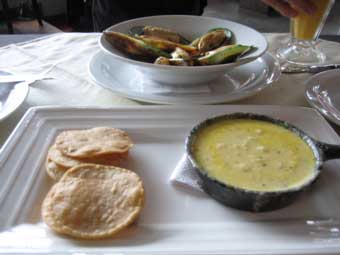 With a vaulted
glass ceiling, palm trees lining the pathway and posh lighting, one
would not expect Saga restaurant to be settled behind a dull parking
lot in Escazú. With a vaulted
glass ceiling, palm trees lining the pathway and posh lighting, one
would not expect Saga restaurant to be settled behind a dull parking
lot in Escazú. Although this restaurant may look out of place, it doesn't deviate much from the norm in Escazú, an area many would classify as suburban sprawl. The majority of the cuisine at Saga seems to fit with the setting: classy presentation, yet lacking any profound flavors. Although the restaurant boasts itself as an “international food restaurant” on its Web site, much of the inspired cuisine is lacking the depth which would be found in authentic dishes. There is no direct theme and the menu seems somewhat scattered. Click here to read the full review |
| Dramatic Arts... |
|
Minotaur theme wins contemporary dance festival  The search
for happiness within ourselves rather than in superficial external
objects was the theme of the winning dance at the 24th Festival de
Coreografos this weekend. A bull-headed dancer took the centre of
attention of Antonio Corrales' piece “Solo sueña un minotauro,”
presented in front of an international board of judges Sunday. The search
for happiness within ourselves rather than in superficial external
objects was the theme of the winning dance at the 24th Festival de
Coreografos this weekend. A bull-headed dancer took the centre of
attention of Antonio Corrales' piece “Solo sueña un minotauro,”
presented in front of an international board of judges Sunday.The judges said that the composition stood out from the other nine contemporary dance acts for its "good choreographic approach, good line, good idea, excellent lighting design, continuity with symbols and finally poetry.” Corrales was both the choreographer and the dancer of the piece, which is the first entry he has made into the competition as a choreographer. Four other acts were also chosen to participate in the opening night of next year's festival: “Imágenes imaginadas para imaginar, serie I,” by Rogelio López, “Mil kilómetros” by Nandayure Harley, “MIA ZOI,” by Iréni Stamou and “4 a.m.” by Silvia Ortiz and David Hernández. |
Symphonic Conductor is a big supporter of music education A mugging at gunpoint could have robbed Costa Rica's Orquesta Sinfónica Nacional of its new conductor just as he was beginning the job, but the conductor, Chosei Komatsu, did not turn his back on San José, and now the next generation of musicians is feeling the benefit. Eating ice cream in the same hotel outside which he was mugged in 2004, the sweet-toothed conductor recounts how the media assumed that he would flee the country immediately. "I told them I would fulfill my job," he said. "Musical education conductor Chosei Kamatsu can help to abate the rising violence in this country. I want to put violins instead of guns into the hands of the children." Last month Komatsu saw a big step forward, as the government of his home country, Japan, finally agreed to a $500,000 donation to the Orquesta Sinfónica Nacional and the Instituto Nacional de Musica. The money, which Komatsu asked for when he was appointed in 2003, has gone towards replacing 25-year-old tubas and other important instruments for the orchestra, as well as getting better facilities for the educational institute. Komatsu said he knows that it is important to get children interested from a young age, as he first became determined to follow a career in conducting as a 4-year-old watching Austrian conductor Herbert von Karajan in action on television. Read all of our interview with Chosei Komatsu here |
| Books ... |
|
New book dwells on the social aspects of food Food is not just a selfish pleasure or a way to stifle hunger, but is central to the evolution of art, according to a new book published by Museos del Banco Central. Artworks by Costa Rican painters are the main content of the hardback book, “Imagenes para Comer,” which follows the representation of food in art since still life painting became popular in the Renaissance. Full-color pictures of both traditional and modern works are far more common than recipes, as the author Marjorie Ross only provides seven recipes within the book. All are traditional Costa Rican dishes showing influences from different sections of the community, such as corn fritters, white beans and chorizo and fruit salad. The book focuses on the meanings that food has within society, and how these are portrayed by art. Click here to read more |
 Front cover of art cook book |
| When would it be smart to fold your hand with three queens? | |
| I
recently played in a $25-50 no limit hold’em game online. The
hand discussed in this column was interesting because it taught a
valuable lesson regarding position, the board cards and reading betting
patterns. At a full table, the first player decided to limp in (call the big blind rather than raise) from under the gun. The button also called. I was in the small blind holding Qh-8d. I called, too, since I already had half the bet in the pot. The big blind checked. Four of us took the flop: Qh-Qd-4c. Bingo! Hoping to pick off a bluff, I tried to disguise my trips by checking. The next two players also checked but the button bet $150. I didn’t raise. Instead, I just called so that I could gauge the interest of the other players. The player under the gun also called and that had me worried. Yes, I flopped trips but my kicker wasn’t very good. My thinking was that the original bettor could have had a wide range of hands and might have been trying to steal the pot. Also, the other player probably had a strong hand because he called the first bet even after I had called. The turn card was the 10s. I checked again. The players after me also checked, so I felt like there was a decent chance that I had the best hand. I’d know soon enough if the limper was planning to check-raise the turn with a better hand than mine. He didn’t. The river brought the Js. That card filled the straight for anyone with A-K. The good news, though, was that the jack nullified my kicker. My hand was now Q-Q-Q-J-10 rather than Q-Q-Q-10-8. Still, I took the cautious route and checked. The first limper bet $400 and the button folded. With $650 already in the pot, I was getting pretty decent odds on my money, about 2.6-to-1. What’s the right play? Well, most players in this situation see only the strength of their own hand and think, “I have trips. I have to call.” They act on impulse. That’s not the right way to act in this situation. It’s much better to break down the hand in a way that allows you to |
 make an educated decision. Take the time to ask yourself two key questions. Could my opponent have the same hand as me? Not likely. Remember, he called from first position. Most players under the gun act conservatively. If he had a queen, he’d likely have a ten, jack, king, or ace to go with it. So, a split pot is extremely unlikely. What hands would my opponent play in this manner that I can beat? First, try to determine the premium hands that you can beat. Maybe he was slow playing pocket aces or pocket kings before the flop. Those would be the only two big hands that you can beat. On the other hand, if he limped in with big slick, the river card made his straight. Next, try to figure out how likely it is that your opponent has one of the hands you can beat. If, for example, you think you’ll have the best hand about 40 percent of the time, then the pot would definitely be laying the right price for you to call. But that wasn’t the case in this hand. In fact, based on the information available, I thought my chances of winning were closer to 10 percent. So, I folded my trips. The other player, incidentally, had A-Q and would have had the winning hand, but that’s irrelevant. The important lesson is to slow down, and collect and analyze the available information before you make critical poker decisions. There’s just no need to act impulsively. Visit www.cardsharkmedia.com/book.html for information about Daniel Negreanu’s new book, "Hold’em Wisdom for All Players." © 2007 Card Shark
Media. All rights reserved.
|
|
|
|
|
|
|
|
|
|
|
|
|
| What we published this week: | Monday | Tuesday | Wednesday | Thursday | Friday | Earlier |
|
|