|
 |
Your daily |
 |
|
|
|
|
|
|
|
|
|
|
|
|
|||||||||||
|
|
|||||||||||
 |
| A.M. Costa Rica Second newspage |
 |
||||||||
| Home |
Tourism |
Calendar |
Classifieds |
Entertainment |
Real
estate |
Rentals |
Sports |
About us |
|
|
|
|||||||||
 |
| Costa Rica Expertise Ltd http://crexpertise.com E-mail info@crexpertise.com Tel:506-256-8585 Fax:506-256-7575 |
 Click HERE
for great
hotel discounts
|
|
as Christmas traditions By Helen Thompson
of the A.M. Costa Rica staff Bull-fighting conjures up images of violence and bloodshed for the average Westerner who has grown up associating it with Spanish torreadors stabbing the animals to an untimely death. Costa Rica's version is a more festive and peaceable affair that Ticos count as one of the essential components of the Christmas season. Rather than one man standing with his red cape and sword ready to face the beast alone, up to 150 Ticos fill the ring, hoping to get a slap at the bull before running off in the other direction. The bull never gets injured, only exhausted by charging back and forth between groups of men who have more to fear from it than it from them. Costa Rica's most famous Corridas a La Tica takes place in Zapote, east of San Jose's downtown, and this year it will start right in the middle of Christmas Day, giving the participants a chance to work up an appetite for dinner. More than 4,000 people will be able to watch the spectacle this year in a new bull ring that has been under construction since September. From Christmas Day until Jan. 1, only Costa Ricans will be allowed into the ring for the national eliminations. After that, the international tournament will begin with participants from Brasil, Guatemala, Mexico, the United States and Costa Rica competing until Jan. 6. Two tournaments per day take place at 3 p.m. and 9 p.m., apart from Dec. 26, when it will be at 4 p.m., and Dec. 31, when it takes place at 8 p.m. There is an entrance fee of 4,000 colons, about $8. Food courts selling essential festival fare such as candy floss and fast food will be located around the site, along with bars, traditional games and an artesania festival involving face painting, mascaradas, music, dancing and theater that runs until Jan. 1. La Guácima in Alajuela will also have bull event this year, starting earlier on Dec. 22 and finishing Jan. 2, with an entrance fee of 3,000 colons ($6). Bull fighting will be at 3 p.m. on Dec. 25, 29, 30, and Jan. 1, and at 9 p.m. everyday except Dec. 26 and 28, with live music and many other events going on each day from midday until midnight. Smaller local versions will take place around the country, continuing well into 2008. The park of Margarita, Talamanca, will host an event on the weekends of Dec. 14 and 23, throughout the evening. San Miguel de Cañas celebrates from Dec. 21 to 25 in the Salon Comunal. Bull viewing for the beginning of 2008 is available at the festival of Rio Negro, Cóbano, from Jan. 21 to Feb. 4, Cóbano's town festival from Feb. 8 to Feb. 18, and Liberia from Feb. 22 to March 2. San Andrés and Providencia remain islands of Colombia Special to A.M. Costa Rica
The International Court of Justice, the principal judicial organ of the United Nations, ruled Thursday that three Caribbean Sea islands disputed by Nicaragua and Colombia belong to the latter country because a 1928 treaty between the two nations settled the issue. But judges at the court which sits in The Hague also ruled that they do have jurisdiction to rule on the sovereignty of three other cays and the delineation of the maritime boundary between Colombia and Nicaragua. Nicaragua had launched action at the court, arguing that it should be granted sovereignty over the islands of San Andrés, Providencia and Santa Catalina, and over the cays of Roncador, Quitasueño and Serrana. The islands are a major resort destination although they are north of Costa Rica off the Nicaraguan Caribbean coast. Colombia raised a series of preliminary objections, arguing that the 1928 treaty between the two nations and the 1948 Pact of Bogotá mean the court does not have jurisdiction. By a majority of 13 to four, the judges found that the treaty had settled the question over the three islands, noting that Nicaragua did not contest the treaty’s validity for more than 50 years after it was signed. “At no time in those 50 years did Nicaragua contend that the treaty was invalid for whatever reason, including that it had been concluded in violation of its constitution or under foreign coercion,” according to Thursday’s judgement. “On the contrary, Nicaragua has, in significant ways, acted as if the 1928 treaty was valid.” But the judges found unanimously that the Court can adjudicate on the three cays — which the treaty specified it did not cover — and on the maritime delineation between Nicaragua and Colombia. Also known as the World Court, the International Court of Justice hears disputes between states and its decisions are binding and without appeal. Our reader's opinion
This reader likes the opinionsof our columnist Jo Stuart Dear A.M. Costa Rica: Jo Stuart, ignore the agenda-laden comments of Mr. Love and others, speak your mind and share your opinions. That's what your readers love about you. I hold a degree in international affairs from Rutgers and am retired from the diplomatic service, having served in posts in the Middle East. Let me tell you, your comments were right on target, so don't let some "lobbyist" for a cause other than America's put you off from expressing your view. Mr. Love should be ashamed of himself for trying to suppress the free expression of your opinions. And the editor of A.M. Costa Rica should be complimented for giving you that chance. So, don't be intimidated by bullies. Stick to your guns and opinions — and share them with a grateful audience that faithfully reads you. Carl Robbins
Atlanta, Georgia and Alajuela
|
 |
 |
|
on our real estate page HERE! |
|
 |
| A.M. Costa Rica third newspage |
 |
||||||||
| Home |
Tourism |
Calendar |
Classifieds |
Entertainment |
Real
estate |
Rentals |
Sports |
About us |
|
|
|
|||||||||
 |
 |
||
| Erick Carballo shows off a
sword at Armoria Polini downtown while the earring was found at the
Antigua Aduana and is the work of José Rivera who
uses 25-centimo coins. |
 A.M. Costa Rica/Anne Clark
|
| By
digging deep, some interesting holiday gifts can be found |
|
|
By Anne Clark
of the A.M. Costa Rica staff Gift-giving can be stressful, especially in a place like Costa Rica. Alongside all the beautiful aspects of culture, craft and landscape, there is a plethora of poorly manufactured cheap stuff. Do you or someone you love want some unique but reasonable gifts this Christmas? Here are some ideas for some awesome possibilities. Someone you know might like swords. First, take a stab at who that might be and then go check out Tribal Tattoo in Mall San Pedro. The elaborately decorated blades are priced between 30,000 and 40,000 colons, about $60 to $80. Some look like "Conan the Barbarian" leftovers. The store staff claims to sell a lot of them. Another place to look for a sword is at Armoria Polini, on Avenida 1 downtown. Their swords are priced between 21,500 and 60,000 colons, some $43 to $120. Most are for collectors, but a few of the Samurai blades could shred a home intruder. Want an almost Louis Vuitton purse? You can get one in Mall San Pedro. From far away, it will look like the real thing, and probably no one will notice the duct tape you had to apply to hold it together after the second week. But for 17,000 to 45,000 colons ($34 to $90), these knock-offs are more affordable than anything on louisvuitton.com. You might find a fancy dress for a holiday office soirée at Big Mama, a store for tall women where most dresses are priced from 15,000 to 40,000 ($30 to $89). The wrap dresses are decent, but some of the rest look like something you might see at certain expat bars. You might not look office-ready, but at least you won't care when that obnoxious guy from the next cubicle gets wasted and spills wine on it. If you hate animals, try the Mascota Perfecta at Mall San Pedro. For 16,800 colons (about $34), this stuffed animal won't shed, eat, climb your Christmas tree or perform bodily functions in your home. |
However, with patience you can wade
through all of the cheap stuff and
find some nice local crafts. La Casona, off the pedestrian mall,
has
some nicer products once a visitor gets through all the shot glasses
and
key chains. Souvenir Chirripó on the second floor of La Casona has Costa Rican crafts handmade by the BriBri Indians. Vendor Holly Tapia said that the jade animal charms are their biggest sellers, with the alligator, turtle and frog rounding out the top three. All animals have a special meaning to the indigenous culture, Ms. Tapia emphasizes and says, “The frog and alligator are the most popular but my favorite is the turtle because I am a slow person!” The prices range from 7,000 ($14) for rough jade to 34,000 ($78) for the imperial green jade, which has more clarity and sheen. The rare black jade, found in the ocean, is the most expensive. The most popular design in black jade is a triangular abstraction of the human form, prices starting at $67. Ms. Tapia said she believes it is not as popular as the green animal jade because it has a more complicated meaning to remember. She also thinks there is a correlation between the price and the relative popularity of each item. Tourists compose most of their business. “I think the people that live outside the country appreciate the Indian culture more," Ms. Tapia said. Some Ticos don't appreciate the indigenous culture and don't know the real meanings of these crafts.” The Diciembre Nuestro show at La Aduana Antiqua in northeast San José has several tables of locally-crafted jewelry, among the best being José Rivera's Joyeria Artesanal. He created bracelets, necklaces, rings and earrings out of silver colon coins, mainly from the 1970s, at reasonable prices. Diciembre Nuestro, the traditional holiday gift mart, runs through Sunday. By the way, swords are traditionally worn on the left leg. |
| Costa Rica's health care system requires patience to join |
|||
| Last weekend I watched
the
Michael Moore movie, “SICKO.” Although he featured the national health
coverage of Canada, England, France, and even Cuba, he did not mention
Costa Rica. But, of course, I thought about the system
here. I have been a member of the government health insurance plan (Caja) ever since I became a resident. Although residents can avoid the red tape of applying for health coverage by signing up through the Association of Residents of Costa Rica, I did it on my own. Like most procedures in Costa Rica, it took time, patience and going from one line to another, this time in the social security building downtown. But being a pensionada, I had enough of both time and patience, not to mention a good book, to sustain me. I was quoted a monthly fee based upon my income as a pensionada, and paying it every month is something I do diligently. In a TV discussion about the possibility of the success of national health coverage in the U.S., the current head of Kaiser Permanente said it would be almost impossible because people would not accept being denied the latest technology or innovations in medicine even if the cost were prohibitive. He did not add the fact that their insurance companies already deny them many procedures. Probably because it does not mean they would accept being treated the same by the government. This is a problem that Costa Rica and every country with universal health care faces. They have a budget. There are times when doctors must decide "Do we shoot the budget for the whole year by sending this little girl to another country to be treated because they have the technology, experimental drugs, etc. to do so, or do we deny her this and divide the money more equitably among more people?" I would not like to have to make that decision. As a patient, one day, I may find myself in the position of that little girl. However, in spite of the long waits, the sometimes delays in getting an appointment, and some of the generic drugs that are not considered as effective as the expensive name brands, I will take this form of medical care any day. Once I have paid my monthly premium, everything is free. Apropros of the waits, a new arrival to Costa Rica, a young man in his 40s, who was living in Florida, told me that he began to feel awful and decided he needed a |
physical check-up. The doctor told him he would have to
wait three months for an appointment. Instead of waiting three
months, after figuring out for himself what the problem
was, he sold his business and moved to Costa Rica. Another
incident I was told of, also in Florida, was of an older man who
suffered a broken foot just before the weekend and was told there was
no surgeon over the weekend and he would have to wait for the following
week. Florida may be having a medical crisis. |
||
 |
|
| Your best advertising investment is A.M. Costa Rica! Check it out! |
|
|
|
|
| You need to see Costa Rican tourism information HERE! |
| A.M. Costa Rica fourth news page |
|||||||||
| Home |
Tourism |
Calendar |
Classifieds |
Entertainment |
Real
estate |
Rentals |
Sports |
About us |
|
|
|
|||||||||
 |
| Two
policemen will go to trial in death of Nicaraguan by dogs two years ago |
|
|
By the A.M. Costa Rica staff
Two Fuerza Pública officers will go to trial for simple murder or manslaughter in the death of a Nicaragua sneak thief who was attacked and killed by two guard dogs two years ago. That was the decision by the Juzgado Penal de Cartago, and the decision was confirmed Thursday by the Poder Judicial. The death of the thief, Natividad Canda Mairena, inflamed anti-Nicaraguan feelings and instigated at the time hundreds of jokes denigrating the thief and Nicaraguans in general. The death resulted in a diplomatic delegation coming from Nicaragua to talk to Rogelio Ramos, who was then the security minister. The basic allegation is that the two officers did nothing and allowed the two dogs to repeatedly attack and bite the cowering Nicaraguan. The scene was at an auto parts yard |
in La Lima de Cartago. The
victim had
to scale a fence to enter the auto parts yard. He was unaware that the
two rottweilers were inside. That was Nov. 10, 2005. The thief was not reached by officials until firemen arrived and sprayed the dogs with their high-pressure hose. Much of the attack was filmed and showed up on local television. The man died in a hospital. The two policemen are Erick Sánchez Torres and Asdrúbal Luna Zamora. They declined to shoot the dogs to save the Nicaraguan. The owner of the dogs said he was unable to handle them at that point. The Ministerio Público or prosecutor' s office is calling the case death by omission. The Tribunal de Juicio de Cartago also will hear a civil complaint by the mother of the Nicaraguan. She seeks money damages. The court will have to set the date for the trial. |
| Law
officers quickly round up four kidnapping suspects in Siquirres case |
|
|
By the A.M. Costa Rica staff
Two men, suspected of kidnapping, were jailed for four months of preventive detention Thursday in Siquirres, Límón. Two more men were arrested Wednesday, as suspects in the same kidnapping, according to Poder Judicial. The director of the Judicial Investigating Organization said that three or four more men are being sought. Kidnappers entered a house in Cairo de Squirres and took three men hostage Tuesday night, including the father of one Judicial Investigating Organization agent. Three men and three women were enjoying a party when the kidnapping took place, according to reports at the time. |
The women were tied up and
left in the house,
and the men were taken away said reports. The kidnapped men were found
and freed by Judicial Investigating Organization agents Wednesday, said
the director, Jorge Rojas Vargas. During Wednesday the four men were arrested. The men who were given preventative detention have the last names of Ortiz Jiménez and Mora Abarca. They were detained in Jiménez de Guácimo. The same night, Oscar Alberto Gonzalez Zuñiga, 30, and Alonzo Antonio Mejoas Movin, 23, were arrested in Aserrí. The kidnapped father of the judicial agent was identified as Arnoldo Mena Flores. Two brothers with the last name of Chávez. Mena is a local businessman. |
| Probe
of $800,000 in briefcase sparks fierce responses in Caracas, Buenos
Aires |
|
|
By the A.M. Costa Rica wire services
U.S. prosecutors have announced the arrests of four men linked to a scandal involving an alleged campaign payment from Venezuela to Argentina.The governments of the South American nations have denounced the U.S. probe as a political attack by Washington. Federal prosecutors announced Wednesday the arrests of three Venezuelans and a Uruguayan man accused of acting as undeclared agents of the Caracas government. U.S. authorities say the men came to Miami to pressure another man, Guido Alejandro Antonini Wilson, to conceal the fact that the money for a Venezuelan political campaign donation came from Venezuela's state oil company. Antonini, who has American and Venezuelan citizenship, has been at the center of the scandal since he was caught in Argentina in August with a briefcase containing $800,000 in cash. He arrived in Miami shortly after the incident, and Argentina has asked for his extradition as part of an investigation into the money. U.S. prosecutors say conversations between Antonini and some of the four men revealed that the money was intended for the presidential campaign of Cristina Fernandez de Kirchner. Ms. Kirchner took over the presidency earlier this week, succeeding her husband, Nestor Kirchner. |
In
Buenos Aires, she denounced the accusations as an attempt to damage
her new presidency. President Kirchner said the attacks against her
will fail, and that she may be a woman, but she will not allow others
to pressure her. She also vowed to maintain close ties with Venezuela's
President Hugo Chávez, a fierce critic of U.S. policy in the
region. In Caracas, Venezuela's foreign minister, Nicolas Maduro, said the U.S. probe is an attempt to damage relations between Venezuela and its Latin American partners. U.S. State Department spokesman Sean McCormack rejected allegations the operation was anything more than a criminal investigation. "This is not an issue of U.S.-Argentine relations," said Sean McCormack. "This is a matter of U.S. law enforcement enforcing U.S. laws on U.S. soil." The four men arrested in Miami face a fine and up to 10 years in prison if convicted on charges of acting as undeclared foreign agents. Officials say they are looking for a fifth suspect in the case. U.S. authorities have filed no charges against Antonini, whose attorney says he was unaware of the money in his luggage. |
|
|||||||||||||||||
| News from
the BBC up to the minute |
BBC sports news up to the minute | ||||||||||||||||
| BBC news and sports feeds are disabled on archived pages. |
|||||||||||||||||
| A.M. Costa Rica Sports news local and from the wires |
 |
|
|
|
|
|
|
|
|
|
|
||||||
|
||||
|
|
|
|
|
Dining, restaurants, entertainment, poker |
|
|
|
|
|
|
|
|
|
|
| Welsh literary festival brings stars of the
page to Colombia |
|
|
By Helen Thompson
There is a town in Wales that is full of books. On every corner of
every cobbled street there is a store with second-hand books spilling
from its wooden shelves, and often several on the stretch in between. of the A.M. Costa Rica staff Each year, this little town in the foothills of the Black Mountains — usually a haven of peace for a quiet cream tea down by the river — becomes a pilgrimage for the literary, intellectuals and people who just love a good read as it holds Britain's greatest festival of books, the Hay Festival. Last year the festival, which sees a collection of the world's leading authors, poets, musicians and speakers gather to share their thoughts and works with the reading public, was transported across the ocean to an equally attractive little town with the added bonuses of sun and sea. Cartagena de Indias, a colonial town in Colombia, will host the second Hay Festival Cartagena de Indias this January, with a bevy of stars of the page from Pullitzer Prize-winners to U.N. ambassadors. Dubbed the 'Woodstock of the Mind' by Bill Clinton, the Hay Festival has enjoyed the presence of great minds such as Nobel Lauretes Wole Soyinka and Derek Walcott, biologist and TV presenter David Attenborough and hundreds of authors from Norman Mailer to Louis de Berniers and Germaine Greer. They impart their wisdom through presentations, conversations, round-table discussions, political debates, music, poetry, film and anything else they can think of to engage the audience, which always asks difficult questions afterwards and expects a decent book-signing session where they can reverence or shun the celebrity in question. The format has been transferred almost unaltered to Colombia, chosen for its link to Gabriel Garcia Marquez, whose novel "One Hundred Years of Solitude" is often thought to embody the revival of Latin American literature in the boom years of the 1960s, encapsulating the sentiments and promoting the identity of a continent in the upheaval of revolution and change during the decade after Fidel Castro came to power. Here, however, 70 percent of the program will be in Spanish, with simultaneous translations into English for the many international guests that are expected to come to the four-day festival. Alice Walker, author of the Pulitzer Prize-winning "The Color Purple," a novel dealing with racism in the deep South of the United States which was subsequently made into an Oscar-nominated film by Stephen Spielberg, is arguably the most famous author on the bill, which was announced Thursday. Cinema buffs will undoubtedly pack out the auditorium for a discussion with Stephen Frears Jan 27, the British director whose major succeses include "Dangerous Liaisons," "High Fidelity" and more recently "The Queen." |
 of the show at Cartagena literary festival The previous U.N. ambassador from Senegal, who still looks 20 when he is dancing to his drummers' African rythms and singing his unique vocals but who has actually just turned 54, will undoubtedly repeat his success in a concert on Jan. 24 at the festival, and then talk about his political work and the problems faced by his home continent of Africa in the new millenium. A sprinkling of other authors such as Man Booker Prize-winners Annie Enwright and Kiran Desai, will be among the other representatives of the West. The environment has traditionally been a topic that preoccupied the festival, and it is involved with and supports various environmental charities including SolarAid, a carbon offsetting charity. This year, Hay saw George Monbiot give an inspirational speech about climate change, but a debate about literature and the environment seems to be the only inclusion in the Cartagena program. Instead, political subjects such as populism in Latin America and international development will be covered, alongside plenty of talks about creative writing and the way novels are formed, largely given by Latin American authors of high caliber. Animation workshops for children, held by the creator of animated music band Gorillaz, and cultural tours of Cartagena, a city that inspired Garcia Marquez's magical realist writings, will also be available during the festival that lasts from Jan. 24 to 27. A full program and prices are available at http://www.hayfestival.com/cartagena/eng-programme.aspx |
| Christmas Entertainment ... |
|
|
Time to get into the Christmas Spirit
train and cursing the dancing Christmas tree. Amid all the hassle it can be difficult to get yourself into the Christmas spirit until you finally sit down on Christmas Eve, down a swift sherry and breathe a sigh of relief that the only obstacle you have left is the cooking. Opportunities do, however, abound in San José for a bit of old-fashioned festivity during Advent, from getting hooked on an epic cinematic adventure to joining in some Christmas carol singing with tinsel in your hair. |
 The
Nutcracker at the Teatro
National
Click here for more ideas on Christmas entertainment - read the full article |
| Film ... |
|
Sharkwater calls for more sharks in the water  Passion is
contagious. Inspired work from someone who is emotionally
invested provokes similar commitments from those lucky enough to
witness Passion is
contagious. Inspired work from someone who is emotionally
invested provokes similar commitments from those lucky enough to
witness Sharkwater film footage it. Rob Stewart's "Sharkwater" documentary inspires this kind of passion. Stewart is an underwater photographer and biologist which is immediately obvious to the viewer with his stunning imagery and knowledgeable facts about shark life. "Sharkwater" is visually astonishing. It was filmed in high-definition and effectively incorporates historical U.S. government-issued public service announcements that are among the best comic fodder from old-school footage reels. Obsessed with sharks since childhood, Stewart realized that the world's shark population is estimated to have declined by 90 percent and commited himself to saving them. Click here to read the rest of our review |
Other films out this week Michael Clayton George Clooney's hit and miss film career once again gets it right as he plays a burnt-out fixer for a powerful law firm in this thriller. He covers up the indiscretions of the rich and famous, and is expected to pull the senior lawyer back into line when he has a breakdown in the middle of an important case. A dirty tricks campaign waged between the two sides of the court case ensues. The film has received excellent reviews for its acting and ambience. The painted veil (Al otro lado del mundo) Not exactly Christmas fare, but beautifully filmed none the less. Edward Norton plays a doctor that takes his unwilling wife (Naomi Watts) to China in the middle of a cholera epidemic, allegedly to offer help to the dying but also to punish her for an affair she had because of her lack of love for the doctor. This love is inspired all too late by the hardship they endure. Alvin and the Chipmunks (Alvin y las ardillas) Those irritating little singing rodents finally get the CGI treatment in the wake of Garfield and their other cartoon friends. A record company manager is trying to exploit the chipmunks in this latest of offerings to entertain the kids at Christmas. They may indeed be pleased, as the chipmunks are pretty cute, but the same cannot be said for the adults who have to sit through the poorly developed plot and lacklustre acting. |
| Art Galleries .... |
|
Mistaken identity? No such thing, says new exhibition  Costa Rica is
a land of volatile volcanoes, orchids, coffee fincas,
Catholicism and Ticos. Costa Rica is
a land of volatile volcanoes, orchids, coffee fincas,
Catholicism and Ticos. Or you could say it's a country of wide seashores, football stadiums, fast food restaurants and beach towns overtaken by Gringos. Some are clichéd symbols of a tourist nation, while others are part of the country's changing culture, but all are involved in Museo de Arte Costarricense's new exhibition that challenges viewers to reconsider their own perceptions of the nation. It is not new to propose that identity is an insecure, many-faceted thing that shifts with each person's viewpoint, but the concept is explored very effectively by the interactive "Las posibilidades de la mirada" (the possibilities of the glance). A fat, Hawaiian shirt-clad, red-faced Gringo, lifting his hand to guard his eyes from the tropical sunlight, greets the museum's visitors at the entrance. He stands next to a placard that describes the exhibition as a consideration of cultural identity and national territory, encouraging people to think about the way ideas of Costa Rica are formed and to see that interpretations of identity are endless and open. Read more - click here |
Oriental engravings brighten up Semana Japonesa in Calderón Guardia  Oriental
engravings that have travelled half way across the world from
Japan have ended their journey in Museo Calderón
Guardia, where an
exhibition of 75 works was inaugurated Thursday. Oriental
engravings that have travelled half way across the world from
Japan have ended their journey in Museo Calderón
Guardia, where an
exhibition of 75 works was inaugurated Thursday.Subjects from autumn trees to high-rise apartments chart the growing influence of the West and development on post-war Japan. Read more - click here Banco Central exhibit brings out the animal in art  The
Museos del
Banco Central de Costa Rica is running "La Animalística en el
Arte Costarricense" in its temporary The
Museos del
Banco Central de Costa Rica is running "La Animalística en el
Arte Costarricense" in its temporary exhibition space below the Plaza de la Cultura. The collection presents the varying uses and depictions of animals by Costa Rican artists throughout history. The exhibition signage placed at the entrance said that the presented works depict animals from two perspectives. Read more - click here |
| Dramatic Arts ... |
|
Minotaur theme wins contemporary dance festival  The search
for happiness within ourselves rather than in superficial external
objects was the theme of the winning dance at the 24th Festival de
Coreografos this weekend. A bull-headed dancer took the centre of
attention of Antonio Corrales' piece “Solo sueña un minotauro,”
presented in front of an international board of judges Sunday. The search
for happiness within ourselves rather than in superficial external
objects was the theme of the winning dance at the 24th Festival de
Coreografos this weekend. A bull-headed dancer took the centre of
attention of Antonio Corrales' piece “Solo sueña un minotauro,”
presented in front of an international board of judges Sunday.The judges said that the composition stood out from the other nine contemporary dance acts for its "good choreographic approach, good line, good idea, excellent lighting design, continuity with symbols and finally poetry.” Corrales was both the choreographer and the dancer of the piece, which is the first entry he has made into the competition as a choreographer. Four other acts were also chosen to participate in the opening night of next year's festival: “Imágenes imaginadas para imaginar, serie I,” by Rogelio López, “Mil kilómetros” by Nandayure Harley, “MIA ZOI,” by Iréni Stamou and “4 a.m.” by Silvia Ortiz and David Hernández. |
Symphonic Conductor is a big supporter of music education A mugging at gunpoint could have robbed Costa Rica's Orquesta Sinfónica Nacional of its new conductor just as he was beginning the job, but the conductor, Chosei Komatsu, did not turn his back on San José, and now the next generation of musicians is feeling the benefit. Eating ice cream in the same hotel outside which he was mugged in 2004, the sweet-toothed conductor recounts how the media assumed that he would flee the country immediately. "I told them I would fulfill my job," he said. "Musical education conductor Chosei Kamatsu can help to abate the rising violence in this country. I want to put violins instead of guns into the hands of the children." Last month Komatsu saw a big step forward, as the government of his home country, Japan, finally agreed to a $500,000 donation to the Orquesta Sinfónica Nacional and the Instituto Nacional de Musica. The money, which Komatsu asked for when he was appointed in 2003, has gone towards replacing 25-year-old tubas and other important instruments for the orchestra, as well as getting better facilities for the educational institute. Komatsu said he knows that it is important to get children interested from a young age, as he first became determined to follow a career in conducting as a 4-year-old watching Austrian conductor Herbert von Karajan in action on television. Read all of our interview with Chosei Komatsu here |
| Food ... |
|
A great meal is not all in the presentation With a vaulted glass ceiling, palm trees lining the pathway and posh lighting, one would not expect Saga restaurant to be settled behind a dull parking lot in Escazú. Although this restaurant may look out of place, it doesn't deviate much from the norm in Escazú, an area many would classify as suburban sprawl. The majority of the cuisine at Saga seems to fit with the setting: classy presentation, yet lacking any profound flavors. Although the restaurant boasts itself as an “international food restaurant” on its Web site, much of the inspired cuisine is lacking the depth which would be found in authentic dishes. There is no direct theme and the menu seems somewhat scattered. |
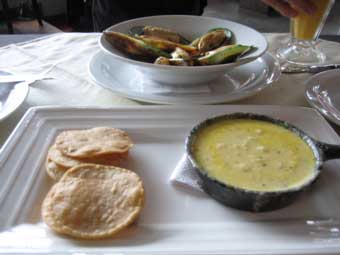 Click here to read the full review |
| Festivals ... |
|
Quepos to get it's own international music festival  The
usually
sedate
sportfishing town of Quepos is awaiting a greater
inundation of visitors than usual this high season, as a gang of rock
bands will descend on it for aclaim will put Quepos
on the
international music festival map. The
usually
sedate
sportfishing town of Quepos is awaiting a greater
inundation of visitors than usual this high season, as a gang of rock
bands will descend on it for aclaim will put Quepos
on the
international music festival map.Experienced American promoters and their rock star friends have taken a gamble on the festival, even though they said they were warned that it was doomed to failure by prominent Costa Rican promoter Marvin Cordoba. Five American bands, a Panamanian group and a Canadian band will be flown in to play alongside a line-up of around 10 Costa Rican bands that is rumored to include both Gandhi and Malpaís, currently the country's most popular home-grown talent. Read more here |
First International Blues Festival Texas blues bands are heading down to Santa Ana for an afternoon of live music. BBQ's and cold beers will accompany artists including Smokin Joe Kubek & Bnois King and Robbie Clarke & the Live Wire Blues Band. Two stages at Motorpsychos Bar and Grill will host a total of seven bands during the afternoon of Feb. 9. Tickets cost $25 and can be found by contacting www.bluesdevilsband.com. Identidad Art Festival Fifty artists will have the enviable job of displaying their work on a warm beach in Guanacaste this February, as part of the Identidad Art Festival. Hosted by Playa Conchal Reserve, the festival aims to revive the cultural values of the area, promoting local art as a tourist attraction. Painters, sculptors and musicians are all welcome to participate and show of Costa Rican talent to the high season tourists during Feb. 2-4. Organisers Jaguart are on the lookout for artists to participate in the show. Interested parties should visit the site www.myspace.com/identidadartfest |
| Some points to consider as you move up to higher-limit games | |
| Many
players think about competing in higher stakes games. It’s a
natural
progression as your skills improve, yet there’s still a lot to consider
when moving up in limits. The first thing to think about is whether you’re truly capable of winning in bigger games. With rare exceptions, you’ll be facing better quality players as you move up to higher limits. So before you even consider jumping to that next level, be honest with yourself about how you fare at your current stakes. Keeping records is a must. It’s the only way you’ll accurately know how well you’re doing in a particular game over the long run. If you determine that you win handily and regularly at your current limit, then you just might be ready to take that next step. Here are a few guidelines to follow when you do make the jump to higher limits. Play shorter sessions. To play effectively in higher stakes games, especially in your first few outings, play shorter sessions. You simply can’t play at a peak performance level if you’re mentally or physically fatigued. If you normally sit for 8 to 10 hours at your current game, don’t play for more than 4 to 6 hours at the higher stakes game until you start to feel comfortable. Decide on a loss limit and stick to it. One of the key reasons players fail when they move to higher limits has less to do with talent and more to do with pressure. In higher stakes games, players must be able to endure bigger financial swings. A few bad beats can send even the best players on tilt. Even worse, an unexpected loss can quickly erode your poker confidence and turn you into a scared-money player. To combat this effect, make sure to set a loss limit that you can handle both emotionally and financially. If you lose that money, even if it’s in the first 10 minutes, get up and leave. For example, if you normally play $5-$10 no-limit hold’em but decide to step it up to $10-$20, don’t risk more than your initial buy-in. A $2,000 loss limit might be appropriate for some, but it’s important to set a limit that’s right for your own situation and playing ability. Whatever your loss limit, it’s critical that you stick to it! For that, you’ll need self-control. If you don’t trust yourself, never bring more money than your loss limit as this will |
 prevent you from impulsively buying additional chips. Take a walk back to your hotel before you thoughtlessly decide to reload your wallet. The fresh air just might knock some needed sense into you. Play a low fluctuation style of poker. If the game you’re thinking about jumping into appears to be fast-paced with crazy action, don’t play. Instead, look for a game that’s more controllable when you decide to step up to higher limits. This way you can comfortably get your feet wet and play a patient game. It’s important to play cautiously in your first higher limit sessions. Don’t make overly aggressive or tricky plays. Remember, your realistic goal is to not lose big. Use this new experience to get accustomed to the higher stakes and to pick up on your opponents’ styles and tendencies. Only after you’ve logged some hours playing at higher stakes should you take chances with bluffs and more aggressive play. Here’s one final point. Determine your own motivation for playing higher limit poker. Is it ego, the desire to improve your game against better competition, or is it simply about making more money? If it’s all about the money, consider that you might actually do better playing small limit games against weak opponents than you would facing advanced players in high limit games. Picking the right game is just as important as playing well. Visit www.cardsharkmedia.com/book.html for information about Daniel Negreanu’s new book, "Hold’em Wisdom for All Players." © 2007 Card Shark
Media. All rights reserved.
|
|
|
|
|
|
|
|
|
|
|
|
|
| What we published this week: | Monday | Tuesday | Wednesday | Thursday | Friday | Earlier |
|
|