|
|
A.M. Costa Rica
Your daily English-language news source Monday through Friday |
||
 |
 |
 |
|
|
 |
||||||||||||||||||||||||
|
|
|||||||||||||||||||||||
 |
||||||||||||||||||||||||
 |
||||||||||||||||||||||||
|
|
|||||||||||||||||||||||
 |
| What we published this week: | Monday | Tuesday | Wednesday | Thursday | Friday | Earlier |
|
|
|
|
|
|
|
Food |
|
Jo
Stuart |
|
Abstracts and fair use are permitted. Check HERE for more details |
| A.M. Costa Rica's Second news page | |||||||||
| San José, Costa Rica, Monday, Jan. 14, 2013, Vol. 13, No. 9 | |||||||||
|
|
|
|
|
|
|
Food |
|
 |
 |
|
Constitutional amendment
is unlikely on firearm rights Dear A.M. Costa Rica: The Bill of Rights is an American citizen’s protection against our own government. It was established by very wise men who understood the dangers of tyranny. They considered this protection so important that they separated it from the rest of the Constitution. They set it apart as if to say: “Look here first!” The right to bear arms is guaranteed for all of us. Can we limit it? Certainly, just as we have limited other rights (free speech does not mean you can yell Fire in a crowded theater). Can we eliminate it? Not without a constitutional amendment, a lengthy process at best (I refer you to the Constitution itself for the process). Can the president use executive powers to limit gun ownership? Unlikely; again, see the Constitution. Can we keep firearms out of the hands of criminals and other persons with evil intent? Not in a free country. Can we limit access, require more background checks, require sellers at gun shows and shops to stop direct, walk-away sales until a background check is complete? We can probably legislate all those, but can we enforce them? Personally, I would like to see a ban on AK-47s and other assault weapons, even though the last ban, in place for about 10 years, did nothing to stop the violence. Do we own weapons? Not in Costa Rica, but we owned hunting rifles and shotguns in the States, and I trained with handguns, although we moved here before I filed for my carry permit. So, where are we? A constitutional amendment? Lengthy and doubtful, as 34 states would have to ratify it even if it passed the House and Senate. A constitutional convention? Both parties are afraid of the outcomes if a convention is called as conventioneers do not have to limit what they discuss and propose. Legislation to require deeper background checks and other delays of sales plus a ban on assault rifles may be the only option. But what about enforcement? In the end, do we really want to tinker with the Bill of Rights? Do we really want to ignore the framers of the Constitution when they said: “Look here first!”? Victoria
Torley
Aguacate Another quake near Nicoya By
the A.M. Costa Rica staff
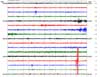
An earthquake estimated in magnitude to be from 4.1 to 4.3 took place at 3:05 p.m. Sunday on the Nicoya peninsula west of the community of Nicoya. The Laboratorio de Ingenieria Sismica at the Universidad de Costa Rica said the magnitude was 4.3. The Observatorio Vulcanológico y Sismológico de Costa Rica at the Universidad Nacional in Heredia said the magnitude was 4.1. In any case, the Laboratorio said the quake was felt along much of the Pacific coast of the peninsula. That area still is feeling replicas from the 7.6 magnitude quake Sept. 5. The Sunday quake was the strongest since a 4.7 quake Christmas Eve just south of Nosara.
|
|||||||||||||||||||||||||||||||||||||||||||||||||||
 |
||||||||||||||||||||||||||||||||||||||||||||||||||||
|
|
|
|
|
|
|
Food |
|
| What we published this week: | Monday | Tuesday | Wednesday | Thursday | Friday | Earlier |
| The contents of this page and this Web site are copyrighted by Consultantes Río Colorado S.A. 2013 and may not be reproduced anywhere without permission. Abstracts and fair use are permitted. Check HERE for details | ||||||
 |
A.M. Costa Rica Third News Page |
 |
| San José, Costa Rica, Monday, Jan. 14, 2013, Vol. 13, No. 9 | |
|
|
|
|
|
|
|
Food |
|
| Carribbean resident calls for action
against crime wave there |
|
|
By
Carol Meeds*
Special to A.M. Costa Rica "Potholes to Paradise" is the name of a book about Costa Rica. It captures the way it used to be in Costa Rica 10 years ago where the biggest inconvenience was the bad roads — potholes! Now Paradise is experiencing a civil war! It is the thieves vs. the capitalists! The thievery has gotten to be the national pastime at least here in this part of the Caribbean Coast of Costa Rica. In the land where government officials accept bribes, anything less than $200 is not enough to report as a theft. That makes it just great for kids to start looking for wallets and purses on the beach and on the porches of the tourist cabinas. They have since graduated to much more violent crime. The capitalists are the people who have come here to make a living off of the tourists. They run rental cabinas and tour packages and restaurants and bars and want to keep the tourists coming, so they do not say anything about the thieves! Years ago, when the Potholes book was written, there were locals who rented out rooms and cabinas during peak times to make some money. The structures were built with very low cost and weak materials. But it was like beach camping, and people loved their back-to-nature experience. Now those same flimsy cabinas offer multiple points of access for thieves. The Puerto Viejo Open Forum has been abuzz with the crimes here. Most recently in the last two days university students who came to help were robbed while they slept in their dorms. A couple on bikes with their child was robbed by two thugs with guns held to the head of their son. Homes are watched from the woods for days until an unlucky |
family all go out to the porch to
look at the
evening and are forced into their homes and beaten and robbed. Tour buses to Tortuguero are held up and shot up! Rapes both violent and the date rape something-in-the-drink kind occur daily! And yes, even murders! The government is not helping. The system is set up so that in order for a crime to be acknowledged by the government, a formal report must be made to the Office of the Inspector General in Bribri. Bribri is a lonely bus trip away from the beach, and the beach is where the crime happens. There is a police station there, but it is not there to do any good. They cannot investigate crime nor can they report it to the system. They have refused to help people under attack in the bar next door to the police station. Another part of the system is the politeness of the local people. They do not like conflict or confrontation. Many, many of these thieves are known by their relatives and neighbors who keep quiet. Silence is consent! I ask all of my neighbors to be silent no more. It is time to let the thieves know that they are not welcome and to let the government know that we want help! If you agree, write a letter and make a statement too! •Ms. Meed is a resident of Puerto Viejo de Talamanca. EDITOR'S NOTE: Although there is ample evidence that the crimes mentioned here did take place, staffers at the central office of the Judicial Investigating Organization said they had no records and were unable to obtain information from offices on the Caribbean coast. |
| A.M. Costa Rica indisputably best read
news site, data shows |
|
|
By
the A.M. Costa Rica staff
A.M. Costa Rica is indisputably the best read online English-language news source in Costa Rica, according to Alexa, the Amazon.com company that keeps track of this type of data. This Sunday Alexa said that A.M. Costa Rica was ranked at No. 93,888 in the world and No. 89 in Costa Rica. Facebook, Google and youTube continue in positions one, two and three in the world, according to Alexa. The Tico Times had a 109,824 world rank and a rank of 226 in Costa Rica, according to Alexa. A.M. Costa Rica showed a 10 percent increase in readers over the last seven days and a 5 percent increase over the last three months, said the company. Alexa said that the readership of The Tico Times dropped 16.4 percent in the last month and went down 10.3 percent over the last three months. All other English language Web sites in Costa Rica are far lower than The Tico Times by tens of thousands of positions. One supposed news site has a world rank of 1,669,979, said Alexa. By contrast, La Nación, the leading Spanish language online news source in Costa Rica has a world rank of 8,343 and a Costa Rica rank of 8. The comparison became possible because The Tico Times ended its print edition last Sept. 28 and now publishes only to the Internet, as A.M. Costa Rica has done since 2001. Alexa measures Internet activity with an inferential statistical technique that counts visitors. Says the company: "In addition to the Alexa crawl, which tells what's on the web, Alexa employs web usage information, which tells us what's being seen on the web by real people. This information comes from our community of Alexa Toolbar users. Each member of the community, in addition to getting a useful tool, is giving |
back. Simply by using the toolbar,
each member contributes valuable information about the web, how it is
used, and what is important and what isn't. This information is
returned to the community with improved related links, traffic ranks,
and more." Although publishers can manipulate Alexa in the short run, the general worldwide trends of Web pages are fairly solid. A.M. Costa Rica also employes the paid services of StatCounter, an Irish firm which counts Web usages. Each page of A.M. Costa Rica contains a small bit of java code that alerts StatCounter when a reader downloads a page. StatCounter reports that A.M. Costa Rica served up 38,251 pages to readers Thursday and 36,589 Friday. These were the last two days of publication. StatCounter also said that there were 13,115 unique visitors Thursday and 12,487 Friday. A.M. Costa Rica advertising executives frequently encourage clients to sign up for StatCounter's free service for smaller Web sites so that the client can clearly see the impact of A.M. Costa Rica advertising. When The Tico Times also maintained a print edition, the actual number of readers was unclear because there were Internet readers of the electronic site and readers of the paper product. The Tico Times did not make public a detailed report based on third-party accounting. Readership numbers are important to advertisers who hope to market their products. Equally important is the demographics of the readers. Since the beginning, A.M. Costa Rica has attracted Internet savvy readers who most likely have disposable income for advertisers' products. In addition perhaps as much as 60 percent of A.M. Costa Rica readers are outside this country, mainly in the United States, Canada and Europe, thanks to the reach of the Internet. A.M. Costa Rica advertising executives also encourage potential clients to check the rankings of this newspaper and that of supposed competitors in order to make an informed decision. |
 |
| You need to see Costa Rican tourism information HERE! |
|
|
|
|
|
|
|
Food |
|
| What we published this week: | Monday | Tuesday | Wednesday | Thursday | Friday | Earlier |
| The contents of this page and this Web site are copyrighted by Consultantes Río Colorado S.A. 2013 and may not be reproduced anywhere without permission. Abstracts and fair use are permitted. Check HERE for details | ||||||
 |
|
||||
| A.M. Costa Rica's Fourth News page | |||||
| San José, Costa Rica, Monday, Jan. 14, 2013, Vol. 13, No. 9 | |||||
|
|
|
|
|
|
|
Food |
|
 |
| Drug arrests dominate police actions at
Palmares festival |
|
|
By
the A.M. Costa Rica staff
Police officials are enforcing a zero tolerance against drugs of any kind in and around the grounds where the Festejos Palmares 2013 is taking place. The Fuerza Pública said Sunday that 154 persons had been detained there and that 128 face allegations of breaking drug laws. Police said they confiscated marijuana, cocaine, crack and even a tablet they think is ecstasy. About 80 persons were detained through the tope horse parade Thursday. There were only a few persons held for theft and a half dozen facing open arrest warrants. The festival runs until Jan. 21, and police have a strong presence on the grounds and the adjacent area. Some residents of Palmares complain that the annual festival brings crooks and other criminals into the community and that break-ins and burglaries are an annual byproduct of the carnival. One carnival goer said that a family member who lives near the carnival grounds had a camera snatched by a man on a motorcycle while he was taking photos of the horse parade. Police said Sunday that those attending the event should leave |
 Ministerio de Gobernación,
Policía
The bags contain evidence,
mostly drugs, confiscated at they Seguridad Pública photo Palamares festival. valuable articles and large sums of money at home. The weekend report is not in yet, but the traffic police said late last week that they had snagged two drunk drivers coming from the carnival. |
| Six die when truck collides and crushes
car in Guanacaste |
|
|
By
the A.M. Costa Rica staff
Six persons died when a truck hit a car in northwestern Costa Rica late Saturday. The dead all were in one car and were returning from a birthday party. The Judicial Investigating Organization detained the truck driver and said that he had more than 1.70 grams of alcohol per liter in his system. He is facing criminal charges. The six persons were three married couples. Four were in their |
20s and two were in their early 30s,
said the Judicial agency. The truck involved was a tractor trailer with a hopper trailer. The truck was loaded with gravel and headed to Peñas Blancas at the Nicaraguan border. The car was headed to La Cruz de Guanacaste. The truck appears to have entered the opposing lane on the two-lane road and collided with the car. Both vehicles went off the road and the truck rolled on the car and dumped its load of gravel on the victims. The car was reduced to basically just its frame. The highway was closed to traffic for six hours. |
|
|
|
|
|
|
|
Food |
|
| What we published this week: | Monday | Tuesday | Wednesday | Thursday | Friday | Earlier |
| The contents of this page and this Web site are copyrighted by Consultantes Río Colorado S.A. 2013 and may not be reproduced anywhere without permission. Abstracts and fair use are permitted. Check HERE for details | ||||||
| A.M. Costa
Rica's Fifth news page |
 |
||||||||
| San José, Costa Rica, Monday, Jan. 14, 2013, Vol. 13, No. 9 | |||||||||
|
|
|
|
|
|
|
Food |
|
 |
|
|
| Epidemiologist
says his site shows flu wave in decline By
the A.M. Costa Rica wire services
As influenza season peaks in the United States, one researcher is working to bring the public into tracking the epidemic. Using new technology, he may be able to provide public health officials with useful information more quickly than the usual methods. And he is applying the new tools to study disease outbreaks around the world. Boston Children's Hospital epidemiologist John Brownstein is literally pinning down where the flu outbreak is occurring. “All the pins represent the people who are reporting to the system," he said. The sea of pins on his virtual U.S. map represents the nationwide network of volunteers for his Web site, Flu Near You. "The idea is, getting people with a small amount of time each week to tell us how they're feeling," he said. A short weekly email survey asks each person about his or her health. In just a few months, Flu Near You has recruited 40,000 volunteers and keeps growing. “So we say, putting the public back in public health," said Brownstein. Hospitals and doctors' offices were seeing rising numbers of flu cases in late December, according to the Centers for Disease Control and Prevention, or CDC. But Brownstein says he is ahead of the others in terms of information. “And Flu Near You is showing that we've already peaked and are heading down. And in fact the latest numbers that are coming out from the CDC actually agree that this has already come down," he said. Brownstein plans to take the system global and expand it to other diseases. He currently runs another Web site, HealthMap, that for seven years has tracked outbreaks worldwide. He says as a graduate student he grew weary of begging health ministers for information. “And so we had this idea, well, what if we mined the Web looking for clues about outbreaks via news, social media, blogs, chat rooms, discussion forums," he said. In Haiti's deadly 2010 cholera outbreak, HealthMap's automated Web searches provided early information on the trajectory of the disease. Today, he is following an ebola outbreak in Uganda. “We think there's opportunities to really track emerging infectious diseases with these tools," he said. Miss New York takes title at Miss America pageant By
the A.M. Costa Rica wire services
A 23-year-old New Yorker has won the Miss America crown. Mallory Hagan won the beauty pageant held Saturday at the Planet Hollywood Resort and Casino on the Las Vegas Strip. Ms. Hagan captured the pageant's top prize after tap dancing to James Brown's "Get Up Off of That Thing" in the contest's talent competition. She also answered a question about whether armed guards should be placed in schools in the wake of last month's deadly shooing spree in Newtown, Connecticut. Her reply was violence should not be fought with violence. Ms. Hagan won a $50,000 college scholarship. She is expected to spend her title year-long reign on a nationwide speaking tour and raising money for the Children's Miracle Network, Miss America's official charity. She finished ahead of Miss South Carolina, Ali Rogers, who took second place, and Miss Oklahoma, Alicia Clifton, who finished third. Ms. Hagan also came out ahead of several other notable competitors whose life stories grabbed headlines this year. Miss District of Columbia, Allyn Rose, has decided to have a double mastectomy to reduce her risk of breast cancer, the disease that killed her mother, grandmother and great aunt. Miss Montana, Alexis Wineman, was the pageant's first autistic contestant. Miss Iowa, Mariah Cary, has Tourette's syndrome, a neurological disorder whose symptoms include multiple involuntary motor and vocal tics. Miss Wyoming, Lexie Madden, once wrestled pigs for scholarship money. Rights group tells Venezuela to end censorship on Chávez By
the A.M. Costa Rica wire services
A human rights group says Venezuela should stop the censorship and intimidation of media that challenge the government's line on President Hugo Chávez's health and inauguration. Chávez has not been seen in public or heard from since undergoing his fourth cancer surgery in Cuba Dec. 11. Human Rights Watch says CONATEL - the government-controlled telecommunications agency - ordered television station Globovision on Jan. 9 to stop airing four spots and similar transmissions criticizing the government's position about whether a presidential inauguration could take place on Jan. 10, the date stipulated in the Constitution, without the president's presence in Venezuela. Human Rights Watch says CONATEL justified its move against Globovision by citing Venezuelan broadcasting law prohibiting the transmission of material that "foment anxiety in the population or threaten public order." The rights groups says CONATEL has opened an investigation into the Globovision spots that could result in sanctions. The group says Globovision is the only remaining television station that is consistently critical of the president's policies. Human Rights Watch said Globovision is already facing six other investigations and has received one sanction that carried a heavy fine. Another fine could result in the suspension of Globovision's transmission or the revocation of its license, Human rights Watch said. Human Rights Watch said the national intelligence police searched the home of Federico Medina Ravell Jan. 6. The rights group said the businessman has been repeatedly denounced on state television as the suspected author of Tweets questioning information the government has provided on President Chávez's health. Medina, who was not home during the search, said intelligence agents detained his wife and children for several hours and took two computers from his home. The attorney general's office said Medina is under investigation for "instigating terrorism in social networks." Jose Miguel Vivanco, the Human Rights Watch Americas director, said "it would be outrageous if a blogger was prosecuted on terrorism charges for questioning official information about the president's health." |
|
|
|
|
|
|
|
|
Food |
|
| What we published this week: | Monday | Tuesday | Wednesday | Thursday | Friday | Earlier |
| The contents of this page and this Web site are copyrighted by Consultantes Río Colorado S.A. 2013 and may not be reproduced anywhere without permission. Abstracts and fair use are permitted. Check HERE for details | ||||||
| A.M. Costa
Rica's sixth news page |
|
||||||||
| San José, Costa Rica, Monday, Jan. 14, 2013, Vol. 13, No. 9 | |||||||||
|
|
|
|
|
|
|
Food |
|
 |
Latin America news |
Wife in court
today in case
of murder of John Bender By
the A.M. Costa Rica staff
Ann Patton, the wife of John Félix Bender, goes on trial today for his murder. Bender died Jan. 8, 2010. Both lived relatively secluded lives on the couple's 5,000-acre Refugio de Vida Silvestre Boracayán in La Floridad de Barú de Peréz Zeledon. Their home was a dramatic, five story 8,000-square-foot glass-walled home on the property. Bender earned in excess of $600 million with a mathematical approach to Wall Street investing. He ran several arbitrage funds before suffering a stroke in 2000, according to online sources. Mrs. Bender, who is a Brazilian naturalized as a U.S. citizen, was detained shortly after the death. Bender died from a bullet to the head at his home. Initially investigators suspected suicide, but they said they found inconsistencies in the way the body lay and other factors. One factor is that Bender was left-handed and he suffered a bullet wound to the right temple. The trial is expected to run for four days and see testimony from 25 witnesses, said the Poder Judicial. The case is in the Tribunal Penal de Pérez Zeledón. Another factor is the discovery of great numbers of jewels at the home. Although they were not searching for jewelry, agents of the Judicial Investigating Organization confiscated boxes of jewels. The material includes loose stones and fully produced bracelets and watches. The jewels may be unrelated to the murder investigation, but agents said at the time that import taxes may not have been paid on the material. Ruta 32 will be closed for painting of new lines By
the A.M. Costa Rica staff
Road officials said that workmen will be repainting the lines on Ruta 32 starting at 9 a.m. today. The work will be in three stages, and the first is to the Zurquí tunnel. The Consejo Nacional de Vialidad said that to do the job the road must be closed. The work will run from 9 a.m. to 1 p.m. until next Sunday. The job is a 169 million-colon contract, or about $338,000. |
|
Latin
American news feeds are disabled on archived pages.
|
|
| Costa Rican News |
AMCostaRicaArchives.com |
Retire NOW in Costa Rica |
CostaRicaReport.com |
|
|
|
|
|
|
|
Food |
|
| What we published this week: | Monday | Tuesday | Wednesday | Thursday | Friday | Earlier |
| The contents of this page and this Web site are copyrighted by Consultantes Río Colorado S.A. 2013 and may not be reproduced anywhere without permission. Abstracts and fair use are permitted. Check HERE for details | ||||||
| A.M. Costa Rica Seventh Newspage |
|
| San José, Costa Rica, Monday, Jan. 14, 2013, Vol. 13, No. 9 | |
|
By the Jet Propulsion
Laboratory news staff
Scientists at the space agency's Jet Propulsion Laboratory in Pasadena, California, have ruled out the possibility the asteroid Apophis will impact Earth during a close flyby in 2036. The scientists used updated information obtained by NASA-supported telescopes in 2011 and 2012, as well as new data from the time leading up to Apophis' distant Earth flyby Wednesday. Discovered in 2004, the asteroid, which is the size of three-and-a-half football fields, gathered the immediate attention of space scientists and the media when initial calculations of its orbit indicated a 2.7 percent possibility of an Earth impact during a close flyby in 2029. Data discovered during a search of old astronomical images provided the additional information required to rule out the 2029 impact scenario, but a remote possibility of one in 2036 remained — until yesterday. "With the new data provided by the Magdalena Ridge at the New Mexico Institute of Mining and Technology and the Pan-STARRSat the University of Hawaii optical observatories, along with very recent data provided by the Goldstone Solar System Radar, we have effectively ruled out the possibility of an Earth impact by Apophis in 2036," said Don Yeomans, manager of NASA's Near-Earth Object Program Office at the Jet Propulsion Laboratory. "The impact odds as they stand now are less than one in a million, which makes us comfortable saying we can effectively rule out an Earth impact in 2036. Our interest in asteroid Apophis will essentially be for its scientific interest for the foreseeable future." The April 13, 2029, flyby of asteroid Apophis will be one for the record books. On that date, Apophis will become the closest flyby of an asteroid of its size when it comes no closer than 19,400 miles (31,300 kilometers) above Earth's surface. "But much sooner, a closer approach by a lesser-known asteroid is going to occur in the middle of next month when a 40-meter-sized asteroid, 2012 DA14, flies safely past Earth's surface at about 17,200 miles," said Yeomans. "With new telescopes coming online, the upgrade of existing telescopes and the continued refinement of our orbital determination process, there's never a dull moment working on near-Earth objects." NASA detects and tracks asteroids and comets passing close to Earth using both ground and space-based telescopes. The Near-Earth Object Observations Program, commonly called "Spaceguard," discovers these objects, characterizes a subset of them and plots their orbits to determine if any could be potentially hazardous to the planet. The Near-Earth Object Program Office manages the technical and scientific activities for NASA's Near-Earth Object Program of the Science Mission Directorate in Washington. Unemployment fraud balanced by uncollected benefits, study says By
the Concordia University news staff
Employment insurance is a vital safety net for the unemployed across North America, yet some take advantage of the system. Recent headlines have made much of a recent report from the U.S. Department of Labor that 11 per cent of all unemployment benefits were overpaid between 2009 to 11. But new research from Concordia University proves that uncollected benefits represent a much larger dollar figure than overpayments. In a study commissioned by the St. Louis Federal Reserve Bank, a Concordia economics professor, David Fuller, examined the U.S. unemployment insurance system's expenditures from 1989 through 2011. With the help of Concordia colleague Damba Lkhagvasuren, Fuller and his co-authors crunched the numbers and proved that overpayments represent a far smaller amount than uncollected benefits. These benefits may be unclaimed due to any number of reasons; from employees being unaware that they’re eligible to individuals believing their unemployment will be too short-lived to justify making a claim. “Some of the unemployment benefit payments were indeed overpayments, as was widely reported by the media,” says Fuller. “These overpayments could stem from simple typographical mistakes on one extreme to outright fraud on the other. For example, an individual's benefit may be accidentally set too high because the wrong formula was used. Deliberate acts of fraud, on the other hand, represented roughly a fourth of the total overpayments during 2007-2011.” When the data is examined over a longer time period, the figures seem less alarming, with overpayments representing less than one-tenth of the benefits paid and overpayments due to fraud less than 3 per cent of the benefits paid. Compare that to unclaimed benefits in the same time period, which are nearly seven times the overpayments. Although cracking down on overpayments would clearly help reduce expenditures for unemployment insurance programs, a higher fraction of eligible people choosing to collect unemployment benefits would significantly increase those expenditures. “On average,” says Fuller, “only 63 per cent of the unemployed eligible for benefits in the U.S. have been collecting them over the past 22 years. If all of those who are eligible for unemployment benefits were to start collecting those benefits, as could easily happen if the U.S. continues to have high unemployment, the additional expenditures could be massive.” Fuller believes the financing structure in the U.S. contributes to the fact that not all those who are eligible actually collect benefits. “In the U.S., benefits are financed by taxes levied on firms,” explains Fuller. “So the firm you work for essentially pays for your benefits.” Compare that to Canada, where workers finance unemployment benefits via a payroll deduction. “That means that Canadians might be inherently more inclined to take advantage of a system that they are directly helping to maintain,” says Fuller, who plans to undertake a similar analysis of unemployment benefits in Canada. “I expect that more unemployed Canadians collect just due to the differences in financing. In addition, benefits tend to be more generous in Canada, which would also tend to increase the number of those eligible who collect.” Concordia is based in Montreal, Quebec. A partner during middle age reported as key to longivity By
the Springer news staff
Could marriage and associated companionship be one key to a longer life? According to new research, not having a permanent partner, or spouse, during midlife is linked to a higher risk of premature death during those midlife years. The work, by Dr. Ilene Siegler and colleagues from Duke University Medical Center in the US, is published online in Springer's journal Annals of Behavioral Medicine. Survival through middle age to become elderly is expected. Therefore understanding who does not survive to become elderly and why is important. Ms. Siegler and colleagues looked at the effect of marriage history and timing of marriage on premature death during midlife. They were also interested in testing the role of pre-marital personality and quantifying the role of health behaviors. The researchers analyzed data for 4,802 individuals who took part in the University of North Carolina Alumni Heart Study, an ongoing study of individuals born in the 1940s. The authors were particularly interested in stability and change in patterns of marital and non-marital status during midlife, controlling for personality at college entry (average age 18), socioeconomic status and health risk behaviors. They found that having a partner during middle age is protective against premature death: those who never married were more than twice as likely to die early than those who had been in a stable marriage throughout their adult life. Being single, or losing a partner without replacement, increased the risk of early death during middle age and reduced the likelihood that one would survive to be elderly. Even when personality and risky behaviors were taken into account, marital status continued to have a major impact on survival. The authors conclude: "Our results suggest that attention to non-marital patterns of partnership is likely to become more important for these Baby Boomers. These patterns appear to provide different levels of emotional and functional social support, which has been shown to be related to mortality. Social ties during midlife are important to help us understand premature mortality." |
|
| What we published this week: | Monday | Tuesday | Wednesday | Thursday | Friday | Earlier |
| The contents of this page and this Web site are copyrighted by Consultantes Río Colorado S.A. 2013 and may not be reproduced anywhere without permission. Abstracts and fair use are permitted. Check HERE for details | ||||||