|
 |
Your daily |
 |
|
|
|
|
|
|
|
|
|
|
|
|
||||||||||||||
|
|
||||||||||||||

| A.M. Costa Rica Second newspage |
 |
||||||||
| Home |
Tourism |
Calendar |
Classifieds |
Entertainment |
Real
estate |
Rentals |
Sports |
About us |
|
|
|
|||||||||
 |
| Costa Rica Expertise Ltd http://crexpertise.com E-mail info@crexpertise.com Tel:506-256-8585 Fax:506-256-7575 |
 |

Click HERE for
great
hotel discounts
|
|
High court rips practices
of two local banking entities By the A.M. Costa Rica staff
Two banks got a legal spanking by the Sala IV constitutional court in decisions released Wednesday. Magistrates criticized BAC San José for an abuse of power in arbitrarily closing a commercial customer's checking accounts. Banco Popular was blamed for reporting a loan customer as being in default even though he had paid off the debt. In the BAC case the bank sent letters to a firm saying that it would be closing the checking accounts. The administration of the firm sent a reply asking why, but the bank never replied, said the summary of the case issued by the Poder Judicial. The court said that the firm was not allowed to exercise its power of self defense and was not given due process. The bank was ordered to pay costs and damages. In the Banco Popular case, the summary said that the borrower came into some money after taking out a 5 million-colon mortgage and paid off the loan. Nevertheless, the next time he sought another loan, the bank said he was in serious default and that he had been reported to the Superintendencia de Entidades Financieras. Although he tried to have his problem resolved at the bank, no one there was able to do it, said the decision. Earthquake rattles homes in vicinity of Volcán Poás By the A.M. Costa Rica staff
A 4.0 magnitude earthquake struck at 10 a.m. Wednesday in the vicinity of Volcán Poás and was felt in varying degrees in much of the country. The epicenter was about 6 kilometers east of the volcano, some four miles. A local fault got the blame from the Observatorio Vulcanológico y Sismológico de Costa Rica. The proximity to the volcano caused some concern among neighbors who thought that the volcano might be becoming more active. Some pictures and dishes were thrown to the floor in the area. Friendly robbers worked near driver testing site By the A.M. Costa Rica staff
A band of robbers has been befriending victims at the driver's examination center in Paso Ancho and then taking their belongings. Investigators attributed up to four robberies a day to the band. Two men, 17 and 26, were detained Tuesday, said investigators. One man was detained Wednesday. Agents expect more arrests. The facility operated by the Ministerio de Obras Públicas y Transportes is where individuals go to take a written and a practical driving test. The offices are several hundred feet from the main highway, and the robbers used to contact their victims in that area and offer to help them with paperwork. After winning the victim's confidence, the robbers would accompany them to the highway and then rob them, said investigators. The two persons detained Tuesday face at least five complaints, agents said. They would be put in a lineup so that victims could make identifications, agents said. Two men found dead in Cartago apartment By the A.M. Costa Rica staff
Two men presumed involved in the drug trade died of gunshot wounds in an apartment in downtown Cartago Wednesday. One had the last name of Marín and was 24 years old. The second man had the name of Arias and was 41, said the Judicial Investigating Organization. Investigators found marijuana and cocaine packaged for sale in the apartment and in a vehicle parked outside the building. Arias suffered a bullet wound to the back of his neck. Marín died from a bullet over the right eye, agents said. Investigators are considering the possibilities of a murder-suicide or a double murder. A .25-caliber pistol was found at the scene. Headset battery recalled because of possible short By the A.M. Costa Rica staff
The consumer section of the economics ministry has issued a warning about dangerous batteries in certain wireless headsets. These are the headsets frequently used in office settings and in call centers. The suspect batteries are of the lithium-ion type from ATL (ATL P/N 603028) used in GN9120 wireless headsets and sold from January 2005 through September 2008, said the ministry. These lithium-ion polymer batteries can overheat due to an internal short circuit in the batteries, which can pose a fire hazard, said the manufacturer, Jabra. A Web page has been set up to specify the recalled batteries and to show consumers how to make a replacement. The local recall notice came from the Dirección de Apoyo al Consumidor of the Ministerio de Economía, Industria y Comercio.
|
|||||||||||||||||||||||||||
 |
 |
| A.M. Costa Rica third newspage |
|||||||||
| Home |
Tourism |
Calendar |
Classifieds |
Entertainment |
Real
estate |
Rentals |
Sports |
About us |
|
|
|
|||||||||
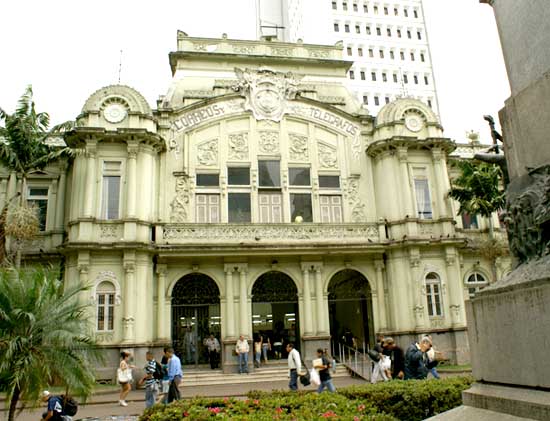
| The ornate Correos building is
from another time with its intricate decorations and creative
architecture. The building houses 15,000 postal boxes, a commemorative
stamp sales office, postal windows, package pickup and a postal museum
as well as administrative offices. |
 A.M. Costa Rica/José Pablo
Ramírez Vindas
|
|
Downtown Correos landmark
about to get a makeover
|
|
|
By José Pablo Ramírez Vindas
of the A.M. Costa Rica staff When you are pushing 100 years, a few cracks and weaknesses are expected, especially if you are the main post office building downtown. The symbol of a slow life in pre-World War I 20th century will need 100 million colons, about $180,000, in repairs just for the exterior. The money will come from the Salvemos nuestro patrimonio arquetectonico program of the Ministerio de Cultura, Juventud y Deportes. Sergio Arguedas of the firm Consultécnica is the architect in charge of the design and the execution of the restoration of the building's facade. No big changes are expected. Arguedas said that the job mostly will be in fixing the many cracks, reconstructing damaged sections and painting the facade with a color different than the current institutional green. At the same time the postal service, the Correos de Costa Rica, has plans to refurbish the interior of the building, which was built between 1914 and 1917. That job will cost about 300 million colons, said Arguedas. That's about $540,000. The architect said that the starting date still has not been |
 A.M. Costa Rica/José Pablo
Ramírez Vindas
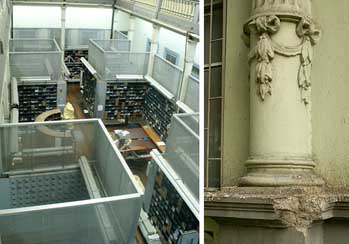
Some of the postal boxes and a damaged columndetermined because the job still is being advertised for bids. But he estimated that the work would take about four to six months. The building gets at least 1,000 visitors a day, and it hosts 15,000 postal boxes. It is immediately east of the main Banco Nacional de Costa Rica skyscraper and faces a small park and the Club Union building between Avenida Central and Avenida 1. A spokesperson for Correos, Ileana Sandí Corrales, said that the building probably would be closed during some of the work. |
|
Rights group rebuts academics
over critical report on Chávez
|
|
|
By the A.M. Costa Rica staff
More than 100 scholars and experts on Latin America, including Noam Chomsky of Massachusetts Institute of Technology, have sent a critical letter to Human Rights Watch on that organization’s highly critical report on the human rights situation in Venezuela and the conduct of its president, Hugo Chávez. In reply, the New York-based Human Rights Watch has issued a point-by-point rebuttal. Human Rights Watch and the initial report's lead author José Miguel Vivanco published a grossly flawed report and acknowledged a political motivation in doing so, and Mr. Vivanco has undermined the credibility of an important human rights organization,” the Dec. 16 letter from the academics said. Human Rights Watch published "A Decade Under Chávez: Political Intolerance and Lost Opportunities for Advancing Human Rights in Venezuela." Vivanco, a Chilean and Latin American director of the organization, and a colleague were expelled from Venezuela Sept. 18 after they tried to give a press conference outlining the major points of the report. The letter from the academics said that the report makes sweeping allegations that are not backed up by supporting facts or in some cases even logical arguments. The academics said that the report relied on opposition sources like the newspapers El Universal and El Nacional or Súmate, and that "these sources have engaged in enough fabrications as to make them unreliable sources for factual material." Súmate is a Venezuelan non-governmental volunteer organization. The academics asked that the report be withdrawn and |
revised. Gregory
Wilpert, adjunct professor of political science at Brooklyn College,
was one of three authors of the academics' letter. He publishes Venezuelanalysis.com. Chávez has been characterized elsewhere as an authoritarian figure who is using his country's oil wealth to hold his political position and to counter the United States influence in the region. The Human Rights Watch rebuttal, which became available Wednesday, if true, raises serious questions about the scholarship of those who signed the original letter. It also shows significant pro-Chávez sentiment on U.S. campuses and elsewhere. Said Human Rights Watch: "After a careful review, we have found that the allegations in your letter do not stand up to scrutiny. The issues covered in our report have been thoroughly researched and the substantive findings are based on a wide range of diverse and credible sources. In seeking to prove otherwise, you have misrepresented both the substance and the source material of the report. You have criticized us for making arguments that we have not made. You have taken our words out of context . . . and distorted their meanings in order to make your points." The letter was signed by Kenneth Roth, Human Rights Watch executive director. He noted that the report had 754 footnotes. Chavez is trying to institute a socialist revolution in Venezuela and he has forged a loose alliance with Evo Morales, president of Bolivia, and Rafael Correa, president of Ecuador. He also is a disciple of Fidel Castro and friendly with Iran's Mahmoud Ahmadinejad, All, of course, are hostile to the United States. Chávez also is the darling of the U.S. left because of his opposition to President George Bush. |
 |
 |
| You need to see Costa Rican tourism information HERE! |
| A.M. Costa Rica fourth news page |
 |
||||||||
| Home |
Tourism |
Calendar |
Classifieds |
Entertainment |
Real
estate |
Rentals |
Sports |
About us |
|
|
|
|||||||||
|
Press groups condemn grenade attack on México TV station
|
|
|
By the A.M. Costa Rica wire services
Press freedom groups are condemning an attack on a television station in northern Mexico and demanding a quick and thorough investigation of the incident. Tuesday, masked gunmen in two pickup trucks threw a grenade and opened fire on the studio of the Televisa network in Monterrey. No one was injured, but the attackers left behind a note warning the station about its coverage of drug gangs. The Inter American Press Association issued a statement Wednesday, saying it is clear that organized crime keeps sending such messages to generate fear and force the news media and individual journalists to resort to self-censorship. Paris-based Reporters Without Borders said the attack shows organized crime is targeting Mexico's local media. |
The Committee to Protect Journalists calls Mexico one of the world's
deadliest nations for journalists, with 21 killed since 2000. It says
drug traffickers are thought to be behind most of the slayings.
Drug-related violence in Mexico claimed more than 5,000 lives in 2008. In a report last year, the U.S.-based Committee to Protect Journalists said there is mounting evidence that local officials have punished journalists who report on the alleged links between government officials and drug gangs. The report said seven journalists have disappeared in Mexico since 2005 and many of them were in the process of investigating relationships between the government and organized crime. It said relatives and colleagues of several missing journalists said they believed local public officials played a role in the disappearances. |
|
Colombian terror group says it plans to release six hostages
|
|
|
By the A.M. Costa Rica wire services
The Colombian leftist terrorist group, the Fuerzas Armadas Revolucionarias, said it is willing to hand over six hostages but that it will only do so in the presence of an international representative. In a statement made public Wednesday, the Fuerzas Armadas said it wants someone from either a "brother country" or the international community to be present when it frees the hostages. Both the Fuerzas Armadas and the Colombian government say they will let someone from the International Committee of the Red Cross be on hand for the hostage release. But Colombian President Alvaro Uribe has said he does not want any other international participation. |
The rebel group has pledged to release two politicians — including Alan
Jara, who is a former governor held since 2001 — along with three
police officers and a soldier. The Fuerzas Armadas has said it would deliver the hostages to Piedad Cordoba, a Colombian opposition senator. Cordoba has been involved in previous efforts to secure the release of hostages held in jungle hideouts. In July, the Fuerzas Armadas was dealt a blow when a military operation freed 15 of its hostages, including French-Colombian politician Ingrid Betancourt and three Americans, without a shot being fired. The hostages were airlifted to safety by Colombian soldiers posing as fellow fighters who were assigned to move the prisoners. |
| News from
the BBC up to the minute |
BBC sports news up to the minute |
| BBC news and sports feeds are disabled on archived pages. |
|
| A.M. Costa Rica fifth news page |
|
||||||||
| Home |
Tourism |
Calendar |
Classifieds |
Entertainment |
Real
estate |
Rentals |
Sports |
About us |
|
|
|
|||||||||
|
for end of Cuba travel ban Special to A.M. Costa Rica
The United States should reinvigorate efforts to advance human rights and democracy in Cuba by lifting of U.S. legal restrictions on American citizen travel to the island, the organization Freedom House said Wednesday. Cuba has consistently received either the lowest or second-lowest ratings on political rights and civil liberties by Freedom House since it first began publishing the global Freedom in the World survey in 1972, the organization noted. Cuba’s citizens are denied most fundamental rights, including the right to elect their government, participate in political opposition, freely express their views, demonstrate, participate in trade unions, own property, travel, or access information free of government control, freedom House said. Since Raúl Castro succeeded his brother as leader of Cuba, some nominal reforms have been announced, though their impact on the lives of Cubans remains negligible, it added. “Cuba remains one of the most repressive countries in the world,” said Jennifer Windsor, executive director of Freedom House. “It is well past time to reassess a policy that impedes the ability of American citizens to freely interact with Cubans on a large scale and thus expose them to unfettered information about the outside world. We call on the incoming administration of Barack Obama to reexamine the embargo and to immediately lift the restrictions on remittances and travel to and from the island.” The United States first began introducing economic sanctions against Cuba in 1960 following that government’s seizure without compensation of U.S. assets on the island. Current U.S. sanctions, which strictly limit trade with Cuba to cash-only sales of U.S. farm products and medical supplies, are unique to all other U.S. sanction policies in that they also prohibit U.S. citizens from traveling to Cuba unless they obtain a U.S. government waiver. “While the Bush administration expanded American support for democracy activists in Cuba, U.S. policy would be even more effective if Americans were allowed to engage more freely with Cuban counterparts,” Ms. Windsor continued. “Those countries that have moved from dictatorship to democracy in recent decades have done so in large part because of the movement of people and ideas across borders.” The United States does not impose similarly restrictive travel sanctions on Americans to other regimes that receive Freedom House’s lowest freedom ratings, including Burma, Libya, North Korea, Somalia, Sudan, Uzbekistan, and Turkmenistan, Freedom House added. In fact, many U.S. citizens do travel to Cuba via México and even Costa Rica. But a visible few suffer sanctions when they return home. |
|
|
|
|
|
|
|
|
| What we published this week: | Monday | Tuesday | Wednesday | Thursday | Friday | Earlier |
|
|