|
 |
Your daily |
 |
|
|
|
|
|
|
|
|
|
|
|
|
|||||||||||
|
|
|||||||||||
 |
| A.M. Costa Rica Second newspage |
 |
||||||||
| Home |
Tourism |
Calendar |
Classifieds |
Entertainment |
Real
estate |
Rentals |
Sports |
About us |
|
|
|
|||||||||
 |
| Costa Rica Expertise Ltd http://crexpertise.com E-mail info@crexpertise.com Tel:506-256-8585 Fax:506-256-7575 |
 Click HERE
for great
hotel discounts
|
|
but RACSA can divert them By the A.M. Costa Rica staff
Unwanted e-mail messages have increased up to 300 percent for many Internet users in Costa Rica. The reason seems to have several factors. First, unwanted e-mails or spam also increase around Christmas as marketeers try to promote their products as gifts. In addition, a proliferation of trojans are automatically sending e-mail messages from infected computers. Many of the spam messages are designed to trick computer users into opening a file online and infecting their own computer. Radiográfica Costarricense S.A., the Internet provider known as RACSA, seems to have had success with its new Barracuda spam protection system. The software channels unwanted e-mails into a special inbox. A.M. Costa Rica monitored e-mail messages forwarded from an unprotected e-mail address to a protected RACSA account. Some unwanted messages did arrive at the protected account but the number was about 25 percent of those forwarded. The remainder were identified and diverted as unwanted spam messages. The bulk of the spam are gambling or sexual in nature, suggesting that pills could change the size of body parts or improve personal relations. Many of these are linked not to a sales site but to malicious files that will damage a computer or duplicate and send spam messages. Some pretend to be links to online greeting cards. The unwanted messages now seem to be coming from all over the globe. Some sampled Sunday came from Trinidad or Taiwan, according to the e-mail addresses of the senders. But the return addresses may be falsified. Classified advertisers in A.M. Costa Rica are vulnerable when they place e-mail addresses in their ads. The newspaper recommends that advertisers use e-mail addresses from free sources such as Gmail, Hotmail or Yahoo and then discard them after they have sold or otherwise concluded a business transaction from the advertisement. Of course some of the unwanted messages are efforts to obtain bank account information and passwords by trickery. Treaty opponents will seek to get vote on veggie bills By the A.M. Costa Rica staff
Free trade opponents have obtained approval from the Tribunal Supremo de Elecciones to gather signatures for a referendum on two key measures that will implement what Costa Rica has promised to do under the agreement. A coalition of environmental groups and members of the so-called patriotic committees opposing the trade treaty announced Thursday that they had been given the green light to collect signatures. But this could not be confirmed until Friday. The tribunal finally confirmed that it issued a resolution Dec. 21 approving the gathering of signatures. The referendum proposal targets two related measures. One would provide patent protection for those who create plant species or other forms of life. The second would put Costa Rica into an international treaty that says the same thing. Some 63 countries already have approved the treaty. Despite a constitutional clause, Costa Rica has weak rules for enforcing patents. The trade treaty requires that the country strengthen those laws. The measure under attack is straightforward: Anyone who develops a new variety is given the rights to market it for 20 years. The term is 25 years if the plant is a perennial. There are some exceptions for others doing research and small and mid-size farms. The penalty for violation is a jail term. It is about to be reported out of committee for floor action when the legislature convenes in January. Eugenio Trejos Benavides, rector of the Instituto Tecnológico de Costa Rica, is a national leader in opposition to the free trade treaty. He testified against the bill and said the law only would benefit developed countries that have a greater capacity for creating new varieties of vegetables. Trejos said the proposal was a menace for agricultural producers as well as for the possible loss of native seed materials and for the dependence that would be placed on foreign firms to provide new varieties. Other opponents have gone even further and claimed incorrectly that farmers would not be able to plant seeds saved from their prior year's harvest. However, some Costa Rican firms in the business of producing new seed and plant species have testified in favor of the measure as have some university representatives who see their institutions profiting from discoveries. Another intellectual property measure in the legislature would protect more conventional forms of discoveries and creative activities. That measure has come under attack because it provides jail terms of up to eight years for those who steal another's creative work or creation, such as a book, play or song. Even the Costa Rican Sala IV constitutional court in a review of that measure said the penalties were too harsh. Free trade opponents probably know that they will be unable to get the required 40 percent of the citizenry to the polls to vote on vegetables, but the effort to collect signatures is a stalling tactic. Costa Rica is supposed to approve 11 more treaty-related measures by the end of February. One already has been approved.
 |
|
on our real estate page HERE! |
|
 |
| A.M. Costa Rica third newspage |
|||||||||
| Home |
Tourism |
Calendar |
Classifieds |
Entertainment |
Real
estate |
Rentals |
Sports |
About us |
|
|
|
|||||||||
 |
| Holidays
prove to be a tragic time for some Costa Ricans |
|
|
By the A.M. Costa Rica staff
The holiday period continues to be marked by tragedies. A truck loaded with timber but without brakes plowed into a van carrying family members to a vacation spot Sunday morning on the Interamericana Sur. Two persons died and a child, 5, had to be airlifted to San José. Meanwhile, in Palo Seco rescue workers recovered the body of one of two cousins who were swept out to sea Saturday. The tractor-trailer-van mishap was near Cerro de la Muerte, and the van was headed for Pérez Zeledón where the family planned to celebrate the New Year with other relatives. Dead was a 14-year-old boy and the driver of the van. Identifications were tentative. The 5-year-old girl initially went to Hospital Max Peralta in Cartago. But physicians there diagnosed her condition so serious as to warrant air transport to the Hospital Nacional de Niños in San José, said the Ministerio de Gobernación, Policía y Seguridad Pública, which provided the helicopter. Three other persons went to Hospital San Juan de Dios in San José via ambulance. Police at the scene said that the tractor-trailer crossed over the center line and was coming downhill in the direction of Cartago without brakes. The Hyundai van suffered a head-on impact. The tractor and trailer overturned. The girl was not identified immediately, but officials said it appeared that she was a passenger in the tractor-trailer. In Palo Seco in Parrita, central Pacific, air and water forces conducted a search for much of the day for the two missing |
swimmers. The Servicio de
Guardacostas and the Servicio de Vigilancia
Aérea eventually located the battered body of one of the two
victims
about 3 p.m., according to the ministry. The boys were identified as Marco Varela Sandoval, 10, and Pedro Varela, 16. They were swept away by a big wave Saturday while they played in the surf with five other youngsters, said the ministry. Most were relatives. Lifeguards managed to save four youngsters, but the two victims were carried away, said the ministry. The body that was recovered was so badly damaged by the sea that identification will have to await research by the medical examiner, said the ministry. The rescue crews were to take to the water again Monday to attempt to locate the other boy. The Cruz Roja reported that a collision in Guanacaste about 1 a.m. Friday left one person, Adrián Carballo Gutierrez, 24, dead and three injured. In the Chomes sector of Puntarenas, the Cruz Roja said that a man, Francisco Durán Cortés, died as a result of a motor vehicle collision. That was at 6:25 a.m. Friday. About 8:30 a.m. a motorcyclist died on Paseo Colón in San José when his vehicle was in a collision with a bus. He was identified as Marco Antonio Solis Campos, 47, the Cruz Roja said. In Cañas, Guanacaste, about 10 a.m. Friday a man, identified by the Cruz Roja as Jerónimo Navarro García, 53, died when his car went into an irrigation canal. Three other persons were injured, rescue workers said. |
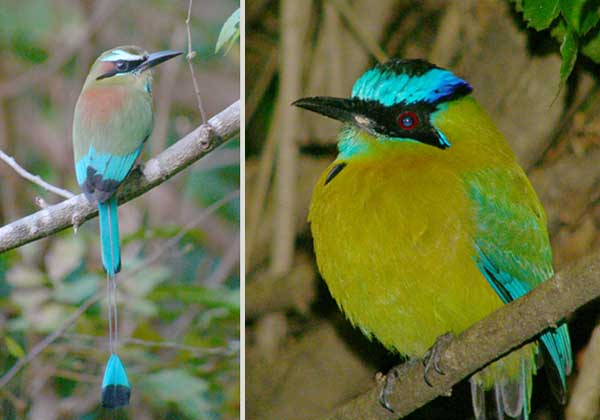 Blue-crowned motmot and the
turquoise-browed motmot of Guanacaste
|
|
| That
flash of blue is the bird with the funny tail |
|
|
By Dennis Rogers
Special to A.M. Costa Rica Among the most conspicuous and exotic species readily seen in populated areas of Costa Rica are the motmots. Their size and metallic blue tones quickly attract attention. This family is restricted to the New World tropics. Its closest relatives likely to be familiar to foreigners would be the kingfishers. There are 10 species, all but three of which are found in Costa Rica. They are generally called pájaro bobo or clown by Costa Ricans, hardly appropriate for such a dignified bird. Most species are characterized by racket tails, with bare shafts part of the length of the main tail feathers. The missing barbs come off from normal wear, without any particular effort by the bird. Best known around San José is the blue-crowned motmot, Momotus momota. It will occupy most any substantial garden or other wooded area, perching prominently, watching for prey, its long tail swinging like a pendulum. It eats earthworms, large insects, and small snakes or |
lizards
and will come to feeding tables for ripe bananas. Its usual call
is an owl-like double hoot, the source of the name motmot though rather
few of the other species sound like it. Nests are in burrows about 10
cms. (4 inches) in diameter and as much
as 4 meters (13 feet) long. Nesting season is March to May, like so
many resident birds, to take advantage of the flush of insects at the
start of the rainy season. Another species typical of the dry forest of Guanacaste is the turquoise-browed motmot Eumomota superciliosa. It is smaller than the previous species but still conspicuous in its more open habitat. It is the national bird of both Nicaragua and El Salvador. Habits are similar to the blue-crowned motmot, with the swinging tail and sit-and-wait feeding technique. The turquoise-browed also catches insects in flight, including butterflies and bees. Its call is a strangled honking, a characteristic sound of Guanacaste riparian forest. In one experiment, hand-raised young motmots were shown to avoid sticks painted to resemble poisonous coral snakes, demonstrating that the trait is innate and not learned. |
 |
 |
||
|
|
|
|
| You need to see Costa Rican tourism information HERE! |
| A.M. Costa Rica fourth news page |
|||||||||
| Home |
Tourism |
Calendar |
Classifieds |
Entertainment |
Real
estate |
Rentals |
Sports |
About us |
|
|
|
|||||||||
 |
| Rebels in Colombia fail to direct hostages rescuers again |
|
|
By the A.M. Costa Rica wire services
A mission to retrieve three hostages held for up to six years by Colombia's leftist rebels remained on standby Sunday as rescue teams awaited instructions on a pick-up location. It was the third straight day that the Fuerza Armadas Revolucionarias de Colombia failed to follow up on its promise to release the trio. Friday Venezuelan President Hugo Chavez dispatched two helicopters bearing Red Cross markings to the central Colombian city of Villavicencio south of Bogota, where they remain waiting for further instructions. With Chávez at the sendoff was U.S. film maker Oliver Stone, who is a Chávez fan. A team of international observers and representatives of the Red Cross are overseeing the release. The airport has become a media hot spot. The rebels have agreed to release two women hostages and a child fathered in captivity. But some involved in the rescue mission are beginning to think that the promise of releasing the trio is just another rebel maneuver to embarrass the Colombian administration. Those hostages are Colombian lawmaker Consuelo Gonzáles, former vice presidential candidate Clara Rojas |
and her
3-year-old son, Emmanuel. They are to be handed over to Chavez or
someone he designates. Argentina's former president, Nestor Kirchner, is one of the Latin American officials who came to Venezuela at the request of Chávez. Chávez said he has been in touch with the governments of Argentina, Bolivia, Brazil, Cuba, Ecuador and France about the final phases of the mission to free the hostages. This week's developments follow a diplomatic rift that developed last month between the Colombian and Venezuelan presidents, after Colombian President Álvaro Uribe complained that Chávez had overstepped his role as a mediator. The Venezuelan leader said, however, that he would continue his efforts for the sake of the hostages. The rebels have offered to trade the freedom of its high-level hostages for the Colombian government's release of hundreds of imprisoned rebels. Apart from the three hostages whose release has been promised, the rebels hold about 40 so-called high-profile captives. Among them is former Colombian presidential candidate Ingrid Betancourt, who was kidnapped with Rojas in February 2002. Rebels are holding three Americans seized in 2003 after their plane, flying a counter-narcotics mission, went down. |
|
|||||||||||||||||
| News from
the BBC up to the minute |
BBC sports news up to the minute | ||||||||||||||||
| BBC news and sports feeds are disabled on archived pages. |
|||||||||||||||||
| A.M. Costa Rica Sports news local and from the wires |
 |
|
|
|
|
|
|
|
|
|
|
||||||
|
||||
|
|
|
|
|
|
|
|
|
|
|
|
| What we published this week: | Monday | Tuesday | Wednesday | Thursday | Friday | Earlier |
|
|