|
|
||||
 |
 |
 |
||
|
|
 |
 |
|
|
||||||||||||||
|
|||||||||||||||
 Click here to find us on our Facebook page! |
|||||||||||||||
 |
|||||||||||||||
|
|
||||||||||||||
| What we published this week: | Monday | Tuesday | Wednesday | Thursday | Friday | Earlier |
|
|
|
|
|
|
|
Food |
|
|
Abstracts and fair use are permitted. Check HERE for more details |
 |
A.M. Costa Rica's Second news page |
|
|
|
San
José, Costa Rica, Friday, Nov. 28, 2014, Vol. 14, No. 236
|
||
|
|
|
|
|
|
|
Food |
|
|
By the A.M. Costa Rica staff
Just as he said he would, President Luis Guillermo Solís has designated for action a bill that would relieve some tourist operators of five years of back sales taxes. This is the tax that they did not know they owed until a decree was published amplifying the meaning of the sales tax law. That was in the last week of the Laura Chinchilla administration. The measure is No. 19.408, and the effort to collect the taxes revolves around the phrase centros de recreo y similares. The administration is defining centers of recreation and similar as any operation that has an office. The tourism sector has been up in arms about this. The bill defers the sales tax until Jan. 1, 2016. Monday begins what is known as the extraordinary session of the legislature. Years ago this established a loophole so that the president could recall vacationing lawmakers for a specific purpose in an emergency, such as declaring war. Now this is a period when the executive branch controls the agenda. Lawmakers may only act on what the president puts before them. Solís issued a decree listing many bills. They include budget bills, one that provides mutual protection for Costa Rican and Chinese investors, and one to regulate pawn shops. Another would authorize an agreement for widening Ruta 32 for 100 kilometers from Limón west. Another bill promotes the development of an electric train in the Central Valley. There are bills to protect the disabled and one to transform the Dirección de Inteligencia y Seguridad Nacional to the Dirección de Intelligencia Estrategica Nacional. This is the private investigative unit of Casa Presidencial. The in vitro fertilization bill is here. too. Another measure makes unspecified changes to a law that penalized violence against women. There also are some anti-corruption measures. Much of the wish list will not be passed in this legislative session, but the submissions show the mood of the executive branch. The text of some of the bills are not available yet, and others are versions of bills that already have been in the legislature. Wider bridge at Río Virilla approved By the A.M. Costa Rica staff
The Contraloría de la República, the budget and contractual watchdog, has approved an agreement to widen the General Cañas highway from four to six lanes over the Río Virilla west of San José. The agreement for the bridge job is 2.1 billion colons or about $4 million. Work to reinforce the bridge and to improve it has been suspended pending approval of this agreement, the Ministerio de Obras Pública y Transportes said. The bridge has been declared ill designed, and there have been continual problems with the roadbed due to vibration. The wider bridge is also part of a plan to put in a new highway to San Ramón, although this is not involved in this deal. The highway itself is six lanes until it reaches the bridge on either side. The minister said that 100,000 vehicles a day use the bridge. Property theft case affects state power firm By the A.M. Costa Rica staff
Judicial police detained an Aserrí man Thursday on the allegation that he faked paperwork with two notaries and then sold rights to a right-of-way he did not own to the Instituto Costarricense de Electricidad. The institute installed power lines through the property. This took place in 2001, and the Judicial Investigating Organization said that the man received 42 million colons from the state power company known as ICE. That is about $77,500. The owner of the property in Tarbaca was a woman who was out of the country at the time, judicial agents said. The property was in a corporation, and the man assumed the role of president with the help of the two notaries. Agents said they already had been detained. Agents allege that he used the same techniques to sell two properties that he did not own in Sarapiquí.
|
|||||||||||||||||||||||||||||||||||
|
|
|
|
|
|
|
|
Food |
|
| What we published this week: | Monday | Tuesday | Wednesday | Thursday | Friday | Earlier |
| The contents of
this Web site are copyrighted by Consultantes R¡o Colorado S.A.
2014 and may
not be reproduced anywhere without permission. Abstracts and fair use are permitted. Check HERE for details |
||||||
 |
A.M. Costa Rica Third News Page |
|
| San José, Costa Rica, Friday, Nov. 28, 2014, Vol. 14, No. 236 | |
|
|
|
|
|
|
|
Food |
|
| Cartago will consider ban Saturday on genetically modified
crops |
|
|
By
the A.M. Costa Rica staff
The political leaders of the Municipalidad of Cartago plan to meet in an unusual Saturday morning session to consider a ban on genetically modified organisms. Social agitators who style themselves as environmentalists are promoting the ban and report that 74 local governments have enacted such a prohibition. The ban actually is against First World companies that have produced genetically modified plants to combat insect or other pests as well as increase the beneficial contents of the foods or cause higher production. The lengthy campaign began when Monsanto Co. received the right to plant several small test patches of modified corn. Such crops have been grown in Costa Rica since the 1990s and include cotton. Corn is targeted especially because it pollinates through the air. Opponents of the modified organisms include some who also protested against offshore drilling and an open pit gold mine in San Carlos. |
Opponents have
stopped short of seeking a ban on the importation of
genetically modified products because nearly all the snack food
produced in the United States use modified corn. Scientists generally
conclude that there is little difference between modified and
unmodified products. In announcing the Cartago meeting at 8 a.m. Saturday, the opponents correctly noted that President Luis Guillermo Solís has designated a nationwide ban on genetically modified organisms as a bill he wants the legislature to consider. A version of the bill already is under study in a committee. The opponents say they are trying to defend the traditional corn species of Costa Rica, but there has been no list provided of which species are of this type. There are more than 100 corn species that have been identified here, and some may even be genetically modified. One of the leading opponents is Fabián Pacheco, who identifies himself as an agrobiologist. He is associated with the Federación Costarricense para la Conservación del Ambiente. That group also opposed the construction of private hydro generating projects and has come out against locating geothermal generating projects in national parks. The organization plans a demonstration Saturday in Cartago. |
| Telephone call leads police to cocaine stash in downtown
parking lot |
|
|
By
the A.M. Costa Rica staff
There are strange developments that seem to be related to the war between rival drug factions The latest is a microbus filled with cocaine that was turned into police by an anonymous caller. The vehicle was found to contain a hefty 360 kilos of cocaine. Drug couriers are not going to win any friends by abandoning a load like this, so one question is who put the vehicle in the parking lot near Parque Morazán. The cocaine was so obvious that the first police officers on the scene could see the packages through a window. Fuerza Pública officers quickly contacted agents with the Policía de Control de Drogas. The one-kilo drug packages were marked with a Batman logo. A lot of the drug discoveries that officers attributed to investigative work or anti-drug dogs really are products of gang rivalry. One gang tries to win an advantage by telling police about drug shipments by its rivals. Another strange event took place in Naranjo Monday when officers on patrol encountered two fake police officers who were holding |
 Ministerio de Gobernación,
Policía y
Seguridad Pública photo
Batman logo can be seen clearly
on the drug packages.drivers of Honduran-registered tractor trailers. Drug agents eventually found 573 kilos of cocaine in one truck. The attempted hijacking clearly was directed at Honduran registered vehicles, so those who set up the fake stop must have had inside information. Investigators have said little about this case. |
| You need to see Costa Rican tourism information HERE! |
 |
|
|
|
|
|
|
|
Food |
|
| What we published this week: | Monday | Tuesday | Wednesday | Thursday | Friday | Earlier |
| The contents of
this Web site are copyrighted by Consultantes Río Colorado S.A.
2014 and may
not be reproduced anywhere without permission. Abstracts and fair use are permitted. Check HERE for details |
||||||
 |
|
||||
| A.M. Costa Rica's Fourth News page | |||||
| San José, Costa Rica, Friday, Nov. 28, 2014, Vol. 14, No. 236 | |||||
|
|
|
|
|
|
|
Food |
|
| Police will
shut off Calle 4 again for annual children's museum show By the A.M. Costa Rica staff
More than 200 law enforcement officers from different agencies will set up a secure route Wednesday so families can attend the illumination of the facade of the Museo de los Niños. All of Calle 4 from Avenida Segunda to the museum will be under tight police protection. This is an annual event to encourage families to attend. The security goes into effect at 2 p.m. The firefighters and the Cruz Roja also are involved. Some 12,000 spectators are anticipated. There is more than just the lighting of the former national prison that now is a children's museum. There will be live acts culminating in fireworks. The show begins at dusk about 6:30 p.m. The Cruz Roja said it is sending 60 of its staff and 12 ambulances. The area along Calle 4 and Avenida 9 is considered by police to be a high crime area. It is inhabited by many immigrants, including Haitians and Dominicans. |
 Museo de los Niños graphic
Graphic shows the protected area. |
Here's reasonable medical care
Costa Rica's world class medical specialists are at your command. Get the top care for much less than U.S. prices. It is really a great way to spend a vacation. See our list of recommended professionals HERE!amcr-prom
|
|
||||||||||||||||||||||||||||||||||||||
|
|
|
|
|
|
|
Food |
|
| What we published this week: | Monday | Tuesday | Wednesday | Thursday | Friday | Earlier |
| The
contents of
this Web site are copyrighted by Consultantes Río Colorado S.A.
2014 and may
not be reproduced anywhere without permission. Abstracts and fair use are permitted. Check HERE for details |
||||||
|
A.M. Costa Rica's Fifth
news page
|
||
 |
 |
|
| San José, Costa Rica, Friday, Nov. 28, 2014, Vol. 14, No. 236 | |||||||
|
|
|
|
|
|
|
Food |
|
 |
 Voice of Americap photo
Brent Clodgio checks a
Thanksgiving turkey while tailgating before an NFL football game
between the Detroit Lions and Chicago Bears in Detroit, Michigan.Turkey and
football mark
U.S. Thanksgiving Day By the A.M. Costa Rica wire services
Americans marked the annual Thanksgiving holiday Thursday with family gatherings, bountiful meals, festive parades and bargain shopping. In New York City on Thanksgiving morning, thousands of people lined the streets to watch the annual Macy's Thanksgiving Day Parade. A tradition for 88 years, it featured marching bands, celebrity performances and giant balloons of cartoon characters such as Spider-Man, Snoopy and SpongeBob Squarepants. U.S. military troops serving abroad kept the holiday, too, gathering at various bases for traditional feasts of roast turkey, stuffing and other foods. In Kabul, Afghanistan, soldiers going through the cafeteria line got at least a small taste of home. "You know, any Thanksgiving that you are on God's green earth is a good Thanksgiving to celebrate," soldier Brandon Galindo said. In Washington, President Barack Obama thanked the troops via his weekly radio and Internet address. He also expressed gratitude for Americans who show compassion by helping those who are less fortunate. Some Americans worked up appetites by pulling on running shoes and going out for organized races known as turkey trots. Other sports enthusiasts exercised their eyeballs, watching football at stadiums or on TV. In the Midwestern state of Michigan, tailgaters at Detroit's Ford Field fired up their grills – some preparing turkeys – before a match between the hometown Detroit Lions and the Chicago Bears. Another Thanksgiving tradition is shopping sales in crowded stores at the start of the holiday shopping season. For years, sales began the day after Thanksgiving – on so-called Black Friday. Now they start on the holiday itself or even several days in advance and generally end the following Monday, known as Cyber Monday. According to the National Retail Federation, about 68 million people in the United States say they expect to shop over the Thanksgiving Day weekend. A blast of rain and snow along the East Coast on Wednesday complicated weekend travel plans for many people in what is traditionally the year's busiest travel weekend in the United States. Tradition says the first American Thanksgiving occurred in 1621, with early North American settlers commemorating a harvest after a harsh winter. The nation's first president, George Washington, declared it a national holiday in 1789. Tensions in Ferguson ease for holiday and weather By the A.M. Costa Rica wire services
Tensions appeared to ease Thursday in the U.S. midwestern town of Ferguson, Missouri, after two nights of violence and looting following a grand jury decision not to prosecute a white police officer in the death of a black teenager. Snow covered the city's streets Thursday, rather than protesters. The Missouri National Guard stood at the police station with no confrontations. But around the country, there were scattered protests from Los Angeles, where 100 people were arrested, to Oakland and New York City. Demonstrators even marched in London. The New York protests took place a block from the iconic Macy's Thanksgiving Day parade, where seven people were detained for pushing through barricades to disrupt the festivities. Late Wednesday, Ferguson saw only scattered protests after two previous nights of unrest and rioting that left dozens of buildings damaged or burned. The unrest followed Monday's announcement that a white police officer will not be prosecuted over the shooting death of an unarmed black teenager. A heavy police presence, snowy weather, and Thursday's Thanksgiving holiday may have helped to shrink the crowds by Wednesday night. Earlier, hundreds of people demonstrated in front of the St. Louis City Hall on Wednesday, chanting “Shame, Shame.” Police arrested three people for failing to disperse, including one who also faces an assault charge. The August shooting death of 18-year-old Michael Brown by officer Darren Wilson inflamed tensions in Ferguson and raised concerns about police violence and racial discrimination in the mostly black St. Louis suburb. Earlier this week, a grand jury decided there was no probable cause to indict Wilson, who said he feared for his life during the confrontation with Brown. Wilson told reporters Tuesday that he has a clean conscience "because I know I did my job right." Protesters across the country have used the case to highlight similar instances in which they say laws are not applied fairly towards African Americans. In Los Angeles and Oakland, California, police arrested dozens of people for a variety of protest-related charges -- but no significant violence was reported. EU Parliament is targeting Google for anti-trust action By the A.M. Costa Rica wire services
The European Parliament is urging European anti-trust regulators to break up Google. The non-binding resolution passed Thursday, 384 to 174, as lawmakers try to prevent service providers bundling search engines with other commercial services. Analysts said although not mentioned specifically by name, the U.S. tech giant responsible for 90 percent of European Internet searches was the target. European Competition Commissioner Margrethe Vestager said she will review complaints made by several of the company’s competitors before deciding whether to proceed. The European Commission has been investigating Google for four years after complaints from competitors including Microsoft and Expedia. Google is also grappling with privacy issues, requests to scrub search results to comply with a court ruling, copyright concerns and tax controversies in the EU. Three earlier attempts by Google to settle complaints and stave off a possible fine of up to $5 billion were rejected by the European competition commissioner. Critics say Google has unfairly subordinated rival company services in search results. Oil producing monopoly worries about world glut By the A.M. Costa Rica wire services
The Organization of Petroleum Exporting Countries has decided to maintain current levels of production, despite a worldwide oil glut that has driven market prices down more than 30 percent since June. Meeting Thursday in Vienna, Austria, oil ministers decided to maintain the present output target of 30 million barrels a day. After the announcement, the price of benchmark Brent crude fell $4, to a four-year low of $73 a barrel. The OPEC meeting, widely seen as one of the most crucial in years, came as shale oil production continues to surge in the United States. Forecasters say U.S. shale extraction will produce an additional 1 million barrels a day this year and 1 million barrels more in 2015. With current OPEC production at 30 million barrels per day, analysts say the surge in U.S. production is proving particularly vexing for the cartel, with no OPEC strategies evident for offsetting the glut. Led by Saudi Arabia and the Gulf states of Qatar, the United Arab Emirates and Kuwait, OPEC pumps about one-third of the world's oil, and has faced recent pressure from its poorer members to cut output. However, wealthier producers argued that cutting production at this time would result in further loss of market shares in North America, where demand for OPEC oil has been sharply reduced. Analysts say the OPEC decision is a particular blow to Venezuela's economy, which is teetering on the brink of recession. The Caracas government is not seen as having the reserves necessary to ride out the weak prices, which experts say could last indefinitely. Sioux language returns with youthful learners By the A.M. Costa Rica wire services
One evening a week, young and old gather in Michael Moore’s classroom in Fort Yates, North Dakota, to learn Lakota, the language of their Sioux tribal ancestors. For many of the students here at Sitting Bull College, it's a tongue their great grandparents spoke fluently at home. But that changed in the early 1900’s, when thousands of Native American children were sent to boarding schools where they were told to assimilate, learn English and forget all aspects of their native culture. Gabe Black Moon, who co-teaches Lakota with Moore, remembered his time at one such school. “The government punished us for speaking our language, and I've seen that happen. It happened to me," he said. "Day one, I went to school, I couldn’t speak English. I got punished pretty bad.” Renewed efforts to preserve Lakota for future generations received national recognition earlier this year when President Barack Obama visited Standing Rock Native American Reservation, where he praised Sioux tribal leaders’ for revitalizing the endangered tongue. One of the few Sioux Indians left who speaks fluent Lakota, Black Moon said he now devotes his days to making sure the language doesn't die out with his generation. He said he is heartened to see younger generations learning to communicate in precisely the manner from which their own parents were discouraged from speaking. One such student, Tiffany Baker, said she decided to learn Lakota to talk with her two-year-old daughter, who is in an immersion program at the college. She said her own father rarely spoke Lakota. “As the elders start passing away, they are taking all their knowledge that they have," she said, describing that class as vital to reclaiming a part of their culture that was nearly lost. "It’s up to us to learn it so that we can carry it on.” As the White House prepares to host more than 500 tribal representatives for an annual conference in Washington Wednesday, it's hoped cultural preservation programs of exactly this kind will receive further acknowledgement and support. |
|
||||||||||||||||||||||||||||||||||||||||
|
|
|
|
|
|
|
Food |
|
| What we published this week: | Monday | Tuesday | Wednesday | Thursday | Friday | Earlier |
| The
contents of
this Web site are copyrighted by Consultantes Río Colorado S.A.
2014 and may
not be reproduced anywhere without permission. Abstracts and fair use are permitted. Check HERE for details |
||||||
| A.M. Costa Rica's sixth news page |
|
||||||||
| San José, Costa Rica, Friday, Nov. 28, 2014, Vol. 14, No. 236 | |||||||||
|
|
|
|
|
|
|
Food |
|
||
|
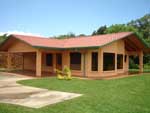
 Tecnológico de Costa Rica photo
This rustic dwelling will be
used as a dining hall and housing for visitors.Talamanca Bribri
graduate as guides
By the A.M. Costa Rica staff
Some 17 students in Talamanca have been awarded the title of local native tourism guides after completing training organized by Tecnológico de Costa Rica. A ceremony was held in Amubri de Talamanca at the Centro de Capacitación Iriria Alakölpa Ú. This is the first class of local guides. The Universidad Estatal a Distancia and the Instituto Costarricense de Turismo also were sponsors, said Tecnológico de Costa Rica, which is based in Cartago. Also involved was the Asociación de Desarrollo Indígena del Territorio Bribri. The program included training in English. For the students graduation now provides the opportunity for employment. Guides are licensed in Costa Rica. Part of the program was training in business. The training center was set up in 2008 and contains computer hookups and a library. Bribri are one of the two major native groups in the eastern side of the Talamanca. Some of the communities are remote and welcome tourists to live in the lifestyle of the residents. Bank asks brokers to help sell properties By the A.M. Costa Rica staff
Banco Nacional has tapped the Cámara Costarricense de Corredores de Bienes Raíces to help market the properties the bank has taken over. Banco Nacional said that 500 members of the real estate chamber will work with its 10 employees who are designated to handle repossessed properties. The bank also said that some of the properties were being offered at discounts up to 50 percent. The bank also is making 20-year loans on some of the properties, it said. |
| Costa Rican News |
AMCostaRicaArchives.com |
Retire NOW
in Costa Rica |
CostaRicaReport.com |
| Fine Dining
in Costa Rica |
The CAFTA Report |
Fish
fabulous Costa Rica |
|
|
|
|
|
|
|
Food |
|
| What we published this week: | Monday | Tuesday | Wednesday | Thursday | Friday | Earlier |
| The
contents of
this Web site are copyrighted by Consultantes Río Colorado S.A.
2014 and may
not be reproduced anywhere without permission. Abstracts and fair use are permitted. Check HERE for details |
||||||
| From Page 7: Bankers go on high alert for holidays By the A.M. Costa Rica staff
The slug of Christmas money coming into the economy has the nation's bankers on edge. The Asociación Bancaria Costarricense and law enforcement Thursday announced plans to prevent some crimes. They have a big job. The bankers said that there are robberies outside of banks and at automatic tellers as well as frauds with checks, fake dollars and fake lottery tickets. The Instituto Nacional de Estadísticas y Censos puts the nation's work force at 1,563,000 persons, and that means some 724 billion colons will be paid out in the next two weeks as the Christmas aguinaldo. That's about $1.3 billion. Many Costa Ricans still shop with cash instead of credit or debit cards. So until Jan. 31, bank security officers and law enforcement officers will be mounting extra patrols and keeping a close eye on potential trouble spots, the bankers said in an announcement. There will be security officers in plain clothes, too, with the special job of spotting accomplices who may be watching for bank customers with large amounts of cash. One reason many banks prohibit the use of cell phones within their buildings is to prevent this. The accomplice notifies bandits waiting nearby. |