|
 |
Your daily |
 |
|
|
|
|
|
|
|
|
|
|
|
|
|||||||||||
|
|
|||||||||||
| A.M. Costa Rica Second newspage |
 |
||||||||
| Home |
Tourism |
Calendar |
Classifieds |
Entertainment |
Real
estate |
Rentals |
Sports |
About us |
|
|
|
|||||||||
 |
| Costa Rica Expertise Ltd http://crexpertise.com E-mail info@crexpertise.com Tel:506-256-8585 Fax:506-256-7575 |
 Click HERE
for great
hotel discounts
|
|
in two separate rescues By the A.M. Costa Rica staff
The helicopter service of the security ministry was called into service twice Sunday to carry youngsters to hospitals. The first was a 14-year-old who suffered a bullet wound in the stomach when his father was cleaning a rifle, said police. The youngster, who was not identified, was carried by helicopter from Bajo Bley, Talamanca, to the Clínica del Valle La Estrella in southern Limón province. Officers said that the family carried the boy for four hours to reach a place where the Caja Costarricense de Seguro Social maintains an emergency radio. The radio was used to contact officials. The boy was said to be stable Sunday afternoon. The second trip was to help a 6-year-old girl in Roca Quemada, Turrialba, who pulled a pot of boiling water off the stove. She suffered burns over 75 percent of her body, officials said. The Servicio de Vigilancia Aérea carried the girl, identified as Rudey Obando Aguilar, and a 2-year-old sibling to Hospital México for treatment, said officials. The younger child was experiencing difficulty in breathing, officials said. Saturday quake shakes up Nicoya Peninsula residents By the A.M. Costa Rica staff
A quake approaching a magnitude of 5 shook up Nicoya Peninsula residents Saturday afternoon. The shock was recorded at 4:22 p.m., and the epicenter was about 9 kms. northwest of Sámara. In addition to that Pacific beach town, the shock was felt in Filadelfia, Santa Cruz, Nicoya, Nandayure and Carrillo, said the earthquake experts at the Universidad Nacional in Heredia. They set the magnitude at 5.0. However, the U.S. Earthquake Information Center said the magnitude was measured at 4.8. The quake was believed to be caused by the continuing stress between the Coco and Caribe plates on which Costa Rica rides. Police sweeps capture illegals and suspects By the A.M. Costa Rica staff
A law enforcement task force questioned 227 persons in three locations in San José Saturday and early Sunday. At one point the officers encountered four Colombian men who were carrying illegal weapons, including a mini-uzi, they said. The four were detained in what is being called Tierra Dominicana, a section of the city near the Museo del Niño where a number of Dominican immigrants live. The sweeps were conducted by the Ministerio de Gobernación, Policía y Seguridad Pública and its Fuerza Pública and Policía de Migración, the Judicial Investigating Organization, the Policía de Tránsito and the Policía Municipal of San José. Other arrests were made in Pavas and in Hatillo. In all, the ministry reported that 15 persons were turned over to immigration officers and eight persons were turned over to prosecutors because they were suspected of a crime or were the subject of a warrant. Four drug-running suspects vanish after judge frees them By the A.M. Costas Rica staff
Four Colombias picked up in a fastboat June 19 with 900 kilos of suspected cocaine were released in their own recognizance by a judge in the Juzgado Penal de Osa with the instructions to sign in periodically. The Judicial Investigating Organization said Friday that the four men have not signed in and that they probably have fled the country. The men were characterized as highly dangerious and probably armed. The incident is likely to focus more attention on the judiciary, which has been under fire lately for failing to incarcerate suspects for preventative detention. Last week men who were suspected of hijackinjg an Importadora Monge delivery truck and its three-person crew were let go almost immediately and several managed to be detained a short time later as suspects in the hijacking of another vehicle. Cuban military flex muscles in anticipation of U.S. attack By the A.M. Costas Rica wire services
Cuba has completed five days of military exercises in preparation for what it says is a possible attack by the United States. The maneuvers included military personnel from the west and central regions of the country. Military aircraft and tanks were also part of the training exercises, known as Moncada 2007, which ended Friday. Earlier this year, ailing Cuban President Fidel Castro said in an article published by the state-run Granma newspaper that his country will continue to build up its defenses against what he said are threats by the United States. He accused President George Bush of wanting to invade the island. Cuba and the United States have had no formal relations in more than 40 years. President Bush has said the longstanding U.S. embargo on Cuba will remain in place, as long as he termed "the regime" maintains its monopoly on the political and economic life of the Cuban people. Bush also challenged the international community to support what he calls the democratic movement growing in Cuba. Fidel Castro and the Cuban foreign minister, Felipe Perez Roque, said the recent Bush speech advocated what they called the reconquest of Cuba by force. Expo for Caribbean firms By the A.M. Costa Rica staff
The Ministerio de Economía, Industria y Comercio, Cámara de Comercio, Industria y Turismo de Limón and local firms plan a Caribbean business fair Friday through Sunday in Limón Centro at the chamber's sports installation. The idea is to provide a forum where residents can see what local businesses produce.
|
 |
 |
|
on our real estate page HERE! |
 |
| A.M. Costa Rica third newspage |
 |
||||||||
| Home |
Tourism |
Calendar |
Classifieds |
Entertainment |
Real
estate |
Rentals |
Sports |
About us |
|
|
|
|||||||||
|
Immortalized
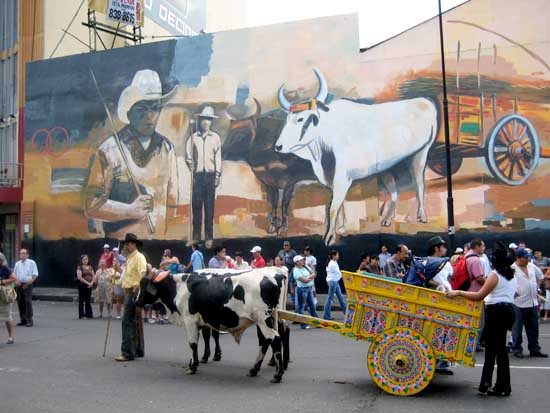
in paint Ox cart moves past a new mural celebrating the tradition on lower Avenida 2 in downtown San José |
 A.M. Costa Rica/Helen Thompson
|
| Escazú
youngster lays claim to being the youngest boyero |
|
|
By Elise Sonray
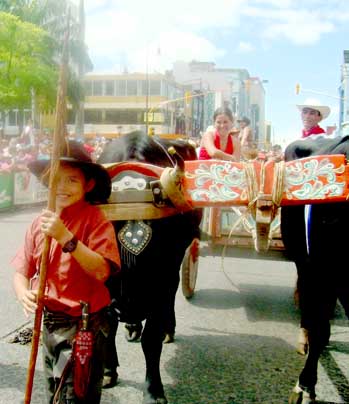
of the A.M. Costa Rica staff Pablo Sandí Madrigal is 10 years old. He carries a 6-foot, steel-tipped stick. The two big oxen he orders around are nearly as high at the shoulders as the stick. But young Sandí still is the boss. The Santa Antonio de Escazú resident was one of hundreds of boyeros or oxcart handlers who took to the streets Sunday in the traditional opening of the Christmas season: the entrance of the saints into San José. Sandi posed for pictures in between yelling commands to the bueyes. “Esa!” means stop, and “Gui!” means go in the boyero-buey language. Young Sandi used both commands abundantly. “This is something very special for me” said Sandi's father, Hernando. “I give thanks to God we are here.” Hernando Sandi, a 52-year-old farmer from San Antonio, said this day always means a lot to him. But today was especially significant, he said, as with glistening eyes he watched his son: “I am 100 percent proud.” Young Sandí said with conviction that he was the youngest boyero in the parade and that he had been in training for three-and-a-half years. Young Sandí and other carthandlers covered the distance from Parque la Sabana to Avenida 2 in the downtown Sunday morning. Hundreds of sturdy “bueyes,” or oxen, pulled brightly painted carts and occasionally received a sharp rap on the muzzle by their handlers. This year marked San Jose's 11th parade of “Santos y Boyeros” or saints and ox-handlers. The parade emphasizes the importance of farmers and agriculture and shows their significance throughout Costa Rica's history. This day shows the support of San José to the people of Costa Rica and the farmers around the country, said San José Mayor Johnny Araya Monge. “We have a great relationship with the farmers, and this is a way we can help them and show our support,” said Araya. A new dimension was added to the parade this year with over 350 folk dancers from various parts of the country. Towering mascaradas also ran through the street greeting spectators and chasing children. The saints are wooden statues hauled in the ox carts. A life-size San José, the father of Jesus, was in the first cart leading the way. He is the patron of the municipality. |
 A.M. Costa Rica/Elise Sonray
Pablo Sandí Madrigal poses with his
team of oxen
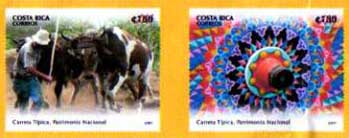 New stamps celebrate ox carts
and oxen
By the A.M. Costa Rica staff Two new stamps are entering circulation in honor of the Costa Rican boyero or ox cart driver and the carreta or famous hand-painted cart. The official announcement of the stamps was Sunday during the boyeros parade in downtown San José. Both stamp designs symbolize the long tradition of oxen in farm work and their importance in Costa Rican history. The total circulation of the stamps will be 70,000 with 35,000 of each design, according to Correos de Costa Rica. Each stamp has a face value of 180 colons, about 36 U.S. cents. |
| Lower
limits are set on startup capital to encourage new insurance firms |
|
|
By the A.M. Costa Rica staff
Those who decide to start a new insurance company in Costa Rica will need from $3.2 to $3.7 million startup capital, according to changes within the proposal to open the industry up to private firms. Now insurance is a government monopoly handled by the Instituto Nacional de Seguros. Evita Arguedas Maklouf, a legislator, said Sunday that she was responsible for setting lower financial limits so that more companies could enter the insurance business here. Lawmakers in a special commission to study the changes in the insurance law worked during an unusual special session Saturday and finally agreed on a version of the bill to send to the full Asamblea Legislativa. They were under orders from the legislative leadership to finish the project by midnight Saturday. The insurance proposal is one of a dozen measures that are |
required to put the principles set
out in the free trade treaty with the United States into Costa Rican
law. The original proposal would have required companies to have $5 million in capital to set up an insurance firm here. Reinsurance firms will need to have at least $11.5 million, according to legislator Arguedas. That is because these companies assume greater risk by guaranteeing the policies of other insurance companies, she said. The bill calls for an office of insurance supervision and addresses a number of loose ends that are being created by the opening of the market to non-government participation. Lawmakers on the one hand are trying to make the Instituto Nacional de Seguros more competitive while creating conditions in which private firms can operate. One such loose end is what will happen to the Cuerpo de Bomberos, the firemen. Now they are employees of the Instituto Nacional de Seguros. Under the proposal sent to the full assembly Saturday, a 4 percent fee will be assessed on insurance policies to support the firemen. |
|
| You need to see Costa Rican tourism information HERE! |
| A.M. Costa Rica fourth news page |
|||||||||
| Home |
Tourism |
Calendar |
Classifieds |
Entertainment |
Real
estate |
Rentals |
Sports |
About us |
|
|
|
|||||||||
 |
| Beautiful property where air is clear — above 3,000
feet www.VistasDeSarchi.com |
| Early
residents seem to have used chocolate seeking booze |
|||
|
By the Cornell University news service
The human love affair with chocolate is at least 3,000 years old — and it began at least 500 years earlier than previously thought, according to new analyses of pottery shards from the
In the past, the only chemical detection of cacao in ancient pottery required an intact vessel and a substantial amount of residue, Henderson said. To detect much smaller chemical traces in broken shards, co-authors Patrick E. McGovern and Gretchen Hall at the University of Pennsylvania Museum and W. Jeffrey Hurst at Hershey Foods used new extraction techniques along with liquid chromatography, gas chromatography and mass spectrometry —‚ techniques that could be used for sensitive chemical testing on many more remnants in the future. "It's not very often that you find a whole vessel," said Henderson. "Now that you can process things from people's trash piles, you can see in much better context how these things were being used." |
But while cacao beans and the spicy,
frothy chocolaty drink they
produced were the stuff of royal ceremonies and elite gatherings in
later millennia, Henderson said, it's likely that the earliest cacao
drinkers made a simpler drink by fermenting the pulp around the seeds. The result (which at least one brewing company, in collaboration with McGovern, is working to reproduce) was a brew that tasted nothing like chocolate. Since both beverages contain theobromine and caffeine, chemistry doesn't reveal whether a vessel held a winelike quaff made from pulp or the celebrated chocolate concoction made from seeds. But while the jugs of later, chocolate-drinking periods were short and wide, with broad openings to allow for pouring back and forth to create froth, the earlier bottles had long, skinny spouts that would frustrate the most diligent Starbucks froth specialist. Over the ensuing centuries, Henderson said, the drink was traded, shared and used in ceremonies, creating social networks across the region and beyond. "The upwardly mobile families were using cacao, serving it as part of a strategy for distinguishing themselves," he said. "It was a way of creating social obligation and political power locally and with people in distant villages. It's that context that gives us a way of understanding how it is that potters in villages hundreds of miles apart have the same understanding of what vessels should look like." And over time, people likely discovered that the fermented seeds, not the pulp, were the real discovery. "If we're right about the shift from wine made from pulp to chocolate made from seeds," said Henderson, then all the pomp and luxury that surrounded chocolate in later years — "the control of cacao plantations by kings and chiefs, all the fancy serving of chocolate in the Aztec courts that so impressed the Spaniards, and the modern chocolate industry that developed from that — all that was an unintended consequence of some early brewing." |
||
| Venezuelan
poll says nearly half of voters oppose reforms pushed by Chávez |
|
|
By the A.M. Costa Rica wire services
A new poll shows that Venezuelan voters oppose by a strong margin changes to the country's constitution proposed by President Hugo Chávez. The polling company Datanalisis announced Saturday that 49 percent of likely voters oppose Chazez's reforms, while 39 percent favor the changes. The survey of nearly 2,000 people was taken mid-November and had a margin of error of about 2 percentage points. Former Venezuelan Defense Minister Raúl Isaias Baduel is predicting that next month the Venezuelan people will vote |
against the proposed constitutional
changes that would greatly expand the power of Chavez. General Baduel has urged voters to reject the changes, saying they would amount to a coup by Chavez. Venezuelans vote on the 69 proposed reforms in a Dec. 2 referendum. The proposals include eliminating presidential term limits and establishing socialist reforms. Also among them are proposals to give authorities sweeping powers if a national emergency is declared, including detention without charges and controls on the news media. The plan has been condemned by Venezuela's opposition parties, human rights groups and the Roman Catholic Church. |
| Uribe
says Venezuelans or French can play a role in release of hostages |
|
|
By the A.M. Costa Rica wire services
Colombian President Alvaro Uribe says that if the country's largest rebel group frees hostages unilaterally, he is open to the captives being received by his French or Venezuelan counterparts or the International Red Cross. Uribe made the comments during a meeting in Bogota of the Latin American Parliament. The remarks came two days after Uribe decided to end mediation by Venezuelan President Hugo Chavez with rebel members of the group known as the Fuerzas Armadas Revolucionarias de Colombia. A statement said the Venezuelan leader violated an agreement with Uribe not to speak directly with the head of the Colombian armed forces, Gen. Mario Montoya, about the hostages. Venezuela said it accepted the sovereign |
decision by Colombia but described
it as "regrettable." Colombia said it will continue seeking what it calls a "humanitarian solution" that will lead to the hostages' release. French President Nicolas Sarkozy has urged Colombia not to end the go-between role Chavez assumed in August. A Sarkozy spokesman said the French leader believes Chavez has the best chance of securing the release of the hostages, such as French-Colombian politician Ingrid Betancourt. Chavez and Sarkozy met in Paris earlier this week to discuss the issue. Betancourt was running for the Colombian presidency when she and her campaign manager, Clara Rojas, were abducted and taken into the jungle. Betancourt has not been heard from since 2003. There is no word on the fate of Rojas. |
| We can put your business announcement
here where those seeking international news will see it |
|
| News from
the BBC up to the minute |
BBC sports news up to the minute |
| BBC news and sports feeds are disabled on archived pages. |
|
|
| A.M. Costa Rica Sports news local and from the wires |
 |
|
|
|
|
|
|
|
|
|
|
||||||
|
||||
|
|
|
|
|
|
|
|
|
|
|
|
| What we published this week: | Monday | Tuesday | Wednesday | Thursday | Friday | Earlier |
|
|