|
 |
Your daily
English-language |
 |
|
|
|
|
|
|
|
|
|
|
|
|
|||||||||||||||
|
|
|||||||||||||||
 |
|
Second news page |
 Click HERE for photo tour of 526 properties for SALE or RENT in Escazú, Ciudad Colón, Santa Ana, Rohrmoser, Curridabat, Heredia and the Pacific Coast. |
|
|
|
|
|
|
|
|
|
|
 |
| Costa Rica Expertise Ltd http://crexpertise.com E-mail info@crexpertise.com Tel:506-256-8585 Fax:506-256-7575 |
 |

|
One out of five tourists come to surf, group says By the A.M. Costa Rica staff
Though many tourists come to Costa Rica for its volcanoes, rain forests and beaches, a full 20 percent of all the tourists who come to Costa Rica, do so to ride its waves, said the Federación de Surf. Costa Rica is becoming such a popular surf destination that the number of surfer's who visit here annually to surf has doubled in the past three years, the federation said. Antonio Pilurzu, the president of the federation, cited information from the Instituto Costarricense de Turismo. Pilurzu said that 222,659 visitors came to surf at Costa Rica’s beaches in 2004, exceeding the 101,014 in 2001, which at that time was equivalent to 12.4 percent of the total amount of vacationing arrivals to the country. For 2004, these numbers increased more than 100 percent, Pilurzu said. That year, surfers who visited Costa Rica represented 20.5 percent of the 1,087,890 people that came into Costa Rica, Pilurzu said. In addition, the tourism board estimates that those 222,659 surfing tourists in 2004, generated $273.3 million in income for Costa Rica as they went in search of good waves. They stayed an average of 10.3 nights in the country, with a daily cost of $119.2. The total cost for the year was comprised of car rentals, lodging, food, souvenirs, tours, and related aspects of the sport. With the recent political instability in Indonesia — a favored area for surf travelers — Pilurzu is hopeful that surfers will come here even more as they seek an alternative international vacation destination this year. “All this information shows us the importance that surfing has for the national tourism industry here in Costa Rica. Certainly, Indonesia has been first in the hearts of surfers around the world, but now, it’s clear with the political situation there, that more surfers will be looking to Costa Rica, which is a non-military country, its very safe, and has lots of beautiful waves,” Pilurzu said. Costa Rican living illegally in Canada coming home By the A.M. Costa Rica staff
A Costa Rican national who had been living in Toronto under a false name was to be deported back here Thursday to stand trial for robbery and other crimes. According to Canadian authorities, William Gurdian Angulo had been living under the name Manuel Montoya Otarola near Toronto as an immmigrant. Based on information from INTERPOL, the international police data base, Costa Rican authorities were able to confirm that Montoya was in fact Gurdian from fingerprints and digital photographs. The order for his arrest was issued to the Judicial Investigating Organization Sección de Capturas Oct. 3, 2004 after he stood trial here for aggravated robbery and was sentenced to 10 years in prison. The captures section obtained another order for his arrest Dec. 5, 2004, for an allegation of counterfeiting money. Canadian authorities informed the Tribunal Penal del Primer Circuito de San José that they had apprehended Gurdian for living in Canada illegally. That arrest happened June 15 this year. |
|
|||||||||||||||||
 |
 |
|
on our real estate page HERE! |
 |
|
Third news page |
 |
| Home | Calendar | Place
a classified ad |
Classifieds | Real estate | Food | About us | |
|
|
|||||||
 |
 |
 |
| Special sex crimes unit downgraded to just prevention |
||
|
By the A.M. Costa Rica staff
A turf war has delivered a setback to an innovative investigation unit specializing in the sex trade, car theft rings, copyright infringement and juvenile gangs. Paul Cháves confirmed the situation Thursday. He is the head of the Dirección de Investigaciones Especializadas of the Ministerio de Gobernación, Policía y Seguridad Pública. Since April 2003 the unit has nabbed some 46 individuals, including some sexual abusers who have been fugitives from justice for years. The unit now has been barred from doing investigations because Costa Rican law appears to give the Judicial Investigating Organization a monopoly on that kind of work. Cháves said he would continue to attempt to prevent the crimes of the type that were handled by his unit. And the unit would continue working on cases already opened if the OIJ cannot take them over, he said. Jorge Rojas, director of the Judicial Investigating Organization or the OIJ from its name in Spanish, had objected just as the unit run by Cháves was earning more and more headlines. The fiscal general, the nation's chief prosecutor made the decision to downgrade the special investigative unit even as Cháves was talking to reporters. Chaves spoke about his plans to seek changes in the law to confiscate brothels and other places where sex is sold in Costa Rica. That was Monday but the decision did not become public until Thursday. Francisco Dall'Anese is the chief prosecutor. He heads the Ministerio Público, which is an independent prosecutorial agency supervised by the courts. In the Costa Rican justice system, which follows the Frenchmodel, the OIJ also is part of the judiciary. |
The decision was taken above the head of Cháves by Dall'Anesee
after
discussions with Rojas and Rogelio Ramos, minister of the security
ministry. The special investigative unit has 40 officers, including four involved in tracking down cybercrimes. The U.S. government supported the unit with an initial grant of $250,000, and the British government made donations for the purchase of computers and video cameras. Cháves said he would retain the members of his team, although other press reports said they would be disbursed to other parts of the security ministry and the Fuerza Pública. Cháves and his unit were involved in a change in philosophy involving sex crimes. Until about 2003 underage prostitution was characterized as something done to the country by North American tourists. But, the majority of sex arrests made by the Cháves unit involved Costa Ricans as both suspect and victim. Cháves himself said that the government engaged in a policy of denial sbout sex crimes against minors at least until 2002. Tuesday the Sección de Capturas of the OIJ made public a list of 15 persons who were being sought. Each already has been convicted but for some reason is not in jail. All but two of the persons on the list were convicted of sex-related crimes, including sexual abuse of minors, rape and corruption of minors. This is the first time that such an extensive list and photos were distributed to the press. The list raises the question how so many could be convicted of such major crimes and not be in jail.
|
|
| All you ever wanted to know about fish . . . and more |
||||
| “Please demystify Costa
Rican fish the way you did local lobster,” a friend asked. OK. Preparation: Ahumado = smoked Al ajillo = in a sauce of butter and garlic A la plancha = grilled or broiled Al horno = baked Al vapor = steamed Budin de pescado = fish baked in a pudding of sour cream, tomato sauce and grated cheese, usually layered with tortillas Ceviche = small cubes of fish marinated raw (pickled) in lime juice with cilantro and diced red onion and red pepper Colombiano = baked in coconut milk Croquetas de pescado or buñuelos = fish croquettes or fritters made with bread crumbs, flour and/or mashed potatoes plus onions, garlic, salt and pepper, fried crispy. Empanizada = breaded and fried En papillote = inside a packet made of parchment or aluminum foil Entero = the whole fish, scaled and gutted, and fried with the head, tail and fins intact Entero sin espinas = the same as entero without the backbone Escabeche = cooked in a vinegar and pickling spice-like sauce Frito = fried Rollo de pescado = fish sausage made with bread crumbs or potatoes, diced hard boiled eggs, cream and spices mashed together and boiled or steamed in cheese cloth, chilled and sliced Salsa crema or salsa blanca = in a white cream sauce Salsa mariscos = in a seafood sauce, usually white with small shrimp, octopus, squid, baby crabs or clams in any combination Salsa negro = served in or with a sauce of pureed black beans, often thinned with white wine and/or cream Sopa de mariscos = pieces of filleted fish in clear broth, often served with white rice on the side. Veracruzana = a sauce for fish of tomato, onion, capers and olives Fish : Atun, tuna. The four kinds of tuna caught or bought here are, by size, 1) black tuna (atun negro), smaller than 15 pounds, 2) skipjack tuna (barrilete) about twice as large, 3) Yellowfin tuna (atun aleta amarillo) up to 300 pounds and 4) the even larger big eye tuna (atun oro grande). Steaks, crusted in herbs and cracked pepper and seared with the inside rare are the most fashionable and tasty. Bobo, mullet. Every fisherman has seen mullet jump clear out of the water in coastal rivers, bays and along beaches. They hardly ever bite on lures or bait, presumably because they are vegetarians. They are quite good smoked. Bonito, bonita. Bonita are smaller, less prized cousins of both tuna and mackerel. They have dark oily flesh, suitable for canning. Dried and shaved bonita flakes are the essence of Japanese broth and sauces. Congrio, conger eel. In all likelihood, conger eel is not a single beast, but one of as many as 150 related species that inhabit all the world’s warm and temperate oceans where there are lots of food fish and rocks. What they have in common is that they are long, large, devoid of scales, look more like a sleek fish than an eel, have sharp teeth and an upper overbite. I include them because you should buy |
some if they ever appear in a local market or on a restaurant menu. They are among the sweetest and tastiest of all fish. If you visit Santiago, Chile, try congrio in one of the seafood restaurants in the Mercado Central. Corvina, sea bass. Far and away the most common fish in Costa Rica, it is a bargain and virtually identical to the very pricey Chilean sea bass that is featured in fine restaurants in the States. Dorado, mahi-mahi or dolphin fish. Lean, firm, white, moist and versatile, it runs close behind congrio on my hit parade. It is beautiful in the water and a good fighting fish. Guaho, wahoo. A gamefish from the south coast of the Pacific, it is good eating. Guapote, rainbow bass. The prize catch in Lake Arenal. Catch and release. Halibut. Not commercially fished here but just as good as its Canadian cousins. Jurel, amberjack and big eye trevally. Edible, but not valued. Marlin. Most commonly found in fish counters in markets, marlin ceviche and fillets are quite tasty and cheap. Mero, jewfish. A monster of the deep, not a common food fish. Muchaca. A common river fish with too many bones. Pargo, snapper. We have several varieties of this very good eating red or yellow fish. Pescaito, tiny fish or whitebait. Eaten whole, floured and fried or in omelets worldwide. Pejerreyes, sardine or anchovy sized fish. A little bigger, therefore usually stripped of backbone and head before frying. Pez espada, swordfish. Firm steaks are tasty, but dry out quickly if overcooked. Pez gallo, rooster fish. Catch and release. Pez vela, sailfish. Catch and release. Picuda, barracuda. Good smoked and decent grilled. Robolo, snook. More fun to catch than to eat Salmon. Not local. Sierra, mackerel. Oily and dark fleshed, it is best prepared Japanese style, fillets with skin intact, covered with sea salt on skin side and crisped close to hot flames or grill. Tarpon. Catch and release Tiburon, shark. If bled when caught and washed well, many types are good eating, prepared like swordfish. Tilapia. Fillets in the markets are from this farm-raised delicate fish used for ceviche, grilling and frying Trucha, trout. Introduced to mountain streams 50-plus years ago in southern Costa Rica and farm-raised at higher altitudes, they are usually pan fried with the skin on. Vieja, red perch. A freshwater river croppy type good for frying or grilling |
|||
 |
|
Fourth news page |
Are you still
spending 70 percent You need to fill this space ASAP! |
||||||
| Home | Calendar | Place
a classified ad |
Classifieds | Real estate | Food | About us | |
|
|
|||||||
 A.M. Costa
Rica/Selleny
Sanabria Soto Alajuela women with babies
 A.M. Costa
Rica/Selleny
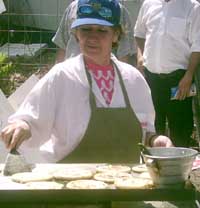
Melva Cordoba Quiros has her Sanabria Soto own version of free trade: pupusas. |
 A.M. Costa Rica/José
Pablo Ramírez Vindas
The crowd of marchers
stretched out about five blocks along Avenida 2 west from
the Plaza de la Democracia.
|
| Thursday was the turn of those who support treaty |
|
|
By Selleny Sanabria Soto
and the A.M. Costa Rica staff Thousands of persons rallied in favor of the free trade treaty with the United States Thursday. The short march down Avenida 2 and speeches at the Plaza de la Democracia were a show of strength to counter a larger march by anti-treaty demonstrators a week ago. Many workers were bused to the march, and opponents of the treaty said the workers were forced to participate. Albino Vargas, secretary general of the Asociación de Empleados Públicos, who opposes the treaty, said later he would complain formally to the International Labor Organization. Some of the participants Thursday did not know the specifics of why they were there. Luisa Diaz Sanchez said that she supports the treaty because she is looking for the future. “TLC means better opportunities to my family. Costa Rica does not have to be afraid to the changes.” All the members of her treaty support group were dressed in red T-shirts. TLC is the acronym based on the Spanish words for free trade treaty. At 9:30 a.m. the musical group “Los Hicsos” started the concert and people danced in the streets. According to Carlos Navarro, the youngest members of the “Los Hicsos,” he was in the march because of his work, but he said he thinks that to approve the Treaty is important because the pact is necessary to end corruption in Costa Rica. Some 12 persons came from HDP- Orchinex Costa Rica, riding from Puntarenas since 5:30 a.m, to support the treaty. Randall Arrollo, coordinator, said that if the treaty is not approved his firm will have to pay more taxes to export their products. All the employees from Azucarera El Viejo, came from Guanacaste, leaving there at 3 a.m, in four buses. “We came here to support our future here. There are not any political colors, TLC and Oscar Arias, are different things,” said Abel Canales Ruiz, he has eight years working in the sugar company. |
Alonso Porras, an
employee of DOLE who has 9 years working in the
fruit marketer, said that his boss told the employees that they had to
come to the march. If not, they will not have jobs in the future,
because the United States is the principal importer country. Melva Cordoba Quiros sold food like pupusas and chuzos de pollo in the middle of the street. She has her own little food company, and she supports the march because she said more jobs are needed. “Actually I don't know a lot of the treaty, just that Costa Rica needs to approve it,” she said. Some young mothers who brought babies have an organization to support the treaty in Alajuela. They live in the Urbanización el Tropico II. They said they think that if the treaty is not approved the Costa Rica economic situation will become worse. Maria Eugenia Alfaro Rodriguez, president of the group, said, speaking economically, that “if Costa Rica gets better, my husband will be better and of course I will be better too.” Efrain Ramírez is an elderly man who came from Desamparados to support the treaty. He is living on a pension and said his principal reason to support the pact is to seek a better pension. Two young people, Jose Alberto Espinoza Perez and Hanzel Gomez Perez, came from Pavas. They said they had no idea why they were there. Many others did not have a clear reason to participate, except that their employers encouraged them to do so. The treaty is before the Asamblea Legislativa, which is expected to begin committee hearings on the document next month. The treaty is a political football in this, the runup to the February presidential and legislative elections. The treaty would exempt from U.S. import duties the bulk of Costa Rican exports. Costa Rica is the last holdout in signing the treaty. Guatemala, Honduras, Nicaragua, El Salvador and the Dominican Republic all have ratified the document, as has the U.S. Congress. With or without Costa Rica the treaty goes into effect Jan. 1. |
| Botched beer truck heist leaves two stickup suspects wounded
|
|
|
By the A.M. Costa Rica staff
A failed attempt to rob a beer truck left one of the presumed bandits with a gunshot wound and the other behind bars, said officers with the Fuerza Pública. Officers said someone made a 911 call Wednesday evening saying that two persons with firearms were carjacking a Nissan Frontier, the officers said. The driver, Mario Ramírez, was an employee with Cerveceria de Costa Rica. When the two robbers tried to hijack the truck, a guard on the truck defended it with a shotgun, officers said. He shot one of the presumed bandits in the throat. A Nicaraguan suspect was later identified by the last names Silva Hurtado, officers said. They |
found a 12-gauge
shotgun nearby, they added. The second suspect, identified by the last names Ulloa Mora, was found soon after with wounds to the chest, stomach and legs. He hid in a tecal tree some 800 meters from where the attempted robbery took place, officers said. Afterwards, officers, with the help of the canine unit, found a a rifle nearby, possibly an AK-47 which they think was linked to the crime, they said. According to Alex Arce Quesada, commander of the Fuerza Pública on Pococí, both subjects have a long rap list but none of their past crimes involved firearms. For this reason, Arce is hopeful the subjects can be convicted and sentenced to hefty stays in prison. |
 |
 |
|
|
|
|
|
|
|
|
| What we published this week: | Monday | Tuesday | Wednesday | Thursday | Friday | Earlier |
|
|