|
 |
Your daily
English-language |
 |
|
|
|
|
|
|
|
|
|
|
|
|
|||||||||||||||
|
|
|||||||||||||||
 |
|
Second news page |
 Click HERE for photo tour of 526 properties for SALE or RENT in Escazú, Ciudad Colón, Santa Ana, Rohrmoser, Curridabat, Heredia and the Pacific Coast. |
|
|
|
|
|
|
|
|
|
|
 |
| Costa Rica Expertise Ltd http://crexpertise.com E-mail info@crexpertise.com Tel:506-256-8585 Fax:506-256-7575 |
 |

|
|
weather institute says By the A.M. Costa Rica staff
The arrival of the dry season will be delayed this year. For the north Pacific, the first area to experience the benefits of winds from the north, the Instituto Meteorológico Nacional said in a statement that the rains should stop sometime next week, perhaps one or two weeks later than normal, with infrequent rain until Nov. 30. For the central Pacific, the rain is expected to taper off by the second half of December, the weather experts said. The bad news is for the southern Pacific where rainy conditions are expected to continue through December into January with rain ending the last week in January. In the Central Valley, too, there is a chance of rain into December, but the bulk of the rainy season is predicted to end by the last week of November or the first week of December. The northern zone and the Caribbean coast is out of step with the rest of the country. Rain begins there this month and continues through February. The weather bureau also said that the Caribbean hurricane season is not yet over and there is the possibility of yet another storm. The number of storms set a record this year. Although they do not touch Costa Rica, the indirect effects can bring torrential rains and severe flooding. A low pressure system between Panamá and Colombia is expected to influence the weather in the short term. The weather institute expects rain in the northern zone and the Caribbean today with some rain possible in the Central Valley. But the institute reports that Saturday will be better. Dog fatally wounds suspected burglar By the A.M. Costa Rica staff
Firemen had to use a high-pressure hose Thursday to drive a rottweiler guard dog away from the burglar he caught and delivered fatal wounds. The dog would not let go of his prey even though his owner arrived at the scene and tried every way to drive the dog away including firing shots into the air. The incident unfolded in Lima de Cartago early Thursday when two men tried to burglarize a mechanics shop. An unarmed guard heard them and released a pair of rottweilers, a breed known as strong protectors of home and turf. One man escaped, but a 25-year-old man suffered multiple bites from the dog. The animal maintained the burglary suspect in his jaws for more than an hour and a half until firemen arrived. Death later at a nearby hospital was attributed to excessive loss of blood. The operator of the shop declined to shoot the dog during the lengthy attack on the suspect. Mayors from El Salvador will visit Desamparados By the A.M. Costa Rica staff
A delegation of five mayors and five other civil servants from El Salvador is scheduled to visit Desamparados to meet with Carlos Padilla Corella, the mayor. The delegation is hoping to understand and learn more about the municipality's initiatives in regard to environmental management as well as water transportation. The meeting is the result of the Corporación de Municipalidades de la República de El Salvador soliciting support from the Fundación de Desarrollo Municipal Centroamericano to organize a meeting with Costa Rican municipalities to understand this country's local experiences with natural resource protection, mainly water. Suspected cocaine haul falls into police hands By the A.M. Costa Rica staff
Fuerza Pública officers seized a total of 98 kilos of cocaine from two men traveling along the Interamericana Sur early Thursday morning, officers said. The two suspects, a 43-year-old Tico identified by the last names Ledesma Ledesma and a 47-year-old Panamanian identified by the last name Arosemena, also had two youths of 12 and 17-years-of age in the car, officers said. The car, which officers stopped at a roadblock at kilometer 53, had the stash hidden in a fake lining fitted over the rear seat in the vehicle, officers said. The two youths were placed under the control of the Patronato Nacional de la Infancia, officers said. Intel wireless technology going around the world Special to A.M. Costa Rica
SANTA CLARA, Calif. — Thirteen carriers from around the world are now deploying the world’s first fixed WiMAX networks based on Intel Corp.’s WiMAX technologies, delivering high-speed broadband access to businesses and residences from Germany to Guatemala. Eleven more carriers are preparing to deploy additional Intel-based WiMAX networks by year’s end. WiMAX is a wireless network that can connect to computers in an area up to miles in diameter. Intel makes chips in Costa Rica. Building on WiMAX trials worldwide, carriers are now rolling out full commercial deployments in cities as well as suburban and rural communities, allowing broadband wireless networks to reach locations where previously they were either impossible or too costly for carriers to pursue, the company said. Included are México and the Dominican Republic. |
|
||||||||||||||||
 |
 |
||||||||||||||||
| PRECONSTRUCTION
& INVESTMENT OPPORTUNITIES from only $35K in Playa del Coco
& Limon. Loft Condos from $80K. Walk to
Beach! Easy Financing. Low $ Down. Many Homes & Townhomes available IN ALL AREAS for IMMEDIATE OCCUPANCY. 954-245-7245   SKIP4848SKIP@AOL.COM WWW.COSTARICAHOMESWEETHOME.COM |
|
on our real estate page HERE! |
 |
|
Third news page |
 |
| Home | Calendar | Place
a classified ad |
Classifieds | Real estate | Food | About us | |
|
|
|||||||
 |
 |
 |
| More on the Caja, and some questions are answered |
|||
| Along with attempting
to
share some information last week about the Caja Costarricense de Seguro
Social and the talk about the health situation in Costa Rica, I
seem to have managed to spread some confusion. I did not check Professor Garnier’s figures for accuracy. My 1996 World Almanac showed that for 1995 the life expectancy in the U.S. for men was 73 and for women 80, while in Costa Rica the figures were 76 and 80. Thus I made the dangerous assumption that things would have improved here and, given reports of the inroads on life expectancy obesity is having in the States, (and, as my editor pointed out, war casualties must be taken into consideration), that things had not improved there. Once again, one learns the dangers of making assumptions. Besides, obesity is a growing problem in Costa Rica, as well. But there is even more confusion, or perhaps I should say, there are questions that have arisen. First of all, there is good news for the reader who asked how much $700 would get him and his wife in health coverage. The $700 on health care is what is the estimate that the Costa Rican government spends per person. The cost to the individual is far less. It is based upon one’s income. I understand that the Association of Residents of Costa Rica will help you get your insurance card and has an agreement with the Caja that their members pay about $40 a month. This may have changed. Many pensionados, who must guarantee an income of $600 a month, pay accordingly. My own health insurance costs run under $200 a year. (But go up with inflation.) However, I secured the insurance myself. The other question was regarding the process of becoming a member of the Caja once one has attained the status of a resident. I can only base my information on what I did. I went to the Caja building on Avenida 2 (kitty corner from the Teatro Nacional). At the information desk I asked the receptionist where I should go to register for health insurance. She told me I would have to go to my |
neighborhood clinic and get an ID
card. (If you are 65 or older, the Caja is where you apply for a
cuidadano de oro – a “golden age” card that has certain
privileges.) Returning to the Caja, I went, as directed, to Window 1, which
was for asegurados voluntarios. After taking another
ficha and more waiting, a clerk will ask you questions and fill out an
application called inscripcion asegurados voluntarios.
I was told to come back Monday to make my first payment. There
are
always people to answer questions and direct you to the correct
line.
You can pay for as many as six months’ premiums at one time. |
||
| Yes, a lobster without claws is pretty good, too |
||||
| My mother lived into
her late
80s despite an arm’s length list of maladies that made her chronically
depressed and anorectic — except for lobster. Place a pair of one pound or a single pound and a half specimen(s) of Homarus americanus on a platter in front of her with drawn butter, and she would exert more negative pressure than a TV commercial vacuum cleaner as she sucked the meat out of every nook and cranny, all the while, smiling. My wife, Joan, insists that I inherited the same crustacean sucking gene. Guilty. Growing up in New England, we were the seafood variants of Pavlov’s dogs, salivating at the mere mention of lobster, clams, oysters and scallops. Alas, the family migrated south and west. One of our sons and my sister now live in Maine; he, all year, and she, during each summer. So, is the green that I wear from envy? No, it is from hummingbirds and parrots, palm fronds, banana leaves and new growth on the mango tree outside my window. We have our own Tico langostas, clawless, but very nice. When I first ate spiny, rock, red rock, South African, Floridian, Australian, warm water, lobster tails or clawless lobsters, or crayfish as they are known in the Southern Hemisphere (Palinurus argus), I was disappointed only in comparison to the North Atlantic variety. These were less juicy, less sweet, less tender and devoid of all the tiny hiding places for discovering an extra morsel, which in my youth was more fun than finding the toy in the Cracker Jacks box. Two reasons that spiny lobsters may have missed the mark of excellence were that they were inevitably deep frozen and then grilled or broiled when defrosted. How could they compare with the live fresh captives plucked from a saltwater pond in a town with an inscrutable Algonquin name, boiled or steamed just enough to cook thru, bathed in melted butter and served with fresh-picked corn and ice cold watermelon? To avoid confusion, crayfish in southern Africa, Australia and New Zealand are the same genus as our Costa Rican lobsters. Crayfish in the warmer climes of North America are unrelated although they look like miniaturized Maine lobsters. They are fresh water dwellers also called crawfish, crawdads, ecrevisses, or mudbugs. Another species is also called mudbug (or Belmain bug, shovelnose, Moreton bug or Spanish lobster) but it is a saltwater, flat-nosed crustacean usually called by the more appealing menu name of “slipper lobster” all over the southern Pacific from Chile to Australia. This is my first column written since we returned from two months circling the Southern Hemisphere. We got to view extraordinary flora and fauna, meet great people, expand our understanding and appreciation for different cultures and sample seafood from Easter Island to South Africa by way of New Zealand and Australia. In a superb restaurant called High Tide in Christchurch, New Zealand, I had a pair of large juicy lobster tails steamed and drizzled with Pernod flavored butter. They were delicious. Kiwis extolled the uniqueness of their lobsters from deep icy fjords like Milford Sound on the west coast of the south island. In Rapa Nui, I had my first slipper lobsters prepared under the aegis of a chef from Normandy. Not quite French hommard, but quite satisfying with a splash of Calvados (apple brandy). In Sydney’s fish market they sold three different crayfish (lobster) varieties. The local New South Wales type which they chauvinistically described as the sweetest and most delicate, was admittedly a little small. From the deeper and colder waters of Tasmania came the largest, considered the best to south Australian palates. East and south alike disparaged the lobsters from Western Australia as too tough for anything other than sauces and bisques, probably because they arrived, frozen solid from a few thousand miles away. In Western Australia’s capital, Perth, the local spiny |
is considered the best and is exported all over the world. In Cape Town, locals insisted that cold Antarctic currents were the reason that theirs were the best. Namibians preferred their own from the pristine waters of Walvis Bay. Our best come from the Gulf of Nicoya by way of Puntarenas, and to my taste buds, they are fine. In my hometown of La Guacima, the local seafood restaurant and bar, Anthony, gets a fresh shipment of langostas every Friday from Puntarenas and keeps them cold, but not frozen solid. They usually last until Monday or Tuesday, but are best Friday or Saturday. If you don’t specify, the chef will grill them a little dry and firm but tasty. If you ask for “al vapor” they will be steamed. A little garlic butter on the side does the trick for me. Depending on the size, an order contains four to 24 halves, comes on a platter with patacones and salad and costs less than ¢ 5,000 ($10), a fraction of the price in upscale seafood emporia. Their menu also includes the standards, ceviche, seafood soup, corvina and shrimp at very affordable prices. Their clientele is local. The service is friendly. Should you wish to serve lobster tails at home, I suggest that you go to the largest wholesale and retail food market in the country, Cenada. If you exit the autopista at Cariari Mall and head east towards Heredia, the road forks just past the mall entrance. Less than a mile down the right fork on the right side of the road is the entrance to Cenada. At the gate you will be asked where you are going. The seafood and fish markets are down the end of the main drive off to the left. Frozen headless lobster tails are always available (closed on Sunday) from well before dawn until mid-afternoon. The average price for a typical serving is about ¢ 1,000 ($2). Please remember to defrost them, and all frozen seafood, in the refrigerator. To grill, cut the tails lengthwise, remove the central vein and grill until the shells are bright red. Served with sauce of your choosing or simply with melted butter and lime wedges. To boil, add deveined halves to a covered pot with a few inches of boiling salted water and steam for 10 to 15 minutes, depending on size and number of halves in the pot. For pomp, you can shell the tails, slice the meat into medallions, sauté in a little butter and bring to the table. Then pour a little warm brandy over the top, ignite and serve flambé. For lobster Cantonese, cut the tail lengthwise, then into medallions with the shell intact. Stir fry for only about two minutes in a little hot peanut oil, until the shells are bright red. Lower the heat and simmer for another five minutes in a black bean sauce (from the jar, it is strong and salty so start with a teaspoonful and increase according to your taste) enriched with minced cooked pork, sliced green onions, a little grated ginger and beaten eggs. Anthony is just north of the church on the same side of the road in La Guacima Centro. 438-0143. Open for lunch and dinner every day. 2&½ stars. $-$$. |
|||
|
|||||||||
|
Fourth news page |
Are you still
spending 70 percent You need to fill this space ASAP! |
||||||
| Home | Calendar | Place
a classified ad |
Classifieds | Real estate | Food | About us | |
|
|
|||||||
 |
These young performers entertained a packed house on Saturday with their skillful dances and traditional, colorful dress. |
 A.M. Costa Rica photos/Joe
Taylor
|
| Monteverde enjoys the results of its theatrical labors |
|
|
By Joe Taylor
Special to A.M. Costa Rica The standing-room-only crowd for the opening of the Galerón Cultural in Monteverde was just a continuation of Gloria Waissbluth’s quest to promote the arts in a community that she has loved since leaving her home in Chile more than 30 years ago. Standing in the newly renovated structure that used to be the community recycling center, Ms. Waissbluth’s husband, Bernardo Lelchuk, introduced the show entitled “Recycling Culture.” For the next three hours Saturday night, Ticos and Gringos of all ages were thoroughly entertained by short plays, singers, storytelling, and video clips. One of the highlights of the evening occurred when Lalo Rojas, a Grammy Award-winning saxophonist from San José, performed several songs with local youth on guitars, drums/percussion, bass, and violin. Cristina Bruno, a well-known technician for Teatro La Polea in San José, operated the lights and the impressive sound system. Her husband, César Melédez, one of Costa Rica’s most well known actors who wrote and starred in "El Nica," was unable to attend the performance. Currently, he is playing the part of Othello in a production at the Teatro Aduana until Dec. 4. Melédez, however, has made the difficult trip to Monteverde on several occasions to help Ms. Waissbluth work with the young actors from the area. Ms. Waissbluth has compiled an impressive resume in her long career in the arts community in Costa Rica since relocating from Chile in 1974. She was a professor of music at the Universidad de Costa Rica, the founder of the Costa Rica Youth Orchestra, and the executive director of the Sinfonía National from 1990-1997. During this time she managed to teach private lessons, and raise three sons with Bernardo, her husband of 46 years. In 1999, Ms. Waissbluth and her husband moved to Monteverde permanently. Ms. Waissbluth knew that the process of turning the recycling center into the Galerón Cultura was going to be a major undertaking and that it would require her calling on her numerous connections in the arts in Costa Rica. She admitted that she has never been afraid to contact patrons when she has needed their support. “The Banco Nacional has been very generous with its financial support,” she said. “They truly care about Monteverde.” Ms. Waissbluth was thrilled to learn that 12 Banco Nacional executives were in the audience Saturday night. She also said she appreciated the financial support of John Aspenall, the owner of the complex which contains the Galerón and the Flor de Vida restaurant. “He cares very much about our vision for Monteverde. He has paid for many of the renovations, and he does not charge us any rent for the building.” Long-time friend Victoria Haller, owner of the Flor de Vida, has also been instrumental in bringing the theater project to fruition. She believed so much in the location of the new theater that several months ago she moved her restaurant from its old location |
near the Hotel
Heliconia to its new home next to the Galerón. Lately, she has
either been serving up creative, vegetarian cuisine, or working
diligently on the new theater. Ms. Waissbluth pointed out that Ms.
Haller, a former architect in Argentina, applied her architectural
skills in the renovation of the theater. Ms. Waissbluth and the other volunteers of the Galerón plan to pass the generosity they have received to those who attend theater performances in the future. “We do not plan on charging an admission,” she stated. However, they do “plan to ask for donations to help pay for the utilities and other costs associated with running the theater which holds nearly 250 people,” she added. Hotel El Establo has agreed to provide rooms for all performers and teachers who will be donating their time and talents to the Galerón. In addition, Selvatura Park has agreed to allow these same individuals enjoy its vast array of activities, all free of charge. “The community support has been amazing,” Ms. Waissbluth said. The quiet, mountain town of Monteverde has never been associated with the word drama until last March 8 and 9 when armed robbers stormed the Banco Nacional killing nine people in the process. The effects of the shootout and standoff still haunt this community that has always valued its peaceful setting in the cloud forest. Ms. Waissbluth was one of the many residents who began a period of mourning after the horrific robbery. She realized that she had to do more to “help people get out of their trauma.” This is when she put her vision of a permanent, independent theater in Monteverde on the fast track. “Our community has been hurt by this event, “ she stated. Once again she turned to the arts for solace and strength. While she will never forget the tragedy of last March, she now can look to a more positive future ahead, especially for the youth. “My vision,” Ms. Waissbluth said, “is to expose this community to as much theater as possible because Monteverde is not like San José. Many people here do not have the exposure to the theater because it is not easy to get to the theater.” With a smile she added, "We are going to bring the theater to them.” She plans on developing a series of workshops for people of all ages to learn more about the theater as an occupation or simply to experience the joy of watching others perform on a stage. In addition, there are plans for three major productions in the year ahead. “One will be a children’s production, the other will consist of high school age students, and the last will be designed more for adult actors and performers,” Ms. Waissbluth said. The Galerón will also provide the stage for an upcoming production "Guys and Dolls" Dec. 9 and 10. The cast consists of students from the Creative Learning Center and the Monteverde Friends School. More information about upcoming performances is available at the Galerón, 645-6078, or the Flor de Vida restaurant, 645-6328. |
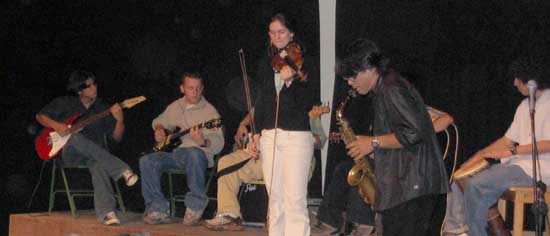 |
These young
Monteverde residents will not forget the night they performed together
with famed saxophonist Lalo Rojas |
 |
 |
| Toothy croc dominated seas 135 million years ago |
|
|
By the A.M. Costa Rica wire services
Argentine scientists have discovered the remains of a fierce sea monster that terrorized Pacific waters in the age of the dinosaurs. The researchers are calling it Godzilla after the legendary movie monster, but it really was an ancestor of modern crocodiles. What has a head like a meat eating dinosaur and a tail like a fish? An ancient sea reptile called a dakosaur. Millions of years ago when dinosaurs ruled the land, these early crocodiles dominated the oceans, but they never seem to have caught the public's imagination as dinosaurs have. Perhaps this will change with the discovery of a 135- million-year-old dakosaur skull and two lower jaws in the Patagonia desert of southern Argentina. The researchers who describe it in the journal Science call it Dakosaurus andiniensis, the Andean Dakosaur, to contrast it to those that swam in other parts of the world at the time. What a contrast it is. "At first glance, it was evident that Dakosaurus andiniensis was truly unique among marine crocodiles," said Diego Pol, an expert on ancient animals at the Ohio State University. He took part in the research and says the creature was distinct from its crocodile cousins of the Jurassic era because it had a tall, short head shaped like a bullet and large, powerful, serrated teeth that seem to belong in a dinosaur's mouth. These features indicate that it was a predator capable of gobbling reptiles and other large sea life, filling a niche eventually taken over by large sharks. In contrast, other dakosaurs and their modern crocodile descendants have long, thin snouts and many thin teeth suitable for feeding on smaller, more agile prey such as fish. "We find these results extremely interesting because |
they indicate that the
diversity of crocodiles back in the Jurassic was much greater than
expected," he added. Based on the size of the skull, Pol and his colleagues from the National University of La Plata, Argentina, estimate that the creature was four meters long, about 13 feet. They infer its body shape based on a computer program that analyzed the fossils and found that they most resemble the early crocodile branch that had flippers and a fish-like tail instead of four feet and a tail like modern crocodiles. "This analysis revealed that the anatomical changes along the evolution of the Dakosaurus lineage were clearly the most drastic evolutionary change in the history of marine crocodiles. This places the 135-million-year-old Dakosaurus andiniensis not only as one of the most recent members of this family, but also as the most bizarre marine crocodile known today," he explained. The National Geographic Society in Washington, which sponsored the research, says dakosaurs were only one of the monsters that cavorted in the world's oceans between 250 million and 65 million years ago. Back then shallow seas and a lack of significant marine predators created new opportunities for many reptiles that had first developed on land. They included such beasts as giant ichthyosaurs that might have reached 25 meters in length and plesiosaurs with seven-meter-long necks reminiscent of the fabled Loch Ness monster in Scotland. Pol said that all dakosaurs became extinct by the end of the Cretaceous era 65 million years ago, leaving us with only a fraction of the crocodile diversity of that long ago time. "This pattern of extinction is what we see in the fossil record of all species. It is fairly common to see that a species or family has its own moment where it diversifies and later goes extinct. The most famous case of this is the large dinosaurs that disappeared by the end of the Cretaceous," he said. |
| Candidate and supporters invade radio station and beat up
reporter |
|
|
By the A.M. Costa Rica wire services
An international media watchdog group says a Mexican mayoral candidate and dozens of his supporters have beaten up a radio reporter in retaliation for broadcasting an unfavorable report about the politician. Reporters Without Borders said in a statement Thursday that Ricardo Bravo, the candidate of the |
opposition Democratic
Revolution Party and his supporters, burst into
the studios of radio La Divertida and attacked Jorge Zamacona Ramirez
as he presented a live program. The group says Zamacona was
seriously
injured. According to the media watchdog group, Zamacona said the attack was reprisal for his having broadcast details of documents that related to alleged fraud committed by members of Bravo's family. |
|
|
|
|
|
|
|
|
| What we published this week: | Monday | Tuesday | Wednesday | Thursday | Friday | Earlier |
|
|