|
| |
Costa Rica Your daily |
 |
|
|
|
|
||||||||||||||||||||||||||
 |
|||||||||||||||||||||||||||
|
|
||||||||||||||||||||||||||
 |
|
|
|
|
|
|
|
|
| What we published this week: | Monday | Tuesday | Wednesday | Thursday | Friday | Earlier |
|
|
 |
 |
|||||||||
| A.M. Costa Rica's Second news page |
|||||||||
| Home |
Tourism |
Calendar |
Classifieds |
Entertainment |
Real
estate |
Rentals |
Sports |
About
us |
|
| San José, Costa Rica, Friday, Nov. 5, 2010, Vol. 10, No. 219 | |||||||||
 |
| Costa Rica Expertise Ltd http://crexpertise.com E-mail info@crexpertise.com Tel:506-256-8585 Fax:506-256-7575 |
 |
 |
|
deplores lack of action Dear A.M. Costa Rica: It appears as though this dredging situation came about without [Nicaraguann President Daniel] Ortega's blessings but somehow became a state issue more than likely to save face without apologizing. This is common for a man who has made a career out of taking what belongs to others. Crying and finger pointing is par for the course when it comes to those that Ortega rubs elbows with. They never throw one of their own under the bus. Our new president needs to send our old president to the OAS as a special envoy due to the fact that most of the world either likes him or fears the publicity of opposing him. Today's article about the land grabbing here in Costa Rica is right on. I see it here on the east coast and it appears as though it is rehearsed and the sad part is their are Gringos and Gringas along with the worst of attorneys involved. It's a common practice that is motivated by money. There is no morality involved, just greed and the criminal element that has found a entire industry that lines everyones pockets at the expense of the newcomers who are honest and give e-pats the benefit of the doubt. Dreams are broken and savings are lost and no one cares. More attorneys to solve the problems while San José legislatures get fatter and continue to ignore the problem because they can't see it from their house. I, too, have made these mistakes but have overcome them in the past several years, but it truly left me wounded and bitter and suspect now of everything. Its Pura Vida with conditions and a big stick, and that's the way it is and will be for a long long time. Bruce Simpson
Hone Creek What happened to CNBC on Amnet cable system? Dear A.M. Costa Rica: Amnet's recent rejuggling of the channels it offers, which it characterized as "nuevos canales," is a thinly disguised attempt to get its subscribers "to pay more for less," as Dean Barbour put it in his letter to the editor.. Indeed, Amnet has failed badly to meet the needs of its subscribers who rely on CNBC, formerly carried on Channel 64, as their primary source of business information. CNBC went off the air sometime on Tuesday, Oct. 26. I began calling Amnet the same day and was informed that there was a problem in receiving the "signal" and that Amnet's engineers were attempting to find a solution. Despite my calls, Channel 64 remained blank for two days. Sometime on Thursday, Amnet began to offer a distinctly inferior business information program presented by Bloomberg. I was assured that this was being offered only temporarily until Amnet restored its signal with CNBC and that a solution would be found by Friday at the latest. When I spoke to a representative on Friday, I was assured that a solution would be found by Monday, Nov. 1. As of the time of this letter, some nine days after the CNBC signal went blank, the problem has yet to be solved. Amnet continues to substitute Bloomberg for CNBC, which is now carried on Channel 77. The Amnet guide on Channel 2 explains that because of circumstances "beyond its control," CNBC is off the air "temporarily." No explanation is given of what those circumstances might be or why Amnet's engineers have been unable to resolve the problem. Perhaps Amnet could hire one of CableTica's engineers since CableTica has enjoyed an UNINTERRUPTED SIGNAL from CNBC during the past week. Or, is it possible that Amnet has not fully disclosed the reason for its failure to provide CNBC as promised but is the result of some circumstance within its control? David Jackson
San Jose
|
|||||||||||||||||||||||||||||||||||||||||||||||||||||
 |
||||||||||||||||||||||||||||||||||||||||||||||||||||||
 |
|
| Home |
Tourism |
Place
classified ad |
Classifieds |
Entertainment |
Real
estate |
Rentals |
Sports |
About
us |
|
| What we published this week: | Monday | Tuesday | Wednesday | Thursday | Friday | Earlier |
| The contents of this page and this Web site are copyrighted by Consultantes Río Colorado 2001, 2002, 2003, 2004, 2005, 2006, 2007 and 2008 and may not be reproduced anywhere without permission. Abstracts and fair use are permitted. Check HERE for details | ||||||
 |
| A.M. Costa Rica third newspage |
 |
||||||||
| Home |
Tourism |
Calendar |
Classifieds |
Entertainment |
Real
estate |
Rentals |
Sports |
About
us |
|
| San José, Costa Rica, Friday, Nov. 5, 2010, Vol. 10, No. 219 | |||||||||
 |
| Providing water is not a
priority for emergency workers. This scene was Thursday at the Banco
Nacional in Aserrí Centro. |
 A.M. Costa Rica/Saray Ramírez
Vindas
|
| Storm's
death toll sure to climb higher |
|
|
By Saray Ramírez Vindas
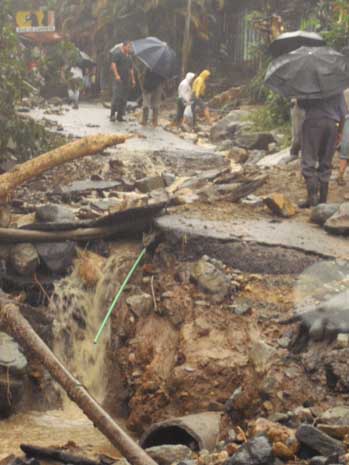
and the A.M. Costa Rica staff At least 21 persons are dead as direct results of the heavy rain that hit the country since Monday. The death toll is sure to climb today. The largest loss of life was in Calle Lajas, Barrio El Carmen, San Antonio de Escazú, where part of Pico Blanco gave way after midnight Thursday and dumped tons of rock, dirt and trees on residents as they slept. The national emergency commission said that at least five homes were buried. Emergency workers found 20 bodies, eight women, six men and six children. But more are believed buried. Unofficial estimates range from five to 20 more. President Laura Chinchilla Miranda decreed two days of national mourning starting today. Casa Presidencial said she would visit Escazú starting at 8 a.m. Her first stop is at the Municipalidad building and then to the emergency operations center in Escuela El Carmen in San Antonio de Escazú uphill from Escazú Centro. Then she will visit a local shelter at the Liceo de Escazú. The emergency commission said that the slide began as a small one some 700 meters above the sleeping victims in the working class neighborhood. Rescue workers said that the hillsides have about a 45-degree slope there. The commission attributed the slide to the heavy rains. The 21st death is believed to be that of a motorist in San Marcos de Tarrazú, who was swept away at a river crossing. Two companions also were carried away and are missing, said the Cruz Roja.. The emergency commission reported that there are 27 shelters operating throughout the country with about 1,394 residents. Principal shelters are in Atenas, Naranjo, Bagaces, Nicoya, Santa Cruz, Quepos, Parrita, Osa, Alajueilita, Aserrí, Desamparados, Dota, Escazú and León Cortés. At least nine bridges have been damaged, including the Turrubares bridge over the Río Grande de Tárcoles, which was destroyed by a 45-foot wall of water. Some homes nearby also suffered damage. Also damaged was a petroleum pipeline there that is being repaired, said the emergency commission. The Ministerio de Obras Públicas y Transportes said that 58 stretches of road were damaged, and 38 were in critical shape. That just includes the national roads. Many canton and local roads were destroyed, too. Water to the metropolitan area was being affected by damage to a major supply line at Puente de Mulas. The Instituto Nacional de Acueductos y Alcantarillados was supplying trucked water to Aserrí and Parrita on the Central Pacific Coast. Aserrí is just a few miles south from and higher than San Rafael Arriba de Desamparados. It suffered a major slide that cut three main highways at Lourdes, a few miles north of Aserrí. There also was damage in Barrio Cinco Esquinas and La Carreta. Some homes including at least one new one were filled with mud and rocks, according to a reporter on the scene. The Cruz Roja said it had 500 emergency workers on duty with 81 vehicles and that it directed evacuations in Santa Cruz, Bagaces, Cartago, Zona Sur, Escazú, Zona de los Santos, Aserrí and Acosta. The organization said there were 100 persons in three shelters in Río Seco, Paraíso y Los Pargos, all Santa Cruz. Some 45 persons were in shelters in Bagaces The organization also reported slides in La Chinchilla and Santa María de Dota and said two person were missing in Finca Pipasa in Herradurra on the Central Pacific coast and two more were missing in Parrita. Flooding in Parrita that started Monday continued. Many residents on the central Pacific coast were walking around in waist-high water. A reader, Bob Milstead, said a neighbor, identified as John Heim in Tres Rios de Osa near Coronado on the central Pacific coast, kept track of the rainfall. Milstead reported that Hein logged 32.7 inches through 6 a.m. Thursday. Monday saw 7.3 inches. There were 15.6 inches on Tuesday, and Wednesday's reading was 9.8 inches. The readerings were reported to be from 6 a.m. to 6 a.m., so the rain after 6 a.m. Thursday is not counted in that total. The most damaging rain of the year was caused by a fusion of a low pressure area near Panamá and Tropical Storm Tomas that was in the Caribbean. Tomas has executed the expected turn to the north and now threatens Haiti. However, the Instituto Meteorológical Nacional said that the effects of the weather system would last through today. However, there was little rain in the metro area after 9 p.m. Most of the influence from the weather system will continue to be in the Central Valley and the Pacific coast, the weather institute said. The approaching storm may be the third humanitarian crisis that Haiti faces this year, coming amid ongoing efforts to assist up to a million people left homeless by the earthquake that devastated the country in January, and a cholera outbreak that erupted last month, according to the U.N. Office for the Coordination of Humanitarian Affairs. |
 A.M. Costa Rica/Saray Ramírez
Vindas
 Photo by Bob Milstead
This is the washout on the Costanera Sur just north of Ojochal
at Cinco Ventanas Road. Some briefs on the storm
By the A.M. Costa Rica staff
Here are some brief developments relating to the storm. The Ministerio de Educación Pública suspended classes for today except in the northern zone, the Caribbean and the northern part of Guanacaste where storm effects were minimal. A bailey bridge over the Río Grande de Tárcoles between Orotina and Turrubare collapsed due to water damage. This is the site where an old hanging bridge failed and dumped a bus into the river Oct. 22, 2009. Five persons died then. The Instituto Mixto de Ayuda Social said it was making an initial distribution of 220 million colons, about $432,000, to its offices in the affected parts of the country. Some Costa Ricans living in the United States contacted A.M. Costa Rica because news reports there were not specific about what section of Escazú was the site of the fatal landslide. None had family in the area of the tragedy. In the Quepos-Manuel Antonio area on the central Pacific coast a large landslide carried away trees and jungle between the Hotel Mono Azul and Hotel Villa Teca. One resident said that the slide and destruction of trees would hamper monkeys on their travels through the trees. "Now, instead of traveling through the trees in that area, they are running along the power lines," the reader said. "There will be more deaths and partial electrocutions to these innocent creatures." Three hydro plants were out of operation. They are the Río Virilla generating station operated by the Compañía Nacional de Fuerza y Luz and the Pirris station in the Los Santos zone and the El Diquis plant in the south of the country, both operated by the Instituto Costarricense de Electricidad. The damage, mostly from flooding, is being evaluated. The company known as ICE also said that 1,235 customers were without power in Quepos in Parrita, 118 in Alajuela at Lanas, Cañales and Salitrales, 464 in San Isidro de El General and 913 at Río Claro. Some 67 cell phone towers also were out of service. |
| Boyeros and their oxen will take to the streets for donations |
|
|
By the A.M. Costa Rica staff
Donations of money, food and clothing are being sought by Costa Rican agencies to help those who suffered during this week's flooding. And residents of the community where the fatal landslide took place are bringing out oxen and carts to make collections. The Comisión Nacional de Prevención de Riesgos y Atención de Emergencias said that the law provides that all aid, national and international, should pass through its accounts. The commission listed accounts at Banco de Costa Rica, 118281-1 for dollars and 91100-3 for colons. It also listed its account at Banco Nacional: 911-8 in colons. The Cruz Roja is the traditional distributor of food during emergencies. It said it would accept non-perishable food items, including canned products, personal hygiene articles like soap, toilet paper and diapers. It also said that donors could deposit money for this purpose at Banco de Costa Rica (204-6 dollars and 176003-3 colons) and Banco Nacional ( 68666-7 dollars and 100100-7 colons). |
Most Cruz Roja local facilities will
accept items. In Jacó Daystar Properties is coordinating for local officials to collect needed items. The firm said it seeks mainly non-perishable food and water. Also clothes, diapers, toilet paper, bath towel, personal hygiene items, toothpaste, toothbrush, blankets, among others. Donations can be delivered in the Daystar Properties offices 50 meters southeast from Municipality of Garabito. More information is available at the municipal police (2643-1213), the Garabito Chamber of Commerce (2643-2853) or Daystar (2643-1290). In San Antonio de Escazú where a slide early Thursday killed whole families, the neighbors organized under the Las Fuerzas Vivas will pass through the community and the canton of Escazú Sunday accepting donations, They will be using oxcarts because the community is the spiritual home of the oxcart driver, the boyero, and even contains a monument to the tradition. They will be seeking clothing and foodstuffs. They expect to conclude at the Catholic church in San Antonio about 11 a.m. |
| The Acosta-Lourdes- Aserrí area also had its share of slides, and some houses were filled with dirt, rock and rubble. |
 A.M. Costa Rica/Saray Ramírez
Vindas
|
| Two Aserrí men say muncipality did not heed warning |
|
|
By Saray Ramírez Vindas
of the A.M. Costa Rica staff A citizen's group in Aserrí warned municipal officials early last month about the possibility of landslides, but officials rejected their concerns because the national emergency commission disagreed, representatives of the group said Thursday. They are Luis Diego Chinchilla Valverde and Enrique Barboza Calero, both members of the 12-year-old Asociación Grupo Cultural Aserrí. They said the organization was concerned after a cliffside collapsed above Santa Ana in early October. The peak, Chitaría, is similar to mountains around Aserrí, they said. They based their concern on a technical study. However, they said the emergency commission told the municipal officials that the study was not professional. The men said they thought that the landslide that hit their area could have been prevented. They lamented the heavy economic damage that the tropical storm caused. |
 A.M. Costa Rica/Saray Ramírez
Vindas
Luis Diego Chinchilla and Enrique Barboza
|
 |
| You need to see Costa Rican tourism information HERE! |
| Home |
Tourism |
Place
classified ad |
Classifieds |
Entertainment |
Real
estate |
Rentals |
Sports |
About
us |
|
| What we published this week: | Monday | Tuesday | Wednesday | Thursday | Friday | Earlier |
| The contents of this page and this Web site are copyrighted by Consultantes Río Colorado 2001, 2002, 2003, 2004, 2005, 2006, 2007 and 2008 and may not be reproduced anywhere without permission. Abstracts and fair use are permitted. Check HERE for details | ||||||

| A.M. Costa Rica fourth news page |
 |
||||||||
| Home |
Tourism |
Calendar |
Classifieds |
Entertainment |
Real
estate |
Rentals |
Sports |
About
us |
|
| San José, Costa Rica, Friday, Nov. 5, 2010, Vol. 10, No. 219 | |||||||||
| Why fear San José, the city of many parks and great
food? |
||||
| This past weekend
I learned that I am as much of a provincial josefino as the proverbial
New Yorker. In short, I learned that there are other wonderful
towns to live in besides San Jose. I visited one of them last Friday when Mike Styles invited me to San Ramón to talk to the members of the Community Action Alliance about the ‘Ten best kept secrets of San Jose.” I felt something of an imposter because one person’s favorite place is another person’s “I don’t go there anymore.” The first well kept secret, at least to the Costa Rican tourism department is: that almost to a person, the tourists and future residents of San Ramón (and other places) are warned upon arrival by tour guides and tour companies to avoid San José. A good public relations surge is needed. It seemed strange even to me that I would begin, in addressing people who are surrounded by countryside, to talk about the city’s parks. But San Jose’s parks, beginning with La Sabana are its jewels and a place to truly enjoy the peace and quiet and presence of trees within the bustle of the city. My favorites begin with the Parque Morazán which was the first place I saw so many young and not so young lovers on benches intensely relating to one another. I learned later that the park was the only place they could find some privacy from their families or from their jobs as domestics. My favorite tree lives in this park – a huge higerón on the southwest corner. In the rainy season it looks like it will surely die, hauntingly so at Halloween, but it recovers and the leaves come back and it becomes its majestic self again. Next to the Morazán is a small park south of the Escuela Metalica. It has a statue of former president Daniel Oduber and a lovely tree-lined walk that reminds me of a cypress-lined drive in Italy. Then my favorite: Parque España, just across the street going east. It is a mini rainforest in the middle of the city and a quiet place to talk. It is actually two levels. On the second is a huge statue of what appears to be a conquistador. Exiting from the left entrance of the park, across the street you will see a doorway into a walled compound where “the old liquor factory” once was. Now its many buildings house the Centro Nacional de Cultura. Check the notices on the |
bulletin board for upcoming activities and exhibitions. If you keep going up the hill, you will come to Parque Nacional, another gem with some interesting statues. One of the things I love about San José is that when facilities close, commercial or public, they are often replaced with parks and cultural centers (i.e. the Sabana park used to be the airfield and the national museum of art is housed in what was the central airport building, both well worth visiting.) Of course, by now you are hungry. If you go back into the Parque España and take the south exit, and go through the underpass, on the right hand side of the street you will come to the parking lot and side door of the Club Colonial. As you enter, on the right you will see doors with “Hombres” and “Damas.” And will be able to make use of clean, well-lighted and best-equipped bathrooms in San Jose. If you go to the front of the casino, past the tables and slot machines, on the left is the Magnolia Café. The front area has windows looking onto Avenida 1. Between 11 a.m. and 2 p.m. you will be able to enjoy the reasonably priced and usually pretty tasty ejecutivo menu – a three course lunch for about $8. If you want a typical Costa Rican lunch for even less, exit the Colonial onto Avenida 1. Turn right a block and a half and you will come to a corner with Hotel Morazán on the right and across the street, the Banco de Costa Rica. On the bank side of the street, down about three doors, is the Flor Café. You will recognize it because the large windows are (unfortunately) covered with signs showing the menu. Inside is a bustling and usually nearly full dining room where very good typical food is served. Next week, for more experimental and international cuisines we will turn right when we exit the culture center and enjoy what Barrio Amón has to offer. |
|||
| Final orchestra performances of season
are tonight, Sunday |
||
|
By the A.M. Costa Rica staff
The last performances of the Orquesta Sinfónica Nacional for this season takes place this weekend, as Chosei Komatsu directs his musicians his final time as director. The invited guest is U.S. pianist Brian Ganz, who won first place in the 1189 international piano competition in Paris. |
The program
features three works by Ludwig van Beethoven. Both the 8
p.m. performance tonight and the 10:30 Sunday one are in the Teatro
Nacional. Komatsu has directed the orchestra for seven years and also held an identical position with the Aichi, Japan, symphony orchestra. This is the 11th concert of the season. |
|
| Home |
Tourism |
Place
classified ad |
Classifieds |
Entertainment |
Real
estate |
Rentals |
Sports |
About
us |
|
| What we published this week: | Monday | Tuesday | Wednesday | Thursday | Friday | Earlier |
| The contents of this page and this Web site are copyrighted by Consultantes Río Colorado 2010 and may not be reproduced anywhere without permission. Abstracts and fair use are permitted. Check HERE for details | ||||||
| A.M. Costa Rica fifth news page |
|
|||||||||
| Home |
Tourism |
Calendar |
Classifieds |
Entertainment |
Real
estate |
Rentals |
Sports |
About
us |
||
|
|
||||||||||
 |
 |
| Home |
Tourism |
Place
classified ad |
Classifieds |
Entertainment |
Real
estate |
Rentals |
Sports |
About
us |
|
| What we published this week: | Monday | Tuesday | Wednesday | Thursday | Friday | Earlier |
| The contents of this page and this Web site are copyrighted by Consultantes Río Colorado 2001, 2002, 2003, 2004, 2005, 2006, 2007 and 2008 and may not be reproduced anywhere without permission. Abstracts and fair use are permitted. Check HERE for details | ||||||
| A.M. Costa
Rica sixth news page |
Looking
for a story from a past edition? See our search page or http://www.amcostaricaarchives.com |
||||||||
| Home |
Tourism |
Calendar |
Classifieds |
Entertainment |
Real estate |
Rentals |
Sports |
About us |
|
|
|
|||||||||
Latin American news Please reload page if feed does not appear promptly |
New
plant species found in Bolivian park project Special to A.M. Costa Rica
Botanists at the Missouri Botanical Garden have described eight new plant species collected in the Madidi national park and surrounding areas located on the eastern slopes of the Andes in northern Bolivia. The new species are from several different genera and families and are published in a recent edition of the Missouri Botanical Garden journal Novon. Missouri Botanical Garden scientists and colleagues from the National Herbarium in La Paz, Bolivia, describe Prestonia leco, Passiflora madidiana, Siphoneugena minima, Siphoneugena glabrata, Hydrocotyle apolobambensis, Weberbauerocereus madidiensis, Styloceras connatum and Meriania horrida. All but one species, Siphoneugena glabrata, were collected as part of Proyecto Madidi, a ten-year effort to inventory plant species in the national park, educate graduate students and conduct an ecological inventory of the national park. The new species will be made available for incorporation in the upcoming Bolivian catalog of vascular plants. Some of the new species are only found in very specific areas of the national park and surrounding areas and have been assigned a provisional conservation status of vulnerable following the International Union for Conservation of Nature guidelines, the botanical garden said. Others are more broadly distributed and clearly indicate that more is to be found. Peter Jørgensen, associate curator at the Missouri Botanical Garden in St. Louis considers the threat to the species to be limited if the protected areas are respected, but several places within the region are at risk of fragmentation as a result of the construction of new roads and the increase in cattle and farming activities. “Before we started this project in 2000, this botanically rich area was essentially a white area on the map, almost unexplored,” said Jørgensen. “There has been very little general collecting in this area. Over the course of a decade we have documented more than 7,000 species, which is about a third of what you can find in North America.” Since the start of the Madidi project, botanists have identified about 132 new species; 32 of which have been published. Eighteen species are currently in preparation for publication, and the remaining need additional collections and documentation. The study area in the project encompasses 110,000 square kilometers and includes three protected areas: the Madidi national park, Pilón Lajas and Apolobamba. Ranging from the glacier-covered peaks of the high Andes mountains to the tropical rain forests of the Tuichi River, Madidi is recognized as one of the world’s most biologically diverse regions. |
| Latin American news feeds are disabled on
archived pages.
|
|
| Home |
Tourism |
Place
classified ad |
Classifieds |
Entertainment |
Real
estate |
Rentals |
Sports |
About
us |
|
| What we published this week: | Monday | Tuesday | Wednesday | Thursday | Friday | Earlier |
| The contents of this page and this Web site are copyrighted by Consultantes Río Colorado 2001, 2002, 2003, 2004, 2005, 2006, 2007 and 2008 and may not be reproduced anywhere without permission. Abstracts and fair use are permitted. Check HERE for details | ||||||