Your daily English-language news
source
Monday through Friday
|
|
|
Your daily English-language news
source
|
|
|
|
|
|
|
|
|
|
|
|
|
|
|
||||||||
|
|
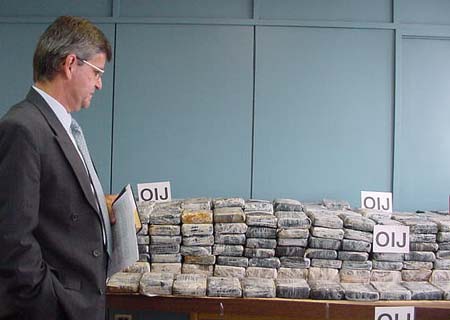
A.M. Costa Rica photo
|
Jorge Rojas of the Judicial Investigating Organization examines the haul of packaged cocaine his agents made in Puntarenas. |
|
hidden in dump truck By the A.M. Costa Rica staff Cocaine smugglers used identical dump trucks to throw police off their trail, officials revealed Thursday. Jorge Rojas, director of the Judicial Investigating Organization, announced the arrest of a Costa Rican and the seizure of 500 kilos of cocaine in one- and two-kilo plastic packages. Judicial officials identified the man by his last names of Matarrita Matarrita and said that the prosecutor in Puntarenas has asked a judge to put the man in preventative detention for six months. The man was arrested when investigators grabbed one of the two International brand dump trucks at a Puntarenas brake shop. The suspect lived in Ciudad Neily on the Panamá border and made frequent trips with the truck to Panamá and to Nicaragua, officials said. An identical truck which even had the same license plate numbers was seized in Ciudad Neily, officials said. The truck in Puntarenas has a false side that allowed smugglers to hide cocaine packages. The dump truck, which is the type that is used to haul loads of rock and gravel could easily handle an additional 1,100 pounds of cocaine. Rojas said that he expected more raids and arrests stemming from the case. Arrests also were expected in Panamá, he said, adding that information from the U.S. Drug Enforcement Agency triggered the investigation. Ecstasy net unraveled
By the A.M. Costa Rica staff Anti-drug police conducted nine simultaneous raids Thursday and arrested nine persons they say were members of an ecstasy ring. Among those arrested was a disc jockey who works at popular dance clubs. Raids were made in Escazú, Goicoechea, Sabanilla, Lomas de Ayarco, La Unión, San Pedro and Curridabat, said the Policía de Control de Drogas. Seized were 221 doses of ecstasy and LSD, 87 grams of cocaine and nearly three kilos of marijuana, said police. Ecstasy is a synthetic drug probably of local manufacture. Investigators said that the people arrested Thursday have a connection with a Canadian and his Costa Rican girl friend who were arrested two weeks ago at a marijuana growing operation in San Pedro de Montes de Oca. The disc jockey underwent arrest at a raid in Escazú. He was identified by the last names of Tijerino Cerna. Investigators said that he worked in a number of different nightclubs and also musical events known as raves that attract the younger set. They called his arrest an important development in the fight against drugs. Police said they could not correctly categorize the people arrested as a band, which suggests leadership. Instead, the people were members of a network that was designed simply to move drugs. Only the disc jockey appeared to have a regular job, police said. Big leap reported
By the A.M. Costa Rica staff Costa Rica experienced a 12.9 percent increase in tourists who came by air in May, the tourism institute said Friday. And the number of tourists who have come to the country during the first five months of 2003 nearly equal those who came here in 2001. The country was on a tourism surge in 2001 until the flow of visitors was cut off by the terrorist attacks of Sept. 11 in that year in the United States. Rodrigo A. Castro Fonseca, minister of tourism, was happy to report Thursday that May, the month with the latest available statistics, showed a sharp increase. Here are the numbers for May: 2001: 57,358
The numbers cover only arrivals by air at both Juan Santamaía International Airport in Alajuela and Daniel Oduber International Airport in Liberia. Here are the air arrivals for tourists during the first five months of the years indicated: 2001: 386,532
Castro said he cold not be certain but suspected that the new Costa Rica tourism Web page that went into service in March might have had something to do with the increase in the month of May. The $833,000 price tax for the Web page has been controversial, and Castro has defended the cost and the project as an example of integrated marketing that the country needs. Some 64 percent of the tourists who come to Costa Rica are North American and those totals were consistent with the overall figures. Sunday is a day here
By the A.M. Costa Rica staff Today may be Halloween, an excuse for youngsters to roam the streets looking for mischief, but the big day in Costa Rica is Sunday. That is All Souls Day in the Roman Catholic calendar and a time for Costa Ricans to visit the graves of their relatives. The Día de los Muertos does not have as much color here as it does in México where feasts are held at the grave sites for the benefit of deceased relatives. However, Costa Ricans will make a point to bring flowers to graves Sunday and to make sure that the grave site is cleaned up and the grass cut. Over-ground tombs may get a coat of paint if the weather cooperates. |
|
|
|
||
|
About 10 years ago, my husband, Sid, who was a good 20 years older than me, died of a massive heart attack. He had been my life, and I'd counted on his solid opinions to guide me through thick and thin. Suddenly, there I was starting my life over at the age of 32, and with a newborn son to boot. Although we had a very nice home, a boat, and two luxury cars, I hadn't realized how terrible our financial situation was, and my options were limited. I hadn't worked since I'd been married, and if I worked now, who would watch our son? My mother finally convinced me to join her and my dad at their bed and breakfast near Montezuma in Costa Rica for a while. I opted to overlook the expense; I needed to get away. Montezuma was a funky little beach town. I arrived in December, and most of the visitors were Tico families. My parents' bed and breakfast was right on the beach. They boasted six rooms, a little bar, and a laundry facility. It was the laundry facility that I remember most. Well, it was more like a bunker than a facility. One set of narrow stairs led from the kitchen to the laundry area. If you survived the treacherous decent, you pushed open a little door and entered the room, which was built out of concrete blocks. In spite of the potentially gloomy surroundings, the laundry room was cheery enough. The washing machine wasn't like any I'd seen in the States. It used a huge paddle to push clothes around a large, open tub. I suppose it could have been similar to my great-great grandmother's washing machine, but it was completely alien to me. We had no dryer, and we strung the clothes up inside the room. Two chairs graced one side of the chamber. I suppose my mother thought some people might actually use them to wait for their clothes to finish washing. One day I was surprised to discover that someone WAS waiting for their clothes. I stumbled down the steps with a basket of laundry and pushed open the door, nearly colliding with a pretty young woman who stood near the agitating washing machine combing her long, black hair. She was accompanied by a huge German shepherd, who nudged my hand as I offered my profuse apologies for nearly running her down with my basket. We chatted for a few minutes about the antiquated state of appliances throughout the country. From her accent, I guessed her to be American or Canadian. "You've recently lost your husband," she said out of the blue. I was shocked. How could she have known that? Then I remembered that the town was small, and she'd probably heard it from someone. "Yes," I said, although my chest clenched up each time I thought about Sid. "My son and I are here visiting my family until I can figure out what to do." |
"Your husband has a message for you," she said, and I listened incredulously as she violated every unwritten rule of compassion and respect for those who have lost a loved one. "You need to look under the boards in your boathouse." I mumbled some polite excuse and set down the basket before bolting from the room. I stood at the top of the stairs near the entrance to the kitchen and began to weep. What was all that about? Why did some people gain joy from torturing others? Did she seek out widows and pretend she could talk to their dead husbands? I wondered how much money she made off people doing that. My mother found me before I could regain my composure. "Who is the guest with the long, black hair?" I demanded. "She's in the laundry room now with her dog." My mother said she had no guests of that description, and because this woman had obviously disturbed me, she marched me right back down the stairs so she could give this lady a piece of her mind. But the woman and her dog were . . . gone. And the washing machine that I had seen filled with water not more than a minute before was dry as a bone. I have not returned to the States, but I did finally ask my sister to look under the floorboards in the boathouse before she put the house up for sale. What she found there has enabled me to forget about ever needing to find work. It also paid for my parents' new laundry facility. Thank you, Sid. Hot Lizard Boy is the pen name of a U.S. author.
|
|
|
|
||
|
Since it was so long ago, most do not remember the baby girl born in Arenal, the original Arenal, not Nuevo Arenal. She was born in the spring of 1960. Her young mother had a very hard time bearing the child, and died in the last moments of her birth. The father and grandmother were present, and gasped when they saw the child. She was a beautiful baby, but was born without any pigmentation whatsoever, and had a transparent quality. The grief-stricken father and grandmother cared for the child and carefully kept her away from sunlight, as her special skin was extremely sensitive to light. They named her Flora De Luna, as she was truly a moonflower. She grew up in the small town, only venturing out at night. Because of this peculiar lifestyle, the residents of the town gave her the nickname "Fantasma". She was lonely most of her life, especially when first her grandmother and then her father died. She moved under a small bridge where the stream passed through Arenal and lived off native fruits and plants. She would come out around midnight every night and walk about the town. There were very few people around at that hour, and the "ghost of the moonflower" was free to roam about the town without stares from passersby. She had heard the noises from a big construction crew for many months and wanted to see what they were building. Through the darkness, it appeared to be a massive wall spanning one side of the valley to the other. Suddenly she was startled by a voice; it was a young man guarding the heavy equipment for the construction. He told her his name was José, and in the hours that passed, they got to know one another. He could not tell in the moonlight that she was so pale; he could only see her inner beauty. In the nights to follow, she and Jose grew enamored with each other. Finally, Jose gave her her first kiss, and they were in love. She returned night after night and dreamed of him as she slept during the day. One night she hurried to the construction site to meet Jose. He was not there. There was a new guard, and he informed her that Jose had unfortunately been crushed by an earth bank that had collapsed on him, and he was dead by the time the frantic workers could dig him out of the wet soil. Fantasma choked on her tears and stumbled back to her bridge, back to a life that was more desolate than before. She heard a lot of traffic in the daytime, but never ventured back to the site where her one love had perished. After days of heavy traffic, the town was totally silent. She was deep in sleep the day it happened; virulent waters covered the town, the bridge, and Fantasma. She struggled and cried out, but soon succumbed to the swift current. No one heard her but the full moon. A nearby volcano spewed a defeated sigh that sparked the night, and then all fell silent once again. Since the townspeople never saw Fantasma, she had long been forgotten. The people had all moved to a new town, Nuevo Arenal. The new lake had taken her life that night. Fantasma thought she had been asleep and had only dreamed of a flood, but something seemed very different when she took her walk that night. The air had a satiny, watery look to it, everything seemed ethereal. She walked to the church, it was empty. She looked in the stores, all were empty. She then went through the neighborhood and the doors to the houses hung open, waving in the current, beckoning Fantasma to enter. Fantasma felt an ache deep in her soul, and she screamed a silent scream as she realized that she |
was truly a ghost. She sobbed to herself because she had always believed that since she had spent her life as a ghost, then in death she would become human like. The force from her anger and pain shot up through the waters like a dolphin and leapt above the water in the moonlight. There in the distance was the huge formidable wall; it appeared to have a street on top with lights strung across the newly formed lake. Fantasma walked the length of the street, back and forth all night, searching for the townspeople. Finally, she heard howler monkeys in the forest and realized that daybreak was coming. She dove gracefully into the waters and came to rest at the base of the bridge. She thought that she would rest during the daylight hours, and resume her search at nightfall. When darkness came, Fantasma again lurched up through the water into the moonlight, and her cries in the night alarmed the parrots and quieted the tree frogs. She walked back and forth across the bridge, and then in desperation, down the path where she had first met José. There sat a guard who looked strangely familiar. It was José! They ran to each other and embraced, and discussed how different it was being a spirit. They compared notes as to how they realized that they were dead, and laughed about the silly thoughts they had. José explained to her that a hydroelectric plant had been built and that was why the townspeople had left and the town had been flooded. He hadn’t seen the landslide coming that killed him, but his last thoughts were of Fantasma and his love for her. They vowed to be together for all eternity, and live in the ghost town of Arenal. By day, they sleep in their watery grave, and by night, they walk hand-in-hand across the bridge. Little by little their town is becoming re-inhabited, but by a spirit world. There is a new priest in the church, the stores are re-opening and children play in the streets. There are dogs, chickens and wildlife. All the creatures in this underworld are ghostly in nature, Fantasma is home at last. They are occasionally visited by a scuba diver, but that is the limit to their contact with humans, until they enter their town to stay. There are still empty houses available, and you can see Fantasma and José walking the bridge at night, looking for new neighbors. Are you looking for a nice quiet town? Copyrighted 2003 By Barbara Gerber |
|
|
|
||
|
I'm not sure I should even be telling this story, it happened to me on Halloween night two years ago. I was returning home to Puriscal from a Halloween party in Piedades around 11:30 p.m. when I missed my turn due to the thick fog. Instead of turning around and backtracking, I took one of the many back roads that were heading in the same direction as Puriscal. A kilometer or two down this road I realized the mud from that days heavy rain would soon make the road impassable. I attempted to turn around and found myself sliding into the ditch. Hopelessly stuck, I grabbed my umbrella and started walking back to the main road. After about 20 minutes I came upon a very small house set about 20 meters off the road. I trudged through the mud to ask to use the phone. When I knocked, the door was answered by an old Costa Rican man. Not able to speak much Spanish, I was still able to pantomime my dilemma. He seemed to understand but had no phone. Instead, he led me to the back where he had two massive oxen already tethered to their yoke. With |
these massive animals we walked back to my car where he wrapped what looked like a brand new chain to my car, and they towed me with ease onto the road. As I drove home, I noticed I'd left my umbrella at the little house. So the next day I returned to reward the kind Tico for his trouble and retrieve my umbrella. I found the side road with no trouble but could not see the house. Not wanting to get stuck again I walked as far as the spot where I'd been stuck, it was easy to see with all the tracks, but the only tracks I could see were my cars. Walking back to the road where I was parked I saw footprints leading off the road. Finally I'd found it! I followed my tracks off the road but did not find a house. Where the footprints ended I found my umbrella and an old rusty chain. Copyrighted 2003 by Jim Smiley |
|
|
|
|
|
WASHINGTON—The National Geographic Society and Vanderbilt University have announced recovery of a 600-pound elaborately carved Maya altar, replete with images and writing that offer new information on the shrouded history of the ancient civilization. The altar was recovered through an unusual collaboration among Guatemalan undercover agents, local Maya villagers and American archaeologists that included a six-month pursuit of the relic and the arrest of a ring of antiquities looters. Archaeologist Arthur Demarest of Vanderbilt University, who helped recover the altar from the looters' hideout, said the relic is one of the finest Maya altars known and provides important clues about one of the wealthiest Maya kingdoms. The great altar was placed in A.D. 796 as a marker at the end of the royal ball court of Cancuén, the site of one of the largest royal palaces ever found, where the ancient city's ruler would play the sacred Maya ball game against visiting kings, said a release. The role of the game was more ritual than sport, and the location of ball courts in the ritual space within Maya cities and the imagery that accompanies them underscores their role as boundaries between the actual and supernatural worlds, the National Geographic Society said. "They also used these royal ball games to celebrate state visits and to conclude royal alliances," says Demarest. "The carvings on the altar actually represent the two kings playing and, thus, record the state visit." The stone altar was set into the ball court floor and was used as a marker or goal post for later games, as well as a sacrificial altar. The altar is one of two from Cancuén known to exist. The other, unearthed in 1915, is on display in Guatemala's National Museum of Archaeology and has long been considered one of that museum's greatest treasures. "The newly discovered altar is a masterpiece of Maya art, even better than the one found in 1915, and its text gives a glimpse of the last years of the Cancuén kingdom," said Federico Fahsen, Cancuén project epigrapher who is deciphering the glyphs. The king pictured on the altar, Taj Chan Ahk Ah Kalomte, was the greatest in Cancuén's long dynasty of rulers. Demarest, with co-director Tomás Barrientos, leads the Cancuén Archaeological Project, which is supported by National Geographic and Vanderbilt, which is in Nashville, Tenn. Discovery of the stone altar, however, did not come about through archaeology, but as the result of a sustainable tourism and indigenous development project conducted by National Geographic, Vanderbilt and the humanitarian organization Counterpart International. The initiative, begun in 2001, is designed to train residents of the impoverished Q'eqchi' Maya villages near the Cancuén ruins to develop tourism and also helps provide basic health services, water, solar power and legal support. While working on the project, Demarest and his colleagues developed the trust of local residents, who eventually came to him with news that the altar had been looted from the ground after it was exposed by a storm. Demarest first learned of the altar's existence more than six months ago while working at the site. "One night four Maya elders showed up at my tent in the project camp," he recalled. "They told me that a woman had been brutally beaten by men in ski masks who were searching for a great altar that had been looted from Cancuén, one that I hadn't even known existed." The nocturnal visit set in motion a secret investigation by Cancuén project members, Guatemala's Ministry of Culture, and the Ecological and Cultural Patrimony Division of Guatemala's S.I.C. (Servícios de Investigación Criminal, that country's equivalent of the FBI) of looting in the region. It was this unprecedented cooperative effort among local Maya villagers, Guatemalan authorities and archaeologists that brought about recovery of the artifact, said a National Geographic Society release. Guatemalan officials said that this may be the first time an entire network of looters and dealers of Maya artifacts has been exposed. "These arrests |
will set an example for the looters
and dealers that Guatemala takes the defense of its ancient Maya heritage
seriously," said Claudia Gonzales Herrera, Guatemala's assistant attorney
general for national patrimony. Herrera will lead prosecution of the looters.
The Cancuén Archaeological Project has been the scene of a series of spectacular discoveries in the remote southwestern region of the Petén rain forest. The project has been unearthing the lost city of Cancuén, an ancient Maya mercantile port city located at the head of the Pasión River, the largest transport "highway" of the Petén during the Late Classic golden age of the Maya civilization (A.D. 600-830). "The local shamans and leaders have long revered these sites as sacred, but because of their involvement in managing the sites, they now also see them as vital to their economic future and to that of their children and grandchildren," said Demarest. "Because of this, some local Maya leaders took great personal risk to inform us about looters in the region, help apprehend the looters, and eventually to testify against them." Jonathan Tourtellot, director of National Geographic's Sustainable Tourism project, views the capture of the looters and recovery of the altar as a great victory for sustainable community tourism. "It's what we've been arguing for some time — that the best way to protect the world's archaeological and ecological treasures is for the local people to share in the benefits of tourism," said Tourtellot. "They need to have an economic stake and a cultural identification with the sites." Demarest agrees that "the story of the altar's recovery is miraculous. Open to us now are clues to the end of the Cancuén kingdom that we never would have found without its recovery." The larger figure carved on the altar is identified as Taj Chan Ahk, the lord of Cancuén's sprawling palace. "Taj Chan Ahk was the greatest in Cancuén's long dynasty of rulers, and his titles on the altar show his aspirations to take control of the whole region during these final decades of Classic Maya civilization," said Fahsen. Taj Chan Ahk used his wealth to construct Cancuén's gigantic palace of fine masonry and to cover it with life-sized stucco sculptures. He also dedicated ball courts and many monuments and used those settings to host feasts, rituals and ball games in order to ally himself with kings of other centers who had greater military power. "His strategies allowed him to stay in power and even expand his authority at a time, about A.D. 800, when most of the other Maya kingdoms of the west were collapsing," Fahsen said. Demarest and his colleagues will use Fahsen's decipherment of the altar and clues from other recently discovered monuments to continue excavations at Cancuén, including a search for the great king's royal tomb. EDITOR'S NOTE: Although the Maya civilization is generally considered to have been located in Mexico´s Yucatan, Guatemala and Honduras, influences and trade routes reached deep into the western part of what is today Costa Rica. ARCHIVE NOTE: At the request of the National Geographic Society, we have not archived the photos that go with this story. The original story and photos may be found HERE! |
| What we published this week: | Monday | Tuesday | Wednesday | Thursday | Friday | Earlier |
|
|