|
Your daily English-language news
source
|
at the speed of
|
|
|
|
|
|
|
|
|
|
|
|
|
|
|||||||||||
|
|
|||||||||||
|
|
|
|
of the A.M. Costa Rica staff An advocate for the proposed International Law Enforcement Academy said Monday that detractors who say the school is militaristic are lying. Carlos Alvarado, an assistant minister, said the nature of the school is clearly defined. Speaking at the monthly meeting of the Democrats Abroad of Costa Rica, he said there will be no military training at the school, and no U.S agencies involved in the academy are military. He is with the Ministerio de Seguridad Pública. The school would train judges, prosecutors and police from Latin America to recognize international crime and fight it, say proponents. Alvarado said the school would not be a one-sided U.S. venture, but many countries would participate. He said Colombia would send experts on kidnappings, and Peru and Bolivia would send experts on drug production. He said the training ground would be a place for all countries to share experiences and help each other. Alvarado said he welcomes the U.S. in the fight against crime. He called Costa Rica and the United States brothers, and said that he has confidence in the United States as an ally. The security minister said that when he talks about the academy, the detractors are talking about a different academy. He said foes are lying about the clear facts of the school. He said there is no plan for military training there, which would be unacceptable to Costa Rica. He said the school would have an open door for anyone to see inside, and ultimately the school would be answerable to the Costa Rican government and Supreme Court. Alvarado called opponents of the academy insincere. He said they were trying to put a fly in the ointment, and opponents would probably be |
A.M. Costa Rica photo/Saray Ramírez
Vindas
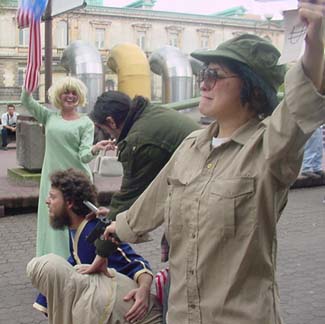
Uncle Sam and allies are beating down the Latin American peasants in
this demonstration Sunday on Avenida Central. The University of Costa Rica
students are against war, petroleum, free trade, etc.
proponents if the academy were sponsored by the Cuban government. Alvarado spoke to people who in the past have expressed reservations about the proposed academy. The usually rambunctious crowd was tempered and respectful throughout the speech. The Democrats last month welcomed Francisco Cordero, a consultant to the Partido Liberación Nacional. Cordero spoke against the founding of the school he said if Costa Ricans trained there they would be more loyal to the United States than their government. Earlier in the meeting the Democrats observed a moment of silence for Paul Wellstone, Democratic senator from Minnesota, who was killed in a plane crash Friday. The Democrat club made a small donation to the senator’s campaign for re-election this fall. |
|
|
|
|
of the A.M. Costa Rica staff Canada will take trade wherever it can get it, and its new treaty with Costa Rica is a model for similar pacts in the region. That would be a good summary of current official thought. In notes to a speech in Halifax, Nova Scotia last week, Pierre Pettigrew said that through its experience with Costa Rica, Canada has been able to modernize its focus and use this to develop other treaties elsewhere. He pointed out that Canada has also proved this in the past with their work with developing countries. He is minister of international trade. Louise Léger, Canada’s ambassador to Costa Rica, last week gave a local slant on the new two-way agreement between Canada and Costa Rica. Ms. Léger, who was involved in the ratification of the agreement, talked briefly about its implementation and implications. “When I arrived, most of my year was lobbying with the Costa Ricans to ratify the agreement,” She said. “They finally did in July. But it isn’t yet final.” She said: “There are a number of, I wouldn’t call them loose ends, but there are things that have to be established. For example, we have a side agreement on the environment, and one on labor issues. So you have to put bi-national committees together. Then you have to decide when this treaty is going to go into effect . . . all these things come after the fact. So, that’s what we’re doing now.” Echoing these sentiments, Pettigrew acknowledged in his speech the part played by partnership with Costa Rica in exploring these environmental and labor rights issues also. However, it is not clear where these side issues will fit into the trade agreement in question. In reality, Ms. Léger said that eventually the agreement will
bring a greater Canadian presence in terms of investment and products to
Costa Rica. Canadian investments here already include Scotia Bank and La
Republica newspaper.
|
These trade agreements don’t come
without their baggage, though. There exist movements around the world who
are opposed to free trade agreements. Some descended on the World Summit
in Johannesburg, South Africa in August to protest them.
Many of the people who attended, and indeed others who didn’t, feel that these agreements create unfair competition for other nations, particularly the developing world countries Pettigrew flirted with in his speech. Basically, these agreements mean lower import tariffs for products from countries with agreements. Other countries — without such agreements — pay higher tariffs. Contrary to this and explaining Canada’s predicament, Ms. Léger says that it was initially Costa Rica that approached Canada about the agreement. Certainly, four other Central American countries have approached Canada for similar agreements, said Ms. Léger. Figures for 2000 estimated trade between Canada and Costa Rica for that year at $268.9 million, according to the Canadian Department of Foreign Affairs and International Trade Web site. The United States has plans for similar agreements, too. Ms. Léger suggested that the implications of these will be far greater than anything Canada has or will have in place. Additionally, European Union countries are keeping a close eye on the market here. Last week, they convened a meeting with Roberto Tovar, foreign minister for Costa Rica, and discussed the foundations of any possible agreement between the European Union (EU) and Costa Rica/Central America. Georgina Butler, British ambassador to Costa Rica, said that the EU is awaiting the outcome of the agreements Costa Rica is developing with the U.S. before entering into more serious negotiations. Regionally, the Free Trade Agreement of the Americas seeks to further enhance free trade across the region. Pettigrew will attempt to advance Canada's trade agenda with the Americas when he attends the seventh Free Trade Area of the Americas Ministerial Meeting Friday in Quito, Ecuador. He will also hold more two-way trade meetings with several Latin American and Caribbean partners on the margins of the meeting. |
| World anticipates
Da Silva’s administration By the A.M. Costa Rica wire services BRASILIA, Brazil —The international community has congratulated President-elect Luis Inacio da Silva, and waits to see how the leftist leader will run South America's largest economy. On Monday, President George Bush telephoned da Silva to offer congratulations for Sunday's landslide victory. The White House says Bush looks forward to working with Brazil's new president, especially with regard to advancing democracy, good governance and free trade in the hemisphere. Paul O'Neill, U.S. treasury secretary, says the financial markets are going to watch very carefully what the newly elected president does when he takes office. European leaders pledged support for Brazil's economy in a bid to calm nervous financial markets. Da Silva says he will honor the country’s financial commitments, keep inflation down and maintain fiscal stability. He has called on multilateral lenders like the International Monetary Fund to help the country through its economic hardships. Horst Koehler, the fund’s managing director, said in a statement that his agency looks forward to working with the da Silva government to help create the conditions that would lead to sustained economic growth in Brazil. The Brazilian currency, the real, has lost 40 percent of its value this year. Investors fear the incoming administration will not be able to continue payments on the country's $260 billion debt. Last month, the International Monetary Fund extended a $30 billion loan
to Brazil to stabilize the economy amid uncertainty surrounding the outcome
of the election. The government-backed candidate, Jose Serra, was defeated
in the election. Da Silva will take office Jan. 1.
Colombia transfers two
By the A.M. Costa Rica wire services BOGOTA, Colombia — The government here has handed over to the United States two suspects wanted for the murder of an American oil worker in Ecuador. More suspects are still wanted in connection with a series of kidnappings of foreign oil workers in the region. In all, eight Colombians are wanted in connection with the violent kidnapping of five American oil workers and the death of one of them Ronald Clay Sander, 54, of Missouri. He was kidnapped in Ecuador in 2000 and later killed by his captors after his employer refused to pay the demanded $80 million ransom. Others taken hostage with him were later set free after a reported $13 million ransom was paid. The eight Colombians charged in a federal indictment unsealed Monday are accused of conspiring to commit hostage taking in order to extort American companies. "This group and their co-conspirators targeted locations where U.S. nationals and other foreign nationals worked and traveled," said Roscoe Howard, U.S. attorney for Washington, D.C. "They conducted surveillance on them, attacked them using deadly force and marched them into the jungles of Ecuador where they were bound and threatened at gunpoint for months until large ransoms were eventually paid." Two suspects named in the indictment are now in U.S. custody in what prosecutors say marks the first time the Colombian government has handed over anyone wanted in the United States on a non-drug related crime. Three others are in Colombian custody, of which two are fugitives. Prosecutors would not comment on the whereabouts of another suspect. Gasoline going up By the A.M. Costa Rica staff Gasoline is going up 10.4 colons per liter. The Autoridad Reguladora de los Servicios Públicos made the decision, which will go into force when published in the official gazette. The increase, less than 3 percent, means that regular will sell for 225.9 colons a liter or about 869 colons per U. S. gallon, some $2.35. Other petroleum products face similar increases. |

Researchers develop
anthrax-detecting system Special to A.M. Costa Rica WASHINGTON, D.C. — Researchers at the National Aeronautics and Space Administration's Jet Propulsion Laboratory have demonstrated a prototype alarm device — similar to a smoke detector — that automatically monitors the air for the presence of bacterial spores, such as anthrax. According to a release Wednesday, a research paper published in Engineering in Medicine and Biology magazine says the laboratory’s bacterial spore detection system is simple and designed for constant and unattended monitoring of spaces such as public facilities and commercial buildings. Researchers report that an alarm sounds when an increase in spore concentration
is detected. A technician would then respond to confirm the presence of
anthrax spores using traditional analysis. The instrument response time
is 15 minutes, fast enough to help prevent widespread contamination.
|
| What we published this week: | Monday | Tuesday | Wednesday | Thursday | Friday | Earlier |
|
|