A.M. Costa Rica photo
|
|
|
||
|
"The Brothers" investment firm suspended operations Monday, and the shock reverberated through the North American community. Hundreds, perhaps thousands of the firm’s investors were waiting for late payments of September interest. With the announcement by Luis Enrique Villalobos Camacho, the fact became clear that there would be no quick interest payments and the status of their principal remained uncertain. In a faxed statement received by this newspaper about noon, Villalobos said he could no longer continue operations because the Costa Rican government and governments elsewhere had frozen his bank accounts. However, he said he would continue to fight in order to pay his debts and make good on his commitments. Villalobos was not available for comment. The faxed message came from a public machine maintained by Correos de Costa Rica. His office telephones were not answered, and workers in the San Pedro Mall said movers took computers and desks away Saturday. Several sources said that Villalobos paid off his employees and gave them severance pay late last week. In his statement, Villalobos said that 300 persons had lost their jobs because of the banking freeze. Villalobos was not answering his cellular telephone Monday morning. Later in the day the device would not accept messages because the mailbox was full, a recorded voice said. Villalobos has tried to distance himself from Ofinter S.A., a money exchange house he said is run by his brother, Osvaldo. The money exchange occupies an office on the second floor of the San Pedro Mall, and Villalobos occupies an adjacent office. That office was closed Monday. Also closed was the money exchange house and a branch in downtown San José. The Costa Rica freeze on the Villalobos accounts is supposed to last until Nov. 26, according to a spokesman for the Poder Judicial. Fiscal Walter Espinoza is investigating Ofinter and the transactions of nearly $400,000 that passed through the firm for the benefit of six Canadians who subsequently were arrested in Canada to face drug smuggling and money laundering charges. Espinoza is part of the drug investigating unit of the judicial system. However, a spokesman said that another probe has been opened by the Judicial Investigating Organization. That investigation is by the financial crimes unit, the spokesman said. When asked to explain why judicial officials are investigating Villalobos when the tainted money passed through a company he does not control, the spokesman said that this was exactly the point officials were investigating, the relationship of Villalobos and Ofinter. In his statement, Villalobos said that investigators had frozen accounts that had no relation to the money exchange house. He said the freeze was disproportionate and covered all the firm’s accounts, not just enough money to represent the estimated $380,000 the Canadians were supposed to have deposited in Costa Rica. U.S. investors in the Villalobos company said that banks there were not honoring his checks. Checks written for interest payments on Servicios De Soporte al Turismo, S.A. are being returned for insufficient funds by BAC Florida, said one investor. Other investors here said that other checks were being dishonored. One said he saw a $4,500 check that had been returned. |
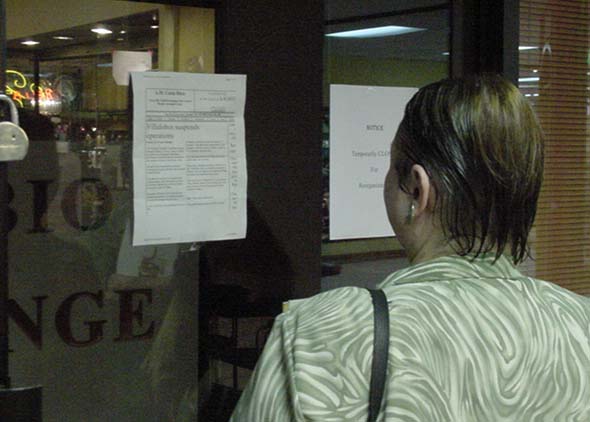
Villalobos generally presented himself as a private individual borrowing money from friends and associates, but he also controls corporations. Some of these are West Park Tech Marketing S.A., Dorado International S.A., Corporación Platino y Oro S.A., Corporación de Oror Internacional S.A. and Bienes Raices Dorado S.A. as well as the Servicios de Suporte al Turismo S.A., according to letters sent to investors. Investigators raided the money exchange and Villalobos’ offices July 4. Since then investors have received varying degrees of assurances and some monthly interest money. This month Villalobos employees told his investors that he would begin paying interest Oct. 7 and had hired a contractor to handle the job. Villalobos has been in business for at least 20 years. He pays from 2.8 to 3 percent per month on investments over $10,000. For many North Americans living here his interest represents their principal income. One investor told a story of seeing two elderly North American men hobbling along in walkers Saturday at the mall seeking to locate Villalobos so they could get money to pay their rent. A.M. Costa Rica has estimated his investment clients at about 5,000. Others say as much as 6,000. The total amount invested is anywhere from $50 million to $1 billion. Villalobos has never told anyone what he does with the money to generate that kind of interest. Costa Rican and U.S. officials have had their eye on him for years because many of his customers do not pay income tax on their interest. Because many payments were in cash, regulators were unable to follow the transactions. Lately Villalobos asked investors to provide bank account numbers where the interest could be deposited. Some opened accounts just for that purpose. The financial impact of the Villalobos suspension is difficult to measure. Many of his investors live in the United States and Canada. About 70 percent of the North American residents here probably are his clients. If 2,000 heads of households here received $2,800 interest each a month from Villalobos, the economic impact of the suspension would be $67 million a year. Shops and restaurants that cater to North Americans already are feeling the pinch. At the San Pedro Mall Monday a steady procession of investors came up quietly to the Ofinter office and read the short suspension notice taped to the door. About 3 p.m. someone also taped a news story from A.M. Costa Rica that was based on Villalobos’ morning statement. Each investor had a story to tell. Each seemed to want assurances that the suspension only was temporary. One woman, a Tica of North American parents suggested that most of the family’s money was invested there. Villalobos in his statement referred to enormous moral damage caused by the freeze of his accounts. Anecdotal accounts from investors include tales of persons who have invested money for the distant family members, mothers, fathers and brothers. Other accounts report that some business people were making a living by offering 2 percent a month interest on the Internet and then investing clients’ money with Villalobos, thereby pocketing the difference. Some of these are believed to have done business with unsavory Runyonesque characters to whom they must now report the halt in the interest payments. |
|
|

 |
|
How to live, invest or find romance in Costa Rica 
|
