|
 |
Your daily
English-language |
 |
|
|
|
|
|
|
|
|
|
|
|
|
|||||||||||||
|
|
|||||||||||||
|
Second news page |
 Click HERE for photo tour of 526 properties for SALE or RENT in Escazú, Ciudad Colón, Santa Ana, Rohrmoser, Curridabat, Heredia and the Pacific Coast. |
|
|
|
|
|
|
|
|
|
|
 |
| Costa Rica Expertise Ltd http://crexpertise.com E-mail info@crexpertise.com Tel:506-256-8585 Fax:506-256-7575 |
 |

|
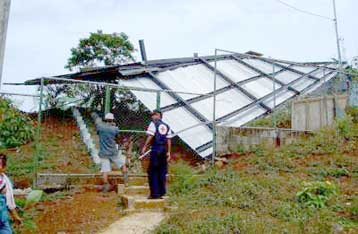 Cruz Roja photo
Cruz Roja workers inspect the roof that was blown off the
school at the community of Seis Amigos near Siquirres by a wind
strom Tuesday. None of the 30 students were injured.With 1,273 in shelters rescues are continuing By the A.M. Costa Rica staff
Emergency commission officials say that although the Guanacaste plains have gained some measure of stability, the rain is still bombarding the highlands of the province and workers with the commission and the Cruz Roja struggled Thursday to get stubborn residents to move from their homes. In the community of Corralillos de Filadelfia, the two organizations were forced to use small boats to move residents to shelters. Local emergency committees continued to evacuate persons in high-risk zones and although the rain has remained relatively calm so far, the Instituto Meteorológico Nacional expects rains to continue through Saturday in Guanacaste, said the Comisión Nacional de Prevención de Riesgos y Atención de Emergencias. Even though the rain has not yet started in earnest, the Cañas, Tempisque and Bebedero rivers are all flooding, the commission said. In a situation reminiscent of New Orleans, several persons in the communities of Bebedero de Cañas and Bagaces ignored authorities' warnings to evacuate. Rescue workers found these persons isolated in their homes frustrating Alexander Solís, the commission's operations boss. He renewed his warnings, urging residents to cooperate with rescuers to minimize the danger to everyone involved. Rescue operations are already difficult enough, the commission said. The flooding rivers are infested with tree trunks and other materials that the currents have washed away. However, workers were still able to bring supplies to Bebedero de Bagaces, la Colonia Esperanza, La Guinea de Filadelfia and Ortega de Santa Cruz, all of which were isolated from help. The newest figures provided by local emergency committees in Guanacaste said that 1,331 persons have been forced from their homes. 1,273 of them are distributed throughout 17 shelters. The remaining 58 are with friends and family. Cañas has 630 displaced persons. 389 persons in Carrillo were forced to flee their homes, and flooding drove away 210 persons in Santa Cruz the majority of which were in Ortega, the commission said. Biodiversity institute has to tighten its belt By the A.M. Costa Rica staff
A funding crisis is causing the Costa Rica Biodiversity Insitute to cut 16 of its 50 biodiversity researchers, said Randall García, director of conservation at the institute. The problem stems from two seven-year grants awarded to the conservation organization from the World Bank and the government of Holland that are scheduled to expire at the end of the year. The project is over, said García, and though the researchers were laid off this year, the institute hopes to rehire them by 2007 for more work. García said that many of the researchers had been working for the duration of the grants to catalog all of Costa Rica's insect life, a monumental task. Costa Rica is renowned for it's biodiversity. According to the institute's Web site, Costa Rica is one of the 20 most biologically diverse countries in the world even though it only takes up .03 percent of the world's surface. A little over 25 percent of the country’s territory is under some category of protection, the institute said. The Institute bills itself as a private research and biodiversity management center, established in 1989 to support efforts to gather knowledge on the country’s biological diversity and promote its sustainable use. The institute works under the premise that the best way to conserve biodiversity is to utilize the opportunities it offers to improve the quality of life of human beings. It is a non-governmental, non-profit, public interest organization of civil society that works in close collaboration with different government institutions, universities, the private sector and other public and private organizations, both within and outside Costa Rica, the Web site. Man arrested at hotel with two 14-year-olds By the A.M. Costa Rica staff
Fuerza Pública officers said they arrested a Desamparados man for trying to abuse two 14-year-old girls. Officers said they received a call from workers at a Tibás motel, the Edén, who said they had heard the two girls screaming. When officers busted in, they said they saw the 47-year-old suspect, identified by the last names Rodríguez Madrigal, with the two girls. The girls told the authorities that the man, who knew them, was trying to sexually abuse them. Authorities arrested the man and put the girls under the care of a Fuerza Pública psychologist until their parents could be notified, officers said. The girls were tricked into going with their abductor as they walked home from school, they told agents. |
|
||||||||||||||||
 |

|
||||||||||||||||
| PRECONSTRUCTION
& INVESTMENT OPPORTUNITIES from only $35K in Playa del Coco
& Limon. Loft Condos from $80K. Walk to
Beach! Easy Financing. Low $ Down. Many Homes & Townhomes available IN ALL AREAS for IMMEDIATE OCCUPANCY. 954-245-7245   SKIP4848SKIP@AOL.COM WWW.COSTARICAHOMESWEETHOME.COM |
|
with the observations of Dr. Lenny Karpman Click HERE! |
 |
 |
 |
| Call-in shows and letters to the editor are like guests |
|||
| I awoke again, early –
around
5 a.m. to a foggy day in San Jose. I could say this about every
day this week – and the last. This was not the way it was say, 10
years ago, even in the rainy season. The changes in the weather
patterns in the rest of the world have affected even Costa Rica. No
surprise, we are part of the world, too. But as yet, the changes
have not been as severe here. Saying this, I think of the concept of relativity. There are no absolutes. Measuring things (like the weather or quality of life) is done in relation to other similar conditions elsewhere. And then the extension of the idea, like it or not, that we are all connected. That busy butterfly in China will sooner or later have an effect on the United States or Costa Rica and the rest of the world. Just as I was readying myself to defend my comments of the past week, I found in the letter section of A. M. Costa Rica that others had already come to my rescue, and even more gratifyingly, to the defense of Costa Rica. Conditions in one country cannot be seen except in comparison to similar conditions in another country. We have no absolutes with which to compare, whether it is weather, freedom or quality of life. Even reality is relative. Reality is sifted through different worldviews. This was certainly evident in the letters. Letters to the editor are like calls in to a TV or radio station. Over last weekend I listened for at least 12 hours to the 25 hour marathon that C-Span programmed to celebrate its 25 years on television. There were many guests talking about each of the past 25 years in politics in the U.S. (C-Span, as you probably know, is devoted to political discussion). |
|
||
| The guide you need for cooking a turkey locally |
||||
| Thelma lives in Florida
and
will be here from early October until mid-November. At home she roasts
a fresh turkey in standard fashion with Pepperidge Farm stuffing mix,
roasted chestnuts and oysters. She heard that the larger frozen birds
sold here can be cardboard dry disasters. Her cousin countered that my
tips for brining and slower cooking helped produce a nearly perfect
bird last year. Her three requests were: to repeat last year’s tips, to
come up with a stuffing (dressing) made with readily available Tico
ingredients and to do it by the beginning of November because they may
celebrate a week early. OK Thelma. Turkey tips: 1.) Defrost the turkey in the refrigerator to avoid salmonella problems. It may take 48 hours for a large bird. 2.) Brine the bird in very salty water, two cups of salt per gallon of water with enough to cover. I combine the two processes by defrosting the turkey in the salt water. Don’t use an aluminum pot. If you don’t have a large enough porcelain or stainless pot for large birds, use two heavy duty plastic bags, one inside the other, tied at the top and left in the fridge for two days. Brining adds flavor and makes the meat juicy. When you are ready to prepare your feast, rinse the bird very well and pat dry. 3.) Most recipes tell you to salt the bird well inside and out. DON’T. The brining has added enough saltiness. 4.) Rubs and glazes are not the same. Glazes burn if you put them on too early. Rubs go on and/or under the skin before the turkey goes in the oven. A simple rub is to coat the skin with flavored sesame oil or butter and then sprinkle with sweet paprika for color. If you want to get fancy, carefully work your hand under the skin over the breast and thighs without tearing the skin. Smear soft butter and finely shredded fresh herbs (e.g. Thyme, sage and tarragon) into the space. For a glaze, you might try guava jelly or marmalade straight from the jar. Paint it on three or four times at 20-minute intervals during the last stages of roasting and it won’t burn unless your oven is too hot. 5.) Particularly with large birds, you have to use low heat, 300 degrees F at most, or the white breast meat will be dry as cardboard by the time the meat near the bone is cooked. Use a meat thermometer and aim for 165 degrees deep in the thigh. You will have to be more patient than ever before and start earlier. Your roasting time will be 3 ½ to 5 ½ hours, depending on size (average bird= 6 to 10 pounds, large is 10-16, expect an additional 25 minutes per pound over 16). Remove from the oven and let it rest for about half an hour before slicing and serving. The meat will actually continue to cook for the first several minutes and the temperature will probably reach 175 degrees. Place the bird on a rack over a roasting pan. Put two cups of water and chunks of carrot, onion and celery in the bottom. Start with breast side down for the first two and a half hours to assure moistness, then turn just once with able bodied help. Gravy 6.) For the gravy, try a two-step version to make the final phase less stressful. First, make a roux with two tablespoons each of flour and butter, lightly brown in a dry skillet and slowly add a quart of rich |
chicken or turkey stock while stirring. This part can be done at any time while the turkey is roasting. The result is bland gravy that is not too thick. When the turkey exits the oven, pour the drippings in the pan into a Pyrex measuring cup. Pour off two thirds of the fat (sprinkle a tablespoon or two on top of the stuffing as described below). Remove the large aromatic vegetables from the pan. Deglaze all the caramelized bits off the bottom and add with the drippings to the gravy. Simmer on the stove. Season for taste. 7.) Don’t stuff the turkey. Make the dressing in roasting pans, precook and you can reheat and brown the top in a hot oven while the turkey is resting. The same is true for reheating precooked candied sweet potatoes. Using the relatively low temperature method to assure a juicy tender turkey, you might never thoroughly cook the dressing inside the bird to a degree that is safe to eat without risking bacterial contamination. Dressing (cooked outside the bird as above) Unless you want to make your own croutons from packaged sliced white bread, corn bread is the way to go. At times, corn bread bits for stuffing turkeys appear on the shelves of upper end markets. If not, there are plenty of corn bread mixes on the shelves, or already baked corn breads in the bakery section (they tend to be sweeter here than in the States). I have seen imported chestnuts on few occasions. Walnuts or almonds are readily available. Lightly boiled fresh hearts of palm are another alternative. I doubt that you can find fresh oysters, but canned smoked oysters are plentiful. If those substitute flavors are unappealing, I suggest you buy “Mexican chorizo” made in Costa Rica, found in nearly every market, but much milder than the real Mexican version. My personal choice is to brown about a pound of crumbled chorizo in a large skillet with about twice the volume of diced vegetables. I prefer sweet red peppers, onions, pre-boiled carrots and celery. Don’t overcook. Just be sure that the sausage is cooked through. Next, I mix in the slightly softened hearts of palm and enough broken bits of corn bread to make a cup per person or more if you want leftovers. To this, I add enough chicken or turkey stock to make it moist but not soggy. Season with ground black pepper, salt and ground sage to taste. It will lose a little flavor in cooking, so season well. Don’t salt until after you have added the stock and tasted. The stock may be salty. Roast it in a well buttered roasting pan in the oven at 350 degrees F for about half an hour as early as the day before and reheat at 400 degrees F for about 25 minutes after the turkey comes out of the oven with some of the turkey drippings drizzled on top. |
|||
 |
 |
| Unhappy beer drinker slashes man who wanted to give him a
plastic cup |
|
|
By the A.M. Costa Rica staff
A confrontation at popular Calle La Amargura in San Pedro Wednesday night turned ugly when a patron sliced a bouncer's throat, killing him, said the Judicial Investigation Organization. The 28-year-old victim, Bernan Neil Gayle, got into an argument with a 26-year-old Panamanian man who wanted to leave Gayle's bar with a bottle. The Municipalidad de San Pedro has an ordinance against |
carrying glass
containers outside of bars and usually plastic cups are
offered to patrons who want to leave but haven't yet finished their
drinks. When the discussion turned violent, bouncers from nearby bars joined the confrontation but not before the Panamanian, identified by the last name Suira, pulled a knife and stabbed Gayle in the left side of the neck, agents said. Gayle died on the way to Hospital Calderón Guardia. |
| Germany and Costa Rica sign $18
million pact for eco-friendly firms |
|
|
By the A.M. Costa Rica staff
The German and Costa Rican governments have signed an agreement that provides more than $18 million in credit to small and medium sized eco-friendly businesses in Costa Rica. The agreement, signed Thursday, seeks to curb the environmental damage caused by small businesses, many of which lack the funds to invest in more eco-friendly technology, a German Embassy statement said. Marco Vinicio Vargas, the vice minister of Relaciones Exteriores y Culto, and Volker Fink, the German ambassador to Costa Rica, met at Casa Amarilla to sign the agreement, called the “Línea de crédito ambiental para microempresas, pequeñas y medianas empresas.” The German development bank, Kreditanstalt für Wiederaufbau, will loan the money to the Banco Nacional de Costa Rica according to the document. The Banco Nacional has more than 23,000 small-business owners as clients, the embassy said. |
The countries reached
the agreement in February 2004, but are only now
signing on it, the embassy said. The Banco Nacional will also be
in
charge of executing the program. The bank will channel part of
the
funds to commercial banks and channel another part directly to
sub-lenders, the agreement said. The money will also establish a technical assistance fund which will finance consulting services to help the receiving businesses to solicit credit and plan their respective projects. This is not the first such agreement between the two countries, since the 1970s, Germany has loaned Costa Rica almost $204 million, the German embassy statement said. “The conservation of natural resources is a priority for the public of Costa Rica, and the agreement demonstrates the spirit of cooperation, compromise and environmental responsibility between Germany and Costa Rica,” the vice mininster said. “By supporting environmental conservation, we hope to contribute to the improvement of the quality of life in Costa Rica,” said Fink. |
| Bellavista Mine yields 4,100 ounces of gold for its owner,
Glencairn |
|
|
By the A.M. Costa Rica staff
Of the 8,177 ounces of gold the Glencairn Gold Corp. sold in September, 4,100 ounces – over half – came from the Bellavista mine in Miramar, the company said. Miramar is approximately 44 miles west of San José. The company began mining in the first quarter of 2005 and produced its first bar of gold in June. Glencairn hopes to produce gold commercially from the mine by the end of 2005, it said. Bellavista is proving to be an excellent operation, everything we expected it to be," said President and CEO Kerry Knoll. "Although mining began later than |
originally anticipated,
both the grade of the
ore and tons mined per month have exceeded the estimates in our
feasibility study." By the end of September, the company had accumulated a total of 510,000 tons of ore at an average grade of 1.64 grams per ton, it said. The company expects it will leach a total of 43,000 ounces of gold from the mine by the end of the year from 775,000 tons of ore stacked on leach pads, it said. The company shut down its mining operations Sept. 15 to avoid the rainiest time of year, it said. However, leaching and gold recovery there continue. The company expects to resume mining by the end of October, it said. |
|
|
|
|
|
|
|
|
| What we published this week: | Monday | Tuesday | Wednesday | Thursday | Friday | Earlier |
|
|