|
Your daily English-language news
source
|
at the speed of
|
|
|
|
|
|
|
|
|
|
|
|
|
|
|||||||||
|
|
|||||||||
|
|
|
|
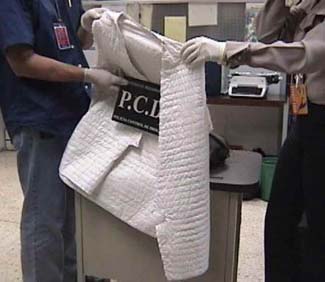
Drug control police arrested a 61-year-old woman and her 34-year-old sister at Juan Santamaría Airport Friday night and said they wre trying to leave the country with 7.1 kilos of heroin in their luggage. Policía de Control de Drogas said the women both had the last names of Manzanares Aguilar. The older woman lives in Alajuela, and the younger lives in Escazú, said police. Both are Costa Rican. Police said they searched the women’s luggage because they were acting suspiciously. The women had men’s underclothing in their luggage, and some of the garments had heroin sewn into the fabric. Costa Rica is a major transit point for drugs. Typically, the drugs are carried to Costa Rica from Colombia or other points in South America. Persons who have never traveled to these drug production points then take the chemicals north and hope to avoid suspicion because they are not travelers. |
Ministerio Gobernación, Policía
y Seguridad photo
Drug agents at airport show off a man's undergarment with heroin inside.
Such crimes have a penalty of from eight to 20 years in jail in Costa Rica. |
| Cell phone frauds
linked to visa scam By the A.M. Costa Rica staff Investigators have arrested a 27-year-old man in a growing case of frauds involving cellular telephones and alleged visas to the United States and other countries. Agents of the Judicial Investigating Organization detained the man Thursday and said he had a double line of frauds. One illegal activity was to sell and resell the same cellular telephone line to a number of persons. The seller would charge between 100, 000 and 150,000 colons (between $270 and $407) for rights to the cellular line. After payment, the cellular line would be activated, but the buyer only could use it for a short time, that is until the man could sell the same line to another unsuspecting party, said investigators. Somehow the man would know who had an application pending for cellular telephones, which are a scarce commodity in Costa Rica, said agents. He would use false papers to get the transactions approved by the telephone company. The same man would sell visas for between $500 and $1,500, and he would have stamps and other paperwork similar to that used by the Dirección de Migración y Extranjería, said agents. Investigators in the Sección de Fraudes are seeking information on other cases that may not have been reported. So far, agents have 16 separate complaints, they said. Earthquake rattles
By the A.M. Costa Rica staff An earthquake hit Costa Rica in the vicinity of Dominical Sunday about 7:25 a.m. The U.S. National Earthquake Information Center determined the magnitude to be about 5.0. Costa Rican officials said 4.6. There were no reports of serious damage. The quake was about 24 kilometers (about 15 miles) deep. The location is right on the Pacific coast of south central Costa Rica.
Pair face charge
By the A.M. Costa Rica staff Police near Paseo Canoas Friday night detained a Costa Rican with the last name of Díaz Franco and a woman from Panamá with the last name of Valdés Concepción and said the pair were trying to smuggle 45 AK-47 rifles into the country. The police agencies included the Fuerza Pública and the Policia Tecnica Judicial of Panamá. The arrest actually took place in Panamá, and the pair remained in custody there over the weekend. Police said they also confiscated 45 empty clips for the same type of semi-automatic rifle. More jail time given
By the A.M. Costa Rica staff A woman being investigated in the stabbing murder of U.S. student Shannon Martin will spend two months more in prison. That was the ruling last week by the Juzgado Penal de Golfito. The woman has the last name of Cruz. She has been held while the case is being investigated. Miss Martin, a University of Kansas senior, died early May 13, 2001. Investigators took Cruz into custody last Nov. 21 and in July arrested two men also for investigation. Police sweep city
By the A.M. Costa Rica staff Fuerza Pública officers swept through the downtown Thursday night and early Friday and arrested 60 persons who were wanted by various agencies. The Judicial Investigating Organization and the Policia Municipal also participated. Among those arrested were a number of minors. Two firearms were confiscated. One youngster had 18 marijuana cigarettes and 16 rocks of crack cocaine, said police. Officers said they also questioned nearly 200 persons who will be investigated further. The bulk of those actually arrested already had warrants issued for them, police said. The area of police concentration was generally in the vicinity of the
Mercado Central between Avenida Principal and Avenida 3 just west of the
downtown pedestrian mall. This is an area of many low-cost hotels and bars.
Police hold man
By the A.M. Costa Rica staff Police arrested a U.S. citizen Friday night after a woman complained that the man has molested her child, his own 5-month-old son, Fuerza Púbica officers reported. Police said that the woman took the boy, her son, to the police station to make the complaint. Police identified the man they took into custody as Drake Sparley, 57 of the Hotel Colón. The hotel is on Calle 8 between Avenidas 5 and 7. Police said the child underwent an examination at the Hospital Nacional de Niños and that based on information from physicians there they decided to hold the man as a suspect. Argentine woman takes
Special to A.M. Costa Rica WASHINGTON, D.C. — Mirta Roses was elected director of the Pan American Health Organization on Wednesday. Upon assuming office on Feb. 1, she will become the first woman and first Argentine to lead the world's oldest international health organization, according to the health organization. In an address to regional health ministers and organization staff, Roses said her vision for the region included "unity and solidarity of all people in the continent in search of concrete goals, leadership and responsibility of governments to convoke all forces of society, and a new emphasis on equity." She also stressed the importance of addressing the needs of the poor, added: "to achieve health for all we must focus on the health of the neediest." Prior to her election, Roses worked for the health organization for
18 years, serving most recently as its assistant director in charge of
technical cooperation and the Emergency Preparedness and Disaster Relief
Coordination Program.
|
Rallies against IMF
and war hit D.C. streets By the A.M. Costa Rica wire services WASHINGTON, D.C. — Anti-globalization activists held a second round of rallies and marches Saturday to protest the World Bank and International Monetary Fund meetings here. Fewer demonstrators than expected showed up for the protests, which went off mostly peacefully. At first, it had all the attributes of a folk festival in the park; young people sitting on the grass under spotless blue skies and some of the balmiest weather this city has experienced in weeks. And then, there was music, a lot of music. Rap here, bongo drum concerts there, in short, the sort of thing the anti-globalization organizers needed to show they intended this protest to be an upbeat, non-violent affair. Rally organizers said 20,000 protesters were on hand, but journalists present at the march agreed 2,000 showed up for the rally and anti-globalization march that ended in front of the heavily guarded World Bank building. Hundreds of riot-clad police guarded World Bank headquarters, but there were few tense moments and police arrested fewer than 10 people by the time rally participants dispersed late Saturday. On Sunday several thousand protesters marched through the streets here to demonstrate their opposition to a possible U.S.-led attack on Iraq. Meanwhile, in official action the International Monetary Fund's policy-making panel of 24 finance ministers ordered Saturday that the organization produce a plan for controlling financial crises. The panel called on the Fund and private sector banks to work out a method for faster and more complete debt restructuring for countries that get into trouble. The ministers want to prevent a repeat of the problem Argentina faced last December when it refused to pay its foreign debt and then defaulted on some of those credits. Some commentators refer to the proposed debt remedy as a kind of bankruptcy process for countries. Bolivian child labor
Special to A.M. Costa Rica WASHINGTON, D.C. — The U.S. Department of Labor has awarded a $1.5 million grant to the private humanitarian organization CARE to develop and implement educational and vocational programs to combat child labor in Bolivia. The initiative is part of the department's Child Labor Education Initiative, according to the Department of Labor. Components of the Child Labor Education Initiative in Bolivia will include: - raising awareness of the importance of education for children - the improvement and expansion of educational infrastructure - strengthening education systems that encourage working and at-risk children to attend school - and strengthening national institutions and policies on education and child labor. Michael Magan, Labor Department associate deputy under secretary for International Affairs, noted the importance of education in addressing abusive child labor practices. "It is of minimal help simply to remove child workers from abusive work situations if we don't provide an alternative." He added, "Our program of education and training counters not only the exploitation of children, but also offers the opportunity for a meaningful, productive future for these young people." The project implemented by CARE will complement other programs in Bolivia
that combat child labor and promote education, according to the Department
of Labor.
|
|
|
|
|
The U.S. Securities and Exchange Commission is seeking civil contempt action against a man who has business interests in Costa Rica. The case is the U.S. government’s continuing court action against The Gaming Factory Inc., which is primarily based in West Palm Beach but also maintained an office in San Pedro. The Securities and Exchange Commission has asked a federal judge in Florida for an order to force defendant Richard Onorato to show cause why he should not be held in contempt. The court several months ago ordered that Onorato give back money that he took in an unregistered stock offering in The Gaming Factory. So far, the man has not complied, said a commission release. The U.S. Securities and Exchange Commission filed a civil action against The Gaming Factory, Inc., in April and charged that the firm, its president, Onorato, 27, and Victor L. Selenow, 40, a sales representative, engaged in fraud in selling the firm’s stock. The U.S. government agency asked and got a court order that the firm’s assets be frozen, that ill-gotten profits be surrendered and that a receiver be appointed to safeguard assets and find investor money. |
A subsidiary, The Gaming Factory
Panama, had offices at the time in San Pedro not far from the center of
town.
The SEC claims that The Gaming Factory solicited investors to purchase unregistered stock via hard-sell telephone solicitations and via Internet. The commission also claims that customers contacted by salesmen were unaware that Onorato was paying 13 to 18 percent sales commission. The Web pages of the company said they are operated in Costa Rica and had little maps showing this country. Sunday most of the company’s Web sites were inactive, and the principal page had been converted into a lure for Hustler’s magazine’s Barely Legal Web page featuring nearly naked women. The commission complaint said that the company grossly overstated its income and prospects when selling stock to investors. The receiver appointed by the court to safeguard the assets of the company will be seeking help in getting some assets back from Costa Rica, said the commission. When the Web site was in operation, its location was described as being in the Residencia de Doña Claudia, behind the Convention Center of the Hotel Herradura in Cariari. |
|
|
|
|
QUITO, Ecuador — Eleven presidential candidates are campaigning here for votes in the Oct. 20 election, with a runoff vote in November almost a certainty. This election comes at a time of deepening concerns over the economy and tensions along the border with war-plagued Colombia. Until recently, Ecuador was a quiet little nation where political issues were all local. Corruption scandals in the 1990s and a military coup two years ago have shaken up the electorate. The spillover of drug and guerrilla violence from neighboring Colombia has also had a deep impact. The candidates in Ecuador's presidential election cover a broad range of ideologies and experience. Leading the pack, according to the latest public opinion polls, are former president Rodrigo Borja, who ruled from 1988 to 1992, and multimillionaire Alvaro Noboa who, in spite of his links to international business, is running a populist campaign. Much of the battle is taking place on the nation's airwaves. In his ads, Borja concentrates on issues like education. He says he wants to work with U.S. software giant Microsoft to bring more computers into classrooms in Ecuador. Around 80 percent of Ecuador's 12 million people live in poverty and the country has been unable to create enough jobs for the workforce. Borja says the country needs a better-educated people in order to attract new industries. Noboa has also addressed the economic problems of the country and has gained attention by |
spending a lot of his own money on
his campaign. He is complaining about recent electoral tribunal decisions
that could restrict his campaign.
Through massive advertising, Noboa has tried to overcome Borja’s popularity as a former leader. The strategy appeared to work, until Noboa dropped from first place in some polls and Borja moved up. Thalia Flores, a political analyst and editor of Quito's Hoy newspaper, said Noboa may have harmed his image with too much spending. She said Ecuadorans are uneasy with the amount of money he has spent, especially since he has surpassed legal limits on spending. But, Ms. Flores said, Noboa has made an impact on many voters with his populist approach and could still win. She said Borja's main appeal comes from the image he created when he was in office a decade ago. She said that while the Borja government may not have had any big success to its credit, it was not plagued by scandal, as have been some recent governments. She said Colombia has expelled many criminals into Ecuador, where they have contributed to a rise in assaults and other violent crimes. She said Ecuador has had to send 10,000 soldiers to its northern frontier to deal with rebel incursions as well as the expansion of cocaine production from Colombia into Ecuador. So far, the tension on the Colombian border has not become a big campaign issue, but many Ecuadoran observers believe the border situation will represent a major challenge for whoever does win the election. |
| What we published this week: | Monday | Tuesday | Wednesday | Thursday | Friday | Earlier |
|
|