|
|
|||||
 |
 |
 |
 |
||
|
|
|
|
||||||||||||||||||||||||||
|
|||||||||||||||||||||||||||
 |
|||||||||||||||||||||||||||
| |
|||||||||||||||||||||||||||
|
|
||||||||||||||||||||||||||
| What we published this week: | Monday | Tuesday | Wednesday | Thursday | Friday | Earlier |
|
|
|
|
|
|
|
Food |
|
|
Abstracts and fair use are permitted. Check HERE for more details |
|
|||
|
San
José, Costa Rica, Monday, Sept. 21, 2015, Vol. 16, No. 186
|
|||
|
|
|
|
|
|
|
Food |
|
|
Promised cuts
in electrical rates approved
By the A.M. Costa Rica staff
The utility regulating agency will go ahead with the electricity rate cut it had promised. The agency, the Autoridad Reguladora de Servicios Públicos, says it has approved a 6.31 percent rate cut for electrical generating. The cut filters down to the rates charged businesses and homeowners by the various distribution companies. The cut for customers will average about 2.82 percent, the agency said. The rate cut will be applied in October through December for all eight of the distribution companies. The cut is due to the lesser need for petroleum-fired generators, said the Autoridad. The rate cuts range from 3.78 percent for customers of the Compañía Nacional de Fuerza y Luz to 1.15 percent for COOPELESCA, based in San Carlos and covering parts of the northern zone. Delivery of sea turtles cut short By the A.M. Costa Rica staff
Fuerza Pública officers detained a man in Liverpool, Limón, when it appears he was trying to sell four sea turtles to the operator of a supermarket there. Police found the live turtles in the truck of the man's vehicle, they said. The man was placed under arrest, and the turtles were doused with water for future release. Tons of clothes with fake labels confiscated By the A.M. Costa Rica staff
Customers officials say they have confiscated 16 tons of clothing that had been falsely labeled with the names of recognized manufacturers. The clothings in a customs broker's warehouse in Heredia, said the Dirección de Fiscalización de Aduanas. In all there were 44,200 separate pieces of clothing that customs investigators said had false labels. Sale of fetus parts may cause shutdown By the A.M. Costa Rica wire services
An end-of-month deadline looms to finance the U.S. government and avert a partial shutdown. Lawmakers, though, are busy pointing fingers as time runs short. “Republicans are twiddling their thumbs as we careen closer and closer to a government shutdown,” said Sen. Chuck Schumer, a Democrat. At issue is Monday for Planned Parenthood, a federally funded women’s reproductive service provider. Earlier this year, undercover video was released in which Planned Parenthood officials discuss the sale of organs from aborted fetuses. Although the video was heavily edited and Planned Parenthood says it broke no laws, the incident reenergized America’s decades-old debate over abortion and thrust the issue before Congress, the body that holds the nation’s purse strings. "We should all agree that taxpayer dollars should not be used for harvesting baby parts for profit,” said Rep. Tim Walberg, a Republican, moments before the House of Representatives voted Friday to finance all federal entities and enterprises except Planned Parenthood. From military operations abroad to national parks at home, the U.S. government spends about $3.5 trillion a year, of which $500 million goes to Planned Parenthood. Under federal law, the organization is barred from using taxpayer funds for abortion services. Even so, it has long been a target of socially conservative Republicans who control both houses of Congress. The House spending bill has little chance of passing in the Senate, and the White House has promised a veto of any legislation defunding Planned Parenthood. Even without the emotion laden issue of abortion, Republicans and Democrats have different funding priorities for the military and domestic initiatives. President Barack Obama is urging dialogue and compromise. "Democrats are ready to sit down and negotiate with Republicans right now,” Obama said in his weekly address Saturday. “But it should be over legitimate issues like how much do we invest in education, job training, and infrastructure, not unrelated ideological issues like Planned Parenthood. We need to set our sights higher than that." Republicans are holding firm. “When an organization dismembers and monetizes babies, we must all act,” said Republican House Speaker John Boehner in a statement. "This is about the gruesome practices of an organization that receives $500 million a year from the federal government,” said Rep. Phil Roe, another Repubican. “As legislators, we carry the responsibility and privilege to protect those who do not have a voice, and to ensure that tax dollars are supporting organizations that truly provide health care for women.” Democrats note that Planned Parenthood does far more than perform abortions. "Let's talk about the 400,000 Pap smears, the 500,000 breast exams, the 4.5 million STD and HIV tests that Planned Parenthood does each year,” said Rep. Lois Frankel, a democrat referring to sexually transmitted diseases as STD. “That’s saving lives, and that’s the truth.” A partisan standoff over funding of President Obama’s signature health care law in 2013 provoked a federal shutdown that lasted more than two weeks. Democrats are warning against a repeat. “In 2013, we saw how badly a shutdown damaged our economy,” said Rep. Cheri Bustos, a Democrat. “Twenty-four billion dollars in lost economic activity, 120,000 fewer private sector jobs created during that shutdown.” Republicans say the issue is a matter of conscience that will define America going forward. “Will we turn a blind eye to this callous disregard for human life?” asked Walberg. “Is this the country we want to be?” The federal government’s spending authority expires at midnight Sept. 30. Although many federal activities would cease, civil servants and military personnel deemed essential would be required to report to work without pay. In past shutdowns, all federal employees were paid retroactively once the government reopened. IRS wants $3.3 billion, Coke reports By the A.M. Costa Rica wire services
Coca-Cola Co. says it has received notice from the Internal Revenue Service that it owes about $3.3 billion in extra taxes, plus interest. In a securities filing, the soft drink giant said Friday that it was fighting the huge bill. Coke said the dispute relates to how it reports income from foreign licensing of manufacturing, distribution, sale, marketing and promotion of products in overseas markets. The company said it had followed the methodology for the licenses outlined in a 1996 agreement with the IRS. It said the IRS had given little warning of the claim before issuing it, and had already told Coca-Cola it was weighing going to court to collect the funds. "The company firmly believes that the assessments are without merit and plans to pursue all administrative and judicial remedies necessary to resolve this matter," Coke said in the filing. |
||||||||||||||||||||||||||||||||||||||||||||||||||||||||||||||
 |
|
|
|
|
|
|
|
Food |
|
| What we published this week: | Monday | Tuesday | Wednesday | Thursday | Friday | Earlier |
| The contents of this Web site are
copyrighted by Consultantes Ro Colorado S.A 2015 and may not be
reproduced anywhere without permission. Abstracts and fair use are permitted. Check HERE for details |
||||||
A.M. Costa Rica Third News Page |
|
| San José, Costa Rica, Monday, Sept. 21, 2015, Vol. 16, No. 186 | |
|
|
|
|
|
|
|
Food |
|
| Dengue virus reported to be more complex than scientists
believed |
|
|
By the University of Texas Medical Branch
at Galveston news staff A new study is reshaping how scientists look at and understand a deadly virus. An international consortium of scientists, including researchers from the University of Texas Medical Branch at Galveston, worked to map out the antigenic differences in various strains of dengue virus. Previously, scientists have described four distinct antigenic variants or serotypes. But in a paper published Friday in Science, researchers reported that while the viruses clustered around the four genetically distinct types, antigenically, or the way a body’s immune system recognizes and responds to the virus, there was overlap among the four dengue types not previously described. While several dengue vaccine candidates are under development, there are currently no licensed vaccines against dengue virus, which infects up to 390 million people a year with about 500,000 patients experiencing potentially life-threatening complications. But even as work continues on a vaccine, scientists are finding their understanding of dengue virus may be simplistic and is changing. “Rather than being four distinct antigenic groups in space and time, there is a continuum, or overlapping of those relationships, which makes the job of vaccine developers harder,” said Nikos Vasilakis, an associate professor in the department of pathology at Texas and one of the study authors. The University of Texas Medical Branch World Reference Center for Emerging Viruses and Arboviruses was able to |
 University of Texas Medical Branch graphic
This is a representation of
the dengue virus.provide many strains of the virus for the study described in the paper, as well as historical data from previous work, said Robert Tesh, director of the center and also an author of the paper. The reference center is one of the largest collections of insect-transmitted viruses in the world and houses about 7,000 different virus strains, he said. Dengue has been around for hundreds of years and has spread throughout the tropics and subtropics, Tesh said. More than a third of the world’s population presently lives in areas where dengue virus is found, according to the Centers for Disease Control. The last large epidemic in Galveston was in the 1920s and the virus ended up spreading to Houston and throughout the Gulf Coast, Vasilakis said. Currently, the only way to control the spread of the virus is by controlling the Aedes mosquitoes that transmit it. But Vasilakis said for truly effective control, a vaccine is also needed. |
| You need to see Costa Rican tourism information HERE! |
 |
|
|
|
|
|
|
|
Food |
|
| What we published this week: | Monday | Tuesday | Wednesday | Thursday | Friday | Earlier |
| The contents of this Web site are
copyrighted by Consultantes Río Colorado S.A. 2015 and may not
be
reproduced anywhere without permission. Abstracts and fair use are permitted. Check HERE for details |
||||||
 |
 |
||||
| A.M. Costa Rica's Fourth News page | |||||
| San José, Costa Rica, Monday, Sept. 21, 2015, Vol. 16, No. 186 | |||||
|
|
|
|
|
|
|
Food |
|
| Researchers report a major advance in possible Alzheimer's
treatment |
|
|
By the Trinity College Dublin news staff
Scientists at Trinity College Dublin have shed light on a fundamental mechanism underlying the development of Alzheimer's disease, which could lead to new forms of therapy for those living with the condition. Alzheimer's is the most common form of dementia globally and affects up to 40,000 people in Ireland today. It is the fourth leading cause of death in individuals over the age of 65 and it is the only cause of death among the top 10 that cannot be prevented, cured or even slowed down. The condition is classically associated with memory loss. However, other symptoms and warning signs include difficulty performing familiar tasks, problems with language such as forgetting phrases or words, and changes in mood, behavior and personality. Alzheimer's disease is characterized, in part, by the build-up of a small protein, amyloid-beta, in the brains of patients. Impaired clearance of this protein appears to be a major factor in the build-up of plaques, and then in the disease process itself. While the mode by which amyloid-beta is cleared remains unclear, it is evident that it needs to be removed from the brain via the bloodstream. Unlike blood vessels anywhere else in the body, those in the brain have properties that strictly regulate what gets in and |
out of the
delicate tissue. This is what is known as the
blood-brain barrier. The barrier functions as a tightly regulated site
of energy and metabolite exchange between the brain tissue and the
bloodstream. "We have shown that distinct components of these blood vessels termed tight junctions are altered in Alzheimer's disease. We think that this alteration could be an entrained mechanism to allow for the clearance of toxic amyloid-beta from the brain in those living with Alzheimer's disease," said postdoctoral researcher James Keaney, who spearheaded the study. Working with the Dublin Brain Bank, which is based in Beaumont Hospital, the researchers from Trinity examined brain tissues of individuals who were affected by Alzheimer's disease during their lifetime and then compared results to those observed in model systems in the laboratory. Assistant Professor Matthew Campbell, added: "Our recent findings have highlighted the importance of understanding diseases at the molecular level. The concept of periodic clearance of brain amyloid-beta across the BBB could hold tremendous potential for Alzheimer's patients in the future. The next steps are to consider how this might be achieved. "Given the recent advances in clinical trials of anti-amyloid beta antibodies, we hope our findings may lead to improved and adjunctive forms of therapy for this devastating condition." |
Here's reasonable medical care
Costa Rica's world class medical specialists are at your command. Get the top care for much less than U.S. prices. It is really a great way to spend a vacation. See our list of recommended professionals HERE!amcr-prom
|
|
|||||||||||||||||||||||||||||||||||||||||||||
|
|
|
|
|
|
|
Food |
|
| What we published this week: | Monday | Tuesday | Wednesday | Thursday | Friday | Earlier |
| The
contents of this Web site are copyrighted by Consultantes Río
Colorado
S.A. 2015 and may not be reproduced anywhere without permission. Abstracts and fair use are permitted. Check HERE for details |
||||||
|
A.M. Costa Rica's Fifth news page |
 |
| San José, Costa Rica, Monday, Sept. 21, 2015, Vol. 16, No. 186 | |||||||
|
|
|
|
|
|
|
Food |
|
| Pope tells Cuban people to be wary of ideology By the A.M. Costa Rica wire services
Pope Francis celebrated Sunday Mass in Havana and warned Cubans of the dangers of ideology. Francis preached before tens of thousands of worshippers who packed Havana's historic Revolutionary Square. "Christians are constantly called to set aside their own wishes and desires, their pursuit of power, and to look instead to those who are most vulnerable," he said. "All of us are asked, indeed urged, by Jesus to care for one another out of love . . . without looking to one side or the other to see what our neighbor is doing, or not doing." Francis paid a visit to former Cuban leader Fidel Castro at his home in Havana. With Castro's family looking on, the two met in what the Vatican called a very informal and friendly environment. They also exchanged books on religion as gifts. Pope Francis later met Fidel's brother and the current Cuban president, Raúl Castro, and was to hold evening prayers with a group of priests and speak to youths at a cultural center. Francis and Vatican officials were the force behind months of secret talks between Havana and Washington in 2014. The talks climaxed with last year's announcements by Raúl Castro and U.S. President Barack Obama to reestablish diplomatic ties for the first time in 53 years. They have since opened embassies in Washington and Havana. Francis praised the détente between the two long-estranged neighbors as an example of reconciliation for the entire world that "fills us with hope." This is the third papal visit to Cuba since 1998, when Pope John Paul II came to the island, followed by Pope Benedict in 2012. Francis will travel to the Cuban cities of Hoguin and Santiago during his visit, with plans to hold Mass today and meet with Catholic clergy in both cities before leaving for Washington. His U.S. schedule includes a private meeting with President Obama, speaking to a joint meeting of Congress, and addressing the United Nations General Assembly in New York. Pope Francis' visit marks a turning point for the Catholic Church in Cuba, which was marginalized for years under Castro's Communist rule, but has slowly re-emerged as a powerful force on the Caribbean island. In a 15-minute speech that quickly turned political, President Castro repeated calls for the U.S. to end its embargo of the island, which he called cruel, immoral and illegal and for the return of Guantanamo Naval Station. Washington imposed the embargo in 1962, and the current Republican-led Congress has ignored President Obama's calls to end it. Opposition groups have been reporting increased detentions of dissidents. Cuba's government has not commented on the claims. Pope's liberal tendencies have divided U.S. Catholics By the A.M. Costa Rica wire services
One of the main themes of Pope Francis’ papacy has been his acceptance of people who disagree with him, especially on church doctrine. But that’s not the attitude Susanne Cassidy said she encountered when she met the archbishop of Philadelphia earlier this year, together with other parents who believe homosexuality is not a sin. "We just wanted him to hear the stories of our families,” said Ms. Cassidy, who has two gay children. “And he then said that if we didn’t really believe all of the church teaching, that we maybe shouldn't consider ourselves Catholics." Francis’ statements on issues as varied as climate change, economic inequality and immigration have all spiced up the political debate in the United States. But when he arrives there today for a five-day visit, Francis will find particularly deep divisions among his followers over his outreach to gays and lesbians. Surveys show a majority of American Catholics believe the church is wrong on homosexuality, and they also hold views on abortion and birth control that deviate from doctrine. And many of them, including Ms. Cassidy, feel the pope has been on their side since early in his papacy when he said in response to a hypothetical question about gay priests “Who am I to judge?” "I understand the pope is not going to change church teaching, at least right now,” Ms. Cassidy said at her home in suburban Philadelphia. “But his words, of telling people to be kinder and use proper words, is so important." The archbishop she met with, Cardinal Charles Chaput, has been cast in local media as anti-Francis, especially after he approved of the firing of a teacher at a Catholic school in his archdiocese because she was married to another woman. The teacher had worked at the school for eight years. Archbishop Charles Chaput declined to be interviewed for this story. But Cardinal Joseph Kurtz, president of the U.S. Conference of Catholic Bishops, said that some people were getting the wrong idea about the pope. "Sometimes the reporting of what Pope Francis says is cast in a way that sounds like a change in doctrine, and he clarifies that, clearly, he’s looking for new pastoral ways to accompany people," Kurtz said. Helen Alvare, a George Mason University law professor and former adviser to the Vatican on women’s issues, agreed. "He is reaching out to those who are angry or separated,” she said, “not because he is watering down or changing the teaching, but because he’s saying, there really is something beautiful here in his teachings about family that will help you come to know God.” Philadelphia was once a bastion of the U.S. Catholic church. A century ago, it received waves of Catholic immigrants. But even a dyed-in-the-wool Catholic like Ms. Cassidy lost faith in the hierarchy when clergy were put on trial for sex abuse and allegations emerged of a cover-up going all the way up to the former archbishop, Anthony Bevilacqua, who died in 2012. “If you believed in everything, and all of the sudden, it was hard to believe in anything. For me personally it was hard to believe anything they said, especially with all the cover ups." The sex scandals arguably hit Philadelphia’s Catholics harder than in any other American city, and the archdiocese also had to close schools and deal with financial misappropriations. Pope Francis will get to see firsthand what the church is up against, in a place whose name means the City of Brotherly Love. GOP candidate Ben Carson rejects Muslim president By the A.M. Costa Rica wire services
Republican presidential candidate Ben Carson said Sunday Muslims were unfit to be president of the United States, arguing that the principles of Islam are inconsistent with American values. "I would not advocate that we put a Muslim in charge of this nation. I absolutely would not agree with that," Carson, a devout Christian, told NBC's "Meet the Press." He said a president's faith should matter to voters and he described the Islamic faith as inconsistent with the Constitution, although he did not specify in what way Islam ran counter to constitutional principles. Carson's comments came amid lingering fallout over Republican Donald Trump's refusal last week to take issue with a man during a New Hampshire campaign event who wrongly called President Barack Obama a Muslim and said Muslims are "a problem in this country." Trump and Ohio Gov. John Kasich, a rival Republican contender, also appeared in separate appearances on the NBC news show. Kasich was asked whether he would have a problem with a Muslim in the White House. "The answer is, at the end of the day, you've got to go through the rigors, and people will look at everything," he said. "But, for me, the most important thing about being president is you have leadership skills, you know what you're doing and you can help fix this country and raise this country. Those are the qualifications that matter to me." Asked whether a Muslim could be elected, Trump said, "Some people have said it already happened, frankly." When Carson was asked if he believed Obama is a Christian, he said, “I believe that he is. I have no reason to doubt what he says." In multiple interviews Sunday, Trump tried to draw a distinction between all American-Muslims and extremist Muslims in the U.S. and elsewhere. "I have friends that are Muslims. They're great people, amazing people," Trump said on CNN's "State of the Union." "You have extremist Muslims that are in a class by themselves," Trump added. "It's a problem in this country, it's a problem throughout this world. . . You do have a problem with radical Muslims." Trump has been a vocal skeptic of Obama's birthplace and faith. After the comments made at the Thursday night rally, New Jersey Gov. Chris Christie and Democratic front-runner Hillary Clinton quickly condemned Trump for failing to correct the town hall participant, while most other 2016 contenders remained silent. Trump said later that he was not morally obligated to defend the president against every negative or controversial comment. Carson also made a distinction when it came to electing Muslims to Congress, calling it a different story from the presidency that "depends on who that Muslim is and what their policies are, just as it depends on what anybody else says." Congress has one Muslim member, Democratic Rep. Keith Ellison of Minnesota. Meanwhile, Carson gave up some ground in a CNN/ORC poll released Sunday, slipping to third place from second with 14 percent of support. The CNN/ORC poll showed Trump continues to lead the Republican contest with the support of 24 percent of registered voters, down from 32 percent in a previous poll. Former Hewlett-Packard chief executive Carly Fiorina surged into second place with 15 percent support. "The only poll that matters is the big one. You know that one. It's going to be the election," Trump told CNN's "State of the Union" in a telephone interview, saying he was surprised by the results. Ms. Fiorina, meanwhile, gained after a strong debate performance in which she icily skewered the brash real estate mogul for disparaging her looks in comments reported by Rolling Stone magazine. "I think women all over this country heard very clearly what Mr. Trump said," Ms. Fiorina said in Wednesday night's debate. Sixteen Republicans are seeking the party's nomination for the U.S. presidential election in November 2016. Kerry says U.S. to increase in 2017 visas for refugees By the A.M. Costa Rica wire services
U.S. Secretary of State John Kerry said the Obama administration will increase the number of refugees allowed to enter the United States to 100,000 annually in 2017, as Europe grapples with its largest influx of migrants since the end of World War II. Speaking Sunday in Berlin, Kerry called the U.S. decision a "step in keeping with America's best tradition as a land of second chances and a beacon of hope." Under the new plan, the U.S. limit on refugee visas, currently capped at 70,000 annually, would jump to 85,000 in fiscal 2016 and then rise to 100,000 the following year. Kerry also said Washington would explore ways to boost the limit beyond the 100,000 ceiling in future years. Kerry did not say how many of the additional refugees would be from Syria but pledged that the U.S. was ready to help. The announcement comes ahead of an emergency summit meeting planned for Tuesday of European Union leaders to address the flood of refugees that has overwhelmed the region. Earlier Sunday, Austria said 11,000 migrants crossed into the country from Hungary in the 24-hour period that ended at midnight Saturday, and was expecting another 7,000 migrants Sunday at the main Nickelsdorf crossing, east of Vienna. Most of the migrants had made the grueling journey across the Balkans into western Europe, with Croatia saying 21,000 had entered its territory in the past four days. Hungarian and Serbian interior ministers also jointly reopened the Horgos-Roszke 1 crossing, which had been closed since last Monday. Meanwhile, Austrian ministry officials were meeting with charity organizations Sunday to try to find temporary shelter for the new arrivals, many coming from countries unable or unwilling to cope with a desperate human tide fleeing war and poverty. After lashing out against Croatian officials, Hungarian Foreign Minister Peter Szijjarto is now trading barbs with his Romanian counterpart over a razor-wire border fence that Hungary is building between the two countries to keep out migrants. Hungary's erection of fences is deeply straining its ties with neighboring countries, who feel the problem of the huge flow of migrants is being unfairly pushed onto them. After completing a fence along the border with Serbia, Hungary is now building fences along its borders with Croatia and Romania. Romanian Foreign Minister Bogdan Aurescu on Saturday called the border closure an autistic and unacceptable act that violated the spirit of the European Union. In Germany, police are investigating an asylum-seeker on suspicion that he fought for the Islamic State group in Syria, newspaper Welt am Sonntag reported Sunday. The suspect is a Syrian national and lives in an asylum-seeker shelter in the northeast region of Brandenburg, the newspaper reported, quoting security sources. The man was secretly filmed with a mobile telephone, allegedly telling other migrants in the center that he had fought for the Islamic State group and killed people. The video led to the probe. |
|
|||||||||||||||||||||||||||||||
|
|
|
|
|
|
|
Food |
|
| What we published this week: | Monday | Tuesday | Wednesday | Thursday | Friday | Earlier |
| The
contents of this Web site are copyrighted by Consultantes Río
Colorado S.A. 2015 and may not be reproduced anywhere without
permission. Abstracts and fair use are permitted. Check HERE for details |
||||||
| A.M. Costa Rica's sixth news page |
|
||||||||
| San José, Costa Rica, Monday, Sept. 21, 2015, Vol. 16, No. 186 | |||||||||
|
|
|
|
|
|
|
Food |
|
||
|
Here are some
big don't, don't, don'ts
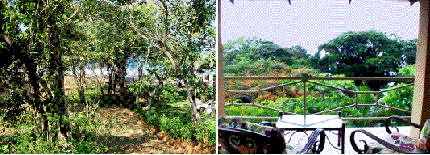
Things I have learned about living and gardening in the tropics. Never ever pull a vine off of a tall tree. Trust me. You have no idea what's living up there. I pulled a vine from a tall tree one time. Evidently
Never walk on a hillside after a rain. Not only is the grass slippery but so is the soil. I ruined a good pair of slacks like that recently, and I really should have known better since I had already made a mess of several pairs of shorts. You have no idea what is hiding in tall grass. Not just snakes and scorpions and spiders, although they are the most feared, but nasty prickly plants that can draw blood and coils of vines that are worming their way across the grass looking for a tree to climb. You can fall flat on your face in a second if one of them grabs you. Oh, and mossy rocks are good for that flat-on-your-face thing too. Then there are the other bugs. Although fire ants prefer short grass, there are always those individualists . . . . Plus the mosquitoes. Mosquitoes are born from water but hide in tall grass and under trees when they aren't actively on the hunt. Then there are the things you do that aren't legal that you didn't know about. Take orchids for example. The point is you can't take them, not unless they are on a downed limb or tree. Taking them from living trees is illegal. And tree ferns are another that you might find and think about transplanting, simply because they are amazing, prehistoric, and a former favorite of dinosaurs, really a living fossil. But don't. They are also protected by law. And just a few more: 1.) That sun is hot. Wear a hat when you garden and try to get one with that ugly flap that covers your neck (I need to find one of those.) 2.) You can burn even if you wear sunscreen. 3.) Biting flies don't seem to be deterred by Off. 4.) Look before you grab onto a tree for support. A lot of these trees have thorns and some of them go right through gloves So, those are just a few things I have learned in the last three years. If you want to add to the list, just drop me a line.  Plant for the Week
“Just what is this,” you may ask? This is the tree
for the week – a grapefruit. I just thought it would be fun to show you
something else I have learned about life in the tropics. This (to
answer the question) is how we move fruit trees in Costa Rica.If you would like to suggest a topic for this column, simply send a letter to the editor. And, for more garden tips, visit https://www.facebook.com/pages/Arenal-Gardeners/413220712106845 |
| Costa Rican News |
AMCostaRicaArchives.com |
Retire NOW
in Costa Rica |
CostaRicaReport.com |
| Fine Dining
in Costa Rica |
The CAFTA Report |
Fish
fabulous Costa Rica |
|
|
|
|
|
|
|
Food |
|
| What we published this week: | Monday | Tuesday | Wednesday | Thursday | Friday | Earlier |
| The
contents of this Web site are copyrighted by Consultantes Río
Colorado S.A. 2015 and may not be reproduced anywhere without
permission. Abstracts and fair use are permitted. Check HERE for details |
||||||
| From
Page 7: 237 firms agree to participate in jobs plan By the A.M. Costa Rica staff
Some 237 firms have signed on to a government program that pays them to hire new members of the workforce. The program is Mi Primer Empleo, and the government announced the plan just last Monday. The government said that 5,153 job seekers had signed up for the program too. The employers are obligated to accept persons from the government list in order to be compensated. They have to hire young men, women of any age or the disabled, according to the rules. The goal is to put 30,000 persons to work. The program is directed by the Ministerio de Economía, Industria y Comercio, which is working with the Instituto Nacional de Aprendizaje and the Sistema de Banca para el Desarrollo, which will provide the money. Employers will get 1.46 million colons or about $2,750 in two payments for hiring the designated individuals. |