|
| |
Your daily |
 |
|
|
|
|
||||||||||||
|
|
||||||||||||
 |
|
|
|
|
|
|
|
|
| What we published this week: | Monday | Tuesday | Wednesday | Thursday | Friday | Earlier |
|
|
|
|
| A.M. Costa Rica Second newspage |
 |
||||||||
| Home |
Tourism |
Calendar |
Classifieds |
Entertainment |
Real
estate |
Rentals |
Sports |
About
us |
|
|
|
|||||||||
 |
| Costa Rica Expertise Ltd http://crexpertise.com E-mail info@crexpertise.com Tel:506-256-8585 Fax:506-256-7575 |
 |

Click HERE for
great
hotel discounts
|
|
and promotes pragmatism By
the A.M. Costa Rica staff
Óscar Arias Sánchez launched into a defense of his administration as he spoke for the last time as president before the Monumental Nacional Tuesday. Arias said Central American was walking between the light and the shadows and urged again that expenditures on military weapons be reduced. Using a characterization of the first day of independence in Guatemala, Arias said that he would call for three days of illumination as did the Guatemala officials in 1821. He said the illumination metaphor was needed because Central America is confused about its destiny. "We are once again walking between the shadows of ambiguity," he said. For Arias, the shadows are strengthening the military at the expense of food for children, literacy and other social goals. No one ever killed poverty with a bullet, said Arias, noting that Latin America spends $60 billion each year on the military. Arias did not mention Hugo Chávez, but the Venezuelan president just made a deal with Russia for a $2.2 billion line of credit to buy tanks and short-range rockets. Arias also took a shot at the interim government of Honduras. He directed his audience's attention to his left to the Monumento Nacional, which shows five women representing the Central American republics, driving out the filibusterer William Walker. One of these women has suffered a terrible experience of a coup, he said. Arias has been trying to negotiate the return of ousted president José Manuel Zelaya to Honduras. The other Central American nations also have suffered lesser blows, said Arias, who said that there are those who confuse patriotism with disrespect and call for violence to defense exhausted ideas. Arias also said that the world changed in 1989 when the Berlin wall fell, and that certain ideologies are passé. He said that communism, capitalism, socialism, socialcristianiso, liberalism and neoliberalism were being replaced by other nations with pragmatism. In a clear reference to his prolonged battle to pass the free trade treaty, he said of the Chinese president that he didn't know if someone in that country accused Deng Xiapoing of selling out the country when he opened the door to foreign investment that began the country's economic ascendency. Many insist on repeating the same slogan for 30 or 40 years fighting with their lives for dead causes, he said. "I am not going to apologize because my government has been able to read the signs of our times," he said. "I am not going to apologize for putting Costa Rica in tune with the changes of the world. I am not going to apologize for having abandoned the prejudices, paradigms and models of the 20th century." Costa Rica is on a new course and has turned on the light and is no longer confused as to its direction, he said. He said this was the principal achievement of his administration. Arias said there were many challenges pending. He said he hoped that a new administration would not lose its direction and that the country would not sacrifice its democracy, its liberty and its peace. U.N. chief Ban also raps growing world weaponry Special
to A.M. Costa Rica
Arms proliferation also was a topic in New York Tuesday when the U.N. secretary general gave an interview. Recent “encouraging” developments in the disarmament arena have provided a crucial window of opportunity for the international community to achieve its non-proliferation goals, the secretary general. Ban Ki-moon, said. “This is a very rare momentum created [by] the international community,” Ban told the U.N. News Centre in a joint interview with U.N. Radio and U.N. Television. In May, the Conference on Disarmament – the world’s sole multilateral forum for disarmament negotiations – adopted a Programme of Work for its 2009 session, ending a 12-year stalemate and allowing the body to negotiate and substantively discuss strategic disarmament and non-proliferation. Further, Russia and the United States committed in July to cut their strategic warheads to between 1,500 and 1,675 and their strategic delivery vehicles to between 500 and 1,000, as part of the joint nderstanding for a follow-on agreement to the Strategic Arms Reduction Treaty. Later this month, U.S. President Barack Obama will chair a meeting of the Security Council focusing on nuclear disarmament and non-proliferation, including the UN-backed Comprehensive Nuclear-Test-Ban Treaty. As secretary general, “I will devote my time and energy to making things move,” Ban said. On the Middle East, Ban expressed concern that negotiations on the peace process have not “produced any tangible results despite such a high level of expectations from the international community.” He said he is optimistic that Obama and the new U.S. administration will be able to accelerate progress on this front so that Israelis and Palestinians can live side by side in peace. “This is our vision and this is our commitment,” he underscored. The secretary general recently returned from a visit to Mexico, where he addressed the 62nd annual U.N. Department of Public Informatio conference with non-governmental organizations. With global military spending topping $1 trillion and rising by the day, he reiterated his appeal to rid the world of nuclear weapons. “The world is over-armed and peace is under-funded,” Ban said at the event, which drew over 1,700 representatives from 70 countries. He noted that more weapons continue to be produced and are flooding markets around the world. “They are destabilizing societies. They feed the flames of civil wars and terror,” he stated. Mrs. Clinton urges Chávez to tightly control weapons By
the A.M. Costa Rica wire services
Secretary of State Hillary Clinton Tuesday called for transparency on the part of Venezuela in an arms buildup by the Hugo Chávez government that U.S. officials believe threatens regional stability. Mrs. Clinton spoke at a meeting with Uruguayan President Tabare Vazquez, who said Latin American governments should combat poverty rather than acquire weapons. Mrs. Clinton's comments at a joint press event with the Uruguayan leader were the highest-level expression of U.S. concern thus far about a Venezuelan arms buildup that gained momentum with an announcement this week that the South American state will buy Russian battle tanks and anti-aircraft missiles. Chávez said in Moscow Sunday he had obtained a $2.2-billion line of credit from Russia for 90 T-72 tanks and an advanced long-range air defense system. U.S.-Venezuelan relations since the populist Chavez was first elected in 1998 have been increasingly difficult, and he said in Moscow the new arms are to counter a U.S.-Colombian agreement last month under which U.S. forces will have access to several Colombian military bases. Mrs. Clinton said Venezuela's arms acquisitions outpace those of all other South American countries and raise questions about a possible regional arms race. "We urge Venezuela to be transparent [in] its purchases, clear about its purposes. They should be putting in place procedures to insure that the weapons that they buy are not diverted to insurgent groups or illegal organizations, like drug trafficking gangs and other criminal cartels. So there is concern that we have expressed, and we'll continue to raise with other countries in the region. And we hope that we can see a change in behavior and attitude on the part of the Venezuelan government," Mrs. Clinton said. For his part, President Vazquez — who has headed Uruguay's center-left government since 2004 — refrained from any direct mention of Venezuela's arms purchases. But the Uruguayan leader, a doctor by training, lamented that Latin American governments are devoting growing resources to armaments rather than dealing with pressing social needs including health and education. He spoke through an interpreter. "Not only is our country worried, but we have already expressed time and again our position against an arms race. We believe it is quite inconvenient for the region to devote such significant economic resources to purchasing arms. But it's a fact and we can't deny it that the countries are buying weapons. To make things worse, our region is the region that has the worst distribution of wealth. Under those conditions it is worse still to be devoting those resources to weapons," Vazquez said. Under questioning, Mrs. Clinton said the United States is ready to work with whatever candidate wins Uruguay's presidential election in October.
|
|||||||||||||||||||||||||||||||||||||||||||||||||||||||
 |
||||||||||||||||||||||||||||||||||||||||||||||||||||||||
| Home |
Tourism |
Place
classified ad |
Classifieds |
Entertainment |
Real
estate |
Rentals |
Sports |
About
us |
|
| What we published this week: | Monday | Tuesday | Wednesday | Thursday | Friday | Earlier |
| The contents of this page and this Web site are copyrighted by Consultantes Río Colorado 2001, 2002, 2003, 2004, 2005, 2006, 2007 and 2008 and may not be reproduced anywhere without permission. Abstracts and fair use are permitted. Check HERE for details | ||||||
 |
 |
| A.M. Costa Rica third newspage |
 |
||||||||
| Home |
Tourism |
Calendar |
Classifieds |
Entertainment |
Real
estate |
Rentals |
Sports |
About
us |
|
|
|
|||||||||
 |
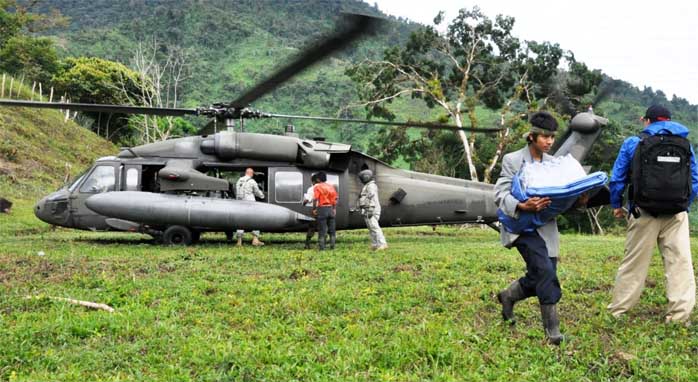 U.S. Southern Command photo by Tech Sgt.
Mike Hammond
Tolokichá residents help
unload medical supplies form a U.S. Blackhawk helicopter |
|
|
U.S. Blackhawks
help bring care to remote native villages
|
|
|
By
Tech. Sgt. Mike Hammond
Joint Task Force-Bravo public affairs For many with cold and flu-like symptoms, relief is just a few minutes away through a local drug store or visit to the family physician. But at Tolokichá in this remote, mountainous and heavily forested region of Costa Rica it's a lot more complicated. Rogelio and Melli Segura and their five children — all under 10 years old — walked an hour and a half up and down mountains to see a doctor for the first time ever. The Seguras, who farm corn for subsistence and are expecting their sixth child, made the long walk after suffering from headaches and other pains for the past five days. After the whole family received examinations from a physician's assistant, they left with bottles of Tylenol — medicine that is over-the-counter in places like the United States but considerably harder to come by in a place inaccessible by road and a three-day hike from the nearest medical care. The Seguras represented six of the more than 240 patients seen here Friday during a combined medical readiness and training exercise conducted by the Costa Rica ministry of health and members of Joint Task Force-Bravo, headquartered at Soto Cano Air Base, Honduras. |
Residents of the area came from
miles around to see healthcare
providers from the ministry and the task force. Some heard of the
opportunity through word-of-mouthand some, like 50-year-old Rafael
Martínez, simply heard the two UH-60 Blackhawks approaching. "I
heard
the helicopter go by and walked for about an hour to see the doctor,"
Martinez said. "It has been at least two years since I saw one."
[Central Valley residents also heard the helicopters and excahgned
messages on various Internet discussion lists about them.] According to the mission commander, U.S. Army Lt. Col. Curtis Anderson, the effort to come to Costa Rica was beneficial to all involved. "This exercise was an initiative of the Costa Rica ministry of health, and we are glad to help support the effort," Anderson said. "Our providers get needed training in practicing medicine in more remote and austere conditions not seen in a traditional clinical setting," he said, noting the lack of electrical power or running water in the area. "The patients benefit from getting medical care which is not readily available, and everyone benefits from two partner nations teaming up to work together toward a common goal." The care provided came on the first of a two-day exercise, and the combined Costa Rican and JTF-Bravo team was prepared to see as many as 500 more patients Saturday at the second location, Xichiari in Turrialba near the Chirripó peak. |
 |
| You need to see Costa Rican tourism information HERE! |
| Home |
Tourism |
Place
classified ad |
Classifieds |
Entertainment |
Real
estate |
Rentals |
Sports |
About
us |
|
| What we published this week: | Monday | Tuesday | Wednesday | Thursday | Friday | Earlier |
| The contents of this page and this Web site are copyrighted by Consultantes Río Colorado 2001, 2002, 2003, 2004, 2005, 2006, 2007 and 2008 and may not be reproduced anywhere without permission. Abstracts and fair use are permitted. Check HERE for details | ||||||
 |
| A.M. Costa Rica fourth news page |
 |
||||||||
| Home |
Tourism |
Calendar |
Classifieds |
Entertainment |
Real
estate |
Rentals |
Sports |
About
us |
|
|
|
|||||||||
| Crew
abandons fastboat loaded with 700 kilos of cocaine |
||
|
By
the A.M. Costa Rica staff
Yet anther load of cocaine has fallen into the hands of law enforcement. The security ministry said that its officers managed to capture a boat loaded with 700 kilos (1,540 pouns) of the drug after a chase Tuesday. That brings to 88 tons the amount of cocaine seized by police during the Arias administration, according to the ministry's accounting. According to the Ministerio de Gobernación, Policía y Seguridad Pública, the chase began along the Pacific coast when an aircraft of the Servicio Vigilancia Aérea spotted the fastboat and gave chase. Eventually the three-person crew headed the boat to shore, jumped out and began to swim to some mangroves. The Servicio Nacional de Guardacostas at the Quepos station and the Policía de Control de Drogas came on the scene and began to investigate the boat. They found the drugs hidden in the 33-foot craft, they said. The crew bailed out of the boat near Pueblo Real de |
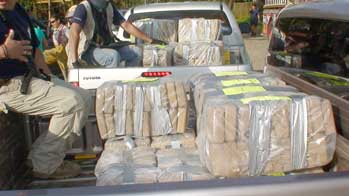 Ministerio de Gobernación,
Policía
Anti-drug police jaul the
confiscated drugs in a pickup.y Seguridad Pública photo Damas in the Cantón de
Aguirre. That was about 8:30 a.m. Police set up roadblocks in an effort
to find the fleeing suspects.
The crew must have recently refilled fuel containers on the craft, the Santa Patricia. There were 14 20-liter fuel containers and only one was empty. The three 75-horsepower outboards on the boat requires a lot of fuel. |
|
| Bolivia,
Venezuela and Burma on U. S. anti-drug blacklist |
||
|
Special
to A.M. Costa Rica
Three countries, Bolivia, Burma, and Venezuela, have failed to adhere to international counternarcotic pacts and take anti-drug measures, according to the White House. Under the Foreign Relations Authorization Act, the president is required to notify Congress of those countries he determines to be major illicit drug-producing countries or major drug-transit countries. A country’s presence on the list does not necessarily reflect its counternarcotics efforts nor does it reflect its cooperation with the United States, said the State Department. The designation can reflect a combination of geographic, commercial, and economic factors that allow drugs to be produced and/or trafficked through a country despite its own best efforts, the department said. When a country does not live up to its obligations under international counternarcotics agreements and conventions, the president determines that the country has “failed demonstrably.” Such a designation can lead to sanctions, according to the law. However, the president may also execute a waiver should he determine that continuing U.S. assistance is in the national interest of the United States. Even without such a waiver, humanitarian assistance and |
counternarcotics
assistance may continue. This year Barack Obama has identified the following countries as major drug-transit or drug-producing countries: Afghanistan, the Bahamas, Bolivia, Brazil, Burma, Colombia, the Dominican Republic, Ecuador, Guatemala, Haiti, India, Jamaica, Laos, Mexico, Nigeria, Pakistan, Panamá, Paraguay, Peru, and Venezuela. Of these 20, the president has determined that only Bolivia, Burma, and Venezuela, “failed demonstrably” during the last 12 months to adhere to international counternarcotic agreements and take counternarcotic measures set forth in U.S. law, said the State Department. In the cases of Bolivia and Venezuela, the president has issued a national interest waiver so that the United States may continue to support specific programs. In Venezuela, funds will continue to support civil society programs and small community development programs, the State Department said. In Bolivia, the waiver will permit continued support for agricultural development, exchange programs, small enterprise development, and police training programs among others, the State Department said. |
|
 |
 |
|
| Home |
Tourism |
Place
classified ad |
Classifieds |
Entertainment |
Real
estate |
Rentals |
Sports |
About
us |
|
| What we published this week: | Monday | Tuesday | Wednesday | Thursday | Friday | Earlier |
| The contents of this page and this Web site are copyrighted by Consultantes Río Colorado 2001, 2002, 2003, 2004, 2005, 2006, 2007 and 2008 and may not be reproduced anywhere without permission. Abstracts and fair use are permitted. Check HERE for details | ||||||
| A.M. Costa Rica fifth news page |
|
||||||||
| Home |
Tourism |
Calendar |
Classifieds |
Entertainment |
Real
estate |
Rentals |
Sports |
About
us |
|
|
|
|||||||||
 |
| Virgen
de los Ángeles to be honored by police By
the A.M. Costa Rica staff
A political battle rages over the use of the word God in the oath taken by government officials and the designation of the Roman Catholic faith as a state religion. But here is an indication of how deeply religion and state are mixed in Costa Rica: The Fuerza Pública will receive the image of the Virgen de los Ángeles at the security ministry's chapel today at 10 a.m.. This is the image usually located in the basilica in Cartago. The veneration will be accompanied by a Mass and Hugo Barrantes, the archbishop of San José is a possible participant, said the ministry. Another manifestation of the Virgin is associated with the police. The Virgen de Ujarrás by law is capitana general of the Fuerza Pública. The virgin is a 16th century sculpture once housed in the community of Ujarrás. In both cases the veneration is not of the statute but what they represent. The Virgen de Ujarrás has nearly a 500-year history in the country, The Virgen, who was the nation's first patroness, is venerated by the policemen in February. As the political season continues to draw closer to the Feb. 7 national elections, the matter of separation of church and state will continue to be discussed, but for many Costa Ricans, even policemen, that is a strange concept. Spain forgives $87 million of Bolivian national debt By
the A.M. Costa Rica wire services
Spain has agreed to cancel the $87 million debt it is owed by Bolivia in an effort to help the impoverished South American country's development. Spanish Prime Minister José Luis Rodríguez Zapatero said Tuesday that 60 percent of the debt would be forgiven entirely, while Bolivia's government will invest the remaining 40 percent in education programs. The prime minister spoke in Madrid during a news conference with Bolivian President Evo Morales. The Bolivian leader said the pardon creates trust not just between the two governments but also between the Spanish and Bolivian people. The two sides also signed an agreement allowing Bolivians in Spain to vote in municipal elections. Zapatero vowed to give a new horizon to Bolivians in Spain, saying they "deserve to be treated with the utmost dignity and rights." About 250,000 Bolivians live in Spain, with only 98,000 of them legal residents. After arriving in Spain Sunday, the Bolivian president gave a speech to Bolivian immigrants and promised to defend their rights. He also denounced plans by the United States to use military bases in Colombia. However, Morales said Bolivia had no plans to break off ties with Colombia over the matter.
|
|
| Home |
Tourism |
Place
classified ad |
Classifieds |
Entertainment |
Real
estate |
Rentals |
Sports |
About
us |
|
| What we published this week: | Monday | Tuesday | Wednesday | Thursday | Friday | Earlier |
| The contents of this page and this Web site are copyrighted by Consultantes Río Colorado 2001, 2002, 2003, 2004, 2005, 2006, 2007 and 2008 and may not be reproduced anywhere without permission. Abstracts and fair use are permitted. Check HERE for details | ||||||
| A.M. Costa Rica sixth news page |
|
||||||||
| Home |
Tourism |
Calendar |
Classifieds |
Entertainment |
Real
estate |
Rentals |
Sports |
About
us |
|
|
|
|||||||||
| Latin American news (if feed is incomplete, please reload the page) |
Florida response says British are malcontents Dear A.M. Costa Rica: I just had to respond to the opinion e-mail of Maggie Drummond in your Sept 15th edition. In it she chastised U.S. citizens for being two-faced by criticizing Costa Rica while refusing to let "British visitors" to the U.S. do the same there, telling them "if you don't like it here, go home." I happen to live in a part of Florida that has an inordinately large amount of "British visitors" as well as "British expats" living here more or less permanently. The real story is that this particular segment of our many tourists are the biggest group of malcontents you'd ever want to meet. What a U.S. citizen most often hears from these whiners is "The way we do it in the UK . . . . " or "Why not let us stay longer?" or " Why can't we become U.S. citizens easier? " There is generally no contradiction in the way U.S. citizens observe others. Bottom line is we "calls 'em as we see's 'em." I am one who decided not to retire there for the obvious reasons so frequently documented in this newsletter. But there are some U.S. Gringos who like Costa Rica, so she is being very selective in her criticism. Methinks Ms Drummond simply has a huge chip on her shoulder, like her wandering compatriots. We let plenty of people into our country on temporary visas. What does she know about the specifics of our immigration policies? This is typical of the Brit know-it-all attitude. One common thread runs throughout: There are very few people worldwide who are clamoring to live in the UK, just the opposite is true, like her. Get over it, lady ! Joe
Furlong
Cape Haze, Florida
|
|
Latin
American news feeds are disabled on archived pages.
|
||
| Home |
Tourism |
Place
classified ad |
Classifieds |
Entertainment |
Real
estate |
Rentals |
Sports |
About
us |
|
| What we published this week: | Monday | Tuesday | Wednesday | Thursday | Friday | Earlier |
| The contents of this page and this Web site are copyrighted by Consultantes Río Colorado 2001, 2002, 2003, 2004, 2005, 2006, 2007 and 2008 and may not be reproduced anywhere without permission. Abstracts and fair use are permitted. Check HERE for details | ||||||