|
|
|||||
 |
 |
 |
 |
||
|
|
|
|
||||||||||||||
|
|||||||||||||||
 |
|||||||||||||||
| |
|||||||||||||||
|
|
||||||||||||||
| What we published this week: | Monday | Tuesday | Wednesday | Thursday | Friday | Earlier |
|
|
|
|
|
|
|
Food |
|
|
Abstracts and fair use are permitted. Check HERE for more details |
|
|||
|
San
José, Costa Rica, Monday, Sept. 14, 2015, Vol. 16, No. 181
|
|||
|
|
|
|
|
|
|
Food |
|
|
Grim future
predicted with sea-level rise
By the Carnegie Institution news staff
New work from an international team demonstrates that the planet’s remaining fossil fuel resources would be sufficient to melt nearly all of Antarctica if burned, leading to a 50- or 60-meter (160- to 200-foot) rise in sea level. Because so many major cities are at or near sea level, this would put many highly populated areas where more than a billion people live under water, including New York City and Washington, D.C. It is published in Science Advances. “Our findings show that if we do not want to melt Antarctica, we can’t keep taking fossil fuel carbon out of the ground and just dumping it into the atmosphere as CO2 like we’ve been doing,” said Carnegie’s Ken Caldeira. “Most previous studies of Antarctic have focused on loss of the West Antarctic Ice Sheet. Our study demonstrates that burning coal, oil, and gas also risks loss of the much larger East Antarctic Ice Sheet.” Caldeira initiated this project with lead author Ricarda Winkelmann while she was a visiting investigator at the Carnegie Institution for Science. Ms. Winkelmann and co-author Anders Levermann are at the Postdam Institute for Climate Impact Research. Although Antarctica has already begun to lose ice, a complex array of factors will determine the ice sheet’s future, including greenhouse gas-caused atmospheric warming, additional oceanic warming perpetuated by the atmospheric warming, and the possible counteracting effects of additional snowfall. “It is much easier to predict that an ice cube in a warming room is going to melt eventually than it is to say precisely how quickly it will vanish,” Ms. Winkelmann said, explaining all the contributing factors for which the team’s models had to account. The team used modeling to study the ice sheet’s evolution over the next 10,000 years, because carbon persists in the atmosphere millennia after it is released. They found that the West Antarctic ice sheet becomes unstable if carbon emissions continue at current levels for 60 to 80 years, representing only 6 to 8 percent of the 10,000 billion tons of carbon that could be released by all accessible fossil fuels. “The West Antarctic ice sheet may already have tipped into a state of unstoppable ice loss, whether as a result of human activity or not. But if we want to pass on cities like Tokyo, Hong Kong, Shanghai, Calcutta, Hamburg and New York as our future heritage, we need to avoid a tipping in East Antarctica,” Levermann said. The team found that if global warming did not exceed the 2 degree Celsius target often cited by climate policymakers, Antarctic melting would cause sea levels to rise only a few meters and remain manageable. But greater warming could reshape the East and West ice sheets irreparably, with every additional tenth of a degree increasing the risk of total and irreversible Antarctic ice loss. This is the first study to model the effects of unrestrained fossil-fuel burning on the entirety of the Antarctic ice sheet. The study does not predict greatly increased rates of ice loss for this century, but found that average rates of sea level rise over the next 1,000 years could be about 3 centimeters per year (more than 1 inch per year) leading to about 30 meters (100 feet) of sea level rise by the end of this millennium. Over several thousand years, total sea level rise from all sources could reach up to 60 meters (200 feet). "If we don't stop dumping our waste CO2 into the sky, land that is now home to more than a billion people will one day be underwater," Caldeira said. Some investors unhappy at Milanes trial By the A.M. Costa Rica staff
The Luis Milanes trial continues in San José, but many investors who were burned by the failure of his Savings Unlimited seem to have lost interest. Prosecutors are seeking testimony from those who have filed charges against the former casino owner. But some are declining because they have lost faith in the judicial process here, according to trial observers and emails from investors. Others are not in the country and find that travel to Costa Rican consulates to present a remote testimony is not convenient. Canadians, for example, would have to go to Toronto or Vancouver. Those who have testified say that prosecutors are encouraging them to say they thought Savings Unlimited was a safe investment. The high-interest operation occupied an upscale suit in Edificio Colón until Milanes, a Cuba-American, closed it down in November 2002. Many investors thought Milanes was investing their money in expanding his casino holdings. Some investors have recounted being given a tour of casinos. However, the casinos were under another ownership. They continued to operate even while Milanes was in flight for years. Recently some have been sold. Savings Unlimited was similar to the Luis Enrique Villalobos high interest operation in Mall San Pedro. But Villalobos would not say what he was doing with investors' money. The Milanes operation was more professional with an etched glass door and a cashier's window. Villalobos made payments in fat envelopes. Ministry cannot act on Nazi goods By the A.M. Costa Rica staff
The Ministerio de Justicia y Paz says it does not have the authority to crack down on vendors of Nazi materials. The ministry said that it has been contacted by the Simon Wiesenthal Center in Buenos Aires, Argentina, and was told that a shop in San Pedro was selling all types of Nazi paraphernalia and should be closed. Since the ministry could not take action, it said that the complaint was sent to other agencies. The outlet selling Nazi goods was not named. Selling such material is illegal in some countries, including Germany. But to do so is not illegal in Costa Rica. The Wiesenthal Center is known for its many years hunting World War II Nazis. No toasts for independence in some areas By the A.M. Costa Rica staff
A handful of municipalities, including Palmares and Cartago will enforce dry laws Tuesday. The Municipalidad de Palmares made that announcement at the same time it said that a parade there would start at 2 p.m. Municipalities now have the option of applying a dry law. In the past, the decision was by the central government. Our reader's opinion
Equal treatment asked for expats hereDear A.M. Costa Rica: The disturbing arrest of Dave Strecker is by no means the only flagrant abuse of the country's legal system by the government, the courts or the judges. What is most galling is the mirror image treatment of crime against North Americans here. There have been over 20 burglaries in the northwest Guanacaste area in recent weeks that have been reported to local police. As the snowbirds return from Canada and the U.S. and discover their possessions gone and their homes ransacked, the number will climb. Two of the perpetrators were caught, jailed for a short time and let go because "the drugs made them do it," and so they walk! They both have dozens of similar crimes on their records, including robbery at knifepoint, home invasion and use of illegal firearms. Cuba Dave's arrest is a symptom of discrimination against foreigners much like the high-profile murder case that was prosecuted three times against Anne Bender. We should be outraged and demand equal treatment under the law, but the foreigners in the U.S. receive no better treatment at the hands of our justice system. To do so would only perpetuate the image of arrogant, "do as I say, not as I do" ex-pats in Costa Rica. Cuba Dave is Costa Rica's drunk uncle, exposing an embarrassing side of their culture for the world to see. How long they imprison him for as a scapegoat remains to be seen. H. Nadine Wayne
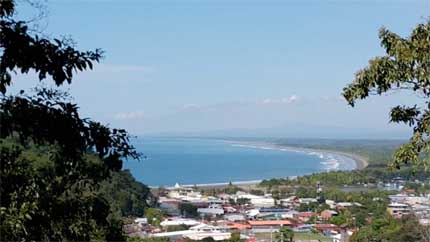
Playa Hermosa |
||||||||||||||||||||||||||||||||||||||||||||||||||||||||||||||
 |
|
|
|
|
|
|
|
Food |
|
| What we published this week: | Monday | Tuesday | Wednesday | Thursday | Friday | Earlier |
| The contents of this Web site are
copyrighted by Consultantes Ro Colorado S.A 2015 and may not be
reproduced anywhere without permission. Abstracts and fair use are permitted. Check HERE for details |
||||||
A.M. Costa Rica Third News Page |
|
| San José, Costa Rica, Monday, Sept. 14, 2015, Vol. 16, No. 181 | |
|
|
|
|
|
|
|
Food |
|
| Torch welcomed with elaborate ceremony at Peñas
Blancas crossing |
|
|
By the A.M. Costa Rica staff
The Antorcha de la Libertad Centroamericana has begun its travels from the northern border. Arrival is expected in Cartago at 8 p.m. This is the annual relay by Costa Rican students and others throughout Central America to bring the message of liberty to what were the Spanish colonies 194 years ago. There was song and dance as the torch reached Peñas Blancas Sunday morning. Then the torch began its 386 kilometer trip. Each student carries the torch about 200 meters, said the education ministry. Some 2,000 will have participated by tonight. There were ceremonies and celebrations along the route Sunday. The project only began in 1964, but those students who have carried the torch say it was an experience they will always remember. Tonight the torch will be in Cartago for a ceremony with President Luis Guillermo Solís and his ministers. The torch is spawning clones all along the route, and the flame is being carried to many of the country's communities. The municipal council of Guatemala declared independence from Spain Sept. 15, 1821. And that is the day being celebrated here today. However, the news did not reach isolated Costa Rica until October that year. Nearly every school in the country will have a parade of faroles tonight. These are the representations of the 19th century street lanterns. Many a parent was up late Sunday night with construction paper and glue helping students build their individual farol. Some are elaborate. The idea is that under these lanterns citizens read the letter of independence in the streets. Costa Ricans will stop at 6 p.m. to sing the national anthem. This is a long tradition, and even waiters and clerks in stores stop their work to sing exactly at 6 p.m. |
 Ministerio
de
Educación Pública photos
Dancing and theatrics at
Peñas BlancasThe torch was to begin its travels today at 5:30 a.m. in the Parque Central in Esparza. At 6:45 a.m. it is scheduled to be at the Escuela Carlos María Jiménez. San Ramón receives the torch at 8:10 a.m. and Palmares an hour and 10 minutes later. At 10:45 a.m. the torch is expected to arrive in Naranjo and then in Sarchí at the Plaza de Deportes at 11:35 a.m. The arrival in Grecia is scheduled for 12:55 p.m. The arrival in Alajuela is planned for 2:15 p.m. and two hours later in Heredia at the Parque Central. At 5:30 p.m. the torch bearers make a short stop at the Hospital de Niños. Then at 5:59 p.m. the torch is to arrive at San Jose's Parque Central in time for the singing of the national anthem at 6 p.m. Then the torch is on to the Parque Central in Tres Ríos at 7:10 p.m. and then to the destination at Las Ruinas at the Municipalidad de Cartago at 8 p.m. Tuesday, which is a legal holiday, will see parades of school children all over the country. The one in San José begins at 8:30 a.m, and so does the Día de la Independencia ceremonies at Parque Nacional with Solís and many dignitaries attending. Students from 12 schools are expected to participate in the San José parade. |
| President's budget pitchman goes on televison to promote the
plan |
|
|
By the A.M. Costa Rica staff
The acting finance minister, José Francisco Pacheco, carried the message to the public Sunday night defending the proposed central government budget for 2016 and promoting the need for new taxes. Pacheco said that only 4 percent of the budget could be managed by the administration. The rest is established by law or the constitution. He also noted that payment on debt made up about a third of the budget. His presentation was an effort to obtain public support for the budget, which is being considered by lawmakers now. He listed popular programs that should not be cut. |
His
presentation is correct in that many laws are passed
establishing expenditures based on a percentage of gross national
product rather than specific amounts. As Pacheco noted, to make changes with these programs would required changing laws or the Costa Rican Constitution. We cannot postpone the obligations and mortgage the future of the country and yours and your children," he said, stressing that the new budget was just a half point higher than the previous year. Pacheco has become the point man for the Luis Guillermo Solís budget since the Helio Fallas, minister of Hacienda, underwent an operation on a foot injury. |
| You need to see Costa Rican tourism information HERE! |
 |
|
|
|
|
|
|
|
Food |
|
| What we published this week: | Monday | Tuesday | Wednesday | Thursday | Friday | Earlier |
| The contents of this Web site are
copyrighted by Consultantes Río Colorado S.A. 2015 and may not
be
reproduced anywhere without permission. Abstracts and fair use are permitted. Check HERE for details |
||||||
 |
 |
||||
| A.M. Costa Rica's Fourth News page | |||||
| San José, Costa Rica, Monday, Sept. 14, 2015, Vol. 16, No. 181 | |||||
|
|
|
|
|
|
|
Food |
|
| Researchers link Gulf War illness and fatigue to damage to
cells |
|
|
By the American Physiological Society news
staff
One in four Gulf War veterans suffers from Gulf War illness. The condition is characterized by unexplainable chronic fatigue, muscle pain and cognitive dysfunction and may be associated with exposure to chemicals, many identified as genotoxins, during deployment. Previous studies suggest that the symptoms of Gulf War illness are due to dysfunction of the mitochondria, the site in cells where molecules that power the body’s processes are produced. Not producing enough energy slows down the body and leaves the individual feeling tired. New preliminary research shows for the first time direct evidence of greater mitochondrial damage in Gulf War veterans. The mitochondrion has its own DNA, separate from the cell’s, that encodes the proteins needed to produce the molecules that power the body’s processes. Damage to the mitochondrial |
DNA directly
affects the
mitochondria’s ability to function and produce energy. Increases in the amount of mitochondrial DNA have been associated with disease. In this study, researchers measured the mitochondrial DNA amount and degree of mitochondrial DNA damage in blood cells from blood samples from veterans with Gulf War illness. Compared with healthy non-deployed controls, Gulf War veterans had more mitochondrial DNA content and greater mitochondrial DNA damage. According to the researchers, these findings further support that mitochondrial dysfunction may be involved in the illness. “Future studies are necessary to confirm these findings and determine their association with mitochondrial function. Work in this area may guide new diagnostic testing and treatments for veterans suffering from GWI,” the researchers wrote. |
Here's reasonable medical care
Costa Rica's world class medical specialists are at your command. Get the top care for much less than U.S. prices. It is really a great way to spend a vacation. See our list of recommended professionals HERE!amcr-prom
|
|
|||||||||||||||||||||||||||||||||||||||||||
|
|
|
|
|
|
|
Food |
|
| What we published this week: | Monday | Tuesday | Wednesday | Thursday | Friday | Earlier |
| The
contents of this Web site are copyrighted by Consultantes Río
Colorado
S.A. 2015 and may not be reproduced anywhere without permission. Abstracts and fair use are permitted. Check HERE for details |
||||||
|
A.M. Costa Rica's Fifth news page |
 |
| San José, Costa Rica, Monday, Sept. 14, 2015, Vol. 16, No. 181 | |||||||
|
|
|
|
|
|
|
Food |
|
| Apology to Vanessa Williams climaxes beauty pageant By the A.M. Costa Rica wire services
Miss Georgia Betty Cantrell was crowned the new Miss America Sunday night in Atlantic City, beating out contestants from all 50 states, plus the District of Colombia and Puerto Rico. Judges made their decision in part based on Miss Cantrell's superb opera performance. But, the pageant's apology to a former winner who was dethroned was one of the most anticipated moments of the evening. Pageant executive chairman Sam Haskell stood on stage with actress/singer Vanessa Williams and said "You have lived your life in grace and dignity and never was it more evident than during the events of 1984 when you resigned . . . . I want to apologize for anything that was said or done that made you feel any less than the Miss America you are and the Miss America you always will be.” Haskell also apologized to Helen Williams, Vanessa's mother, who was in the audience, in the televised event. The elder Williams was near tears amid the standing ovation after the apology. Vanessa Williams was the first African American woman to win the Miss America crown, but she stepped down amid a nude photo scandal. Ms. Williams went on to have a successful entertainment career as a singer and an actress. She was also one of the judges in Sunday's competition. Haskell said no one with the current Miss America staff was involved in the events that led to Williams' resignation. Djokovic takes tennis title in grueling match amid rain By the A.M. Costa Rica wire services
Serbia's Novak Djokovic won the U.S. Open Sunday night after waiting out a three-hour rain delay and needing more than three more hours to beat one of the best men's tennis players in history. The win over Switzerland's Roger Federer was the 10th grand slam tournament win for Djokovic and his third this year, after taking both the Australian Open and Wimbledon. "It's quite an incredible evening for me," Djokovic said after the match. "I have tremendous respect for Roger and what his game is presenting to me and to any other player." He called Federer perhaps the best player in history, and said facing him adds a little pressure. Djokovic and Federer have dominated men's tennis during the past decade along with Spain's Rafael Nadal. After Sunday's final, the last major of the year, the trio has now won 40 of the past 48 grand slams. Federer has not won a major since 2012 and not at the U.S. Open since 2008 when he beat Djokovic in the semifinals. But he rolled through the early rounds this year, defeating all of his opponents in straight sets to reach the final. Djokovic grabbed the early lead, winning the first set 6-4, but Federer responded by taking the second set 7-5. Djokovic looked to be in control from there, winning the third set 6-4 and leaping out to a 5-2 lead in the fourth set. But Federer rallied, prompting an extra boost of energy from the crowd in New York as he battled back to 5-4. Djokovic prevailed though, watching Federer's final volley drift just past the baseline for the 6-4 set. "Today I was serving at 5-2 in the fourth set and Roger showed why he's a champion," Djokovic said. There was no guttural scream or dropping to the knees in celebration, just a smile and a jog to the net to shake hands with Federer. Djokovic walked away and looked into the crowd and shook his head in disbelief before hopping up into the stands to hug his family and friends. Federer, who celebrated on that court five straight years from 2004-2008, could only sit in his courtside chair and watch. The 34-year-old described the past two weeks as wonderful and drew cheers when he announced he will return next year. "I'm very pleased with where my game's at," Federer said. "I thought it was a great match." He added his congratulations for Djokovic and said he felt great about where his game is right now. "I love the sport, I've got a lot of passion," he said. Djokovic said closing out the match was a huge relief and that he would enjoy it as long as he could. "I love this sport, as Roger said. He has a lot of passion for this sport, I do too. If we didn't have the love and passion, we wouldn't be here," said Djokovic. Lawmakers want to study Obama plan to admit Syrians By the A.M. Costa Rica wire services
U.S. lawmakers are scrutinizing the Obama administration's plan to admit 10,000 Syrian refugees to the United States, where the possibility of terrorist infiltrators is a top concern. "If I could be assured these people could be vetted properly, I would be supportive," said House Homeland Security Committee Chairman Michael McCaul on ABC's This Week program. "We don't know who they are." The plight of Syrian refugees has gripped the world's attention, including on Capitol Hill. "These are refugees from torture, from murder, from killing, from genocide," said Sen. John McCain, a Republican, in a fiery floor speech last week. With millions of Syrians displaced, the United States plans to admit 10,000 refugees. But even that tiny proportion is raising concerns. "From a national security standpoint, I take ISIS at its word when they said, in their own words, 'We will use and exploit the refugee crisis to infiltrate the West.' That concerns me," said Republican McCaul of the Islamic State. "We have to deal with this crisis. But this could be a very reckless and dangerous policy." The Obama administration says Syrian refugees will be thoroughly screened. "We would not take any shortcuts when it comes to our security," said White House spokesman Josh Earnest. "So there will be an effort to try to accelerate that process or move more people through that process, but it will not come at the expense of the robust security precautions that will remain in place." Even so, President Barack Obama's special envoy in the fight against the Islamic State acknowledges the potential danger is real. "I think we should watch it," said retired Gen. John Allen on This Week. "We should be conscious of the potential that Daesh may attempt to embed agents within the population." Refugee proponents, meanwhile, say admitting 10,000 Syrians is a step in the right direction, but a number that barely begins to address the unfolding refugee crisis. Germany tightens its borders in response to refugee crisis By the A.M. Costa Rica wire services
Germany has temporarily suspended participation in the much-vaunted European Union system of passport-free movement between member countries and has imposed border controls, saying it was forced to do so to limit the influx of refugees from war-torn countries, mainly Syria and Iraq. The announcement Sunday by the country’s interior minister, Thomas de Maiziere, came on another fast-moving day in Europe’s migration crisis, with Germany halting all trains for 12 hours with its neighbor Austria, the main conduit through which 450,000 refugees have arrived in Germany this year. Analysts predicted the halting of trains would prompt more desperate scenes on the Austrian-German border, as tens of thousands of refugees try to enter Germany by any means possible. “Germany is temporarily introducing border controls again along internal borders. The focus will be on the border with Austria at first," de Maiziere said Sunday. “The aim of these measures is to limit the current inflows to Germany and to return to orderly procedures when people enter the country.” The suspension of German participation in passport-free movement between member countries came as Germany's federal states warned they are struggling to handle the refugee influx, and pushed back on German Chancellor’s Angela Merkel’s decision to welcome hundreds of thousands of refugees. The Christian Social Union, the mainly Bavarian sister party of Chancellor Merkel’s Christian Democratic Union in the governing coalition, also upped its criticism of the German leader’s move to relax the rules for Syrian asylum-seekers wanting to settle in Germany. In rare direct criticism of the government, leading members of the party turned on Ms. Merkel, saying she is making an “unparalleled historical mistake.” Horst Seehofer, party leader, told Spiegel magazine: “It was a mistake that will occupy us for a long time yet. I see no possibility of putting the stopper back into the bottle.” The mayor of Munich, Dieter Reiter, announced the city’s capacity to cope with arriving refugees is exhausted. Germany’s decision to suspend its participation in the passport-free program is likely to anger other EU members, especially Belgium and France, who have threatened several times since 2011 to do the same in response to Italy handing out humanitarian passports to refugees and economic migrants. Charges against Chinese prof will be dropped, Feds report By the A.M. Costa Rica wire services
U.S. federal prosecutors are planning to drop fraud charges against the Chinese-born former chairman of Temple University's physics department, who was accused of scheming to provide sensitive technology to China. The U.S. Attorney's Office in Philadelphia filed a motion in federal court Friday to dismiss four counts of wire fraud against Xi Xiaoxing, a naturalized U.S. citizen who was born in China. In its filing, the government said only that it had received additional information' since charges against the 57-year-old professor were filed in May. Xi had maintained his innocence, saying he did nothing more than "common academic collaborations practiced by so many colleagues every day." After his arrest in May, he voluntarily stepped down as chairman of the university's physics department, but remained a faculty member there. Prosecutors accused him of seeking prestigious appointments in China in exchange for providing data on electronics technology invented by a U.S. company. Xi was working for the U.S. firm while on sabbatical in 2002. The company developed a thin-film superconducting device containing magnesium diboride. In 2004, Xi was awarded a grant from the U.S. Defense Department to purchase the device for research, but prosecutors allege that he "exploited it for the benefit of third parties in China, including government entities." The dismissal motion comes after Xi and his lawyer, Peter Zeidenberg, gave a presentation to investigators Aug. 21. That presentation included affidavits from world renowned physicists and experts who looked at emails between Xi and contacts in China, and explained that he was involved in a scientific pursuit that had a very narrow commercial application and did not involve restricted technology, Zeidenberg said. Xi had faced up to 80 years in prison and a $1 million fine if convicted. The dismissal motion still must be approved by a U.S. district judge.  Voluntad Popular photo
Lilian
Tintori, wife of Leopoldo López, speaks to her husband's
supporters and
press.
U.S. and others deplore López prison sentence By the A.M. Costa Rica news services The United States is expressing
outrage at the jailing of Venezuelan opposition leader Leopoldo
López.
López was sentenced to nearly 14 years in prison in connection with opposition-led protests last year that turned deadly when state forces clashed with demonstrators. Samantha Power, the United States' U.N. ambassador, said that Lopez's trial was unfair and "it goes without saying that these charges on the basis of what López did are absurd." Power said Lopez's conviction was not going to advance peace and prosperity and stability in Venezuela at a time when the country is going through an economic crisis. The U.S.-trained economist was convicted of inciting violence against the government in an attempt to force President Nicolas Maduro from office. López, 44, is the founder of opposition party Voluntad Popular. Earlier, the White House said Maduro's government was using the justice system to attempt to silence critics. "The decision to prosecute and sentence López, and the conduct of his trial, have highlighted significant failures in the rule of law and judicial system in Venezuela,'' National Security Council spokesman Ned Price said. Amnesty International said in a statement that Lopez's sentence showed an utter lack of judicial independence and impartiality in Venezuela. "His only crime was being leader of an opposition party in Venezuela," said Erika Guevara-Rosas, the Americas director of Amnesty International. "With this decision, Venezuela is choosing to ignore basic human rights principles and giving the green light to more abuses." The court rejected all but two defense witnesses, both of whom ultimately declined to testify, while letting the prosecution call more than 100 during the closed-door sessions, according to Lopez's attorneys. López insists he called only for peaceful protests, and his backers blame armed government supporters for much of the bloodshed last year that resulted in more than 40 deaths. Government officials said López implicitly encouraged the violence. More opposition protests have been scheduled for next week in response to the verdict. |
|
|
|
|
|
|
|
|
Food |
|
| What we published this week: | Monday | Tuesday | Wednesday | Thursday | Friday | Earlier |
| The
contents of this Web site are copyrighted by Consultantes Río
Colorado S.A. 2015 and may not be reproduced anywhere without
permission. Abstracts and fair use are permitted. Check HERE for details |
||||||
| A.M. Costa Rica's sixth news page |
|
||||||||
| San José, Costa Rica, Monday, Sept. 14, 2015, Vol. 16, No. 181 | |||||||||
|
|
|
|
|
|
|
Food |
|
||
|
The
seed-collector's dilemma: Memory
Well, I just dumped out my pocketbook (looking for car keys) and several dozen small round black seeds fell onto the desk. Hmmm. I wonder where those came from. Was it that small shrub down in Liberia or that orange
We have good intentions, really. We intend to put the seeds in some good soil when we get home but things get rushed. The next time we see the seeds, they have been through the washer and dryer. Nothing sprouts after that kind of treatment. But suppose, just suppose, that you remember to take the wrapped seeds out of pocket (or wherever) and put them in the ground or even a pot. What then? If you are like me, you forget to put a note on the pot of what they are or where they came from. Or you do, but the sun bleaches out the note, or you mix up a couple different pots. The only thing to do is wait until the seeds sprout and give you something to work with. It is now “name that leaf” time. Have you looked around at all the different trees and shrubs that have a mimosa-like leaf? Confusing isn't it? Some turn into 10 meter trees and some stay as shrubs. Put one in the wrong place, and you have a problem. Sometimes I think I should take a hint from all those crime shows on TV, the ones where everybody carries a bunch of evidence bags to the scene of the crime. Little sandwich baggies would be good and a nice marking pen, but will I remember to do that? That kind of organization is usually beyond me, but, if I hurry out now, while I am thinking about it, I could put baggies in the car, maybe even a pen. Will I remember where I put them when the time comes? Probably not . . . . But it's a good plan.  A.M. Costa Rica/Victoria
Torley
Plant of the Week
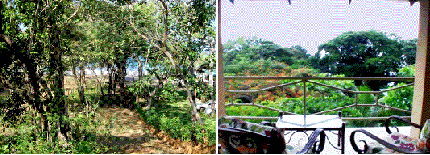
Not one plant, but two that illustrate my I-don't-know-what-it-will-be dilemma. The plants are not the same age, so take that into account. One will be a tree, one a shrub. If you can figure it out, let me know which is which. If you would like to suggest a topic for this column, simply send a letter to the editor. And, for more garden tips, visit https://www.facebook.com/pages/Arenal-Gardeners/413220712106845 |
| Costa Rican News |
AMCostaRicaArchives.com |
Retire NOW
in Costa Rica |
CostaRicaReport.com |
| Fine Dining
in Costa Rica |
The CAFTA Report |
Fish
fabulous Costa Rica |
|
|
|
|
|
|
|
Food |
|
| What we published this week: | Monday | Tuesday | Wednesday | Thursday | Friday | Earlier |
| The
contents of this Web site are copyrighted by Consultantes Río
Colorado S.A. 2015 and may not be reproduced anywhere without
permission. Abstracts and fair use are permitted. Check HERE for details |
||||||
| From
Page 7: Trump calls big salaries of CEOs disgraceful By the A.M. Costa Rica wire services
Billionaire real estate mogul Donald Trump, the leading 2016 U.S. Republican presidential contender, Sunday attacked the big salaries of corporate chief executives as disgraceful. Trump told CBS's Face the Nation, "You see these guys making these enormous amounts of money, and it's a total and complete joke." In U.S. political campaigns, Democratic candidates often criticize the wide disparity between the pay of CEOs of big companies and their employees, which can be as much as 350 times greater. But Republicans, often thought to be the party of big business in the United States, rarely attacks the salaries of corporate and Wall Street chieftains. The 69-year-old Trump often brags about his wealth and business success building New York skyscrapers. But he laid the blame for high CEO pay on the executives themselves, who he said put their friends on corporate boards of directors, who in turn approve the big salaries for company leaders. "It does bug me," Trump said. It's very hard if you have a free enterprise system to do anything about that, he added. The boards of companies are supposed to control spending and high pay executive pay, "but I know companies very well and the CEO puts in all of his friends." Trump has taken a populist, anti-Washington message to the top of the 16-candidate Republican field. He said in the coming weeks he would unveil proposals to cut individual and corporate taxes, "but for the hedge fund guys, they are going to be paying up." The Republican contenders are getting set for Wednesday's next round of debates, with several of the candidates vowing to attack Trump for his shifting views on U.S. health care, abortion and other issues over the years and make the argument that he is not in line with the views of the party's dominant conservative voters. Republican Party Chairman Reince Priebus told CNN's State of the Union Sunday that "there will probably be more elbows thrown in that debate" than in the first one last month. Another Republican political novice, former neurosurgeon Ben Carson, has risen to second behind Trump in surveys of Republicans across the U.S. In an appearance on ABC's This Week, Carson dismissed Trump's recent remark that he did not have enough energy to be president. "You don't have to be loud to be energetic," Carson said. |