
|
 |
Your daily
English-language |
 |
|
|
|
|
|
|
|
|
|
|
|
|
||||||||||||
|
|
||||||||||||
 |
|
Second news page |
 Click HERE for photo tour of 511 properties for SALE or RENT in Escazú, Ciudad Colón, Santa Ana, Rohrmoser, Curridabat, Heredia and the Pacific Coast. |
|
|
|
|
|
|
|
|
|
|
 |
| Costa Rica Expertise Ltd http://crexpertise.com E-mail info@crexpertise.com Tel:506-256-8585 Fax:506-256-7575 |
 |
 |

|
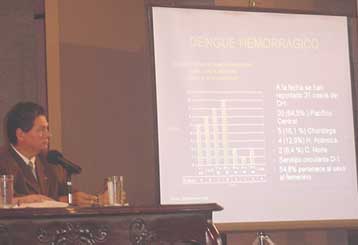 A.M. Costa Rica/Saray
Ramírez Vindas
Francisco Cubrillo displays his data during a press conference
TuesdayDengue cases continue to plague both coasts By the A.M. Costa Rica staff
A health ministry official said Tuesday that some 21,361 cases of dengue have been reported in the country this year. He said that 31 persons had contracted the more severe hemorrhagic form of the disease. One person, Christian Rodríguez, 24, of Puntarenas has died as a resut of the current epdemic, but the health official, Francisco Cubrillo, said that a second suspicious death on the Caribbean coast turned out to be a heart attack. He said that the last week showed a 250 percent increase in reported cases when compared with the same period a year ago. He is a vice minister in the Ministerio de Salud. Costa Rica has put in nearly $1 million to treat victims of the disease. Most hospitals on the coasts are crammed with patients suffering from dengue. Cubillo said that 64.5 percent of the cases are in the central Pacific region and 12.9 percent are from the Caribbean area. His data showed a slight dip in the number of cases during the last week. He said that the ministry was not pushing fines for those who maintain places where the Aedes aegypti carrier mosquito can breed, although such fines are on the books. Health officials are seeking compliance instead. The prevalence of the disease has hurt the tourism industry even though tourists can easily avoid the day-biting mosquito by using protective sprays and common sense. According to the U.S. National Institutes of Health dengue fever can be caused by any one of four types of dengue virus: DEN-1, DEN-2, DEN-3, and DEN-4. A person can be infected by at least two, if not all four types at different times during a life span, but only once by the same type, said the institute. Infection by one type provides immunity against that strain but also seems to make the individual prone to the hemorrhagic type if infected by a different strain. Dengue is called the bone breaking disease because it causes severe pains in the joints. The disease can produce a rash that may appear over most of your body three to four days after the fever begins. A second rash may appear later in the disease, according to the institutes of health. The U.S. Centers for Disease Control advises those sick with dengue not to take aspirin. Acetaminophen or other over-the-counter pain-reducing medicines are safe for most people, said the centers. Because the disease is caused by a virus, there is no cure. Physicians urge keeping the fever down with medicines, if necessary, drinking fluids and getting bed rest. Part of the problem in Costa Rica this year is caused by a successful anti-dengue campaign last year. The number of those ill was reduced significantly and health officials were slow in resuming a cleanup campaign this year. Our readers' opinions
New customs form is called a loser Dear A.M. Costa Rica: I read the article of the gentleman who had difficulties with customs and also those that reacted to his comments. Trying not to take any side in the 300-hat incident, I would like to comment on customs in Costa Rica. Most all countries ask if you are bringing in things for sale or business. The form used by C.R. customs for years stated luggage and went on to define it on another page as things you could reasonably use during your stay, regardless if you were going to another country when you left Costa Rica. It also stated you need to declare used items. On the old form you had to jump back and forth many times between pages to come to the conclusion you had a $500 exemption (which had been only $300 up to a few years prior). In late August I noticed a revised form and thought to myself that finally they had made the form clear. It was quite the opposite. I was shocked when I attempted to read it. Rather than clear English it was more like pigeon English. Tourists and others were trying to comprehend the form to comply. One section seemed to lump guns, narcotics and medications together. There are educated men and women in Costa Rica that speak English as well as myself. So why have custom forms in English that is not even understandable? This concept of having an outside source fix things for you with the government reminds me of the Philippines where fixers sit outside government offices to fix things for a fee that you can not get taken care of inside by public servants. Thus the public servant inside triples their government salary by under-the-table cuts with their friends or relatives outside fixing things for you that should have been easily done inside. Another problem I have is seeing signs upon entering Costa Rica and on the customs form talking about child sexual molestation. The problem with this is that 99 percent of those entering the country would not think of having sex with a child, and those that do would disregard any warning anyhow. This to me hurts the image of Costa Rica because it almost gives one the image that sex with minors by tourists is prevalent which would mean the parents of the minors must be approving. I too have seen jerks from the States with arrogant attitudes. However, reading the letter from the gentleman trying to pay the duties for the hats did not lead me to believe he was an idiot or a jerk. My experience with custom agents in the U.S.A. have ranged from great to horrible. Perhaps instead of judging the man that complained somebody could direct him to a person within the Costa Rican Government that could look into his concerns. David Gibson
Sacramento Calif. San Pedro |
|
||||||||||||||||||
 |
 |
||||||||||||||||||
| A.M. Costa Rica was 'hit' 2,592,014 times in August with 470,125 page views from 89 countries Shouldn't your ad be here? Contact us! |
|
with the observations of Dr. Lenny Karpman Click HERE! |
 |
| Proposed law to grant subsidy to television system |
|
|
By the A.M. Costa Rica staff
When the Instituto Costarricense de Turismo goes out to place avertising to promote the country, some 10 percent will have to be spent with the Sistema de Radio y Televisión Nacional known as SINART, if a proposed law is approved. The Comisión Permanente de Asuntos de Gobierno y Administración approved the measure Tuesday and sent it to the full assembly. According to the measure, the state-run television system is guaranteed 600 million colons, about $1.2 million, a year in government funding. But other government agencies will have to kick in, too. According to the proposal, the Asamblea Legislativa, the Defensoría de los Habitantes de la República, the Contraloría General de la República, autonomous institutions and public services and dependencies of |
the executive branch
will have to designate 10 percent of their advertising budgets for
SINART S.A. Government agencies that do not comply with this law will not have their promotional budgets approved by the Contraloría General, says the measure. The proposed law does not consider viewership or other normal advertising considerations in awarding the system the money. SINART, the government's television and radio outlet, runs live coverage of the Asamblea Nacional on its Channel 13 weekday afternoons. It also operates Radio Nacional. The proposed measure actually represents a hidden tax because government agencies get their money from taxes and other public sources. So agencies will be increasing their promotional budget to compensate for the Sinart writeoff. |
| Six approved, new
highway overpasses might protect pedestrians |
|
 A.M. Costa Rica/Saray
Ramírez Vindas
Flora Ureña Villalobos is comforted by passers-by
and a policeman after she was hit by a bus at Avenida Central and
Calle 13 Tuesday. |
By Saray Ramírez Vindas
of the A.M. Costa Rica staff Pedestrians will be harder targets now that six bridges have been approved over the major highways in the Metropolitan Area. However, vehicles continue to take their toll elsewhere. The Contraloría General de la República has approved contracts for six bridges, including two near Multiplaza on the Autopista Próspero Fernández where countless pedestrians have been cut down. Another pedestrian bridge will go up on the Autopista General Cañas in front of Los Arcos and the Real Cariari shopping center. Three bridges will go up on the Auotopista Florencio del Castillo between San José and Cartago. The sixth will be on the Circunvalación south of San José. The yellow hearts painted on the highways mark the spots where pedestrians died. Most died trying to cross the multi-laned roadways. The bridges will cost 600 million colons or about $1.25 million. Seriously injured Tuesday in San José downtown was Flora Ureña Villalobos. She was hit by a bus bound for Tres Rios. Orlando Méndez, the bus driver, said the woman, about 65, crossed against the light at Avenida Central and Calle 13. |
| Correos de Costa Rica, under private pressure, plans a
makeover |
|
|
By Saray Ramírez Vindas
of the A.M. Costa Rica staff Every day more and more people use the Internet to buy and sell any kind of product from clothes, magazines, cameras with the latest technology and medications or software. This brings the postal agency more business, which increases the demand for service. So Correos de Costa Rica is going to be transformed, according to Rudy Cuadra of the postal agency. The postal sector of Costa Rica should be included in the development of a national plan to provide and improve the quality of services and efficiency for clients, he told reporters Tuesday. Among other changes, the postal service plans to |
improve package
delivery and to provide a service of transmitting money across national
boundaries. The postal service is facing increased competition from
private companies. This plan will involve the government as the regulator of public services with the goal of finding a solution to the postal development, said Susy Moreno Amador, general manager of Correos de Costa Rica, who also spoke with reporters at Casa Presidencial. The Universal Postal Union and the postal unions of the Americas, of Spain and of Portugal will help with the project. One of the main goals of the new postal plan is to create a competitive environment. The postal services of the participating countries will provide a professional team to make technological, legal and infrastructure recommendations, said Cuadra. |
 |
 |
| U.S. ports system meeting the challenge of Katrina |
|
|
Special to A.M. Costa Rica
No change in U.S. agricultural exports is forecast in the short term despite problems brought on by Hurricane Katrina, the U.S. Department of Agriculture reports. In a report released Monday, the department actually forecasts small increases for exports of cotton, maize and soybeans, key U.S. crops coming into harvest season from September to November. "We would think that the impact, based on what we know now, would be miniscule if even detectable," an agriculture official said. For the 2005-2006 export year, the report forecasts U.S. exports of all feed grain including maize at 290.8 million metric tons, up from a forecast of 287.4 million made a month earlier. The report does forecast a delay in some exports from September to October, the official said, "but in terms of the overall impact, it was nil." U.S. production of most agricultural commodities was reported as increasing. How those commodities |
destined for export
will be shipped overseas remains uncertain. Another department official said a limited amount of ocean-bound shipping was leaving from Mississippi River ports north of New Orleans. The port at New Orleans, devastated by the hurricane, ordinarily accounts for 60-70 percent of U.S. grain exports. Both U.S. producers and foreign buyers are watching eagerly the pace of recovery at New Orleans' port while producers also are exploring ways to get their commodities to other seaports, such as Galveston, Texas, which lies close to New Orleans. According to the USDA report, Katrina-related disruptions to U.S. poultry exports "are expected to be relatively short term as firms shift exports to other ports." Because of the hurricane, the United States is expecting more imports of at least one commodity, sugar. The Agriculture Department forecasts that during the 2005-2006 year U.S. imports of sugar will increase 176,000 tons: 136,000 tons from higher tariff-rate quotas and 40,000 tons from high-tier sugar imports from Mexico. |
| Experts on cybersecurity are meeting in São Paulo |
|
|
Special to A.M. Costa Rica
Government experts involved with computer security in the Americas are meeting this week in São Paulo, Brazil, to continue cooperation on a hemispheric cybersecurity strategy developed by the Organization of American States. The hemispheric organization said that the "Second Meeting of Government Cybersecurity Practitioners" will focus on developing plans for a rapid-response network to detect vulnerabilities and threats to information systems in the hemisphere. The first such meeting of the hemisphere's government cybersecurity experts took place in Ottawa, Canada, in 2004. The creation of a network of what are called "Computer Security Incident Response Teams" is part of a cybersecurity strategy developed jointly by the |
organization's
Inter-American Committee against Terrorism and the Group of Experts on Cybercrime, which was established by the hemisphere's ministers of justice and attorneys general. The cybersecurity strategy was formally adopted by the Organization of American States General Assembly in June 2004 in Quito, Ecuador. At that Quito meeting, the OAS said that the Internet and related technologies have become "indispensable tools" for its member countries, spurring tremendous growth in the global and hemispheric economy. But the Internet has also "spawned new threats that endanger the entire global community of Internet users," the Organization of American States warned. The organization said that information that goes through the Internet can be "misappropriated and manipulated to invade users' privacy and defraud businesses." |
|
|
|
|
|
|
|
|
| What we published this week: | Monday | Tuesday | Wednesday | Thursday | Friday | Earlier |
|
|


