|
 |
Costa Rica Your daily |
 |
|
|
|
|
|||||||||||||||||||||||||
 |
||||||||||||||||||||||||||
|
|
|||||||||||||||||||||||||
|
|
|
|
|
|
|
|
| What we published this week: | Monday | Tuesday | Wednesday | Thursday | Friday | Earlier |
|
|
 |
 |
 |
||||||||
| A.M. Costa Rica's Second newspage | |||||||||
| Home |
Tourism |
Calendar |
Classifieds |
Entertainment |
Real
estate |
Rentals |
Sports |
About
us |
|
|
|
|||||||||
 |
| Costa Rica Expertise Ltd http://crexpertise.com E-mail info@crexpertise.com Tel:506-256-8585 Fax:506-256-7575 |
 |
 |
|
 Ministerio de Gobernación,
Policía
This is the homemade .22 caliber pistoly Seguridad Pública photo Parents face tough choices
on having weapon in home By the A.M. Costa Rica staff
There are no easy solutions for parents with minor children when there is a gun in the house. The vice minister of Seguridad, Jorge Chavarría Guzmán, is the latest to encourage citizens to disarm. "Prevention is vital and we cannot let ourselves be carried away by fear," he said. Everyone wants a secure house, and it is necessary to begin in the home. This security we can maintain without firearms, and if we decide to have them the responsibility is to secure them adequately." His comments were cited by the Ministerio de Gobernación, Policía y Seguridad Pública as it announced that 14 families have surrendered weapons to get them out of their homes. There was a ceremony Thursday in which President Laura Chinchilla participated in the destruction of handguns. Left unsaid is the quandary of parents. A weapon that is locked up and secure is not very useful when criminals break into the home, something that is happening more frequently here. Yet the same weapon, if placed in a drawer loaded, is a magnet for youngsters. A teen girl critically injured herself with her father's weapon last week in a suicide attempt over her love life. And the problem is not just with children. Two police officers on duty shot themselves in the last two weeks. Both died. One was believed accidental. One was believed to be suicide. Both shootings happened in the police stations. Sunday a private guard manipulating his .22-caliber pistol accidentally shot a child. Another child suffered a wound in the foot from a stray shot during a gang shootout last week. Meanwhile, the Dirección General de Armamento is available at 2229-1486 for anyone who wishes to surrender a weapon. Regardless of the country's gun laws, crooks have no trouble getting weapons. Fuerza Pública officers confiscated a homemade pistol Thursday in Puerto Viejo de Sarapiquí. Four young men were in the vehicle in which the zip gun was found. It was a .22-caliber device made of pipe and a heavy rubber band. Officers said they suspect that the four men were robbers who were targeting commercial establishments in the province of Heredia. Homemade shotguns and other types of homemade weapons are discovered periodically. There is a litany of persons stopped with illegal weapons. In the countryside, the weapon may be an old shotgun or .22-caliber rifle used for hunting. But there are many confiscations of weapons from persons who appear to have a criminal use for the firearm. Seldom are there reports of convictions. Even when someone murders an individual with a weapon, the murderer is penalized far more than for the act of carrying an illegal weapon. One example is a man with the last names of Grajal Núñez. He killed a schoolboy, Jonathan Viquez Madrigal, in Limón Nov. 30, 2008, during a robbery. Last week he got 20 years in prison for the murder but just six months for carrying an illegal weapons. Others who might get a similar sentence for carrying an illegal weapon will not see prison. Under Costa Rican criminal law persons with a clean record can receive conditional release for sentences up to three years in prison. Grajal, by the way, probably will be out in six or seven years on the murder conviction due to the way the Costa Rican prison system generously calculates time served. Shark-finning campaign launched by three groups Special to A.M. Costa Rica
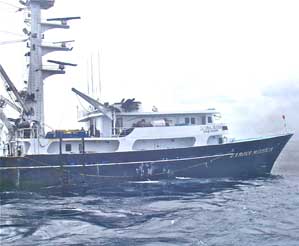
Three organizations have launched a campaign against shark finning by Costa Rican-based boats. The cruel practice of “shark finning” is threatening Costa Rica’s eco-friendly image, said Ethical Traveler, one of the organizations. Shark finning is the act of chopping the fins off of live sharks and dumping the then-helpless sharks back into the sea to drown. The fins are exported to Asia where they are used in an expensive delicacy: shark fin soup—or as journalist John Platt calls it, “Extinction in a Bowl.” A 2007 study published by Science magazine showed a 90-percent decline in global shark populations in recent decades. A study commissioned for the Convention on International Trade in Endangered Species found fishermen responsible for the death of over 200 million sharks each year. "Sharks are a majestic and critical part of the ocean ecosystem," said Jeff Greenwald, executive director of Ethical Traveler. "Killing them for their fins is more than just barbarous and wasteful — it’s illegal under Costa Rican law. This crime must be stopped." EthicalTraveler.org has partnered with nonprofit groups MissionBlue.org and Costa Rica’s Pretoma.org to stop shark finning in the Central American nation. In April, Pretoma founder Randall Arauz received the prestigious Goldman Environmental Award for his work to pass a Costa Rican law requiring that sharks be “landed” with their fins attached — a major victory for the sharks. But the work is not finished, said Ethical Traveler. Arauz is also launching a campaign to discourage Costa Ricans from eating shark meat, which is often concealed behind different names — such as cazón, bolillo, and bolillón — and consumed unknowingly. Thanks to the growing middle class in China, appetite for shark fin soup is as insatiable as ever, Ethical Traveler notes. According to Arauz, shark fins sell for more than 100 times the price of shark meat. Arauz notes that “Taiwanese finning ships are now docking at Costa Rica’s private facilities under cover of darkness, in order to escape the reach of the country’s anti-finning law.” Travelers and environmentalists are pressuring the Costa Rican government to step-up enforcement of existing laws against landing fish at private docks, and to discourage the consumption of shark meat. More information on the campaign is available HERE. Ethical Travel is an organization that encourages tourists to visit only those countries that protect human rights and the environment. Ethical Traveler is a project of the Earth Island Institute, based in San Francisco, California. Specifically, the organizations ask that: • Costa Rica's customs laws be strictly obeyed, even in privately owned docks; • Shark meat be properly labeled, so that consumers are not misled; • Directed shark fisheries be banned, and shark quotas established; • Marine protected areas be created in coastal waters that serve as critical habitats for sharks, and in oceanic migratory corridors between Parque Nacional Isla Cocos and Galapagos Islands National Park in Ecuador). Mission Blue is an organization encouraging public support for a global network of marine protected areas. |
||||||||||||||||||||||||||||||||||||||||||
 |
|||||||||||||||||||||||||||||||||||||||||||
| Home |
Tourism |
Place
classified ad |
Classifieds |
Entertainment |
Real
estate |
Rentals |
Sports |
About
us |
|
| What we published this week: | Monday | Tuesday | Wednesday | Thursday | Friday | Earlier |
| The contents of this page and this Web site are copyrighted by Consultantes Río Colorado 2001, 2002, 2003, 2004, 2005, 2006, 2007 and 2008 and may not be reproduced anywhere without permission. Abstracts and fair use are permitted. Check HERE for details | ||||||
 |
| A.M. Costa Rica third newspage |
 |
||||||||
| Home |
Tourism |
Calendar |
Classifieds |
Entertainment |
Real
estate |
Rentals |
Sports |
About
us |
|
| San José, Costa Rica, Monday, Aug. 9, 2010, Vol. 10, No. 155 | |||||||||
 |
 |
| The green roof above the
multi-story hotel appears to be like a park with an ocean view. |
 Arqueco Ltda. rendering
|
| Proposed Manuel Antonio hotel will have a park for a roof |
|
|
By the A.M. Costa Rica staff
A new luxury beachfront hotel proposed for Manuel Antonio will have a 40,000 square foot roof covered with grass and other native vegetation to serve as a habitat for wildlife, said developers. The project is the Palazzo Park Hotel & Residences, which is being designed by Arqueco Ltda., architects, developers said a release: "A key component of Palazzo Park is Costa Rica's first large-scale green roof proposed by project developer KC |
Development Group. Eco or green
roofs use vegetation to absorb
rainwater, treat grey water, provide insulation to cool the structure,
reduce energy consumption, and create habitat for wildlife. An open-air
common area with vistas of the rainforest and the sea, Palazzo Park's
green roof will provide over 40,000 square feet of native vegetation
designed as habitat for indigenous species." The developers also said they were restoring some 500 acres at Playa El Rey adjacent to Parque Nacional Manuel Antonio. The goal is to provide more habitat for the endangered mono titi in the park. These are the white faced squirrel monkeys that are landlocked in the park. |
| Heredia will have a $200 million, 20-year sewer project |
|
|
By the A.M. Costa Rica staff
The Heredia utility company has outlined a 20-year, $200 million project to provide sewer service to nine cantons of the province. Alfio Piva, serving as president in the absence of Laura Chinchilla, was briefed on the project Friday. The company is Empresa de Servicios Públicos de Heredia. The project includes a treatment plant for the sewage. Rather than dumping the treated water into a river, the plan is to use it for irrigation of various eco projects, said the company. Piva noted that the project would be of benefit to more |
than just
Heredia residents. The province contains about 70 percent of the water
sources that supply the Central Valley. The Instituto Nacional de Acueductos y Alcantarillados also has a major sewerage plan on the drawing board. Right now all of the Central Valley sewage collection system drains into the Río Grande de Tárcoles and then to the Pacific Ocean. The government company known as AyA plans to extend the sewer system into places that now do not have access and construct a treatment plant in Escazú. The Japanese government allocated $130 million to the project four years ago but there has been no actual site work done. Piva was acting president because Ms. Chinchilla was in Bogotá, Colombia, at the inauguration of Juan Manuel Santos. |
 |
| You need to see Costa Rican tourism information HERE! |
| Home |
Tourism |
Place
classified ad |
Classifieds |
Entertainment |
Real
estate |
Rentals |
Sports |
About
us |
|
| What we published this week: | Monday | Tuesday | Wednesday | Thursday | Friday | Earlier |
| The contents of this page and this Web site are copyrighted by Consultantes Río Colorado 2001, 2002, 2003, 2004, 2005, 2006, 2007 and 2008 and may not be reproduced anywhere without permission. Abstracts and fair use are permitted. Check HERE for details | ||||||
| A.M. Costa Rica fourth news page |
 |
||||||||
| Home |
Tourism |
Calendar |
Classifieds |
Entertainment |
Real
estate |
Rentals |
Sports |
About
us |
|
| San José, Costa Rica, Monday, Aug. 9, 2010, Vol. 10, No. 155 | |||||||||
| Tropical forests facing big upsets, new
study reports |
||
|
By the Carnegie Institution for Science
news service
By 2100 only 18 to 45 percent of the plants and animals making up ecosystems in global, humid tropical forests may remain as they are known today, according to a new study led by Greg Asner at the Carnegie Institution’s Department of Global Ecology. The research combined new deforestation and selective logging data with climate-change projections. It is the first study to consider these combined effects for all humid tropical forest ecosystems and can help conservationists pinpoint where their efforts will be most effective. The study is published in Conservation Letters on Thursday. “This is the first global compilation of projected ecosystem impacts for humid tropical forests affected by these combined forces,” remarked Asner. “For those areas of the globe projected to suffer most from climate change, land managers could focus their efforts on reducing the pressure from deforestation, thereby helping species adjust to climate change, or enhancing their ability to move in time to keep pace with it. On the flip side, regions of the world where deforestation is projected to have fewer effects from climate change could be targeted for restoration.” Tropical forests hold more then half of all the plants and animal species on Earth. But the combined effect of climate change, forest clear cutting, and logging may force them to adapt, move, or die. The scientists looked at land use and climate change by integrating global deforestation and logging maps from satellite imagery and high-resolution data with projected future vegetation changes from 16 different global climate models. They then ran scenarios on how different types of species could be geographically reshuffled by 2100. They used the reorganization of plant classes, such as tropical broadleaf evergreen trees, tropical drought deciduous trees, plus different kinds of grasses as surrogates for biodiversity changes. For Central and South America, climate change could alter about two-thirds of the humid tropical forests biodiversity — the variety and abundance of plants and animals in an ecosystem. Combining that scenario with current patterns of land-use change, and the Amazon Basin alone could see changes in biodiversity over 80 percent of the region. Most of the changes in the Congo area likely to come from selective logging and climate change, which could negatively affect between 35 and 74 percent of that region. At the continental scale, about 70 percent of Africa’s tropical forest biodiversity would likely be affected if current practices are not curtailed. In Asia and the central and southern Pacific islands, deforestation and logging are the primary drivers of ecosystem changes. Model projections suggest that climate change might play a lesser role there than in Latin America or Africa. That said, the research showed |
 A.M. Costa Rica/Dennis Rogers
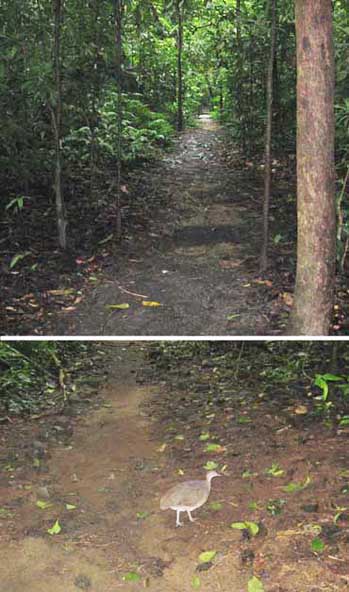
The trail system at the headquarters of Parque Nacional Carara
has been expanded to four kilometers, allowing a good opportunity to
see the lowland rainforest up close. Visitors may see wildlife typical
of the forest interior such as agoutis or this great tinamou. The
entrance is on the main Orotina-Quepos highway two kilometers south of
the Río Tárcoles bridge.that between 60 and 77 percent of the area is susceptible to biodiversity losses via massive ongoing land-use changes in the region. “This study is the strongest evidence yet that the world’s natural ecosystems will undergo profound changes — including severe alterations in their species composition — through the combined influence of climate change and land use,” remarked Daniel Nepstad, senior scientist at the Woods Hole Research Center. “Conservation of the world’s biota, as we know it, will depend upon rapid, steep declines in greenhouse gas emissions.” The Carnegie Institution’s Department of Global Ecology is in Palo Alto, California. |
|
| Home |
Tourism |
Place
classified ad |
Classifieds |
Entertainment |
Real
estate |
Rentals |
Sports |
About
us |
|
| What we published this week: | Monday | Tuesday | Wednesday | Thursday | Friday | Earlier |
| The contents of this page and this Web site are copyrighted by Consultantes Río Colorado 2001, 2002, 2003, 2004, 2005, 2006, 2007 and 2008 and may not be reproduced anywhere without permission. Abstracts and fair use are permitted. Check HERE for details | ||||||
| A.M. Costa Rica fifth news page |
|
|||||||||
| Home |
Tourism |
Calendar |
Classifieds |
Entertainment |
Real
estate |
Rentals |
Sports |
About
us |
||
| San José, Costa Rica, Monday, Aug. 9, 2010, Vol. 10, No. 155 | ||||||||||
 |
 |
| Home |
Tourism |
Place
classified ad |
Classifieds |
Entertainment |
Real
estate |
Rentals |
Sports |
About
us |
|
| What we published this week: | Monday | Tuesday | Wednesday | Thursday | Friday | Earlier |
| The contents of this page and this Web site are copyrighted by Consultantes Río Colorado 2001, 2002, 2003, 2004, 2005, 2006, 2007 and 2008 and may not be reproduced anywhere without permission. Abstracts and fair use are permitted. Check HERE for details | ||||||
| A.M. Costa
Rica sixth news page |
|||||||||
| Home |
Tourism |
Calendar |
Classifieds |
Entertainment |
Real estate |
Rentals |
Sports |
About us |
|
|
|
|||||||||
Latin American news Please reload page if feed does not appear promptly |
begins today all over nation By the A.M. Costa Rica staff
Workmen begin today restoration of the nation's roads under 21 three-month contracts that were awarded without bidding. The contracts became necessary when a series of three-year contracts that had been awarded in a bidding process were challenged. The Contraloría de la República authorized the direct contracts under which companies will apply asphalt to roadways, repair potholes, cut grass and pickup trash in the gutters. Francisco Jiménez said that the Unidades de Inspección will be in charge of supervision. He is minister of Obras Públicas y Transportes. The Contraloría authorized 11 contracts in July for six months while other proposed contracts are disputed. The public works officials hope that disputes over bidding will be resolved in three months, although there is the possibility of even more appeals. The short-term agreements cover 21 zones of the country, Jiménez said. Alajuelita overpass almost ready to handle traffic By the A.M. Costa Rica staff
The much-awaited Alajuelita overpass on the Circunvalación highway south of the downtown will be open by Aug. 30, said the Ministerio de Obras Públicas y Transportes. This is the east-west bridge that passes over the Alajuelita traffic circle. Road officials said Friday that the work was 85 percent complete and that the remaining jobs had to do with constructing a pedestrian bridge and putting in sidewalks. The new bridge has six lanes. The intersection also is known as Rancho Guanacaste. The job, done by Constructora Meco S.A., cost $11 million. The route carries 63,000 vehicles a day. Several traffic circles are left on the Circunvalación, and these are bottlenecks that stall traffic. The first overpass was done at the Y-Griega traffic circle. The government eventually will put bridges over all the older traffic circles. The bridges carry through traffic, and only entrance and exit traffic to the Circunvalación use the circles once bridges are finished. |
| Latin American news feeds are disabled on
archived pages
|
|
| Home |
Tourism |
Place
classified ad |
Classifieds |
Entertainment |
Real
estate |
Rentals |
Sports |
About
us |
|
| What we published this week: | Monday | Tuesday | Wednesday | Thursday | Friday | Earlier |
| The contents of this page and this Web site are copyrighted by Consultantes Río Colorado 2001, 2002, 2003, 2004, 2005, 2006, 2007 and 2008 and may not be reproduced anywhere without permission. Abstracts and fair use are permitted. Check HERE for details | ||||||