|
 |
Your daily |
 |
|
|
|
|
|
|
|
|
|
|
|
|
||||||||||||||
|
|
||||||||||||||
| A.M. Costa Rica Second newspage |
 |
||||||||
| Home |
Tourism |
Calendar |
Classifieds |
Entertainment |
Real
estate |
Rentals |
Sports |
About us |
|
| San José, Costa Rica, Monday, Aug. 6, 2007, Vol. 7, No. 154 | |||||||||
 |
| Costa Rica Expertise Ltd http://crexpertise.com E-mail info@crexpertise.com Tel:506-256-8585 Fax:506-256-7575 |
 Click HERE
for great
hotel discounts
|
|
in center of Desamparados By the A.M. Costa Rica staff
Supporters of the Deportivo Saprissa and those backing the Deportivo Heredia clashed in Desamparados Sunday morning, and one man suffered critical knife wounds. Two persons were arrested, said the Fuerza Pública. The two groups of fans seem to have come upon each other by accident. The Saprissa fans, called La Ultra, were getting buses to San Carlos for a game there. The Heredia fans, called La Garra, arrived in Desamparados for a game between their team and the Brujas Fútbol Club. Police came from Desamparados, San Francisco de Dos Ríos and the Dirección Regional de San José to break up the melee, which was in the municipal park in Desamparados Centro. The Fuerza Pública said that the brawl involved about 100 persons. Also hurt was Jorge Fernández Vega, 45, identified by police as simply a passerby. He got a rock in the face. Three other persons also suffered injuries. The two arrested individuals were both 21 years old. They have the last names of McKenzie Córdoba and Solano Campos, said police. One vehicle was stoned and the rear window was smashed out. Police said the vehicle belonged to Erasmo Mora Mora who came to the street near the park to pick up a passenger who had attended a funeral in the nearby Catholic church. Drug camp or gasoline station raided on coast at Portalón By the A.M. Costa Rica staff
A security ministry aircraft spotted what appeared to be a drug camp near Portalón some 25 kilometers (16 miles) south of Quepos, and a raid Sunday resulted in the confiscation of oil and fuel for outboards. A shootout took place a little while later as Fuerza Pública officers tried to capture three men believed to be linked to the encampment. Two were believed to be still in flight in the nearby mountains. One man was being held. Police confiscated two boats, including one that appears to have been used to carry drugs, probably from Colombia. One or two more boats fled the area and were being followed offshore by the U.S. Coast Guard, said police. José Fabio Pizarro, director general of the Fuerza Pública, said that 150 quarts of oil and 44 containers, each with 15 gallons of gasoline, were confiscated. The oil was of a type that is mixed with gasoline for use by outboard motors. The camp was hidden in a mangrove and included a tent. The fast boats usually used to deliver drugs from Colombia are open and have three to four 100-horsepower outboards attached to the stern. Costa Rica is a transfer point and a refueling area. The confiscated boats were towed to Puntarenas for investigation. New computer worm likely to be hiding in computers By the A.M. Costa Rica staff
A new computer worm called Storm appears to have infiltrated millions of computers, and industry officials wonder what will happen next. The worm enters a computer when a user visits an infected Web page or opens an infected file. Information Week, an industry journal, estimated that the worm might be hiding in 2 million computers awaiting a signal from its creator to send out floods of e-mails. The link to the worm arrives in messages that claim to be a notice of an e-card or a fake news story. Industry officials expect the creators of the worm to launch directed attacks against unspecified Internet providers and flood them with fake messages. This would knock the servers offline. Costa Rican expats are prone to such worms because many of them do not keep software active to repel such worms. Hotel operator is victim of one-car Osa crash By the A.M. Costa Rica staff
A U.S. businessman visiting his tourist hotel in Ojochal de Osa died Thursday when his rented vehicle went off a bridge, said the Judicial Investigating Organization. They identified him as Chad Michael Hymel, 39, who had arrived the day before from Houston, Texas. The accident happened about 2:30 a.m. in Tres Ríos de Coronado de Osa on a bridge over the Río Sándalo. Police in the area said that the bridge is narrow, has no railings and is located on a curve. They also blamed lack of illumination for the one-vehicle crash. Burglar hits Escazú home By the A.M. Costa Rica staff
A thief took equipment worth about $10,000 from a home in Urbanización Palmas de Mallorca in San Miguel de Escazú, the Fuerza Pública reported. The Thursday theft was reported by homeowner Isabel Casanovas who said the loot included a television, a DVD player, sound equipment and jewelry. The subdivision has a private guard service, but those on duty reported they did not see anything unusual. Collision with bus kills pair By the A.M. Costa Rica staff
A San José-bound bus collided headon with a passenger car near Nicoya not far from the Punte de Amistad, the bridge over the Río Tempisque, and a man and his wife in the car died. Both vehicles overturned, and a handful of bus passengers required medical treatment. Dead were Juan Ricardo Leitón and María Sequeira Cortés, both of San José. Stepfather given four years By the A.M. Costa Rica staff
A trial court in Desamparados Friday sentenced a stepfather to four years in prison for aggravated sexual abuse of a child under 10 years. he was identified by the Poder Judicial press office by the last names of Soto Lara. The judges acquitted him on two sex charges. The Ministero Pública has sought a 20-year sentence.
|
 |
|
on our real estate page HERE! |
| A.M. Costa Rica third newspage |
 |
||||||||
| Home |
Tourism |
Calendar |
Classifieds |
Entertainment |
Real
estate |
Rentals |
Sports |
About us |
|
| San José, Costa Rica, Monday, Aug. 6, 2007, Vol. 7, No. 154 | |||||||||
 |
 |
| The best fact of all is that A.M. Costa Rica ads work. They are read in 90 countries each weekday morning. |
|
| AOL
founder planning $800 million project in Guanacaste |
|
|
By José Pablo Ramírez Vindas
of the A.M. Costa Rica staff Another major project has been announced for northwest Costa Rica, and this one, at Punto Cacique, has some big names at the helm. The first is Steve Case, the chairman, who was here Friday presenting the project before President Óscar Arias Sánchez. Vice chairman of the parent firm is Philippe Bourguignon, former president of Club Med and president and chief executive officer of Euro Disney. The president of the parent firm, Revolution Places, is Donn Davis, who with Case helped build America Online, the Internet firm. The company has Philippe Cousteau, grandson of the famous undersea explorer, as an environmental adviser. The project is being presented as an integrated luxury resort. The first phase, due to open in 2010, is on 263 hectares, about 650 acres. The estimated investment is $800 million, said the company. The project seeks to bring in One&Only Resorts, which will build 120 detached casitas. Also planned is an 18-hole golf course and a tennis center. Exclusive Resorts was listed to build 30 residences. Miraval Cacique is contracted to build 60 villas and 120 luxury rooms. The location is just north of Playas del Coco. Although Case and his associates do not have extensive experience in real estate development here, the president of Revolution Places Costa Rica is Darren Linnartz, who worked for 15 years with Marriott/Ritz Carlton. As expected Casa Presidencial praised the plan and said that the project would provide jobs for 2,500 direct and indirect employees. The project also would generate $20 million in taxes. |
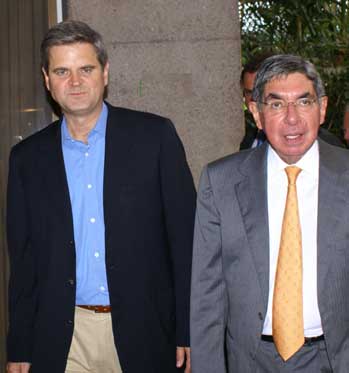 A.M. Costa Rica/José Pablo
Ramírez Vindas
Steve Case walks with Óscar Arias at Casa Presidencial.The company promised to donate a million trees for a conservation group to plan nearby and $1 million for organizations that develop initiatives to protect the Costa Rican environment. The Pacific coast of Guanacaste is facing serious infrastructure problems, not the least of which is the availability of good water. Another major project, involving an estimated $600 million investment, was announced for Esparza earlier this year. The Instituto Costarricense de Turismo said that more than $2 billion in projects have been announced for Costa Rica this year. Those in the real estate industry estimate that only about 30 percent may actually be built. |
|
Pilgrimage to Cartago was not
always a solemn occasion
|
|||
| Pidale a la Negrita “You may beseech the little black lady.” In “the most noble and most loyal city of Cartago,” la muy noble y muy leal ciudad de Cartago, one only need petition the Black Virgen, and she will grant your request. Negrita here refers, of course, to the Virgin of the Angels, La virgen de Los Angeles, the patroness of Costa Rica, whose statue resides in the famous basilica in the city of Cartago. Negrita is also a term of endearment. Many North Americans find this difficult to grasp as they insist on equating the Spanish word negra, or negro, with a similar- sounding pejorative in English. In Costa Rica any pretty dark-skinned girl might be affectionately referred to as negrita, for there is no shame attached to this word. Quite the contrary, it is complimentary. History tells us that in 1623 an Indigenous girl named Juana Pereira (probably not her real name) got up very early one morning and went out to pick up firewood for cooking before she went to school. That morning she walked to a different place than she usually did. In this place she found a black doll on a large rock, and, since there was no one else about, she took the doll with her. Back home she showed the doll, which was carved from a black stone, to her mother, and then put it in a little wooden chest where she kept her childhood treasures. When she returned from school later that afternoon, she went directly to the chest only to find that the doll had vanished. But her mother claimed no knowledge of the doll’s disappearance. Next morning the child returned to the location where she had discovered the black doll and, sure enough, there it was in exactly the same spot it had been the day before. Once again she brought the doll home, but this time she did not tell her mother. Again, after school, the doll was missing from the wooden chest. The little girl told her mother what had happened, and together they walked to the spot in the forest where the doll had been found before. There, atop the same rock, it lay once again. All this was very confusing and a bit frightening to the child and her mother, so they decided to go to the parish priest and ask him what it meant. The padre went with them to the rock and when he saw the little black doll, or La Negrita, he interpreted it as an apparition of the Blessed Virgin. The fact that the doll kept vanishing and reappearing in the same place meant that a church dedicated to the Holy Mother must be constructed on that spot. And that is the story of how La Basílica de la Virgin de los Ángeles came to be built in Cartago. |
Since her discovery by that little girl nearly 400 years ago, La Negrita has come to be venerated by hundreds of millions of people and many thousands of miracles have been attributed to her. On Sept. 24, 1824, the same day that Costa Rica became an independent state, La Virgin de los Angeles became our patroness. Her day in the liturgical calendar is Aug. 2. Many pilgrims walk hundreds, sometimes thousands of miles from as far away as Mexico and Colombia, and also fly into Costa Rica from all around the world, to venerate her. The central goal of this pilgrimage is to arrive at the Basilica in time for the first Mass at 5:30 a.m. Aug. 2. When I was a high school boy, we would gather near our school in San Pedro and watch the people walking to Cartago. Then around midnight we would start our own walk toward the basilica. It is not a totally solemn occasion. There is a great feeling of camaraderie among the pilgrims and much laughter and singing can be heard. We always brought plenty of things to eat and drink along the way. It was an interesting and enjoyable experience, and I’m glad I had it. But the trek is not for the weak or faint of heart. Even as a young person I eventually got very tired of walking. There is no place to sit down, and when we arrived the church was always already full, so there is nothing to do but stand around in the vast square outside and listen to the Mass over loudspeakers. Now when I see on television older and often quite infirm people struggling on this long pilgrimage, they have all my sympathy. One cannot fail to be moved by the majesty of such immense acts of faith regardless of one’s personal views on religion. |
||
| You need to see Costa Rican tourism information HERE! |
| A.M. Costa Rica fourth news page |
A.M. Costa Rica rates Display and classified rates have increased as of June 18, 2007. The average display increase is between 6 and 8.5 percent. This is the first rate increase in the six-year history of the newspaper. The new rates are posted here: As usual, the bulk of any income goes to get you a better newspaper. |
||||||||
| Home |
Tourism |
Calendar |
Classifieds |
Entertainment |
Real
estate |
Rentals |
Sports |
About us |
|
| San José, Costa Rica, Monday, Aug. 6, 2007, Vol. 7, No. 154 | |||||||||
| U.S.-foreign
communications are targeted Bush signs bill allowing widespread U.S. eavesdropping |
|
|
By the A.M. Costa Rica wires services
and the A.M. Costa Rica staff President Bush has signed into law a bill that gives the U.S. government more power to eavesdrop on suspected foreign terrorists and even expats living in Costa Rica. The legislation lifts a previous requirement that such surveillance could not begin without advance permission from a court. Bush said in a statement Sunday that this change will give U.S. agents dynamic and flexible tools for counterterrorism work. The new law, called the Protect America Act, allows the U.S. National Security Agency to intercept telephone conversations, e-mail and other communications between foreigners that are routed through American equipment. Should a U.S. resident become a target of such an investigation, court approval still will be required, according to the law. In fact, several government programs now routinely intercept and automatically survey digital communications entering and leaving the United States. The New York Times revealed in December 2005 that Bush in 2002 authorized the intelligence agency to monitor international telephone calls and international e-mail messages of hundreds, perhaps thousands, of people inside the United States without warrants in an effort to track Al Qaeda. The bill signed Sunday would seem to make that questionable practice totally legal. The American Civil Liberties Union condemned the House and Senate for bowing to pressure from the Bush administration and rushing to pass the measure that amends the Foreign Intelligence Surveillance Act. The administration lobbied heavily to alter the legislation before Congress recessed, said the Civil Liberties Union. The White House pushed for sweeping changes to the spy law after a judge rejected its use of wide-scale, untargeted surveillance. The vote to update Foreign Intelligence Surveillance Act had bipartisan support during voting in both the Senate and House of Representatives, despite sharp criticism from opponents of the measure who contend it will curtail Americans' privacy rights. The current law is only good for six months, and it is a temporary fix. The Bush administration plans to present more permanent legislation when Congress returns from its vacation. The measure also gives immunity to the telecommunications industry against any claims while the |
companies are working with the
government. Specifically the legislation authorizes for six months the National Security Agency to intercept, without a court order, communications between people in the United States and foreign targets overseas. The Bush administration would have to demonstrate to a special court that a surveillance request only targeted individuals outside the United States. The administration has been reluctant to disclose to Congress how it handles such surveillance, and there is no guarantee that aggressive employees will not use the intercepts for their own advantage. Under the older law, the government had to obtain court approval to conduct surveillance of suspected terrorists within the United States. The outdated Carnivore program run by the U.S. Federal Bureau of Investigation contained detailed filters that targeted only those persons and activities specified in a warrant. When the bill was being considering in the U.S. House, the chairman of the House Intelligence Committee, Silvestre Reyes, a Democrat, rose to voice reluctant support, saying the bill was not ideal but was necessary. However, Rep. Sheila Jackson Lee reflected the concerns of other Democrats that the legislation will place the privacy of Americans at risk. Ms. Lee said, "What we are doing here tonight, we are shredding the Constitution, we are tearing up the Bill of Rights, because we are telling Americans that no matter what your business is you are subject to the unscrupulous, undisciplined, irresponsible scrutiny of the attorney general and others without a court intervention." According to the Civil Liberties Union the legislation would allow for the intelligence agencies to intercept — without a court order — the telephone calls and e-mails of Americans who are communicating with people abroad and puts authority for doing so in the hands of the attorney general. No protections exist for Americans whose calls or e-mails are vacuumed up, leaving it to the executive branch to collect, sort, and use this information as it sees fit, said the organization. The government Echelon program, run by the National Security Agency, involves a number of friendly foreign countries. The program has become controversial in the European Union. There are indications that the United States and Canada used the program for political and commercial espionage to benefit international negotiations or local industries. An A.M. Costa Rica news story two weeks ago showed how persons could use a digital signature on their e-mail to encrypt messages so only the recipient could read them. |
| Cuban
boxers found at beach end up going back to Cuba, Castro column says |
|
|
By the A.M. Costa Rica wire services
Cuban leader Fidel Castro says two Cuban boxers who have returned home after apparently defecting during the Pan American Games in Brazil will be treated fairly and not arrested. An article attributed to Castro Sunday in a state newspaper, Juventud Rebelde, that the men will be given decent tasks for future work. Olympic boxing champion Guillermo Rigondeaux and |
Erislandy Lara were found Thursday
in a beach resort town near Rio de
Janeiro after failing to appear for matches last month at the Pan
American games in Brazil. State media say the two arrived back in Cuba early Sunday. Media reports said the boxers signed contracts with German boxing promoters but apparently changed their minds and agreed to return to Cuba after being detained by Brazilian police for overstaying their visas. Castro has blamed American money for the defections. |
| Brazilians
march to protest corruption scandals involving appointees of de Silva |
|
|
By the A.M. Costa Rica wire services
Thousands of Brazilians marched through Sao Paulo and other cities Saturday in a protest against corruption scandals that have involved members of President Luiz Inacio da Silva's government. At least 2,000 demonstrators, many of them wearing black clothing and red clown noses, gathered on Sao Paulo's Avenida Paulista. Similar protests took place in the capital Brasilia, Rio de Janeiro and Curitiba. Corruption charges have brought down several government officials connected to President da Silva in recent years. |
Last May, Energy Minister Silas
Rondeau denied any wrongdoing but
resigned after allegations linking him to a financial scandal involving
public-works project. In another case, the leader of Brazil's senate, Renan Calheiros, was accused of taking payoffs from a construction company. He has denied the allegations, and remains in office. Separate accusations of political dirty tricks and illegal campaign spending forced da Silva to fire his campaign manager, Ricardo Berzoini, prior to the first round of last year's presidential election. |
| We can put your business announcement
here where those seeking international news will see it |
|
| News from
the BBC up to the minute |
BBC sports news up to the minute |
| BBC news and sports feeds are disabled on archived pages. |
|
| A.M. Costa Rica Sports news local and from the wires |
 |
|
|
|
|
|
|
|
|
| San José, Costa Rica, Monday, Aug. 6, 2007, Vol. 7, No. 154 | ||||||
|
||||||
|
|
|
|
|
|
|
|
| What we published this week: | Monday | Tuesday | Wednesday | Thursday | Friday | Earlier |
|
|