|
| |
Your daily |
 |
|
|
|
|
||||||||||||
|
|
||||||||||||
 |
|
|
|
|
|
|
|
|
| What we published this week: | Monday | Tuesday | Wednesday | Thursday | Friday | Earlier |
|
|
 |
| A.M. Costa Rica Second newspage |
 |
||||||||
| Home |
Tourism |
Calendar |
Classifieds |
Entertainment |
Real
estate |
Rentals |
Sports |
About
us |
|
|
|
|||||||||
 |
| Costa Rica Expertise Ltd http://crexpertise.com E-mail info@crexpertise.com Tel:506-256-8585 Fax:506-256-7575 |
 |

Click HERE for
great
hotel discounts
|
|
 Ministerio
de Gobernación, Policía
y Seguridad Pública photo Police
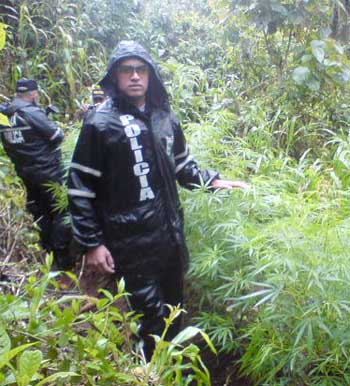
officer shows the bed where marijuana grows
Marijuana farmer seems to know pot agriculture By
the A.M. Costa Rica staff
That was no amateur who put in the bed of marijuana in the Platanillo sector of Turrialba. Police were able to harvest about 10 kilos, perhaps 22 pounds of the juvenile plants on a rainy afternoon. The Grupo de Apoyo Operacional of the Fuerza Pública got a telephone tip telling them where the bed was, according to Ronald Robles Garro, the regional subintendente. It appears that the pot farmer knew about agriculture. His marijuana plants were put in raised beds where they could benefit from loose soil perhaps enriched with fertilizer. In all there were 56 plants of about 20 inches to 40 inches in height. There were no arrests. Man here said to be fugitive from Florida mortgage scam By
the A.M. Costa Rica staff
A Florida fugitive has been living here for a year without any notice from immigration officials. He joins an unknown number of similarly sought individuals who pursue their daily lives here untroubled by official oversight. The fugitive, Erich Michael Heckler, 38, would still be on the
Florida officials arrested Heckler and nine other persons in March 2006 and said they were involved in a mortgage scam. They were facing allegations of fraudulent money practices and racketeering stretching over a two-year span. The 10 people were involved with the company Alternative Home Financing, Inc. They faced more than 60 felony counts in relation to this allegedly deceptive scheme, said the Florida Department of Agriculture and Consumer Services at the time. According to the allegations in the charging documents filed in the Circuit Court in Lee County: At various times from 2002 through 2004, Alternative Home Financing, Inc., (approached individuals, labeled nominees, and enticed them into allowing the firm to apply for mortgages in their names in order to buy houses. The firm paid the individuals a small amount for allowing it to use their names to apply for these mortgages. Alternative Home Financing would complete the mortgage application paperwork and falsify application information in order for the individuals to qualify for the mortgage. The firm then received an inflated property appraisal and received two mortgages on each home, one for the purchase price and another for the balance of the appraisal value. Heckler was a vice president of the company. Alternative Home Financing said that they would manage the property, finding a tenant and collecting monthly payments and paying the mortgages. The paper buyer would have no involvement beyond the mortgage application. The firm then would place a tenant with insufficient credit into the homes under a proposed lease/option-to-buy contract. After a specified period, the tenant would have the option to buy the house. The tenant would pay a deposit as consideration for this option, usually in the amount of $5,000, and a monthly payment, which was to be applied directly to the mortgage. The firm failed to make a majority of the mortgage payments, and many of the mortgages went into default. In some instances, the firm took the tenant’s deposit money and did not place the tenant in a home. Ultimately the mortgage would foreclose, leaving the tenant without a home they believed they were purchasing, and a defaulted mortgage debt associated with the original purchaser. Heckler was bailed out of jail in 2007 and failed to make a court hearing in 2008, the newspaper said. Chiapas home to a fusion of native and Catholic faiths By
the A.M. Costa Rica wire services
Chiapas, Mexico, has a vibrant religious scene. The country is predominantly Catholic. However, other faiths abound, ranging from ancient Mayan rituals to modern-day Evangelicals. Many indigenous people mix Christianity with Indian beliefs. A hybrid form of religious practice is dramatically observed among native people in San Juan Chamula, an isolated settlement in the highlands of Chiapas. "The Catholic Church always prayed in the dark, inside the church and silently. You know, it is a conversation between you and your God," journalist Kyra Nunez said. She explains that the Catholic Church increasingly has to compete with new forms of worship springing up to attract members to the faith. "And, one of the forms of attracting people is music," she explained. "So, the prayer, the normal prayer — Hail Mary or whatever — they do it singing, and dancing and expressing themselves and . . . apparently getting into the mood of the people." Tensions between the increasingly popular Evangelical Protestant movement and Catholic churches are strong, at times. This phenomenon has been particularly acute in San Juan Chamula, the small town outside San Cristobal. The town was at the center of the 1994 Zapatista uprising, which campaigned for the rights of indigenous people. Social and religious warfare between Indian converts to Evangelical Protestant religions and adherents of a traditional Indian form of Roman Catholicism hit a high point in the 1990s. Scores of people were injured during open clashes between the groups. The municipal president of San Juan Chamula, Domingo Lopez González, oversees 148 communities within the area. He said religious problems between Evangelicals and Catholics persist in a number of the small communities. But, he says San Juan Chamula, itself, has no problems because people are allowed to worship as they wish. González and two other political leaders enter the Church of Saint John the Baptist, which dominates the Central Plaza. The men, who are wearing heavy white sheepskin ponchos, stand at the back of the church and chant a prayer in Tzotzil, one of seven Mayan languages spoken in Chiapas. The chant is hypnotic in its repetitive insistence. The dimly lit church is illuminated by hundreds of candles. The thick, sweet smell of incense wafts upwards from burning cups. Groups of people form small circles. Some kneel before floral offerings. Some pray and sing in a strange fusion of ancient Mayan tradition and Catholic practice. Some swig moonshine. Others imbibe from large bottles of Coca Cola because belching is believed to expel evil spirits. Many people hold small animals. The disquieting sound of periodic screeches from chickens ready for slaughter punctuates the air. San Cristobal Tourist Officer Citalli Bendana Castilla says the church is the only one in Mexico that practices this peculiar blend of Catholicism and ancient Mayan religion. She says people pray and sacrifice animals to the saints to provide them with good health or to ward off the evil eye and bad spells. "They believe that if they kill the animal, they can be helped," Castilla explained. The Spanish conquered the region in the 16th century. The invaders brought their Catholic religion to the native people. Although the Mayans accepted the new European faith, they infused it with symbols of their own ancient beliefs. The Mayans found it easy to adopt the cross. They note that, before the conquest and before Christ, the cross was symbolic of the ceiba tree, which the ancient Maya believed stood at the center of the universe.
|
||||||||||||||||||||||||||||||||||||||||||||||||||||||||||||||||||
 |
|||||||||||||||||||||||||||||||||||||||||||||||||||||||||||||||||||
| Home |
Tourism |
Place
classified ad |
Classifieds |
Entertainment |
Real
estate |
Rentals |
Sports |
About
us |
|
| What we published this week: | Monday | Tuesday | Wednesday | Thursday | Friday | Earlier |
| The contents of this page and this Web site are copyrighted by Consultantes Río Colorado 2001, 2002, 2003, 2004, 2005, 2006, 2007 and 2008 and may not be reproduced anywhere without permission. Abstracts and fair use are permitted. Check HERE for details | ||||||
 |
| A.M. Costa Rica third newspage |
 |
||||||||
| Home |
Tourism |
Calendar |
Classifieds |
Entertainment |
Real
estate |
Rentals |
Sports |
About
us |
|
|
|
|||||||||
 |
 |
|
Caribe Sur
chamber meets with Fuerza Pública officials
|
|
|
By
the A.M. Costa Rica staff
Caribbean coast tourist operators and business people are continuing to agitate for more police and better citizen security. The Cámera de Comercio y Turismo del Caribe Sur said Monday that its members had held a session with Pablo Bertozzi. subdirector of the Fuerza Pública, and Manuel Salas, the regional director in the Talamanca area. The chamber said that the major reason for the meeting was to seek more policemen in Hone Creek, Puerto Viejo, Cocles, Playa Chiquita, Punta Uva and Manzanillo. A chamber release said that about 40 persons attended the |
meeting. Luis Videla, chamber vice
president, said that he will seek to
hold a meeting in Puerto Viejo with community members, José
Manuel
Arroyo, a magistrate; Francisco Dall'Anese, the chief prosecutor; and
Janina del Vecchio, the security minister. He said that many tourists visit the area and the chamber wants to improve security. The chamber had become active when members thought that some police stations would be closed due to health problems. The ministry admitted that some of the police stations have health issues. In fact, policemen at the Cahuita station are not commuting from Puerto Viejo due to the condition of their living quarters, the ministry has said, adding that no station will be closed completely. |
|
Artisans and
vendors fear Arias museum will take their spot
|
|
|
By
the A.M. Costa Rica staff
Artisans and vendors protested at Casa Presidencial Monday because they are afraid that they will lose their sales space to a proposed museum of peace promoted by Óscar Arias Sánchez. Lawmakers have passed a bill that permits the vendors to stay on the west side of the Plaza de la Democracia where they have been for 15 years. But the protesters fear that Arias will veto the bill. They planned to camp out all night in protest. The street is Calle 13 bis, which the protesters say was given them for 99 years in 1995. The sales are made from small stands covered by a tin roof. Goods are mostly tourist |
quality.
The vendors ended up there after they were ushered from Plaza de la
Cultura. There have been plans to move the vendors to a building between Avenida 4 and 6, but that seems out of the way for tourist customers. The vendors themselves have plans to build a modern structure where they are to house their businesses. They said they fear that a new museum of peace planned by the Fundación Arias para la Paz will take over where they now are for parking. Officials have elaborate plans to remodel the area, including the current work on the Plaza de la Democracia and the Museo Nacional. |
|
Three of Arias
administration ministers will seek election in February
|
|
|
By
the A.M. Costa Rica staff
An unusual aspect of Costa Rica's election law is that high-placed officials have to leave their job six months before elections in order to be candidates. So Casa Presidencial confirmed Monday that three ministers would be leaving their jobs in order to be candidates. They are Guillermo Zúñiga of Hacienda, Viviana Martín of Justicia y Graicas and Francisco Morales of Trabajo. They would have to resign by Thursday in order to stay within the bounds of the law. |
Each is expected to seek a post in
the legislature. Ms. Martín already
said she would be leaving. All are expected to have high places on the
Partido Liberación Nacional election list. All three are believed to be from San José. President Óscar Arias Sánchez, of course, cannot run for re-election. The Constitution forbids successive terms. Other public officials who stay on the job will not be able to seek elective office, but they could be appointed by a friendly victor in the presidential race. |
 |
| Home |
Tourism |
Place
classified ad |
Classifieds |
Entertainment |
Real
estate |
Rentals |
Sports |
About
us |
|
| What we published this week: | Monday | Tuesday | Wednesday | Thursday | Friday | Earlier |
| The contents of this page and this Web site are copyrighted by Consultantes Río Colorado 2001, 2002, 2003, 2004, 2005, 2006, 2007 and 2008 and may not be reproduced anywhere without permission. Abstracts and fair use are permitted. Check HERE for details | ||||||
 |
| A.M. Costa Rica fourth news page |
 |
||||||||
| Home |
Tourism |
Calendar |
Classifieds |
Entertainment |
Real
estate |
Rentals |
Sports |
About
us |
|
|
|
|||||||||
Jason Torres is greeted by fans as he finished his competition Monday. |
 International Surfing
Association/Fabián Sánchez
|
|
Costa Rican
surfers manage to stay alive in world games
|
|
|
Special
to A.M. Costa Rica
Costa Ricans Jason Torres, Carlos Muñoz, Luis Vindas and Natalie Bernold stayed alive Monday in the third day of the World Surfing Games, as did Gilbert Brown. Diego Naranjo and Cristian Santamaría will participate for the first time in the longboard. The games are in Playa Hermosa, and sponsors said more than 800 people showed up as spectators Monday. Three of the Costa Rican participants have been forced into the epercharge heats where sudden death elimination made every wave important. Unlikely countries fought their way to the next round with surprise results Monday. Landlocked Germany's Thomas Lange, along with tiny nation surfers like Salvadorian Porferio Miranda, Italy's Federico Pilurzu, Vindas, and Brian Sanford from the Dominican Republic pulled out all the stops to keep their World Games hopes alive. “I was in last place until the final five minutes,” said Ecuadorian Dominic Barona, who won her heat against Brazil and Argentina. “Then I got one of the really rare perfect ones where I got 3 big moves and a 7 point score. That took me to first place from last!” Underdogs like Mexico's Angelo Lozano, Panamanian Gary Saavedra, Japan's Kai Ojima, Argentine's Leandro Ursena |
and Lucas Santamaria, Puerto Rican
Brian Toth, all won their heats and moved straight through to the next
round. Big surf nation powerhouses won, too. Hawaii's Roy Power's, South African Rudy Palmbloom, Frenchman Mickey Picon, and Kristian Kimmerman and Marco Fernandez from Brazil all won their heats and moved their countries to a stronger position. Both Australians Mick Campbell and Matt Bemrose came back with a vengeance in their repercharge heat, reminding everyone the Aussies are the reigning champs from the 2008 event. On the Women's side, the number of nations that are still in contention is not only making it a very interesting race, but also become a component to the overall country ratings. With only one man left in the Italian contingent, young Agostina Pellizzari's win and place in the repercharge was a huge boost to Italy. Venezuela, hardly a high-rated favorite surf power, has enough contenders left to make Yocelyn Aldana win a big contribution even with difficult surf. “The waves were really tough out there, shifty, inconsistent, and mostly close outs,” said Venezuelan Maria Rojas, who couldn't advance on just one good wave score. “But my teammate Yocelyn Aldana got through, so Venezuela is still in the running.” Australia's Samantha Cornish took a first in her repercharge battle helping to keep a less dominant Australia's overall chances alive and well. |
|
Bridge work does
not even last a day, despite weekend of elaborate effort
|
|
|
By
the A.M. Costa Rica staff
The transport ministry from the minister to the hourly employees have red faces today because elaborate repair work on a bridge over the Río Virilla did not even last a day. The westbound lanes of the Autopista General Cañas were closed again this weekend while workmen sought to repair a big crack at an expansion joint. The traffic tieup was |
enormous, as it has been two times
before. Workers installed more steel and topped the job with about an inch of concrete. It was the concrete that failed almost immediately before the pounding of thousands of cars. The crack is not life-threatening. But motorists have a tendency to slow down as they cross the area. This generates more jams. The highway is the principal route to the west from San José and to the international airport. |
 |
|
 |
|
| Home |
Tourism |
Place
classified ad |
Classifieds |
Entertainment |
Real
estate |
Rentals |
Sports |
About
us |
|
| What we published this week: | Monday | Tuesday | Wednesday | Thursday | Friday | Earlier |
| The contents of this page and this Web site are copyrighted by Consultantes Río Colorado 2001, 2002, 2003, 2004, 2005, 2006, 2007 and 2008 and may not be reproduced anywhere without permission. Abstracts and fair use are permitted. Check HERE for details | ||||||
| A.M. Costa Rica fifth news page |
|
||||||||
| Home |
Tourism |
Calendar |
Classifieds |
Entertainment |
Real
estate |
Rentals |
Sports |
About
us |
|
|
|
|||||||||
 |
| Ocean management
plans reported to be successful Special
to A.M. Costa Rica
Scientists have joined forces in a groundbreaking assessment on the status of marine fisheries and ecosystems. The two-year study, led by Boris Worm of Dalhousie University and Ray Hilborn of the University of Washington, includes an international team of 19 co-authors. The study shows that steps taken to curb overfishing are beginning to succeed in five of the 10 large marine ecosystems that they examined. The paper, which appears in the July 31 issue of the journal Science, provides new hope for rebuilding troubled fisheries. The research was supported by the National Science Foundation through its National Center for Ecological Analysis and Synthesis in Santa Barbara, Calif. The study had two goals: to examine current trends in fish abundance and exploitation rates (the proportion of fish taken out of the sea); and to identify which tools managers have applied in their efforts to rebuild depleted fish stocks. The work is a significant leap forward, the scientists say, because it reveals that the rate of fishing has been reduced in several regions around the world, resulting in some stock recovery. It bolsters the case that sound management can contribute to the rebuilding of fisheries elsewhere. It's good news for several regions in the U.S., Iceland and New Zealand. "These highly managed ecosystems are improving" says Hilborn. "Yet there is still a long way to go: of all fish stocks we examined, 63 percent remained below target and still needed to be rebuilt." "Across all regions we are still seeing a troubling trend of increasing stock collapse," added Worm. "But this paper shows that our oceans are not a lost cause. "The encouraging result is that the exploitation rate — the ultimate driver of depletion and collapse — is decreasing in half of the 10 systems we examined in detail. Management in those areas is setting the stage for ecological and economic recovery. It's only a start — but it gives hope that we have the ability to bring overfishing under control." The authors caution that their analysis was mostly confined to intensively managed fisheries in developed countries, where scientific data on fish abundance is collected. They also point out that some excess fishing effort is simply displaced to countries with weaker laws and enforcement capacity. While most of the fisheries that showed improvement are managed by a few wealthy nations, there are some notable exceptions. In Kenya, for example, scientists, managers and local communities have teamed up to close some key areas to fishing and restrict certain types of fishing gear. This led to an increase in the size and amount of fish available, and a consequent increase in fishers' incomes. "These successes are local, but they are inspiring others to follow suit," said Tim McClanahan of the Wildlife Conservation Society in Kenya. "We know that more fish can be harvested with less fishing effort and less impact on the environment, if we first slow down and allow overfished populations to rebuild," added co-author Jeremy Collie from the University of Rhode Island. "Scientists and managers in places as different as Iceland and Kenya have been able to reduce overfishing and rebuild fish populations despite serious challenges." The authors emphasize that a range of management solutions are available to help rebuild fish stocks. They found that a combination of approaches, such as catch quotas and community management, coupled with strategically placed fishing closures, ocean zoning, selective fishing gear and economic incentives, offer promise for restoring fisheries and ecosystems. However "lessons from one spot need to be applied very carefully to a new area," says co-author Beth Fulton of the Wealth from Oceans Flagship in Australia. "There are no single silver bullet solutions. Management efforts must be customized to the place and the people." According to the authors' analysis, Alaska and New Zealand have led the world in terms of management success by not waiting until drastic measures are needed to conserve, restore and rebuild marine resources. Some other regions are currently recovering from overfishing: fish abundance has recently been increasing above the long-term average in Iceland, the Northeast U.S. Shelf and the California Current. This new study is a follow-up to a 2006 paper in Science by Worm and others that highlighted a widespread global trend toward fisheries collapse. The results of that paper led to a public disagreement between Worm and Hilborn. Through their subsequent discussions, however, the two scientists recognized a shared sense of purpose. |
|
| Home |
Tourism |
Place
classified ad |
Classifieds |
Entertainment |
Real
estate |
Rentals |
Sports |
About
us |
|
| What we published this week: | Monday | Tuesday | Wednesday | Thursday | Friday | Earlier |
| The contents of this page and this Web site are copyrighted by Consultantes Río Colorado 2001, 2002, 2003, 2004, 2005, 2006, 2007 and 2008 and may not be reproduced anywhere without permission. Abstracts and fair use are permitted. Check HERE for details | ||||||
| A.M. Costa Rica sixth news page |
|
||||||||
| Home |
Tourism |
Calendar |
Classifieds |
Entertainment |
Real
estate |
Rentals |
Sports |
About
us |
|
|
|
|||||||||
| Latin
American news digest |
Soldiers get prison terms in murders of fake rebels By
the A.M. Costa Rica wire services
Colombian prosecutors say a judge has sentenced 15 soldiers to as many as 30 years in prison for killing two brothers falsely identified as rebels killed in combat. Officials say a captain, three subordinates and six enlisted men received 30-year terms for planning or taking part in the May 2006 killings in Medellin, Colombia's second largest city. Five soldiers were also sentenced to four years each for helping to cover up the crime. The brothers, Arley and Yon Cardona, worked as food vendors in Medellin and disappeared on May 25, 2006, when returning from a delivery. Their bodies were found the next day in a morgue and identified as guerrillas. Human rights groups say the army has regularly executed civilians and passed them off as slain guerrillas to inflate their tallies of defeated enemy fighters. Philip Alston, a top United Nations human rights expert, recently described the practice as "cold-blooded pre-meditated murder for profit," following a 10-day investigation in June. Colombian President Alvaro Uribe last year fired at least two dozen army officers, including three generals, in connection with the widening scandal. The country's top army commander Gen. Mario Montoya also resigned. The practice was uncovered last October when the bodies of 19 young men who had disappeared from a poor Bogota suburb were discovered in mass graves in the country's northeast. The civilians were originally declared to be rebels killed during fighting. |
Latin
American news feeds are disabled on archived pages
|
|
| Home |
Tourism |
Place
classified ad |
Classifieds |
Entertainment |
Real
estate |
Rentals |
Sports |
About
us |
|
| What we published this week: | Monday | Tuesday | Wednesday | Thursday | Friday | Earlier |
| The contents of this page and this Web site are copyrighted by Consultantes Río Colorado 2001, 2002, 2003, 2004, 2005, 2006, 2007 and 2008 and may not be reproduced anywhere without permission. Abstracts and fair use are permitted. Check HERE for details | ||||||