Your daily
English-language
news source
Monday through Friday

|
|
Your daily
English-language |
|
|
|
|
|
|
|
|
|
|
|
|
|
|||||||||||||||||
|
|
|||||||||||||||||
|
Costa Rica Second news page |
 |
|
|
|
|
|
|
|
|
|
|
 |
| Costa Rica Expertise Ltd http://crexpertise.com E-mail info@crexpertise.com Tel:506-256-8585 Fax:506-256-7575 |
 |
 Click HERE
for great
hotel discounts
|
|
U.S. has consumer pact
with Costa Rican ministry Special to A.M. Costa Rica
The U.S. Federal Trade Commission and Costa Rica’s consumer protection authority, the Ministry of Economy, Industry, and Commerce, have signed a memorandum of understanding to promote enhanced cooperation in the fight against cross-border fraud. The agreement is an effort to crack down on telephone and Internet fraud of U.S. citizens that originate in Costa Rica. Current developments to fight cross-border crime here are based on this document that was signed earlier this year. The memorandum facilitates greater law enforcement coordination in consumer protection matters affecting both nations. This memorandum is a "best efforts" agreement — it is not legally binding and does not alter either country’s existing consumer protection laws, the FTC said. The memorandum's key provisions include: Scope of Cooperation: The memorandum provides for cooperation in the enforcement of consumer protection laws. In the case of the United States, this means "unfair or deceptive acts or practices" embodied in laws enforced by the Federal Trade Commission (except for antitrust laws). In the case of Costa Rica, it refers to relevant chapters of the law for the promotion of competition and effective consumer protection. Notification of Enforcement Activities: The Federal Trade Commission and the ministry will use their best efforts to notify each other of consumer protection enforcement activities that might affect the agencies’ mutual interest. Cooperation and Coordination: The agencies will use their best efforts, where appropriate and consistent with their laws, to assist each other in gathering information and coordinating law enforcement activities. Exchange of Information: The memorandum encourages the exchange of information for consumer protection law enforcement purposes, provided it does not conflict with existing limitations on information disclosure. The Federal Trade Commission is working to promote international consumer protection cooperation on a global level. The agency has also signed agreements with Australia, Canada, Ireland, Mexico, Spain, and the United Kingdom. The commission vote to approve the agreement was 5-0. The Federal Trade Commission works for the consumer to prevent fraudulent, deceptive, and unfair business practices in the marketplace and to provide information to help consumers spot, stop, and avoid them. Women's club charity dinner dance is Sept. 2 By the A.M. Costa Rica staff
The Women's Club of Costa Rica will hold its charity fund raiser dinner dance Sept. 2 at 7 p.m. in the Hotel Real InterContinental, Escazú, the group has announced. The theme is "In the Mood," based on the Glenn Miller big band tune. However, dancing will include music from the 40s through the 70s, the announcement said. The evening will also include a raffle, a silent and live auction, and dinner. Donation per ticket is 20,000 colons. Information: 273-1142, 285-1276, mpaul_wccr@hotmail.com, www.wccr.org The group also will have a raffle, and money raised will go to club charity projects including social services and scholarships. Our readers' opinions
The fault is with Hezbollah Dear A.M. Costa Rica: In response to Jim Shapiro's letter "turning the other cheek" in reference to Israel's battle for survival in an area surrounded by lawless enemies bent on her destruction, perhaps "walk a mile in my shoes" might be a more appropriate slogan for him. That the terrorist group Hezbollah stoops to placing its rocket battlements that fire into civilian neighborhoods in Israel amidst innocent civilians in Lebanon means that Israel should not try to eradicate such an inhumane and blood thirsty group, sworn to its destruction, is easy for someone in Mr. Shapiros safe and secure surroundings to foolishly proclaim. Hari Singh Khalsa
Play Santa Teresa He's against cease-fire Dear A.M. Costa Rica: We never see these images on CNN mainly because CNN is Arab owned and controlled. They show what they want the world to see and what they want the world to believe: the poor, innocent, peace loving Muslims being persecuted by those nasty Israelis. BULLSHIT!!! Tell it the way it is. [The writer enclosed photos of demonstrators in England carrying signs that said, among other things, "Butcher those who mock Islam." "Slay those who insult Islam." The Lebanese government and its people harbored the Hezbollah and treat them as humanitarians and heroes. They welcomed the Hezbollah into their territories and into their homes. They cheered when the Hezbollah fired rockets into Israel. Now that Israel is retaliating, the Lebanese don't think it is fun any more. Now they are crying "Poor us - please world, make them stop shelling us." To hell with a cease-fire. Let Israel defend itself the way they know how. They know where the Hezbollah rockets are being fired from. The Israelis give plenty of warning before they start shelling an area so the civilian population will have time to get to safety. Many of the civilian causalities were due to their refusal to leave; they were families of the Hezbollah. Again I say "NO" to a cease-fire. Let Israel deal with those who attacked them in their own way. Art Smiley
Escazú |
|
|||||||||||||||
 |
 |
|||||||||||||||
 |
 |
|
on our real estate page HERE! |
 |
|
Third news page |
 |
|
|
|
|
|
|
|
|
| San José,
Costa Rica, Thursday, Aug. 3, 2006, Vol. 6, No. 153 |
||||||
 |
 |
 |
 A.M. Costa Rica/Saray
Ramírez Vindas
|
Long way
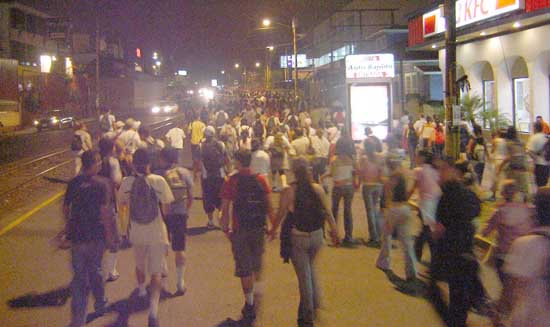
still to go Even Tuesday night the streets were full of pilgrims on their way to Cartago. This shot was taken in San Pedro, some 20 kms from the Basilical de Nuestra Señora de los Ángeles. |
| Nation recovering from mostly crime free pilgrimage |
|
|
By the A.M. Costa Rica staff
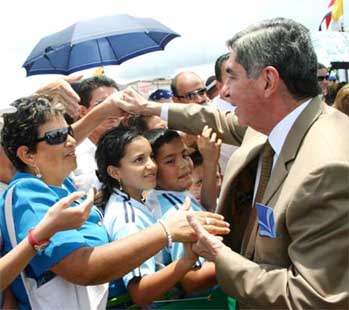
The great annual pilgrimage concluded Wednesday, and tired, foot sore faithful returned to their homes. The Fuerza Pública is taking credit for a mostly crime-free event that spanned five days. Only two crimes were reported, and those involved were detained. The religious ceremony Wednesday took place under the shadow of war in the Middle East. Both President Óscar Arias Sánchez and church speakers agreed on the need to eliminate violence and foment tolerance. "Don't permit, Señora, Costa Rica to be a land of raised ramparts for the word of hatred," said Arias in his public prayer to the Virgen de los Ángeles, the patroness of the nation. "Don't permit that insults be the weapons of our own annihilation." The ceremony at the Basílica de la Virgen de los Angeles in Cartago was attended by many in government, including ministers and members of the Asamblea Legislativa. José R. Barquero, bishop of Alajuela, said that there was a new mentality afoot, a new culture with many |
 Casa Presidencial photo
President Óscar Arias Sánchez was highly popular
with those at the Cartago ceremony.signs of death. The statements from the churchmen were interpreted as being against same sex matrimony, in vitro fertilization and experiments with stem cells. Arias repeated his call for an immediate and effective cease-fire in the Middle East, and asked the Virgin to help the country to battle poverty and intolerance. |
|
||||
 |
|
|
|
|
Fourth news page |
|
|
|
|
|
|
|
|
| San José,
Costa Rica, Thursday, Aug. 3, 2006, Vol. 6, No. 153 |
||||||
 |
| Political pundits try to figure out who is Raúl Castro |
|||
|
By the A.M. Costa Rica wire services
In Cuba, Vice President Raul Castro has maintained a low profile since assuming executive authority while his older brother, Fidel, recovers from intestinal surgery. Cuban officials insist the transfer of power is only temporary, but many Cuba-watchers see the exercise as a dress rehearsal for the eventual permanent passing of the reins to Raul Castro, Fidel's designated successor. Just how Raul Castro would lead, and where he would take the country is an open question. For decades, Raúl Castro has lived in the shadows of the charismatic Fidel. The two brothers have been virtually inseparable since childhood. They plotted together in a failed coup attempt in 1953, after which they both went to prison. They departed for México on their release, and later fought together in Cuba's 1959 Communist takeover. Commonly viewed as Fidel's right-hand man, Raul has served in a variety of high-ranking government posts, including vice president and defense minister. Raúl, 75, is now the focus of attention, yet shows no eagerness to step into the limelight during the temporary transfer of power. A former chief of the U.S. Interests Section in Havana, Wayne Smith now heads the Cuba program at the Center for International Policy in Washington. Smith, who continues to visit the island as a researcher and has met both Fidel and Raúl on numerous occasions, says the brothers are very different people. "Raúl has always been thought of as a rather dour, not terribly imaginative, not charismatic like his brother, which is true enough," said Mr. Smith. "But Raúl Castro does have a sense of humor. He is pragmatic, and, as a matter of fact, I think Raúl will be much more open to a relationship with the United States, and an opening to the rest of the world than was his brother." Cuba-watchers note that Raúl Castro has carried out some of Fidel's harshest orders, including crackdowns on dissidents on the island. Yet it was |
Raúl who successfully argued for limited economic liberalization in the
1990s after the collapse of the Soviet Union, famously noting at the
time that "beans are more important than bullets." More recently, when
asked what will transpire after his
brother's death,
"Whatever one might say about Fidel, Raúl is not up to the evil genius qualities that his brother has. It is very unlikely that General Castro will be able, for any length of time, to keep control of Cuba," he explained. Calzón notes that other, younger members of Cuba's Communist hierarchy likely harbor ambitions of leadership. Some Cuba-watchers say a newly-inaugurated Raúl Castro may be tempted, at least initially, to rule with an iron fist to demonstrate his authority and intimidate potential rivals. But just what will happen is open to debate. In fact, given that Fidel Castro is only four years Raúl's senior, should he recover fully from his current ailment, there is the possibility that the president could outlive his brother. In Washington, the Bush administration is taking a wait-and-see approach, especially during the current temporary transfer of power in Havana. State Department spokesman Sean McCormack. "The fact of the matter is, this is a pretty closed decision-making circle," he said. "And it is very opaque as to what is actually going on." McCormack adds, however, that the United States stands willing to aid Cuba in a transition to democracy if and when the people demonstrate their desire for change. |
||
| Democracy means trade and investment, U.S. Commerce chief says |
|
|
Special to A.M. Costa Rica
Because Latin America is primarily democratic, the region tends to be "pro-market, pro-trade, pro-investment," and enjoys strong trade relations with the United States, said U.S. Commerce Secretary Carlos Gutiérrez. Briefing reporters Tuesday, Gutiérrez described his recent visit to Perú, where he attended the inauguration of Peruvian President Alan Garcia, and offered his perspective on the U.S.-Latin America trade agenda. On the economic front, "I believe that we are more aligned than ever before with Latin America at large," he said. Gutiérrez told reporters that the region recognizes the need to reinforce the rule of law, and increasingly is committed to transparency in regulations and government actions. Adherence to those concepts will enhance Latin America's investment climate, and the region generally has embraced them, he added. The United States remains actively engaged with its neighbors in pursuit of trade agreements, both bilateral and multilateral, that will benefit the region as a whole, said Gutiérrez. He said U.S. Trade Representative Susan Schwab recently returned from Brazil, after consulting with Brazilian trade experts about reviving World Trade Organization talks. U.S. |
officials also are holding discussions with their counterparts in Panamá to achieve a free-trade agreement, he said. The United States has already established a trade agreement with Chile, "and it is doing exceptionally well," Gutiérrez observed. Similarly, "we've just negotiated a free-trade agreement with Perú, and we believe that that will do extremely well," he said. It is no coincidence that these countries have democratically elected governments and as such, "they believe in trade; they believe in investment; they believe in free enterprise," he said. By the same token, he said, "we do $39 billion of two-way trade with Brazil, and we believe we can do a lot more." Asked whether the United States is concerned about a shift towards left-of-center policies in some parts of Latin America, Gutiérrez said: "By and large, there may be tactical differences here and there, but fundamentally I believe that we have alignment" on the most important issues. Overall, there is a broad consensus on the necessary foundation for long-term prosperity: "It's democracy; it's trade; it's business, investment, social justice," he said. "Those are the fundamental aspects that really count, and that's where we have great, great consistency with the beliefs in Latin America today." |
| News from the BBC up to the minute |
BBC sports news up to the minute |
| BBC news and sports feeds are deactivated in the archives pages |
|
 |
 |
|
|
|
|
|
|
|
|
| What we published this week: | Monday | Tuesday | Wednesday | Thursday | Friday | Earlier |
|
|