|
 mmmm
|
Your daily
English-language |
 |
|
|
|
|
|
|
|
|
|
|
|
|
||||||||||||||
|

|
||||||||||||||
|
Second news page |
 |
|
|
|
|
|
|
|
|
|
|
 |
| Costa Rica Expertise Ltd http://crexpertise.com E-mail info@crexpertise.com Tel:506-256-8585 Fax:506-256-7575 |
 |

|
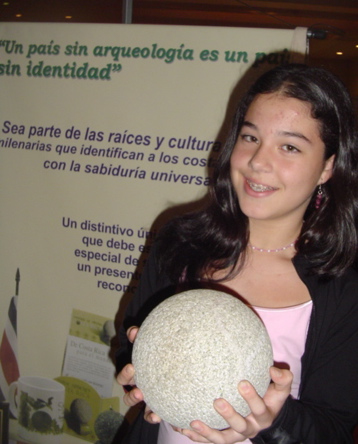 A.M. Costa Rica photo
The mysterious prehistoric stone spheres of southwestern Costa
Rica are now being replicated as tourist items. Natalia Sojo
Rodríguez, a participant at an exhibition of Osa Peninsula
tourism businesses, shows off one produced by Stonespherescr.com,
her parents' company. With a stand and a plaque they
make great presentation items, they said.Patrols downtown
will be beefed up By the A.M. Costa Rica staff
Tourists in San José may walk a little easier down Avenida Central. Edward Guzmán, head of the metropolitan Fuerza Pública, said that starting today, the agency will put an additional 45 plainclothes and 40 uniformed officers on the street to augment the force already on patrol. In addition Guzmán said that 120 students are in the police academy and will be ready for service Aug. 11. Guzmán said that the police officers already on the street have been a “good force,” in diminishing the number of violent crimes in the heart of San José, but it is of vital importance that the city feel safe. He added that although the citizen perception of security in the capital is negative, the crime level in San José has actually diminished since last year. One of the reasons for the extra eyes, Guzmán said, is the growing number of tourists who visit the capital each year. Costa Rica generally has two high-traffic tourist seasons. The first is during the December and January holidays when rain here is scarce. The other tourist season happens when schools in the States let out for the summer. That season is well underway and may be one of the reasons for the extra officers. Pilot's body recovered from ocean at Flamingo By the A.M. Costa Rica staff
Rescue workers recovered the body of Greg Gund Sunday and plan to continue searching for two elementary school students who died in the same plane crash. Gund, a Pacific coast resident, was the pilot of a single-engine plane that crashed into the sea about a mile west of Flamingo Saturday morning. The crash was described in detail in a Saturday A.M. Costa Rica article. Still missing are Justin Ruetz and Jack Ruetz, both young Flamingo residents who are presumed to have died with their mother, Cindy, in the crash. Her body as well as those of visiting California resident Connor Kells and his son Paul have been recovered. Gund is the son of George Gund III, former owner and now minority shareholder of the San Diego Sharks NHL franchise, according to the Cleveland Plain Dealer newspaper. The family continues to run the Cleveland-based George Gund Foundation, which benefits innovative area charities, the newspaper said. Greg Gund was a former building services coordinator for the Sharks, holding that position as recently as the 2001-2002 season, said the San Jose Mercury News in the city where the team is located. Greg Gund was pinned in the wreckage of the plane and was not extracated until local fishermen used a boom and winch to pull the body of the plane from the estimated 100-foot depth. Rescue workers will conduct an extensive search today for the bodies of the boys. The crash took place during a pleasure flight near the Pacific coast community. The plane went in the sea near Isla Plata. Opinion from a reader after four years here Dear A.M. Costa Rica: I have lived in Panamá for the past five-plus years, having moved here from four somewhat miserable years in Costa Rica (I guess I’m a slow learner). Dealing with ICE (6 months or longer to get a phone and a year or longer for a cell phone), RACSA (among the highest cost and least reliable internet connections in the world including Bangladesh), ICE with constant power failures, whatever the water company is called, providing minimal or no water from 9 a.m. to 5 p.m. for weeks on end – in Rohrmoser yet; and waiting over a year for a claim from your lovely and inefficient insurance monopoly was just too much! Combine this with crime in and outside San Jose as well as many Ticos' Xenophobic attitude and you can see why more people are leaving CR. Give us a break Alan [Bollinger], I think you are confusing the service and costs in Maui with those in Panamá. One can go into any of a dozen locations in Panama City alone and walk out with a working cell phone in less than an hour. We have a choice of cell phone providers, i.e. competition. A hard line takes 24 to 48 hours from the time the order is placed to the installation, including high speed internet at a cost less than CR. I can call the US 24/7 for 11 cents a minute using my phone (less in off-peak time); how much is it now in CR? In Panama City alone there well are over 100,000 people connected to high speed internet which is available throughout the country. Internet is also available from multiple sources, i.e. competition. How many are in Costa Rica outside San José? Panamá sits on the cross between all five Internet cables with the most rapid connections worldwide. I have hardly ever had a power failure except during a major storm or when someone knocks down a pole and never for more then 30 to 45 minutes. The water has never been shut off! Panamá is rated in the category of the safest cities in all Latin America by Pinkertons and the people here are very glad to have us as residents and visitors. William Schroff
Pamamá |
|
|
with the observations of Dr. Lenny Karpman Click HERE! |
 |
 |
| A saying for when a little is all you really need |
|||
| Poquito porque es
bendito “Just a little because it’s a blessing.” You might use this dicho when someone gives you — let’s say — a half cup of coffee rather than a full one, or a tiny sliver of cake. People sometimes give you so little in order to ensure you’ll ask for more. My grandmother was famous for this. She used to make an arroz con leche (rice pudding) that was absolutely out of this world, but her servings were miniscule. This guaranteed that we kids would always ask for more, to which her reply was always "Poquito porque es bendito." She wanted us to beg, which, of course, we always did. Most of us know the experience of having something and still wanting more. But sometimes if we get all we want then the desire isn’t there anymore and we end up feeling unsatisfied. Some people have this relationship with money. They never feel they have enough. Though money can indeed solve a multitude of problems, it can also be a false security blanket. I have a friend who bought a very expensive luxury car. One day, after church, she returned to the parking lot only to discover that someone else admired her beautiful automobile as well. They’d stolen it! Of course it was a terrible thing. My friend was very proud of her fancy car, and she was distraught for weeks after its disappearance. Sometimes poquito porque es bendito can mean: “Let’s not go to extremes. Is it really necessary to buy the most expensive car on the lot just because we can afford it?” As children, my brothers and sisters and I always had pets, sometimes too many pets: parrots, cats, dogs, horses and once even a pig. But I want to tell you a story about our little dog. When we were about 7 years old, my twin brother and I had a dog named Duque. He was our near-constant companion, we played with him, cared for him, fed and bathed him. One day when we got home from school Duque was nowhere to be found. We searched the neighborhood high and low, but our beloved pet had vanished. We fretted and fretted over his disappearance until finally my poor father went looking for Duque all around our end of town. He called the neighbors. He put up signs. He offered a reward. But, all to no avail. Duque appeared to have been spirited off by aliens to some distant corner of the universe. Then one Sunday afternoon a few weeks later I was walking with my father through La Plaza when lo and behold there was our wayward dog! I ran to him calling “Duque! Duque!” The dog came running, |
My father asked him if he found the dog a few weeks ago, and
the man
said yes. My father tried to explain that he was our dog, but the man
said he found the dog and it was his now. My father looked at me, my
eyes wide and brimming with tears. He offered the man money for Duque,
but the man refused saying he’d given the dog to his son and wasn’t
going to hurt the boy’s feelings. |
||
| A quick vocabulary lesson for the fútbol-inclined |
|
|
By Garrett Olney*
Special to A.M. Costa Rica One of the most exciting aspects of life in Latin America or Europe for that matter is soccer. I have recently become a soccer fan. My knowledge of Spanish is quite limited, and sometimes soccer games, such as the recent Costa Rica-U.S. game, are only shown (here in the States) on Spanish-speaking television. So, in a gesture of public service, I submit the following to help out English speaking soccer fans who find themselves watching the game with Spanish-speaking commentators. I apologize in advance for the errors. Soccer (fútbol) is a game (partido) which is played on a field (cancha) in a stadium (estadio) with a ball (pelota) and two teams (equipos). The players (jugadores) include forwards (delanteros), mid-fielders (mediocampistas), defenders (defensores) and a goalkeeper (portero, guardameta, arquero, or goleador). The players kick (patear) the ball from the field (tiro) or the corner (tiro de esquina). Sometimes a player commits a foul (falta) and might even get |
yellow-carded (amonestado)
or red-carded (expulsado). Sometimes one offensive player will be offsides (fuera de lugar) in which case the referee (arbitrar) will stop play. A team scores (anotar) by kicking the ball into the goal (arco). Frequently, a game goes into stoppage time (prorroga). The team with the most points is the winner (ganador) and the other is of course the loser (perdedor) unless there's a tie (empate). If one team badly defeats another, it's a rout (derrota). Regardless of which team scores, it is incumbent upon the announcer to shout loudly and repeatedly "Goal!" (gol), making the word extend 5 to 10 seconds in length. Hopefully, the above translations may be helpful in picking up the gist of the announcer’s play-by-play. The unwritten rule seems to be that no matter how slow the game might be, the announcer must deliver his commentary in a breathless, over-excited fashion at machine-gun speed. Happy soccer-watching, fellow fans! *Garrett Olney is a reader from Quincy, Calif. |
|
||||
| When that table game from the bar becomes serious |
|
|
By the A.M. Costa Rica staff
It looked like the end of a local soccer match. The guys lounged in the lobby of the Ambassador Hotel Sunday were downing water and beer while they wiped the sweat off their foreheads. Some were still panting. Just what this bunch was doing in the lobby of a hotel on Paseo Colon was not immediately discernible. It turns out that foosball, or “mini-fut” as Ticos call it, is a big deal here. Players in the Costa Rica national foosball tournament were competing for just over $3,600 in prize money. Many would consider it a bar game, something to curse over with your buddies and play one-handed around the table while nursing a beer. But darts and pool are also bar games. However, they're also internationally recognized sports, and tournaments in those sports are broadcast on television. So why not mini-fut? Here's how it works: The game can be played with two or four players. Each side has a team of plastic soccer players attached to four separate tubes that the live players can rotate to shoot and manipulate side to side to block or pass. A typical bar game usually features each player spinning his players like mad hoping to coax a ball in. Basically, It's pretty simple, but the United States Table Soccer Association's official rules of play are over twice as long as the United States Constitution. At the tournament on Sunday, players were explaining game philosophy to each other and passing the ball forward through their ranks with fake outs and quick touches. When they did shoot, it was with a quick flip of the wrist. These shots went off so fast that they were impossible to see. You could tell if a player scored only by the satisfying thunk as the ball smacked the back of the goal. By the end of their matches, many players were drenched in sweat. One of these players, Juan Flores, 18, was playing for his first time. He practicied with a buddy before |
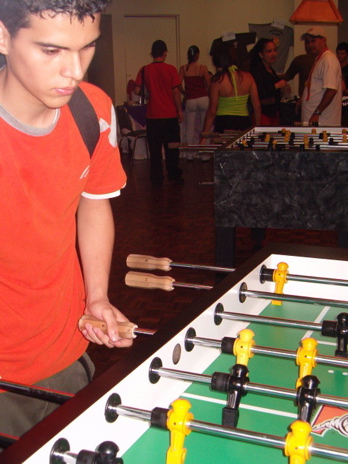 A.M.
Costa Rica/Jesse Froehling
Juan Flores in his first tournament
his match. Fortunately for him and others, there was a novice category. The tournament started Saturday with at least 120 players in different divisions. By Sunday afternoon, the rookie singles and doubles divisions had been decided except for the final. The singles open division – the one with the most prize money – was in full swing. The finals for that division were at 8:30 Sunday night. The open singles division cost 4,000 colons (just over $8) to enter. First place takes home 150,000 colons ($313), second place gets 100,000 colons ($208), third 60,000 ($125) , fourth 40,000 ($83), fifth, 30,000 ($62) and sixth 20,000 ($42). |
| Bush stresses free trade bill in talks over the weekend |
|
|
Special to A.M. Costa Rica
The proposed U.S.-Central America free trade agreement will help stabilize young democracies by boosting job growth in those countries while also expanding business opportunities in the United States, President George Bush said Friday. The U.S. president kicked off a weekend of promoting the measure that soon will face a critical vote in the U.S. House of Representatives. Saturday in his weekly radio address Bush called on the House to "follow the Senate's lead by approving the Central American and Dominican Republic Free Trade Agreement." Friday before an audience in North Carolina, Bush described the expected benefits of the pact known as CAFTA, which he said, "will help advance a key part of our foreign policy." The agreement is designed to eliminate or severely reduce trade barriers between the signatory countries, thereby enhancing the region's competitiveness in the global economy and laying the foundation for long-term prosperity, Bush explained. And because it will help struggling democracies "deliver a better life to their own citizens," the pact also will assist regional governments in defeating domestic elements that seek to undermine democratic and economic reforms, he explained. |
The agreement includes
Guatemala, Honduras and El Salvador, three
countries that already have ratified it, and Costa Rica, Nicaragua and
the island nation of the Dominican Republic. In Costa Rica Sunday
President Abel Pacheco empaneled a group of five “notables”
including
former U.S. astronaut Franklin Chang Díaz, who have been asked
to
estimate the impact of the measure. Pacheco has not yet sent the
document to the Asamblea Legislative for discussion and a ratification
vote. The Spanish word notables can best be translated as
learned
people. The United States has a stake in helping young democracies develop, Bush said Friday. CAFTA aims to reduce poverty and, as incomes rise throughout the region, "it will help create a vibrant middle class" that buys more U.S. products, he argued. The pact almost certainly will help reduce illegal immigration as well, since rising regional growth "will mean somebody is more likely to find a job close to home" than attempt to enter the United States illegally, Bush observed. In short, CAFTA is more than just a trade bill: it is an important foreign-policy tool that will "help stabilize democracies" and "will help our friends grow and prosper," the president said. "I'm calling on the Congress to pass CAFTA," he said. "It's a pro-jobs bill. It's a pro-growth bill. It's a pro-democracy bill. We cannot turn our backs on our friends." |
|
|
|
|
|
|
|
|
| What we published this week: | Monday | Tuesday | Wednesday | Thursday | Friday | Earlier |
|
|