|
| |
Your daily |
 |
|
|
|
|
|||||||||||||
|
|
|||||||||||||
 |
|
|
|
|
|
|
|
|
| What we published this week: | Monday | Tuesday | Wednesday | Thursday | Friday | Earlier |
|
|
 |
| A.M. Costa Rica Second newspage |
 |
||||||||
| Home |
Tourism |
Calendar |
Classifieds |
Entertainment |
Real
estate |
Rentals |
Sports |
About us |
|
|
|
|||||||||
 |
| Costa Rica Expertise Ltd http://crexpertise.com E-mail info@crexpertise.com Tel:506-256-8585 Fax:506-256-7575 |
 |

Click HERE for
great
hotel discounts
|
|
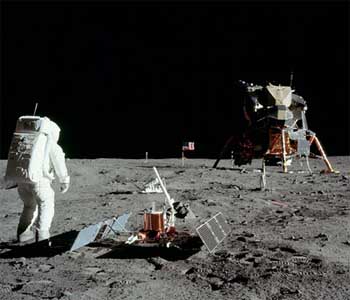 Neil Armstrong/NASA photo
Buzz Aldrin installs seismic detectors on
the moon
It takes a Hollywood firm
to restore Apollo 11 footage By the A.M. Costa Rica wire services
Exactly 40 years to the day after Apollo 11 astronauts blasted off on the way to their historic first moon landing, NASA previewed restored video of the first moon walk. The enhanced images are a dramatic improvement over the pictures seen by hundreds of millions around the world when they were broadcast live from the moon. On his way to being the first man to set foot on the moon, Neil Armstrong opened a door on the lunar landing craft that had a small television camera attached. The camera swung out, giving a worldwide audience its first look at — well, it was actually hard to tell at first. "The camera worked, but what we saw at that point was rather disturbing, because it was not what we had simulated, and we knew we had a problem," said Stan Lebar, who helped develop that camera, a three-kilogram marvel of its day. But the signal it transmitted from the moon was lower quality than regular television, so it had to be converted to broadcast standards before it could be seen around the world. To convert it, technicians aimed a regular TV camera at a monitor showing the moon pictures, but NASA's Richard Nafzger says the converter was hard to adjust exactly right. "Some of the degradation that you saw was not necessary. It was some operator error, some setup error. So degradation would occur by conversion, but in order to get live TV from the moon, when everything was set perfect, it was certainly acceptable for an historic event. And that was the goal, and that's what we did." The raw television signals from the moon were recorded, along with voice communication and other data, on 14-track magnetic tape, and they went into storage, along with hundreds of thousands of other reels of tape containing data from satellites and other spacecraft. Modern digital imaging technology could probably do a better job upgrading the historic moon video, if technicians could get their hands on the original tape. Trouble is, several years ago, NASA realized the tapes were missing. Nafzger headed a team to find the missing tapes, 45 reels out of hundreds of thousands of tapes with Apollo data. They ultimately concluded the tapes had been erased and reused to record data from later space programs. "The records clearly showed that there's an inescapable conclusion that this team has reached, and that is that these 45 tapes were included in the several hundred thousand that were pulled out, recertified, degaussed, and put back into the network." Nafzger's team scoured archives in and out of NASA — as far afield as Australia, in fact, where giant satellite dishes had captured Apollo's transmissions. "We acquired what we considered the best available broadcast. We had tapes recorded in Sydney, Australia, during the mission." He and a colleague found kinescopes at the National Archives that had not been viewed in 36 years, that were made in Houston. "And we found tapes that were fed directly from Houston to CBS, the raw data as recorded and archived." Then NASA took their films and tapes to Hollywood and a company called Lowry Digital. "We're probably the most prolific digital restoration house in the world," said company president Mike Inchalik, "having restored everything from "Casablanca" and "Singing in the Rain" and "The Robe" all the way up through the James Bond movies . . . ." Inchalik said the collection of miscellaneous bits of Apollo 11 video is exactly the sort of scenario they're used to dealing with in restoring Hollywood movies. "The studios, the television broadcasters, routinely scour the earth to find the best surviving elements. And we are very often in the business of having to put together that patchwork, if you will, of material, and make it into a seamless, finished piece of material." Seen side by side, the restored images look dramatically better, with more detail in the shadows and fewer artifacts of the video's 400,000-kilometer transmission path. The result can be seen on the NASA Web site. And NASA officials stress that this is just a partial restoration. The $230,000 project is still in progress, with the final version of the restored Apollo 11 TV pictures from the moon set to be released in September. Another border problem surfaces in northern zone By the A.M. Costa Rica staff
With the focus on Costa Rica's northern boundary due to a World Court ruling, another problem is being raised by the Defensoría de los Habitantes The national border in one section in the Canton de Upala is incorrectly marked, according to the defensora, Lisbeth Quesada, and the boundary should be renegotiated. The problem is that some traditionally Costa Rican land now appears to be in Nicaragua due to errors made in 1994 when boundary markers were placed by the Instituto Geográfico Nacional and the Nicaragüense de Estudios Territoriales. Because of the uncertainty some landowners cannot get credit. The national boundary is not the Río San Juan but the south bank of the river. A dispute over free passage on the river was resolved in Costa Rica's favor Monday by the International Court at the Hague. But the current problem was not involved in that case. In the disputed point the border is supposed to be two miles from the bank of Lake Nicaragua, but the measurement might be off a half mile. The Defensoría inspected the area in April. The agency issued a statement Thursday. Museum offers three more vacation workshops for kids By the A.M. Costa Rica staff
The health ministry has ordered a week more of midyear vacation for school children to counter the spread of the swine flu, so the Museo Nacional is increasing its schedule of workshops for the vacation period. In one free workshop next week, children will learn how the early residents of Costa Rica worked with gold and jade. Another workshop explores nature with the help of the museum's botanic garden. The third workshop addresses the boyero and the carreta con bueyes, the traditional oxcart and driver. Details are on the museum Web site. Activists blame Putin for death of journalist By the A.M. Costa Rica wire services
Russian activists are blaming Prime Minister Vladimir Putin for maintaining a climate that resulted in Wednesday's murder in the Caucasus of journalist Natalya Estemirova. Her colleagues from the Memorial human rights organization and other groups told a Moscow news conference that Putin's protégé in Chechnya, Ramzan Kadyrov, is specifically responsible for Estemirova's death. Memorial chairman Oleg Orlov called Natalya Estemirova the soul of the organization; a journalist dedicated to uncovering widespread criminality in Chechnya. Orlov accuses Chechen President Kadyrov of responsibility for her death. Kadyrov was hand-picked by Putin. Orlov says he thinks responsibility for an atmosphere of permissiveness and impunity in Chechnya as well as massive and serious crimes committed by government representatives lies with Russia's current and recent senior leaders, including Putin and President Dimitri Medvedev. Kadyrov says the killers will definitely be found and punished. Kadyrov acknowledges Ms. Estemirova was kidnapped in downtown Grozny, the Chechen capital. Human rights activists note this as well, but add that her body was found in neighboring Ingushetia. They also ask how it could have been transported without official cover through many checkpoints in the volatile region.
|
|||||||||||||||||||||||||||||||||||||||||||||||||||||||||||||||||
 |
||||||||||||||||||||||||||||||||||||||||||||||||||||||||||||||||||
| Home |
Tourism |
Place
classified ad |
Classifieds |
Entertainment |
Real estate |
Rentals |
Sports |
About us |
|
| What we published this week: | Monday | Tuesday | Wednesday | Thursday | Friday | Earlier |
| The contents of this page and this Web site are copyrighted by Consultantes Río Colorado 2001, 2002, 2003, 2004, 2005, 2006, 2007 and 2008 and may not be reproduced anywhere without permission. Abstracts and fair use are permitted. Check HERE for details | ||||||
 |
| A.M. Costa Rica third newspage |
 |
||||||||
| Home |
Tourism |
Calendar |
Classifieds |
Entertainment |
Real
estate |
Rentals |
Sports |
About us |
|
|
|
|||||||||
 |
 |
|
Former telephone monopoly not
generous to new arrivals
|
|
|
By Dennis Rogers
Special to A.M. Costa Rica Costa Rica’s incumbent telephone operator is resorting to all sorts of legal mechanisms to stymie the entrance of competitors big and small. Nonetheless the telecommunications regulator has authorized the first telephone and Internet operators. June 23 marked the end of the monopoly with the approval of six firms which intend to provide various services. After the cable television operator Amnet, these are minor companies which intend to offer Internet connections and IP international phone services. The biggest stakes will be the arrival of competition in cell phones. This still requires a spectrum auction. A regulator report on spectrum use recommends that the incumbent Instituto Costarricense de Electricidad optimize its operations to free up space, especially in the desirable 850 MHz band. “ICE is not going to leave the 800 band to make space for competitors,” declared Pablo Pedro Quirós, the former monopoly's general manager. It plans to put the next set of 950,000 lines it’s purchasing on those frequencies. Much of the band is presently occupied by a TDMA system set to be phased out this year. The new system will make it even harder to get bandwidth away from the company, as recommended by the report. Overall, the government company has concessions to 78 percent of commercial spectrum, most of it unused or used inefficiently. As the Instituto Costarricense de Electricidad, known as ICE, is the main electricity distributor for the country, it has also instructed subsidiary Fuerza y Luz to obstruct cable television companies’ use of power poles. Two small electric co-ops elsewhere in the country have already been fined for refusing access to their posts, apparently anticipating the opportunity to offer Internet and television services. The Cartago-area distributor Junta Administrativa del Servicio Eléctrico de Cartago was one of the first entities approved to sell Internet service, over the objections of ICE, even though the Cartago company expressed an interest in distributing ICE’s Internet product. ICE resorted to a financial weapon when it refused to turn over a tax it had collected over the last trimester of 2008 and the first of 2009. This money corresponds to a tax on Internet and telephone service, and is part of the approved tariff, not a tax on ICE itself. The amount was about $850,000, and the telephone regulator nearly shut down, unable to pay salaries. ICE’s lawyers alleged that it was not authorized to pay the new Superintendencia de Telecomunicaciones rather than the regulator originally charged with telecoms. Following a series of court orders, ICE quickly turned over the money. |
ICE
also took action against Superintendencia President George Miley after
he gave an interview to La Nación describing ICE’s
reactions as those of an eldest child when the new baby comes home: “He
throws a tantrum, falls on the floor . . . .” As for attacks from ICE
questioning the impartiality of the Superintendencia’s earliest
decisions, “we see it like the kid: if you pay attention he will only
do it more.” ICE responded by demanding that Miley be recused from any
decision related to the company. At the time ICE had attempted to raise
telephone rates unilaterally alleging it was free to do so with the
opening of the monopoly. In an op-ed piece ostensibly written by Quirós, in reply to a news story with a similar litany of accusations, he declared “ICE will maintain its leadership, and a leader doesn’t surrender or let itself be beaten, but fights until its last breath.” So far the approved companies are: • Dodona SRL, which is now doing business as Amnet offers cable Internet connections and seeks to provide transmission of data, voice-over-Internet, access to information webs, and value-added services like video conferencing and television by subscription; • Intertel Worldwide S.A., which seeks to provide prepaid public telephone service using the Internet; • R&H International Telecom Services S.A., which seeks to provide voice-over-Internet services for homes and businesses; • Worldcom de Costa Rica S.A., which seeks to provide wireless Internet connections and by land line, voice-over-Internet and corporate networks; • Callmyway NY S.A., which seeks to provide many types of communication services; and • Redes Inalámbricas de Costa Rica S.A., which seeks to provide corporate networks with wireless technology. Amnet has said it would offer its own Internet services to its customers and cut out Radiográfica Costarricense S.A., known as RACSA, an ICE subsidiary set up for Internet use. ICE itself wants to strip RACSA of its Internet customers in favor of its own. However, RACSA vowed this week to continue offering service even if Amnet jumps ship. The television cable company provides a link between users and the RACSA computers. RACSA said it might run its own lines, use radio signals or rent cable space from Amnet. The Amnet contract runs until the end of the year. |
| Sometimes readers take issue with opinions expressed here |
|||
| Long-time
reader Ruel suggested some time ago that I publish some of the comments
that I get. There were quite a few responses to my last column on
contented Costa Ricans. Most were from expats who live here and
agreed with me, and I even got an e-mail from a happy Tico. However, not everyone was pleased with what I wrote. One unhappy expat is miserable and blames my overly rose-colored columns for luring him. And two Americans – both males – wrote saying very similar things about the absence of a military. Forest said “One thing that bothers me about your reasoning for moving to CR is because you 'wanted to live in a country that had no military.’ You are not so naïve as to think Costa Rica does not rely upon the U.S. military for its defense, are you? If any country were to threaten Costa Rica’s borders, exactly what do you think would happen? Why do you think it is now able to maintain neutral in the midst of neighboring Latin American country’s turmoil?” It is true that since World War II, the U.S. has used its military force in Guatemala, the Dominican Republic, Nicaragua, Panama, and Chile, and has had a presence in Honduras, El Salvador, Ecuador and Colombia. But necessarily to protect their borders. Since the 1948 dispersal of its military, there have been two attempted invasions of Costa Rica – both from Nicaragua. In 1955 former leftist President Rafael Calderón Guardia, exiled in Nicaragua by the Figueres Junta, tried to come back with an army. He was backed by President Somoza of Nicaragua. After Nicaraguan planes strafed San José, Costa Rica appealed to the Organization of American States to allow it to buy war planes. The U.S. then sold four Mustang fighter planes to Costa Rica for $1 each. I don’t know if Costa Rica used the planes, but it managed to repulse Calderon’s counterrevolution with the help of 6,000 volunteers, some of them high school students. In 1978, under longtime dictator Gen. Somoza, Nicaragua again tried to invade Costa Rica. At the time the U.S. was helping Somoza fight off the Sandinistas. The U.S. ambassador in Costa Rica took a telex from President Jimmy Carter to Costa Rican President Anastasio Carazo. President Rodrigo Carazo at first refused to read it. He obviously knew what was in it. The note was not an offer of help, but a warning that Costa Rica should not support the Sandanistas. President Carazo told the ambassador what he could do with the message, and to tell President Carter that Costa Rica would |
not be intimidated by the United States. This
“undeclared war” ended
with Costa Rica still its own master. (The story of this war is told by
Juan José Echeverría Brealey in his book, “La Guerra No
Declarada.”) Mitch goes on to say “Have you ever thought about the mess the
world
would be, with every tin pot dictator running around torturing and
killing a la Saddam in Kuwait, and most of Africa where we have kept
our nose out?” |
||
 |
| You need to see Costa Rican tourism information HERE! |
| Home |
Tourism |
Place
classified ad |
Classifieds |
Entertainment |
Real estate |
Rentals |
Sports |
About us |
|
| What we published this week: | Monday | Tuesday | Wednesday | Thursday | Friday | Earlier |
| The contents of this page and this Web site are copyrighted by Consultantes Río Colorado 2001, 2002, 2003, 2004, 2005, 2006, 2007 and 2008 and may not be reproduced anywhere without permission. Abstracts and fair use are permitted. Check HERE for details | ||||||
| A.M. Costa Rica fourth news page |
 |
||||||||
| Home |
Tourism |
Calendar |
Classifieds |
Entertainment |
Real
estate |
Rentals |
Sports |
About us |
|
|
|
|||||||||
|
New thriller gives a taste of
Costa Rica a decade ago
|
|
|
By the A.M. Costa Rica staff
The country again is featured in a book that focuses on scams. The book is "Dancing with a Chameleon" and the author said that it is a true account with the names of principal characters changed. The author is Peter Russell, who now lives in Australia. Costa Rica is the location when the Russell character chases an elusive individual, the chameleon, who stole $1.4 million from him. Russell said in an e-mail that the book has two story lines that intertwine. The first is chasing the thief through the United States, Europe and the Caribbean to Costa Rica. "The book describes my chase through these countries and then through San José, San Pedro, Cartago to Quepos |
Beach," he said. "A number of
well-known places are featured (although some names have been changed
to protect their privacy.) It's an accurate picture of what CR was like
back in 1999." The second theme is the effort by the Russell character and others to the transfer of some $800 million from an Italian bank into the United States on behalf of an African family who ruled over a West African country from 1962 to 1992, the author said. "These two stories are true," affirmed Russell. "The book moves at a very quick pace where lots of people become involved and lots of problems occur until a resolution is achieved." The publisher is Eloquent Books in New York. |
|
There's so much cocaine that
there's a storage problem
|
|
|
By the A.M. Costa Rica staff
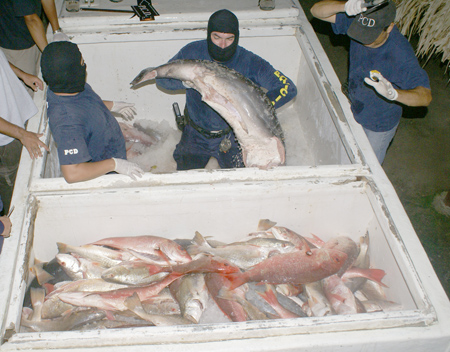
Anti-drug officers are so overloaded with confiscated cocaine that they are seeking legal ways to destroy the drug before the end of the judicial process. The Servicio Nacional de Guardacostas captured a boat with 1,300 kilos of cocaine early Tuesday, and Fuerza Pública officers detained a seafood delivery truck near Golfito Thursday that contained 400 kilos of cocaine, they said. Add to that the nearly 347 kilos of cocaine confiscated after a helicopter crashed carrying a drug load May 1, plus a series of smaller confiscations during the last few months, and secure storage is scarce. Security was a major concern Wednesday in Golfito where four Colombians were arrested with a boat load of packages. Law officers said there were 1,300 kilos (about 2,860 pounds of cocaine) aboard. Still smarting over the robbery of 320 kilos of cocaine from the offices of the prosecutor there early March 26, officials took no chances. The drugs were guarded by two policemen and a watchman when heavily armed men arrived to take the packets. Subsequently, police officers, the watchman and others were detained as officials admitted the job was an inside one. This week more than 100 police officers from elite units traveled to Golfito. The drugs came to San José on the floor of a bus that was manned by rifle-wielding officers. The convoy even had protection from security ministry aircraft above. Fuerza Pública officers stopped the seafood delivery truck in Río Claro, Golfito. The vehicle had a large cooler on board containing three compartments filled with seafood. The suspected cocaine was under the cooler. |
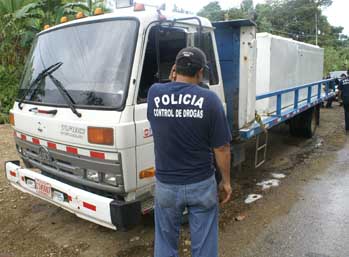 Ministerio de Gobernación,
Policía
y Seguirdad Pública photo Anti-drug officer surveys the seafood
transport that yielded 500 kilos of suspected cocaine.
Officials said they suspected the drugs came from a fastboat that was found abandoned near Playa Pavones. The boat had twin outboards and had exhausted six of seven large fuel containers. The truck driver, a Costa Rican with the last names of Fernández Oviedo, was detained, officials said. Eventually the confiscated drugs will end up in an industrial fire. The only difference is that officials hope to do so long before the judicial process is concluded, which could take two years. That would eliminate the drugs and the temptation and the threat to security. When U.S. Navy boats at sea capture a drug boat and turn the crew and the craft over to Costa Rican officials, sailors usually just provide a small amount of drug for use in the legal process here. The bulk of the illicit cargo goes to the United States for processing and destruction. |
 |
 |
| Home |
Tourism |
Place
classified ad |
Classifieds |
Entertainment |
Real estate |
Rentals |
Sports |
About us |
|
| What we published this week: | Monday | Tuesday | Wednesday | Thursday | Friday | Earlier |
| The contents of this page and this Web site are copyrighted by Consultantes Río Colorado 2001, 2002, 2003, 2004, 2005, 2006, 2007 and 2008 and may not be reproduced anywhere without permission. Abstracts and fair use are permitted. Check HERE for details | ||||||
| A.M. Costa Rica fifth news page |
 |
||||||||
| Home |
Tourism |
Calendar |
Classifieds |
Entertainment |
Real
estate |
Rentals |
Sports |
About us |
|
|
|
|||||||||
 |
| More tourists
expected at Guayabo monument By the A.M. Costa Rica staff
Those connected with the Monumento Nacional Guayabo expect an increase in tourism now that the pre-Columbian city has been designated an engineering masterpiece. The Asociación de Guías Locales U- SERE has received official recognition. This is a group of some 22 bilingual experts who offer their services to visiting tourists. They are receiving advanced training in English and in the history of the archaeological site. Only four hectares (nine acres) of the 20-hectare *50-acre) site have been excavated. The impressive waterworks and draining systems that still function were enough to win the creators of the city international recognition. The site became a national monument in 1973. It is on the slopes of the Turrialba volcano and was occupied from 1000 to about 1400 by a native Costa Rican culture that extended to other parts of the Central Valley. Heredia pianist captures prestigious music award Special to A.M. Costa Rica
Jonathan Duarte, the 16-year-old pianist, has been awarded first place in the Intermediate Division of the prestigious Interlochen Concerto Competition. The Interlochen Arts Camp in Michigan is the world’s premier summer arts program for aspiring young artists. The camp attracts approximately 3,000 students, faculty and staff from all 50 U.S. states and more than 40 countries. Approximately 10 percent of the nation’s professional orchestra musicians have roots at Interlochen, and the alumni community has received 89 Grammy Awards. According to a camp instructor, young Duarte was awarded first place for the quality of his performance of an advanced piece, and his degree of musicality. He performed Sergey Prokofiev Concerto No. 1 in D flat major, Opus 10. The Canadian-Costa Rican youth is a student of the Instituto Superior de Artes and the Universidad Nacional, under the direction of Dr. Alexandr Sklioutovski. Only a few weeks ago, young Duarte, along with other Interlochen students, performed at the prestigious Carnegie Hall in New York. The youth, who lives in Heredia, will perform his winning piece with the Interlochen Philharmonic Sunday at 3:00 p.m. at the Interlochen Camp. Refinery construction pact revised to favor Recope By the A.M. Costa Rica staff
Central government officials have signed an addendum to an agreement with the Chinese government petroleum company stating that Costa Rica's petroleum monopoly will not be eroded. The agreement with the China National Petroleum Corporation International came after the Contraloría de la República questioned some aspects of the original agreement. The Chinese are expected to invest up to $1 billion over four years to enlarge and modernize the refinery in Moín. The Refinadora Costarricense de Petróleo, known as Recope, will continue to run the plant. Government officials hope that the project will provide jobs for from 1,000 to 1,500 more workers. |
|
| Home |
Tourism |
Place
classified ad |
Classifieds |
Entertainment |
Real estate |
Rentals |
Sports |
About us |
|
| What we published this week: | Monday | Tuesday | Wednesday | Thursday | Friday | Earlier |
| The contents of this page and this Web site are copyrighted by Consultantes Río Colorado 2001, 2002, 2003, 2004, 2005, 2006, 2007 and 2008 and may not be reproduced anywhere without permission. Abstracts and fair use are permitted. Check HERE for details | ||||||
| A.M. Costa Rica sixth news page |
|
||||||||
| Home |
Tourism |
Calendar |
Classifieds |
Entertainment |
Real
estate |
Rentals |
Sports |
About us |
|
|
|
|||||||||
| Latin
American news digest |
More foreclosures seen for U.S. housing market By the A.M. Costa Rica wire services
Hopes for a quicker economic recovery in the United States are being dashed by the latest information on housing. Data compiled by real estate information services company RealtyTrac warns that about 1.5 million U.S. owners have been told they are in danger of losing their homes. The company Thursday said one in every 84 households got at least one foreclosure notice during the first six months of the year, a new record, despite government efforts to help homeowners. RealtyTrac officials said a growing number of Americans are not able to make monthly home loan payments because they no longer have jobs. Data from the U.S. Labor Department Thursday offered little encouragement. The number of Americans filing for first time unemployment benefits last week fell to the lowest levels since January. But government analysts said the numbers are likely distorted because of the recent upheaval with two of the three top U.S. auto companies. First time claims fell by 47,000 to a nationwide total of 522,000. The number of Americans continuing to file for unemployment insurance also dropped to fewer than 6.3 million from more than 6.9 million the week before. A separate report Thursday by a branch of the U.S. Federal Reserve also gave more grim news, finding a sharp decline in manufacturing for one eastern region of the United States, encompassing the states of Pennsylvania, New Jersey and Delaware. The Fed has said unemployment may peak at more than 10 percent. The most recent data shows the U.S. unemployment rate at 9.5 percent, a 26-year high. During a hearing Thursday, Herbert Allison, the U.S. Treasury assistant secretary for financial stability, told senators the Obama administration was doing everything it could to help distressed homeowners. But he said even if the government's programs were a "total success" millions of people could still lose their homes.. |
Latin
American news feeds are disabled on archived pages.
|
|
| Home |
Tourism |
Place
classified ad |
Classifieds |
Entertainment |
Real estate |
Rentals |
Sports |
About us |
|
| What we published this week: | Monday | Tuesday | Wednesday | Thursday | Friday | Earlier |
| The contents of this page and this Web site are copyrighted by Consultantes Río Colorado 2001, 2002, 2003, 2004, 2005, 2006, 2007 and 2008 and may not be reproduced anywhere without permission. Abstracts and fair use are permitted. Check HERE for details | ||||||