|
| |
Your daily |
 |
|
|
|
|
||||||||||||
|
|
||||||||||||
 |
|
|
|
|
|
|
|
|
| What we published this week: | Monday | Tuesday | Wednesday | Thursday | Friday | Earlier |
|
|
 |
| A.M. Costa Rica Second newspage |
 |
||||||||
| Home |
Tourism |
Calendar |
Classifieds |
Entertainment |
Real
estate |
Rentals |
Sports |
About us |
|
|
|
|||||||||
 |
| Costa Rica Expertise Ltd http://crexpertise.com E-mail info@crexpertise.com Tel:506-256-8585 Fax:506-256-7575 |
 |

Click HERE for
great
hotel discounts
|
|
falling off Flamingo cliff By Valeria Morales Espinoza
of the A.M. Costa Rica staff A 12-year-old U.S. tourist died Tuesday when her quadracycle failed to make a curve and she and the vehicle plunged down an 80-meter (about 260-foot) cliff, said police. The young victim was identified as Brooky Laurence Scaline, said the Policía de Turismo. The accident took place in Flamingo, Santa Cruz Guanacaste. The girl was on vacation in the country with eight more North Americans, police said. They rented the four-wheeled vehicles to take a tour guided by two Costa Ricans, which consisted in passing by a steep and wooded area near the beach, they said. Her inexperience with the vehicle caused her to accelerate to catch up with the group, and the vehicle was unable to navigate a curve, they said. She suffered several fractures all over her body and a blow to the head that caused her death, said Citer Cortés and Juan Carlos Solano of the tourist police. 389 Internet cafes seek OK to offer phone service Special to A.M. Costa Rica
The Costa Rican Superintendencia de Telecomunicaciones has received almost 500 applications for permission to provide services. Anyone who plans to offer voice-over-Internet commercially has to register. Of 497 applications, 389 are for Internet cafes which will usually do little else under telecom laws. George Miley, president of the supervising agency, expressed his pleasure at such interest. “This way telecom services reach the local population. Additionally, incentives for small business and micro enterprise are promoted.” Five more companies have been approved to operate in Costa Rica, according to an agency press release. These are Telecomunicaciones Integrales de Costa Rica, R&H International Telecom Services, Grupo Publicidad e Internet Inc., Credit Card Services, and Inversiones Karl del Este. Few Internet cafes initially applied to the agency, partly because many operators did not know they had to do so and partly because the application process was extensive. The agency has now reduced the application requirements for Internet cafes. Acción Ciudadana seeks maritime law suspension By the A.M. Costa Rica staff
The Partido Acción Ciudadana said Tuesday that it supported those coastal residents whose homes and lands are jeopardized by the maritime law. The political party demanded that the executive branch stop immediately the clearance of coastal dwellings and commercial establishments. It also said it supported a law proposed by members of coastal communities who have banded together to confront legal action against them. The political party was stating a theme that might become important during the presidential election campaigns. Individuals in coastal communities face removal if they have not obtained an official concession for maritime zone land from the local municipality. The maritime zone is considered to be the first 200 meters from the mean high tide line. The first 50 meters are exclusively for the public. The remainder of the land can be allocated to individuals and corporations for development. Many hotels and other tourist operations are located on concession rather than titled land. Many long-time hotels and businesses are located on the forbidden 50-meter zone. But enforcement of the maritime zone law means the destruction of a number of structures. Restaurants and other structures were torn down in Quepos, Tamarindo and other Pacific communities. The residents of Cahuita on the Caribbean coast face a special problem. They were the beneficiaries of a law passed four years ago that allowed them to obtain title to their homes. Many homes predate the 1977 maritime law by as much as 80 years. But the residents never followed the procedure to obtain official title. The law allowed them to do so, but two ex-lawmakers objected and filed suit. The Sala IV constitutional court voided the law. This month there have been clearances of structures in Quepos, and residents in the Cóbano area on the Nicoya Peninsula are protesting similar actions in the coastal communities there, including tourist mecca Montezuma. The Partido Acción Ciudadana said that the original maritime law did not give adequate consideration to the coastal dwellers. It urged the executive branch to respect the human rights of these people. In some cases the destruction of private property on maritime zone land is a matter for the courts or even by the Contraloría de la República, which answers to the legislature. A new law covering the maritime zone might jeopardize the rights of those who already have received concessions after a prolonged legal process. Other political party representatives have given support to the proposed law presented by the Frente Nacional de Comunidades en Extinción. But the legislature moves at its own pace and there is no telling what might be in a new law if it is ever passed. U.S. asks for patience in Honduran crisis By the A.M. Costa Rica wire services
The United States Tuesday said that there should be no artificial deadlines in efforts by Costa Rica President Óscar Arias Sánchez to mediate the Honduran political crisis. Ousted Honduran President Manuel Zelaya said he will quit the talks unless he is reinstated quickly. The Barack Obama administration is standing by its insistence that Zelaya be returned to office as part of any settlement, but it is counseling patience on the part of the deposed president who was ousted in a coup June 28. With U.S. encouragement, Arias, a Nobel Peace Laureate, agreed to mediate the dispute between Zelaya and interim Honduran President Roberto Micheletti, who was installed by the country's congress after the coup. The mediation process began last week when Arias met separately with the two rivals in San José. He has set another round of talks Saturday with representatives of the two sides, but Zelaya said Monday he will abandon the talks if an agreement returning him to power is not reached at that time. At a news briefing here, State Department Spokesman Ian Kelly said the United States continues to support a restoration of democratic order in Honduras that includes Zelaya's return to office but said there should be no time constraints on negotiations. "We think that all parties in the talks should give this process some time," said Ian Kelly. "Don't set any artificial deadlines. Don't say if 'X' doesn't happen by a certain time, then the talks are dead. We have to give the process a chance, and support what President Arias is doing." President Zelaya was arrested by Honduran troops and deported to Costa Rica in the June 28 coup, triggered by his efforts to hold a referendum that could have kept him in office beyond the end of his term in January. Coup supporters said the left-leaning Zelaya sought to violate the country's constitution, and that interim President Micheletti was legally installed. But the United States and the Organization of American States say the coup violated the Inter-American Democratic Charter and Honduras has been suspended from the organization. President Arias, who won the Nobel prize in 1987 for his efforts to resolve Central American civil conflicts, also appealed for additional time Tuesday. He said Zelaya's desire for an early return is understandable but that there must be patience. Zelaya, a political ally of populist Venezuelan President Hugo Chávez, has not said what he will do if his self-described ultimatum for a return to power within a week is not heeded. The interim government in Tegucigalpa has said Zelaya cannot return under any circumstances. Four detained on high seas after another drug chase By the A.M. Costa Rica staff
A U.S. Navy anti-drug patrol spotted and turned into shore a suspected boat load of smugglers, and Costa Rican officials detained them after a chase with boats and a helicopter. Four Colombian citizens were detained and 1,280 kilos of suspect cocaine were confiscated, said the Ministerio de Gobernación, Policía y Seguridad Pública. Officials quickly sent an extra contingent of police south to Golfito to mount guard over the merchandise. This is where five men robbed 320 kilos of cocaine from the courts building. Suspects detained later included policemen and a watchman.
|
||||||||||||||||||||||||||||||||||||||||||||||||||||||||||||||||
 |
|||||||||||||||||||||||||||||||||||||||||||||||||||||||||||||||||
| Home |
Tourism |
Place
classified ad |
Classifieds |
Entertainment |
Real estate |
Rentals |
Sports |
About us |
|
| What we published this week: | Monday | Tuesday | Wednesday | Thursday | Friday | Earlier |
| The contents of this page and this Web site are copyrighted by Consultantes Río Colorado 2001, 2002, 2003, 2004, 2005, 2006, 2007 and 2008 and may not be reproduced anywhere without permission. Abstracts and fair use are permitted. Check HERE for details | ||||||
 |
| A.M. Costa Rica third newspage |
 |
||||||||
| Home |
Tourism |
Calendar |
Classifieds |
Entertainment |
Real
estate |
Rentals |
Sports |
About us |
|
|
|
|||||||||
 |
 A.M. Costa Rica photos/Frank
Stenstrom
Hammerheads, by the hundreds or individually, are the
signature species at Isla del Coco |
|
|
At Isla del Coco, the real
treasure is under the ocean
|
|
|
By Frank Stenstrom
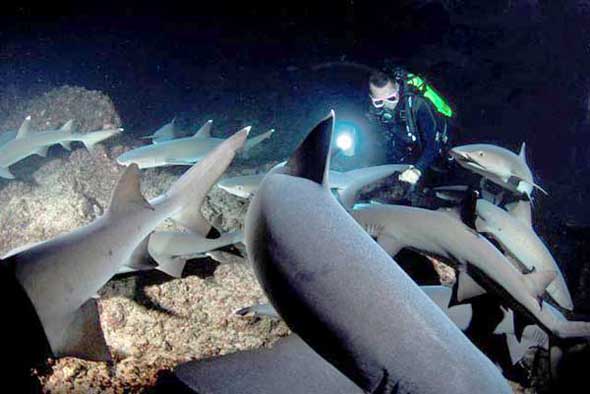
Special to A.M. Costa Rica The first group of hammerhead sharks came straight toward us. They are three to four meters long, and their self-confident approach caused us to take cover behind some over-hanging rocks 25 meters below the surface. Soon thereafter a congregation of about 50 hammerhead sharks passed directly over us, no more than a few meters distance from us. We remained motionless and held our breathes. In a few moments we were surrounded. It was a sight that commanded our respect. Their massive gray and white bodies moved gracefully while their black eyes scanned the deep blue depths of the ocean. When we were sure they had gone, we left our hiding-place and swam toward a rock shelf where roughly ten reef sharks lay en masse. The reef sharks regarded us sluggishly and seemed not to bother about us. During the first dives I felt apprehensive already at some distance from them while making my approach. But now after a number of days in their environment and after seeing hundreds of reef sharks, it is a first when I almost rub up against their meter-long bodies that my uneasiness reawakened within me. Abruptly, about 20-30 centimeters distance from them, the sharks come alive and their bodies become rigid and filled with apparent force. Their yellowish green eyes look threatening, and I back carefully away fearful of an attack. The reef sharks quickly leave their rock shelf. Few places on this earth have such an enormously rich marine life as does Isla del Coco, the tropical island 500 kilometers southwest of Costa Rica's mainland. It is also known as Treasure Cove Island. The first pirates came here during the 17th century to rejuvenate themselves and gather supplies in preparation for their next raid along the American coast. According to an enduring legend, the pirates also hid gold and precious stones worth hundreds of millions of dollars on this very island. However, none of the 500 known treasure expeditions found so much as one gold doubloon. The real treasure now is the ocean around the island. In the warm, shimmering turquoise aquatic sanctuary live animals and plants which in many cases are found only around Isla del Coco. There is nothing to compare to this, said underwater photographer Jay Ireland, who for 30 years has dived in places all over the world. "Coco is for me No. 1." he said. "There is nowhere else I have swum around with hundreds of hammerhead sharks around me then following that, met whale sharks, giant manta rays, sea turtles and dolphins. During just one dive! There are unprecedented numbers of species here, and the most surprising is the enormous numbers in which they exist." Isla del Coco is one of the few places in the world where hammerhead sharks assemble in the thousands. They come here along with other large ocean dwellers like whale sharks and giant manta rays to let themselves be cleansed of reef fish. Most dives are also done near these cleaning stations which often lie 30 to 40 meters below the surface. It is here hammerhead sharks stop to let small fish clean away parasites and dead tissue. Scientists also believe hammerhead sharks are drawn to the island to breed, and that can be why they gather in such large flocks. Another theory is that Isla del Coco is a half-way point during their wandering in the Pacific Ocean. Because the island is a national park certain divers live on board our boat during the 10-day trip. The actual diving |
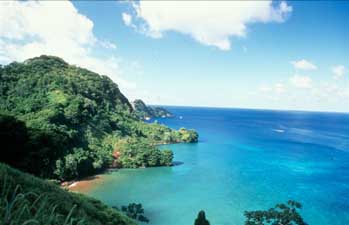 Overview of the island where bays are few
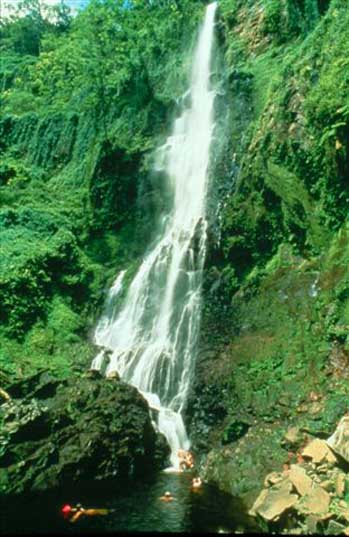 Experiences are more than just visiting with the fish as this cascade shows. Divers cooled off here. takes place from Zodiacs or small aluminum boats. The number of divers on every boat is usually 20, and normally there are three dives a day. Those who are not worn out after three dives are even offered a night dive. The diver who wishes to go on a treasure hunt or bathe under one of the over 200 waterfalls on the island has an unforgettable experience. Early one morning, just for that reason, we came ashore with the Zodiacs. The high waves made it necessary to swim the last bit to then be suddenly cast up on shore by the waves. When all had gathered, we started into the jungle and began our hike toward one of the waterfalls. It is hidden by the dark green tropical foliage, and it is easy to let your fantasy take over. Every cave one sees seems to be the ideal hiding place for a treasure of gold and precious jewels. On the larger rocks seafarers have carved in the names of ships and short messages. " Cousteau" is one we found. Arrows and mysterious symbols were carved into yet another of these large rocks. Continued on next page
|
 |
| You need to see Costa Rican tourism information HERE! |
| Home |
Tourism |
Place
classified ad |
Classifieds |
Entertainment |
Real estate |
Rentals |
Sports |
About us |
|
| What we published this week: | Monday | Tuesday | Wednesday | Thursday | Friday | Earlier |
| The contents of this page and this Web site are copyrighted by Consultantes Río Colorado 2001, 2002, 2003, 2004, 2005, 2006, 2007 and 2008 and may not be reproduced anywhere without permission. Abstracts and fair use are permitted. Check HERE for details | ||||||
| A.M. Costa Rica fourth news page |
|
||||||||
| Home |
Tourism |
Calendar |
Classifieds |
Entertainment |
Real
estate |
Rentals |
Sports |
About us |
|
|
|
|||||||||
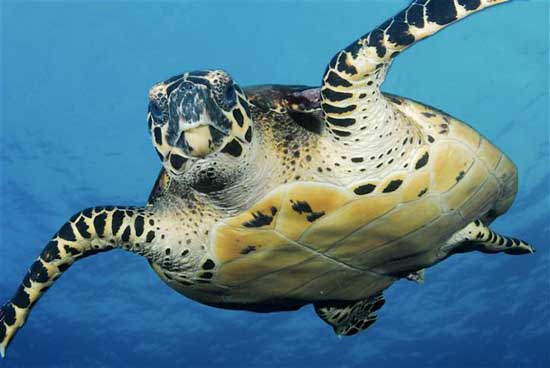
| Not all the inhabitants of the
waters around Isla del Coco are fish. This turtle was ready to pose for
the cameras. |
 |
|
Dive master says it is not a
good idea to touch a shark
|
||
|
Continued from previous page
After half an hour of hiking along a jungle brook we arrived in front of a cliff wall where a waterfall was cascading down 60 meters. The water was wonderfully cool and refreshing. While we rested under the falls the guide began telling us of how gold fever can change people. It was mainly concerning a man by the name of Gissler, a German who in the early 1900s lived on Isla del Coco with his American wife. For 20 years they searched for hidden treasure before giving up and returning to the mainland. Gissler later died penniless in New York City, never having succeeded in discovering so much as one gold coin, said the guide. Of course it is exciting to experience Isla del Coco as an old pirates' island. All that fades away, however, the minute a diver enters the water. During one of my dives with my diving partner, Randy Johnson from Alaska, we were approached by 12 large mantas right near the surface. We adapted our weights and hung motionless just under the surface while they calmly swam under, over and between us within just a few inches. We could clearly see traces of parasites on their bodies, small sores and even, swimming around them, the reef fish who helped to heal the mantas sores. That dive was worth more than any treasure of gold. When we later came up to the surface, we were told by the driver of our Zodiac that mantas often follow the rubber boats and that they like to hold themselves close to them. To live aboard a boat in the middle of the Pacific Ocean with 15 to 20 other divers for 10 days is an intense experience. Everyone has something wonderful and fantastic to tell about their dive. Free time is spent exclusively preparing for the next dive; cameras are cleaned, batteries charged, and film is developed. Even though every dive involves contact with sharks in the hundreds, attacks are rare. This is due in part to the crew on board who thoroughly instruct divers not to touch the sharks. "I have witnessed one or two accidents where a diver was attacked by reef sharks, but it has always been the diver's fault, said dive master Mario Vargas, who has been diving around Isla del Coco for almost 20 years. He explained that it is of course inviting to touch the sharks when they come so close. "Reef sharks, especially, which can measure up to three meters long, usually ignore divers but if someone touches them, they will be bitten immediately and it hurts," said Vargas. "Most often it is a bite on the hand and the attack is over." He said he never witnessed a hammerhead shark attack. Divers are certainly more respectful of them. Undercurrents around Isla del Coco can betray a diver. To try and swim against them is useless, and a diver has to hold himself near the coastline during every dive. If a diver loses sight of the coastline, the under current drags him right out into the open Ocean. The crew, however, is experienced and knows where to look if a diver does not come up at the agreed upon meeting place. Powerful up or down streams are also common. They are caused by deep ocean streams that collide with the coast, and they can, in no time at all, drag a diver with them. In such an instance all that counts is reacting quickly and adjusting weights. |
If a diver does not, things can end badly. During one dive I was sucked into a climbing stream. Before I managed to react, it had carried me into a cliff wall where 20 or 30 needle sharp sea urchins waited. Without seeing them, I put my left hand right on their spikes — and screamed. I was only really worried when I saw blood seeping out of my glove because I thought the reef sharks near me would react to the smell of blood. But they could not have cared less. Isla del Coco is full of cliffs, and all the dives are done along the coastline or out to sea some hundred meters from the edge of the beach. The bottom is made up of fine sand and sharp cliffs of volcanic origin. Disability varied between 25 to 50 meters. The island lies five degrees north of the equator. Divers who expect warm tropical diving with corals will be disappointed. Most of the coral was carried away in 1982 and 1983 by a product of El Niño, a warm ocean current which periodically pulls in toward the American coastline. For visitors, Isla del Coco is an oasis both under the surface and on land. The pirates have of course left the island but the priceless wealth of flora and fauna still remain — and possibly a few gold doubloons. EDITOR'S NOTE: Mr. Stenstrom is a Swedish journalist. |
|
 Color of rock wall emphasizes the
disposition of this reef shark while mantas glide effortlessly
|
 |
 |
| Home |
Tourism |
Place
classified ad |
Classifieds |
Entertainment |
Real estate |
Rentals |
Sports |
About us |
|
| What we published this week: | Monday | Tuesday | Wednesday | Thursday | Friday | Earlier |
| The contents of this page and this Web site are copyrighted by Consultantes Río Colorado 2001, 2002, 2003, 2004, 2005, 2006, 2007 and 2008 and may not be reproduced anywhere without permission. Abstracts and fair use are permitted. Check HERE for details | ||||||
| A.M. Costa Rica fifth news page |
Last
month A.M. Costa Rica received 5.4 million hits from interested readers. Shouldn't you be advertising here? (Everyone else is . . .) |
||||||||
| Home |
Tourism |
Calendar |
Classifieds |
Entertainment |
Real
estate |
Rentals |
Sports |
About us |
|
|
|
|||||||||
 |
| Money sent home slows by 7.3%, World Bank says Special to A.M. Costa Rica
Remittance flows to developing countries are expected to be $304 billion in 2009, down from an estimated $328 billion in 2008, said the World Bank, releasing a new migration and remittances brief to coincide with an International Diaspora and Development Conference this week. The predicted decline in remittances by 7.3 per cent this year is far smaller than that for private flows to developing countries. According to the World Bank, remittances are relatively resilient because, while new migration flows have declined, the number of migrants living overseas has been relatively unaffected by the crisis. However, sources of risk to the outlook include uncertainty about the depth and duration of the current crisis, unpredictable movements in exchange rates, and the possibility that immigration controls may be tightened further in major destination countries. "There is a risk that rising unemployment will trigger further immigration restrictions in major destination countries. Such restrictions would curb remittances more than forecast and would slow the global recovery in the same way as protectionism against trade would endanger a global upturn,” explained Hans Timmer, director of the World Bank’s Development Prospects Group. Remittances have slowed in many corridors since the last quarter of 2008. In line with a recent downward revision in the World Bank’s forecast of global economic growth, the new update (2009-2011) highlights the impact of the present financial crisis on the remittance flows and, describes broad regional and country specific trends. Remittance flows to Latin America have been falling in large part because of a slowdown in the U.S. construction sector. The new forecasts show a 6.9 percent decline in remittances for the Latin America and Caribbean region. Sub-Saharan Africa is also likely to experience an 8.3 percent slowdown in its remittance flows. However, flows to South Asia and East Asia have been strong, but remittances are expected to decline somewhat in 2009. India, China and Mexico retain their position as the top recipients of migrant remittances among developing countries. Smaller economies such as Tajikistan, Moldova, Tonga, Lesotho, and Guyana are the top recipients in terms of the share of their national total of goods and services. "Remittances provide a lifeline to many poor countries. Although they remain resilient, even a small decline of 7 or 10 percent can pose significant hardships to the people and to governments, especially those facing external financing gaps. Reducing remittance fees and developing innovative tools to leverage remittances for financial inclusion and capital market access should be a part of our response to the financial crisis,” said Dilip Ratha, head economist in the Development Prospects Group. |
|
| Home |
Tourism |
Place
classified ad |
Classifieds |
Entertainment |
Real estate |
Rentals |
Sports |
About us |
|
| What we published this week: | Monday | Tuesday | Wednesday | Thursday | Friday | Earlier |
| The contents of this page and this Web site are copyrighted by Consultantes Río Colorado 2001, 2002, 2003, 2004, 2005, 2006, 2007 and 2008 and may not be reproduced anywhere without permission. Abstracts and fair use are permitted. Check HERE for details | ||||||
| A.M. Costa Rica sixth news page |
|
||||||||
| Home |
Tourism |
Calendar |
Classifieds |
Entertainment |
Real
estate |
Rentals |
Sports |
About us |
|
|
|
|||||||||
| Latin
American news digest |
Cuba-U.S. talks restarted on orderly immigration By the A.M. Costa Rica wire services
Talks between the United States and Cuba on immigration issues have resumed after six years. A spokeswoman for the U.S. delegation to the talks said U.S. and Cuban representatives began meeting early Tuesday in New York. The delegates are discussing the implementation of the U.S.-Cuba Migration Accords. A statement issued earlier Tuesday said the discussion will focus on how best to promote safe, legal and orderly migration between the two countries. Craig Kelly, deputy secretary of State for Western Hemisphere affairs, is leading the U.S. delegation, which also includes representatives from U.S. agencies involved in migration issues. Migration talks had been suspended in 2003 by President George W. Bush. In May, the U.S. government offered to restart the negotiations as part of President Barack Obama's effort to improve relations with Cuba. In April, Obama eased limits on family travel to Cuba. Indian troops parade to mark Bastille Day By the A.M. Costa Rica wire services
A ceremonial detachment of Indian soldiers has marched with thousands of French troops down the Champs Elysees in Paris, in the annual French military parade marking Bastille Day. The Indian contingent marched Tuesday under the watchful eyes of French President Nicolas Sarkozy and visiting Indian Prime Minister Manmohan Singh. Crowds cheered and French air force jets flew overhead in formation. The annual holiday parade marks the July 14, 1789, storming of the Bastille prison in eastern Paris that helped spark the French revolution. |
| Latin American news feeds are disabled on archived pages.
|
|
| Home |
Tourism |
Place
classified ad |
Classifieds |
Entertainment |
Real estate |
Rentals |
Sports |
About us |
|
| What we published this week: | Monday | Tuesday | Wednesday | Thursday | Friday | Earlier |
| The contents of this page and this Web site are copyrighted by Consultantes Río Colorado 2001, 2002, 2003, 2004, 2005, 2006, 2007 and 2008 and may not be reproduced anywhere without permission. Abstracts and fair use are permitted. Check HERE for details | ||||||