|
| |
Your daily |
 |
|
|
|
|
|
|
|
|
|
|
|
|
|
|||||||||||||
|
|
 |
| A.M. Costa Rica Second newspage |
 |
||||||||
| Home |
Tourism |
Calendar |
Classifieds |
Entertainment |
Real
estate |
Rentals |
Sports |
About us |
|
| San José, Costa Rica, Tuesday, July 10, 2007, Vol. 7, No. 135 | |||||||||
 |
| Costa Rica Expertise Ltd http://crexpertise.com E-mail info@crexpertise.com Tel:506-256-8585 Fax:506-256-7575 |
 |
 Click HERE
for great
hotel discounts
|
|
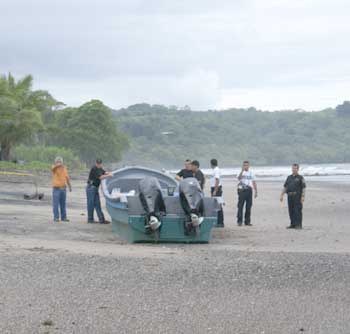 Guillermo Solano/Ministerio de
Gobernación,
Policía y Seguridad Pública. Officials survey craft at Playa Manzanillo
Two drug boats blocked
en route to United States By the A.M. Costa Rica staff
Two more boats believed heading from Colombia to the United States were intercepted at sea Monday. The crew of one beached it at the tip of the Nicoya Peninsula. The crew of the other boat set it afire and sank it. The two fastboats are designed to evade detection on the ocean. However, unidentified U.S. forces at sea spotted both and drove them toward shore. One came ashore at Playa Manzanillo in the Cóbano district of the peninsula. Officials said they found 900 kilos of cocaine in the launch and four suspected crewmen hiding in the bushes. As the U.S. craft closed in on the second craft, the crewmen jumped in the water after setting it on fire. That was about seven nautical miles off Playa Carrillo near Sámara, also on the Nicoya Peninsula, said officials. Officials will try to float the sunken boat today. The four crewmen, identified as Colombians, were turned over to Costa Rican officials by the U.S. forces. Officials said that these were the 10th and 11th such boats intercepted in recent months. So far this year, officials have seized 21 tons of cocaine, most of it from boats. The Servicio Nacional de Guardacostas, the Policía de Control de Drogas, the Fuerza Pública and the Judicial Investigating Organization participated in the twin actions Monday. Five vacationers who died were rappelling waterfalls By the A.M. Costa Rica staff
The five vacationers who died Sunday in the Río San Lorenzo were climbing down a waterfall with ropes. The five, a husband, wife and three children, were in the path of a surge of water that knocked them off their feet and over another waterfall into a pool. They were Luis Salazar Gonzalo, 42; his wife Isabel Barquero, 36; and sons, Luis, 16, Esteban, 12 and José, 11. Saved was the family's 5-year-old, Valeria, who was grabbed by a guide. The family from Palmitas, Naranjo, Alajuela, was taking advantage of the weekend to stay at a local hotel and engage in rappelling down the waterfall under the auspices of a local adventure tour company. The family was a victim to rain that had fallen in the nearby mountains that caused the surge of water in the stream Raid designed to break up continual gang warfare By the A.M. Costa Rica staff
Judicial police made six raids in the Limón vicinity Monday to break up a war between two rival gangs. Guns and drugs were confiscated, the Judicial Investigating Organization said. The gangs had a habit of shooting it out on the public streets, said officials. Agents said the gang members also held up businesses and persons on the street. Sunday burglar loots Trejos Montealegre home By the A.M. Costa Rica staff
A daylight burglar broke into a home in Urbanización Trejos Montealegre, Escazú, Sunday and made off with 1 million colons ($1,925) in cash and about 5 million in electronic gear, said the Fuerza Pública. The owner of the home is Alfonso Pereira Paz, officers said. When the man arrived home about 11 a.m. he found the front door open, they added. City streets being resurfaced By the A.M. Costa Rica staff
Crews are working at night to resurface the principal streets in San José. The Ministerio de Obras Públicas y Transportes estimated the job will be done by the end of this week. The price tag is 30 million colons or about $58,900. The work, which is going on between 2 a.m. and 4 a.m. started July 4. The streets getting the new asphalt are avenidas 1,7, 8, 9 and 10 and calles 0, 1, 9, 10, 11 and 12. Lightning kills swimmer By the A.M. Costa Rica staff
An 18-year-old man died Monday when he was struck by lightning on Playa Penca about 3 p.m. The man, identified as David Otoniel Rocha Rivera, was just getting out of the surf when the bolt hit, according to the Judicial Investigating Organization. England tightens smoking law By the A.M. Costa Rica wire services
It is the beginning of a new era for smokers in England. No more lighting up in closed public places, including in pubs and private clubs. Other parts of Britain already have such bans. A new smoking ban against lighting up in enclosed public spaces went into effect July 1. It is part of the government's efforts to reduce smoke-related illnesses. Businesses can no longer have smoking rooms. And they must display "no smoking" signs and maintain smoke-free work vehicles. Those who fail to meet these requirements face fines of more than $5,000.
|
| We had another great month for readership in June. We served up more than 1 million pages. If you do business in Costa Rica, you should be seeking customers here! |
 |
|
on our real estate page HERE! |
| A.M. Costa Rica third newspage |
 |
||||||||
| Home |
Tourism |
Calendar |
Classifieds |
Entertainment |
Real
estate |
Rentals |
Sports |
About us |
|
| San José, Costa Rica, Tuesday, July 10, 2007, Vol. 7, No. 135 | |||||||||
| Happy Birthday, Lisa Love, Mom and Dad |
 |
| Bush
to Latin America; 'We care deeply about your plight' |
|
|
Special to A.M. Costa Rica
President George Bush highlighted Monday a series of initiatives designed to help countries in the Western Hemisphere provide health care, expand economic opportunities and invest in education. “A healthy and educated and prosperous neighborhood is in the long-term interests of the United States,” Bush told participants in a “Conversation on the Americas.” The White House-sponsored conference brought together government officials, regional diplomats, representatives from 250 non-governmental organizations and corporate foundations from 34 countries to exchange ideas on ways in which the United States can expand its efforts to improve the lives of people across the Americas. The event follows Bush’s five-nation tour of Latin America earlier in 2007, in which he highlighted what he said was a U.S. commitment to social justice for nations of the region by helping them provide education, meet basic health care needs and expand economic opportunities for their citizens. “We are a community of democracies, and the challenge we face together is to deliver its benefits to all of our citizens by expanding access to education, to health care, to economic opportunity and jobs,” said Karen Hughes, under secretary of state for public diplomacy and public affairs, in introductory remarks. To this end, Hughes said, the Bush administration nearly has doubled foreign aid to the region from $857 million in 2001 to more than $1.5 billion in its budget request for the fiscal year that begins Oct. 1. The Millennium Challenge Corp. has concluded agreements with El Salvador, Haiti and Honduras totaling $900 million in additional aid, she said. But both figures are dwarfed by an estimated $95 billion that flows from the United States southward each year in the form of remittances, charitable donations, and the work of organizations and corporate foundations. In June, Bush directed the USNS Comfort, a Navy hospital ship, to embark on a four-month voyage to 12 Latin American and Caribbean nations during which its personnel, joined by doctors, nurses and health care volunteers from the non-governmental organization Project HOPE, plan to treat 85,000 patients and conduct up to 1,500 surgeries. “We care deeply about the plight of other people, and when we see their suffering we want to help. And the Comfort is a way for us to send a clear message that we care about the people that live in the neighborhood that we occupy together,” Bush said. In remarks later in the day, first lady Laura Bush announced the creation of the Partnership for Breast Cancer Awareness and Research of the Americas, an initiative that brings together medical professionals from the United States, Brazil, Costa Rica and Mexico in the fight against the most common cause of cancer-related death for women worldwide. Citing trade as the most effective way to alleviate poverty in the Americas, Bush called on the U.S. Congress to approve the free-trade agreements negotiated with Colombia, Panama and Peru. |
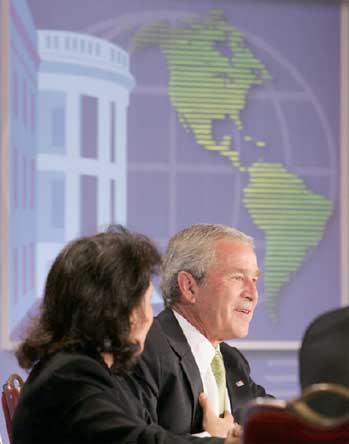 White House photo by Chris Greenberg
George Bush comments at the Conversation on the Americas
Monday in Arlington, Virgina.“Trade agreements are good for both sides. It's good for U.S. workers, and it's good for Peruvian, Colombian or Panamanian workers. And it's in our interest to promote trade,” Bush said. Bush highlighted the power of microcredit to help poor farmers start new businesses with help from Guatemalan panelist María Pacheco, general manager of Kiej de los Bosques, a business incubator that has helped communities establish markets in which to sell their crops. “I'm really optimistic because what I have seen is that trade can be beautiful, a trade that recovers ecosystems, a trade that values ancestral cultures, a trade that incorporates people that were outside of the productive sector for the first time into a supply chain,” Ms. Pacheco said. Corporations engaged in the region are also active in community-development projects, said panelist Vivian Alegria, director of the Coca-Cola Foundation in Mexico, which is building schools, promoting health and wellness programs and funding arts programs, projects supported by the U.S. president. “I would encourage companies that do business in the neighborhood to understand that it's one thing to sell a product, it's another thing to help people be able to buy the product and become involved in the communities in which they're doing business,” Bush said. Since 2004, the United States has invested more than $150 million in education programs across the Western Hemisphere, including a $76 million initiative to help more young people learn English and study at U.S. schools, according to a White House fact sheet. Following Bush’s remarks, several members of his Cabinet led panel discussions at the daylong event. |
| Mrs.
Bush announced partnership including Costa Rica to fight breast cancer |
|
|
Special to A.M. Costa Rica
Mrs. Laura Bush announced Monday the launch of the Partnership for Breast Cancer Awareness and Research of the Americas. This is an initiative to unite experts from the United States, Brazil, Costa Rica, and Mexico in the fight against breast cancer. The president's wife spoke during the White House Conference on the Americas in Arlington, Virginia. The partnership joins the medical expertise of The University of Texas M. D. Anderson Cancer Center with the global grassroots network and educational resources of Susan G. Komen for the Cure, the regional management |
experience of the
Institute of International Education’s West Coast Center, and the
commitment of the U.S government represented by the U.S. Department of
State, Bureau of Western Hemisphere Affairs, Office of Public Diplomacy
and U.S. embassies in the three countries, said the State Department. This partnership represents an expansion of the U.S.-Middle East Partnership for Breast Cancer Awareness and Research, launched by Mrs. Bush in June 2006. Building upon workplace awareness programs, community needs assessments and medical exchanges, Partnership for Breast Cancer Awareness and Research of the Americas activities will develop long-term programs that can be used throughout the region, said the State Department. |
| Gibson visits
Arias with a plan to help Actor-director Mel Gibson gestures to the obvious enjoyment of President Óscar Arias Sánchez Monday during an hour-long meeting at Arias' Rohrmoser home. The actor said later he just wanted to visit because Arias is a neighbor. Gibson, a frequent visitor, just purchased a tract of land near Sámara. Casa Presidencial said Gibson told Arias he was working on a plan to provide health and education to Costa Rica's Indian population. |
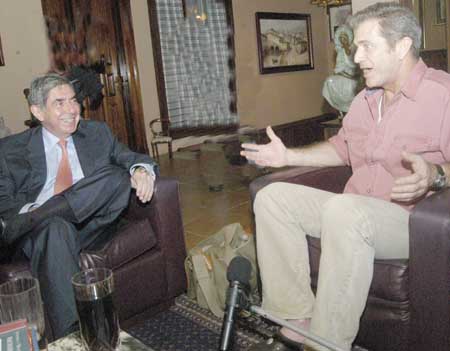 Casa Presidencial photo
|
| You need to see Costa Rican tourism information HERE! |
| A.M. Costa Rica fourth news page |
A.M. Costa Rica rates Display and classified rates have increased as of June 18, 2007. The average display increase is between 6 and 8.5 percent. This is the first rate increase in the six-year history of the newspaper. The new rates are posted here: As usual, the bulk of any income goes to get you a better newspaper. |
||||||||
| Home |
Tourism |
Calendar |
Classifieds |
Entertainment |
Real
estate |
Rentals |
Sports |
About us |
|
| San José, Costa Rica, Tuesday, July 10, 2007, Vol. 7, No. 135 | |||||||||
| Venezuelans
find it hard to define '21st century socialism' |
|
|
By the A.M. Costa Rica wire services
For years, Venezuelan President Hugo Chávez has spoken almost daily about his vision of so-called "21st century socialism." Yet many Venezuelans of varying political persuasions are unsure what the slogan means and have great difficulty defining it in precise terms. After winning re-election last December, President Chavez spoke of his plans for the future: "Now more than ever, I am obliged to move Venezuela's path towards socialism," he said. But what, precisely, is his program of 21st Century socialism? Universidad de Caracas student Jesús Echeverría is not sure. "I, for one, do not know what 21st century socialism means," he said, "but it seems to me to be an arrangement in which the president can manipulate all the country's institutions." Venezuelan lawyer and former information minister Fernando Egaña gives a similar response. "It is a great question that I am not able to answer because it has never been explained," he said. "In a practical sense, 21st century socialism means indefinite re-election within a state with no separation of powers and without any institutional counterweights." Earlier this year, Venezuela's national assembly, made up entirely of Chávez loyalists, voted to allow the president to rule by decree. Since then, an empowered Chávez has nationalized telecommunications and electric-power companies, renegotiated contractual arrangements with foreign oil corporations and shut down an opposition-allied private television station. Many Chávez supporters say 21st century socialism means social and economic equality. They are quick to rebut |
opposition accusations that 21st
century socialism is mere window-dressing for autocratic despotism. Caracas resident Carolina Pérez describes the president as her "idol." "For eight years, the opposition has been saying that the revolutionary process will strip people of their businesses and take away their children for indoctrination," she says. "If the president were so inclined, he would already have done so." Chávez backers say, for the first time, Venezuela's massive oil wealth is being used to benefit all citizens, not just the wealthy elite. The president has launched massive social welfare campaigns in health care, education, food assistance and other areas. Even critics of Chávez concede that the popularity of these programs helped propel his re-election victory in December. Venezuelan public-opinion pollster Luis Vicente León says the populist president has been intentionally vague in spelling out his program, allowing his followers to define it for themselves according to their interests. "Chávez simply says that he represents 21st century socialism," he said. "So if you like Chávez and I ask you what 21st century socialism means, you will probably say 'Chávez' or 'a better distribution of oil wealth' or 'giving educational scholarships' or 'providing for the poor.' Well, these are all things that people like." What is next on the agenda of Chávez? No one knows for sure, but he has threatened further crackdowns on the private news media, promised more expropriations of properties deemed underutilized by the state, and pledged to remain in power until the year 2030. For that to occur, Venezuela's constitution would have to be amended to eliminate executive term limits. |
| U.N.
food agency chief warns of lack of progress eliminating hunger on
Isthmus |
|
|
Special to A.M. Costa Rica
South America and the Caribbean have made substantial progress toward eliminating hunger, but Central American states are lagging behind in the same fight, the head of the United Nations Food and Agriculture Organization told a meeting in Brazil Monday. He is Jacques Diouf, the agency's director-general. He told a conference on food and nutritional security in Fortaleza that the number of people across the whole region suffering from hunger fell from 59 million in the early 1990s to 52 million in 2001-03. But that sharp drop was confined to South America and the Caribbean, whereas in Central America the progress was not as positive, either in the number or proportion of victims of hunger and malnutrition, Diouf said. |
He called on those countries to take
notice of successful campaigns
such as Zero Hunger, a program launched in Brazil in 2003 that has
since spurred similar schemes in Nicaragua and Colombia. “FAO has learned very important lessons from this experience in Brazil. These lessons can be applied in other countries engaged in combating hunger,” he said. He said that any programs to improve food security must consider factors such as the rapid urbanization of much of the developing world. Insufficient access to land and water, a lack of available credit for the rural poor and the impact of climate change on farming land are also affecting the capacity of poorer nations to reduce hunger, Diouf said. |
| We can put your business announcement
here where those seeking international news will see it |
|
| News from
the BBC up to the minute |
BBC sports news up to the minute |
| BBC news and sports feeds are disabled on archived pages. |
|
| A.M. Costa Rica Sports news local and from the wires |
 |
|
|
|
|
|
|
|
|
| San José, Costa Rica, Tuesday, July 10, 2007, Vol. 7, No. 135 | ||||||
|
||||
|
|
|
|
|
|
|
|
| What we published this week: | Monday | Tuesday | Wednesday | Thursday | Friday | Earlier |
|
|