Your daily English-language news
source
Monday through Friday
|
|
|
Your daily English-language news
source
|
|
|
|
|
|
|
|
|
|
|
|
|
|
||||||||||||||
|
|
||||||||||||||
 |
| Costa Rica Expertise Ltd http://crexpertise.com E-mail info@crexpertise.com Tel:506-256-8585 Fax:506-256-9393 |
| Alex Solís hangs
on to his position By the A.M. Costa Rica staff The Asamblea Nacional Monday still could not decide if it would empanel a commission to investigate the conduct of Alex Solís, the man just named to be contralor general de la República, the financial watchdog. Some legislative members have been threatening to set up a committee after it was disclosed that Solís signed the name of his better known brother to a real estate document and then notarized the signature as authentic. His brother is Ottón Solís, leader of the Partido Accion Ciudadana and a likely candidate for president. Alex Solís became the contralor general June 7. The position reports to the legislature. Since his actions as a notary became public, he has refused to consider resigning from the eight-year appointment. Solís contends that he signed the document with the full knowledge of his brother. However, Alicia Bogarín Parra, the director of the Dirección Nacional de Notariado, has said that such action is prohibited and was a crime. Last Friday, Director Bogarín released a statement through the Poder Judicial press office saying that her comments were general ones about notaries and should not be applied to specific situations. Notaries in Costa Rica have much more power than their North American counterparts. They must be lawyers. Alex Solís claims he is the victim of political infighting. Fast boat leads chase,
By the A.M. Costa Rica staff U.S. ships frustrated a cocaine shipment and, in a separate action, saved three Costa Rican fishermen who were stranded on the high seas for 15 day. The anti-drug action started Monday when a U.S. aircraft spotted a fastboat of presumed Colombian origin on the high seas. A six-hour chase ended at the Costa Rican coast at Parque Nacional Manuel Antonio in Quepos de Aguirre. Four Colombian men were arrested about 5 p.m. at the end of the chase. They were identified by the last names of Hernández Rodríguez, Fajardo Salencia, Vives Cárdenas and Mina Castro. Much of the sea chase was carried out by patrol boats and aircraft from the Servicio Nacional de Guardacostas. Officials said that the four men drumped packages into the sea some 35 miles off the coast. A fast boat is about a 40-foot launch with three giant outboard motors afixed to the stern. Such boats can carry about two tons of merchandise, officials said. Officials will be searching the Pacific today for the presumed packages of cocaine that were thrown into the sea. The rescue was made by the USS Cromellin which found the Don Luis II afloat with mechcanical trouble about 54 miles south of Cabo Matapalo in the central Pacific. The fishing boat has been drifting for 15 days, officials said. The fishermen were identified as Jeudy Gómez Vargas, captain, and Fabio Angulo Contreras and Wilfrido Barahona Gutiérrez. Although crewmen from the Cromellin tried to repair the vessel’s motor, they could not and ended up sinking the boat so it would not present a danger to navagation, said officials here. Letter to editor
Dear A.M. Costa Rica: I was horrified to read the letter to the editor in today's edition
regarding how great Ronald Regan was as a president. For the real truth
behind what Regan did as president, how he really messed with our country,
I would refer your readers to an article published by The New York Times,
written by Marilyn Berger on June 6. Regan was known as the "Teflon President."
Readers should point their browsers to HERE!
.
Judith Loring
EDITOR’S NOTE; For benefit of readers without registration
for The New York Times Web site, the cited article is a balanced obituary
of Ronald Reagan which points out his involvement in Latin America, the
Iran contra scandal and other negative aspects of his presidency.Montana, U.SA. |
|
In Costa Rica: From elsewhere: A.M. Costa Rica
Consultantes Río Colo.
|
reaches those folks who never even thought about your product or service.*
*That's the ones you want, right?
|
|
This dog just may be listening to what you say |
|||
|
A 9-year-old border collie who apparently understands a vocabulary of 200 words — most of them in German — has led scientists to conclude that the remarkable dog has language-learning ability comparable, in some ways, to a human toddler. Their findings raise anew the question of whether language is strictly a human trait. Rico is hardly the first non-human animal to show skills at language comprehension. His vocabulary
Rico's skill was the subject of a news conference in Berlin on Sunday organized by Science, The American Association for the Advancement of Science and the Max Planck Institute for Evolutionary Anthropology in Leipzig, Germany. Scientist Julia Fischer, along with her Science co-author and Rico's owners, brought the study to life for a room filled with journalists representing media outlets around the world. And, of course, there was Rico. After an appearance on a German game show about three years ago that launched his science-and-show-biz career, followed by months of methodical scientific testing, Rico emerged from the news conference as an international star. "Such fast, one-trial learning in dogs is remarkable," said Katrina Kelner, Science's deputy editor for life sciences. "This ability suggests that the brain structures that support this kind of learning are not unique to humans, and may have formed the evolutionary basis of some of the advanced language abilities of humans." In the early chapters of Rico's story, he appeared on the popular German game show "Wetten, das...?" Fischer heard about his amazing performance and arranged a meeting with Rico in September 2001. After Rico's caretakers agreed to the collaboration, Fischer's team at the Planck Institute set out to test the dog's word skills. In a series of controlled experiments, he correctly retrieved, by name, a |
total of 37 out of 40 items randomly
chosen from his toy collection.
Next, the researchers tested Rico's ability to learn new words through fast-mapping. The German scientists placed a new toy among seven familiar toys. In a separate room, the owner asked Rico to fetch the new item, using a name the Border collie had never heard before. Rico correctly retrieved the new item in seven of 10 such tests. He apparently uses a process of elimination, much as young children do, to surmise that new words tend to refer to objects that do not already have names. After a month without access to these target toys, Rico retrieved them, upon request, from groups of four familiar and four completely novel toys in three out of six sessions. His retrieval rate is comparable to the performance of 3-year-old toddlers, according to the authors. Toddlers would have loved the press conference. Rico's owners brought a wicker chest, two large boxes and four crates all filled with toys Rico knows by name. During the photo shoot at the end of the press conference, journalists wielding still and video cameras crawled under tables to catch the photogenic pooch in action. As people threw toys and Rico scampered, the press conference spilled into a second room, the hallway and the building's atrium. With toys spread everywhere, it looked like the end of an extravagant birthday party. The three different Santa Claus toys Rico played with, each with a unique name, added to the festive spirit. After the last TV crew left once, returned to catch Rico's bark on tape and then departed again, Fischer looked to the future. Over lunch and espresso, she talked about her research and the ways it may remain in the collective memory of the global scientific community and beyond. "The public will probably come away with the story, 'Smart dog learns like a child'," Fischer said. But, she added: "I don't want to become 'the whimsical dog lady'." Instead, she hopes that within the scientific community, Rico's popularity draws attention to questions regarding the evolution of language as well as her larger body of research. "In some ways, science is storytelling," Fischer said. "Even within the scientific community, people relate to and remember stories. Storytelling plays a part in how we accumulate knowledge. Stories wrap information in something that people will remember." Her team is now investigating Rico's ability to understand entire phrases, such as requests to put toys in boxes, or to bring them to certain people. It's a fair prediction the news media and the public will be keen to hear of the results. How does Fischer feel about the media attention so far? "Overwhelming," she said, "[but] in a good way." |
||
|
|
|
|
TEGUCIGALPA, Honduras — A U.S.-backed group of international donors for Honduras has reiterated its support for that country's plan to cut poverty within its borders. A statement released Monday by the Inter-American Development Bank at a meeting here reaffirmed Honduras' plans to boost economic growth and ensure that the country's poverty reduction plan "preferentially benefits the poorest groups of the population." At the meeting were representatives of the United States, Canada, Japan, several European countries and a number of international financial institutions. Achieving high growth rates "will not be sufficient without a process of wealth and income redistribution" in Honduras, said the statement from the development bank, whose representative chaired the meeting. Delegates at the meeting said that in light of the lessons learned after Hurricane Mitch struck Honduras in 1998, Hondurans must strengthen their country's environmental sustainability and reduce their high vulnerability to natural disasters. Donor nations and multilateral agencies have provided |
Honduras with billions of dollars
in aid to support reconstruction since Hurricane Mitch hit the country.
But the biggest challenge Honduras now faces, the delegates said, is lowering its high poverty rate. The delegates said efforts must be made to help the poor acquire land and housing, and to improve social services such as education, health care, drinking water and sanitation. These efforts will have to be buttressed by policies to continue increasing tax revenues, strengthening the financial system, and promoting the development of micro-enterprises and small business in rural and urban areas, the delegates said. Delegates at Tegucigalpa also discussed the challenges Honduras will face in seizing opportunities stemming from expanded access to international markets through the U.S.-Central American Free Trade Agreement, and other trade pacts with Canada and the European Union. Honduran President Ricardo Maduro said at the meeting that his country would need the international community's support to ensure a better life for his people. |
|
|
|
|
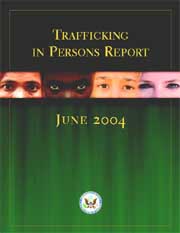
Costa Rica listed as so-so in U.S. trafficking report |
|||
|
and wire services The U.S. State Department put Costa Rica in a middle category in its annual report on world-wide trafficking in persons. "The Government of Costa Rica does not fully comply with minimum standards for the elimination of trafficking; however, it is making significant efforts to do so," said the reported issued Monday. Some 10 countries were cited for failing to adequately combat the problem and could face U.S.
Powell opened a news conference on the release of the State Department's fourth annual report on human trafficking, which is mandated by Congress and assesses the record of more than 140 countries around the world on the issue. The report divides countries into three categories based on their performance, with those placed in the bottom tier facing U.S. economic sanctions later this year, unless their record improves. Powell said he believes progress is being made against trafficking because of the attention that has been focused on the issue by the U.S. reports, which he said are "not shy about naming names" of lagging countries. But he said 600,000 to 800,000 people, and possibly more, are still being trafficked across international borders each year for the sex trade and forced labor, a number he said is so large as to "freeze our imaginations." Of the 10 countries in the third tier, four are holdovers from last year: Burma, North Korea, Cuba and Sudan. Joining the list were Bangladesh and two African states, Equatorial Guinea and Sierra Leone. Three Latin American states, Venezuela, its neighbor Guyana and Ecuador were also added, reflecting growing concern about sexual exploitation and forced labor in that region. The State Department said that the governmental |
turmoil in Venezuela means no attention
was being paid to the trafficking problem.
Most countries, like Costa Rica, were placed in a middle category, or second tier, with a mixed performance. But the new report places several on a so-called "watch list" for countries not in compliance with Congressional standards and which could be downgraded. The Dominican Republic, for example, is on the watch list. Other countries on the watch list include India, Russia, Mexico, Nigeria and U.S. allies Turkey, Greece and Japan. The head of the Bush administration's interagency task force on human trafficking, former congressman John Miller, said Japan's efforts have not been commensurate with the problem thus far, though there are signs of progress. Costa Rica’s neighbor to the north, Nicaragua, and Panamá to the south are both classified as tier 2. The three countries that provide the bulk of the prostitutes who work in Costa Rica covered the range. One, the Dominican Republic, is on the Tier 2 watch list. Said the report: "Observers estimate 25,000-30,000 minors are in prostitution in the Dominican Republic; most are Dominicans, but some are Haitians. Many of these children are victimized in the sex tourism industry." And the country has some 50,000 citizens engaged in prostitution abroad. Colombia also has an estimated 50,000 citizens working as prostitutes abroad, but it is classified as Tier 1, the best. The report said: "The Government of Colombia fully complies with the minimum standards for the elimination of trafficking. The government has shown political will at the highest levels to address one of the largest national outflows of trafficking victims in the Western Hemisphere, brought about by a guerrilla insurgency and narco-criminal enterprises. "In response, the government’s inter-agency committee is a model for the hemisphere: coordinating prevention campaigns, promoting law enforcement, launching a criminal database, and facilitating intra-government cooperation." In Nicaragua, "The government’s new measures announced in 2003 to fight sex trafficking of minors are commendable, but Nicaragua continues to lack an effective law enforcement strategy," it said. Nicaragua also is a principal supplier of prostitutes to Central America and the world. Although the summary of the situation in Costa Rica reads about the same as last year’s report, this sentence is left out this year: "The vibrant tourism industry attracts a small but growing percentage of sex tourists primarily from the United States, Canada, and Germany who prey on children." |
||
|
|
|
| This is what the U.S. State Department
report on human trafficking said about Costa Rica:
Costa Rica is mainly a destination and transit country for women and children trafficked for sexual exploitation. Victims are internally trafficked from San Jose to coastal and border communities in the provinces of Limon, Puntarenas, and Guanacaste. Victims are trafficked to Costa Rica from Nicaragua, Colombia, Panama, the Dominican Republic, Ecuador, the Philippines, Russia, and Eastern Europe. Although most foreign victims remain in Costa Rica, traffickers also attempt to transport them onward to the U.S. and Canada. Costa Ricans migrate illegally to the U.S. and Canada; authorities believe some may be trafficked. In 2003, authorities discovered two Costa Rican women in Japan who had been trafficked there. The Government of Costa Rica does not fully comply with minimum standards for the elimination of trafficking; however, it is making significant efforts to do so. Costa Rica needs to create institutional links between its increasingly effective law enforcement efforts against traffickers and social services to victims. As a regional leader, Costa Rica is positioned to play a strong role in developing mechanisms to gather and share intelligence on trafficking in Central America and the Caribbean. Prosecution
|
augmented in 2003, their important
work remains hampered by resource constraints. According to government
data, in 2003, authorities made 14 trafficking-related arrests. All of
those arrested were detained on charges of child sexual exploitation. Of
the 14, authorities placed six offenders in pretrial custody, prosecutors
charged seven defendants, and the courts sentenced one defendant. Costa
Rica is considering new legislation to improve its anti-trafficking laws.
These improvements should address all forms of trafficking, including internal
trafficking.
Protection
Prevention
|
|
|
|
|
|
|
|
|
| What we published this week: | Monday | Tuesday | Wednesday | Thursday | Friday | Earlier |
|
|