Your daily
English-language
news source
Monday through Friday

| |
|
|
Your daily
English-language |
|
|
|
|
|
|
|
|
|
|
|
|
|
|||||||||||||
|
|
|||||||||||||
|
Costa Rica Second news page |
 |
|
|
|
|
|
|
|
|
|
|
 |
| Costa Rica Expertise Ltd http://crexpertise.com E-mail info@crexpertise.com Tel:506-256-8585 Fax:506-256-7575 |
 |
 Click HERE
for great
hotel discounts
|
 A.M. Costa Rica/José
Pablo Ramírez Vindas
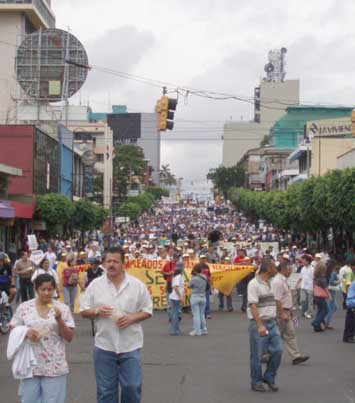
Marchers fill Avenida 2 on the way to the
courts.
Court decisions and treaty
bring out public workers By José Pablo Ramírez Vindas of the A.M. Costa Rica staff As expected an estimated 15,000 union members and supporters took to the streets Wednesday in a protest against the proposed free trade treaty with the United States and some recent constitutional court decisions that rolled back benefits for workers. Some strikers plan to continue their stoppage today. Friday morning is a holiday, according to Casa Presidencial, so public employees can watch the Costa Rica-Germany inaugural game of the 2006 World Cup. Public employees are supposed to return to work at noon Friday, but there is a good chance that workers will take a five-day weekend. The march Wednesday on Avenida 2 ended in the area of the Corte Suprema de Justicia where the Sala IV constitutional court is located. Albino Vargas, secretary general of a leading public employees union, tried to link the court decisions with the free trade treaty. He claimed that the court decisions were in preparation to drive Costa Rican wages and benefits down to the level of other Central American nations. Vargas of the Asociación Nacional de Empleados Públicos y Privados was accompanied by José Merino del Río, a national deputy who represents Frente Amplio. He is the only member of his party in the legislature. Merino has written extensively against the free trade treaty. The connection outlined by Vargas is a stretch. The decisions on worker rights stem from 2004 cases filed by two sitting deputies of the Movimiento Libertario. The court rejected excessive severance pay for employees of the Instituto National de Seguros, the insurance monopoly, and certain benefits for workers at the national petroleum refinery. But the decisions also brought to light the fact that workers were getting extensive benefits from collective bargaining at state enterprises where managers have little incentive to keep costs down. For example, the refinery union negotiated the use of a motor vehicle. The court also turned thumbs down on the practice at the Compañía de Fuerza y Luz of excusing one half an employee's electric bill. Rights acquired by workers in Costa Rica are difficult to cancel. The workers have a continuing legal right to these benefits once they are given. Court decisions are one of the few ways these benefits could be eliminated. Marchers fear another way is if competition from businesses allowed under the free trade treaty bankrupt existing state monopolies, like insurance and telecommunications. Two investigators face extortion allegations By the A.M. Costa Rica staff
Two agents of the Judicial Investigating Organization have been detained on an allegation of extortion. The case is being handled by both the drug and corruption units of that agency. A news release said that the men face an allegation that they were collecting about 6 million colons (about $12,000) as a payment to insure that they would not continue an investigation. One arrest was made in San Ramón and the other in Alajuela, both Tuesday evening. Jorge Rojas Vargas, director of the investigating organization, said the arrests showed that internal controls were working. Fiesta in San Antonio By the A.M. Costa Rica staff
San Antonio de Desamparados is celebrating with a fiesta in honor of its saint, St. Anthony of Padua, and the weekend will see a parade with fireworks Monday. The parade is Saturday at 11:45 a.m. starting at the Liceo de San Antonio. A carnival picks up where the parade leaves off. Monday in the community stadium fireworks will be set off, starting at 8:30 p.m. |
|
|||||||||||||||
 |
 |
|
on our real estate page HERE! |
 |
|
Third news page |
 |
|
|
|
|
|
|
|
|
| San José,
Costa Rica, Thursday, June 8, 2006, Vol. 6, No. 113 |
||||||
 |
 |
 |
| Dream is born in the jungle on the Caribbean coast |
|
|
By Annette Carter
Special to A.M. Costa Rica At the far north end of Cahuita on Costa Rica’s Caribbean coast and just inside the jungle the buzz of power tools and the clang of hammers blend with the natural sounds of birds and howler monkeys. The noise marks the development of a project that beginning this fall will bring yoga and meditation practitioners from around the world to this small seaside village. Although the project is a collaborative effort of Marcelo Ruiz and his wife, Jacqueline Bűrkler, the seeds of inspiration for this yoga, retreat and conference center to be known as The Goddess Garden were actually planted many years ago on two separate continents. While Ecuadorian-born Marcelo was making his way in the States running a taxi company and teaching school in Chicago, Swiss-born Jackie, who has a doctorate in biochemistry, was searching with her husband for a more tranquil environment in which to live and work. They left Switzerland and settled in Colombia, South America, where they lived for 13 years and began their family. When her husband died in the mid-90s Jackie began to search for a less politically-charged environment in which to raise her kids and found the Caribbean coast of Costa Rica, living first in Puerto Viejo de Talamanca and later moving to Cahuita where she purchased land and built a home in the middle of the jungle. Marcelo’s hectic American lifestyle and a search to find himself led him to the study of the Indian culture, meditation and Shamanic work. Eventually he moved back to Ecuador. On a trip to Costa Rica he thought “Maybe I can do something here,” bought land by the sea and two years later opened Hotel La Diosa (The Goddess) on Playa Negra in Cahuita. “Then I met Jackie,” he said with a smile. Their vision, a combination of Jackie’s desire to “live in nature” and Marcelo’s vision to encourage people in their search for peace and a more holistic lifestyle came together in the planning and construction of The Goddess Garden. The center is being built on Jackie’s jungle property, and her original home is being reconstructed to fit in with the plans. “I could’ve made good money in my profession in Switzerland, but living here I live with animals and trees,” said Jackie. “I still love it here (on my land), but it would be great if other people can come here too.” The concept for the center and its construction, the couple says, is to be in complete harmony with nature. To construct Jackie’s original home only three trees were cut. To build the additional two buildings for the center the couple chose sites on the property in natural clearings so there would be no need to cut more trees. This is important, she said, because “the monkeys need the trees to live here.” “We try to do the least amount of damage to the nature,” Marcelo said. Even the power lines are specially insulated to prevent electrocution to the birds, monkeys and sloths who use them as crossings and perches. “The Goddess Garden is always for the earth’s family,” he added. In addition to Jackie’s former home which will house a restaurant and bar overlooking a pool and hot tub,bathrooms, changing rooms and a sauna, the |
 A.M. Costa Rica/Annette
Carter
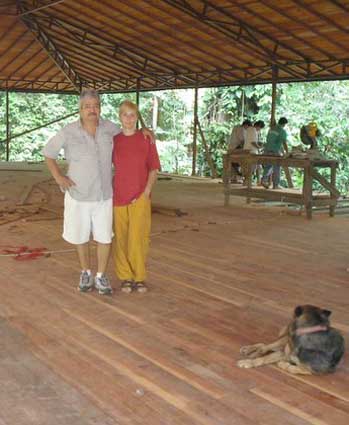
Marcelo and Jackie on the top floor of The Goddess Garden’s
conference center currently under construction. This is the area
in which yoga and meditation will take place.property will have a 120-square meter (1,290-square foot) circular open-air activities pavilion with an 8-meter (26-foot) high sloped roof constructed of palm leaves and Eucalyptus wood. The third building is the two-story conference center equipped with a stage, audiovisual capabilities and equipment, and seating for about 50 people on the first floor. The meeting space is surrounded totally by windows as a means to bring the nature indoors. A separate first floor room will feature an orchid display complete with waterfall. “There are 1,200 species of orchids growing in Costa Rica,” Marcelo said. The open-air second story is designed for yoga and meditation with a space and special floor for that purpose as well as a library and meditation shrine. Throughout the space will be an informal art gallery. The outdoor tiled pool and hot-tub are surrounded by fragrant and other gardens designed to showcase the 150 plant varieties growing naturally on the property. Marcelo said the plan is to offer The Goddess Garden to yoga and meditation groups initially. “The idea is to be open to all kinds of ideas and we don’t want to impose any kind of philosophy,” he said. But, he added, we also see this as a conference center where companies could have meetings or retreats or people could even have weddings here. “There is no place like this on the Caribbean coast of Costa Rica,” he added. Although there are currently no hotel rooms on the property, rooms are available at the couple’s Hotel La Diosa and they are working with neighbors to encourage them to build and provide lodging as well, all keeping with the theme of preserving the environment in the process. As a way to give back the couple hopes to partner with their long-time BriBri Indian friends in the Talamanca mountain village of Yorkin in a sustainable effort to allow the villagers to showcase their culture and sell their work at the center. The village of Yorkin is isolated and accessible only by canoe limiting its residents’ ability to earn a living. Eventually, they hope to hire BriBri to work at the center as well. |
 |
 |
|
|
|
Fourth news page |
|
|
|
|
|
|
|
|
|
| San José,
Costa Rica, Thursday, June 8, 2006, Vol. 6, No. 113 |
||||||
 |
| Arias in Geneva asked for support on arms trade pact |
|
|
By the A.M. Costa Rica staff
President Óscar Arias Sánchez called upon an international summit on armed violence to support his vision of a comprehensive arms trade treaty. He asked the group, the Summit on Armed Violence and Development, to include a call for the treaty in its final declaration. The event was Wednesday in Geneva, Switzerland. "The notion that arms construction and trade are good for a nation’s economy has no credibility in a world as connected as ours," said Arias in an English text provided by Casa Presidencial here. "In a world as connected as ours, a gun fired at one of us is a moral and monetary loss to all of us. A job in an arms factory may be one small economic step forward for a worker, but it is two giant leaps back for mankind." "When it comes to the link between conventional weapons, armed violence and crippled development, the evidence is so overwhelming that practically no one disputes it," he said. The arms treaty would require that countries license arms exports and be responsible for the use the weapons are put at their final destination. The treaty |
also would require an
international list of arms deals. A draft treaty is the product of a meeting of a group of Nobel Peace Prize laureates convened by Arias. The Arias Foundation for Peace and Human Progress estimates that small arms kill 300,000 person a year and injure a million. An arms treaty "would make legal ties out of the moral ties by which we already know we must abide," said Arias in Geneva. "I cannot stress enough how important these ties are. For it is within the constraints of our international system that the voices of nations are liberated. It is binding treaties that unbind countries from the fear of conflict. And it is only our unrelenting bond to each other, as human beings, that sets us free." Among nations that oppose the treaty is the United States, which is a major exporter of small arms. Arias said Wednesday that 30 nations, including Switzerland, have given support for the measure. Ironically, as Arias was speaking Channel 7 Teletica in San José was airing a story about the 40 people a day who take the Costa Rican test to carry a concealed weapon. Many cited concern for personal security. |
| Honduran president satisfied with his discussions with
George Bush |
|
|
By the A.M. Costa Rica staff
Honduran President José Manuel Zelaya said President George Bush has assured him that he is committed to an immigration bill that treats foreigners with respect while upholding U.S. laws. Zelaya Tuesday told reporters he had a candid discussion with Bush in Washington Monday about finding solutions to common problems facing the Western Hemisphere. The Honduran leader said he was satisfied with the frankness of the discussion. Bush has said he supports a comprehensive immigration bill that will protect U.S. borders and allow people to come to the country to work on a temporary basis. |
Lawmakers in Washington
have been debating different approaches to
immigration reform, a controversial issue that sparked recent
demonstrations throughout the U.S. Zelaya said he traveled to Washington to discuss the Temporary Protected Status. This is a type of immigration status that allows nationals from El Salvador, Honduras and Nicaragua to live as U.S. residents while their homelands recover from recent hurricanes and other natural disasters. He also said discussions focused on ways to expand commercial opportunities between the U.S. and Honduras. The Honduran president has backed the Central American Free Trade Agreement that eliminates trade barriers with the U.S. |
| Protesting farmers break into the lower level of Brazil's
legislature |
|
|
By the A.M. Costa Rica wire services
BRASILIA, Brazil — Hundreds of landless farm workers in Brazil briefly invaded the lower house of parliament Tuesday, ransacking part of the building and clashing with security guards. More than 20 people were injured, at least one of them seriously. The incident began when landless protesters arrived at the congress building in the capital, Brasilia, demanding the government speed up the redistribution of unproductive land. Protest organizers say they wanted to present their demands peacefully to congressional leaders, but |
accused security guards
of blocking their way and attacking the demonstrators. The protesters then broke through the glass entrance of the Congress, using sticks and stones to smash windows, computers and furniture inside. They left the building an hour later after the president of the lower chamber, Aldo Rebelo, called the army to help re-establish order. Brazilian President Luiz Inacio Lula da Silva's office condemned the break-in as an act of vandalism. The protesters belong to a radical group known as the Movement for the Liberation of the Landless, a breakaway faction of a larger group called the Landless Workers' Movement. |
 |
 |
|
|
|
|
|
|
|
|
| What we published this week: | Monday | Tuesday | Wednesday | Thursday | Friday | Earlier |
|
|