Your daily
English-language
news source
Monday through Friday

| |
Your daily |
|
|
|
|
|
|
|
|
|
|
|
|
|
||||||||||||||||
|
|
||||||||||||||||
 |
| A.M. Costa Rica Second newspage |
 |
||||||||
| Home |
Tourism |
Calendar |
Classifieds |
Entertainment |
Real
estate |
Rentals |
Sports |
About us |
|
| San José, Costa Rica, Thursday, June 7, 2007, Vol. 7, No. 112 | |||||||||
 |
| Costa Rica Expertise Ltd http://crexpertise.com E-mail info@crexpertise.com Tel:506-256-8585 Fax:506-256-7575 |
 |
 Click HERE
for great
hotel discounts
|
|
license and passport project By the A.M. Costa Rica staff
The Banco de Costa Rica was supposed to begin handling driver license renewals and Costa Rican passport applications today, but the bank said Wednesday that the project would be put off at least until a demonstration July 3. In a lengthy press release, the bank said that it would be expanding the coverage from the initial 10 locations to some 30 bank branches throughout the country. Between now and the first days of July the bank systems would undergo tests with officials from the Ministerio de Obras Públicas y Transportes and the Dirección General de Migración y Extranjería. The bank summary said that some 400,000 driver's license are expired and that some 45,000 persons are expected to renew or request a passport by Christmas. It called these numbers a massive demand. Those persons interested in setting an appointment for July can contact the bank starting today at 800-BCRCITA (800 227 2482). Foreigners who are seeking their first Costa Rican driving license cannot take advantage of this system. They have to go instead to the license bureau at Avenida 18 and Calle 5 to have their foreign license checked. Alcatel case figure admits role in cell phone bribery By the A.M. Costa Rica staff
Hernán Bravo, a former board member of the Instituto Costarricence de Electricidad, agreed to accept an abbreviated process in his bribery case. He is the first to admit guilt of those being investigated in the award of some 400,000 cellular telephone lines to the Alcatel firm. Bravo is expected to be a key witness against other suspects, including former president Miguel Ángel Rodríguez. Two former Alcatel employees have been indicted in the United States on a charge that they distributed some $2.5 million in order to get the $149 million contract. A judge must now consider if he will accept what amounts to a plea agreement from Bravo. If he does, Bravo will be sentenced to three years of conditional liberty, basically a suspended sentence. He is believed to have returned an estimated $1 million that he accepted. The hearing Wednesday took place at the Tribunal de Juicio de Goicoechea. Former president Rodríguez lost his post as secretary general of the Organization of American States over this scandal. He strongly denies his guilt and has even written a book about his unhappy involvement with the judicial system. He served time in La Reforma prison. Three robberies reported in Escazú and Santa Ana By the A.M. Costa Rica staff
Two men were robbed by gunmen in Escazú Tuesday, and gunmen invaded a home in Santa Ana, said the Fuerza Pública. In the first case, Walter Jiménez, an employee of the Instituto Costarricense de Electricidad, said that two armed men on a motorcycle robbed him about 3:20 p.m. The men took about 500,000 colons (nearly $1,000) and telephone cards, he said. The robbery took place about 400 meters east of the Escazú Centro park. Three men stuck up Cristopher Alvarado Gómez in San Antonio de Escazú about 8:15 p.m. He lost 6,000 colons (a bit more than $10), a sweater, a cell phone and his hat. The home invasion took place about 7:35 p.m. at the house of Elías Soley Soley, said the Fuerza Pública. The building is about 200 meters south of the Vivero El Guayaca in Santa Ana. Three masked men made their way into the home through a section that still was under construction. They found only a domestic employee there. They took two computers, jewels, cash and other items valued at 3 million colons, about $5,800, said police. None of the victims suffered physical damage, said police. Fastboat captured at sea with about 2 tons of coke By the A.M. Costa Rica staff
Drug agents ran down a Colombian fastboat with three crewmen Wednesday some 37 miles west of Quepos in the Pacific. Involved in the apprehension were the U.S. Coast Guard, the Servicio de Guardacostas, the Policía de Control de Drogas and the Servicio de Vigilancia Aérea. The boat carried an estimated two tons of cocaine, and crewmen tried to set it afire when they realized capture was near, said officials. The three suspects were supposed to have arrived in Quepos Wednesday night. In another case, officials reported that two Costa Ricans have been detained as suspects of transporting some six kilos of cocaine into the port of Caldera. The Policía de Control de Drogas said they suspected that the crewmen obtained the cocaine for services rendered to drug smugglers. Local fishermen are known to provide gasoline for the Colombian fastboats. The two men arrested were operating the boat “Matina." Officials were upset because they said the cocaine would have entered the local drug market.
|
 |
 |
|
on our real estate page HERE! |
| A.M. Costa Rica third newspage |
 |
||||||||
| Home |
Tourism |
Calendar |
Classifieds |
Entertainment |
Real
estate |
Rentals |
Sports |
About us |
|
| San José, Costa Rica, Thursday, June 7, 2007, Vol. 7, No. 112 | |||||||||
|
Want to see A.M. Costa Rica
the way it was meant to be? Set your browser to use Times New Roman with text at 14 point and a resolution of 72 dots per inch |
 |
| The red biohazard bags are
misused as regular trash bags, which encourages scavengers to open them
to find soda cans and paper. Then they empty the sturdy bags to carry
what they find. So the dangerous contents are left at the dump site. |
 Photo by Todd Pepper
|
| Faulty
control on biowaste creates a lurking health danger |
|
|
By Dennis Rogers
Special to A.M. Costa Rica Management of hazardous medical waste in Costa Rica is still inconsistent and poorly controlled. Given hand loading of trucks and the presence of scavengers at dumps, the danger of disease transmission from improperly handled waste is more than theoretical. The hospitals of the central metro area produce about 17 tons of waste a day, and about 25 percent of that should be classified as biohazard. This would include any blood products, body parts, placental material, microbe cultures, expired medications, and “sharps,” such as needles or scalpel blades. Biohazard waste, and biohazard only, should be placed in clearly marked red bags. This requires a culture of separation that is lacking in many medical facilities. In Costa Rica there are scavengers at dumps who sort out aluminum, plastic bottles, and paper. If the red bags regularly have pop cans or office paper, they all will be opened. Also, a supermarket chain recently has taken to using red bags, but these have their emblem and are obviously flimsier. The high quality of the red biowaste bags themselves makes them attractive to scavengers to use when collecting recyclables. Presumably they dump the contents, whatever those may be, on the spot. Chemicals from cancer treatment and those used in x-ray processing contain heavy metals. Some radioactive materials are also produced as waste. There seems to be no clear management of these. The Caja Costarricence de Seguro Social, the government health provider, maintains policies for waste disposal. The large hospitals are well equipped with autoclave technology to manage the infectious waste. Supposedly a central disposal system was to be up for bid for private operators by 2005, but there is no sign of progress on that front. Many of the smaller Caja facilities pay private transport to take red bags to landfills, though a document prepared by Caja investigators suggested that many end up in illegal dumps. If this is so, they must be remote or carefully hidden, as regular monitoring of dumpsites in the Heredia area did not show any obvious medical waste. The clinic in Tibás was able to avoid a crisis by paying a private service during the collapse of garbage pickup there in 2005 and 2006, though ordinary waste did pile up resulting in rats and flies at the health facility. At the end of 2005 there was a disagreement between the municipality of Cartago and the local hospital, in which the garbage collectors complained of hazards, including some needle punctures, when picking up the hospital’s waste. Later, the hospital director showed off the facility’s autoclave and denied any danger. |
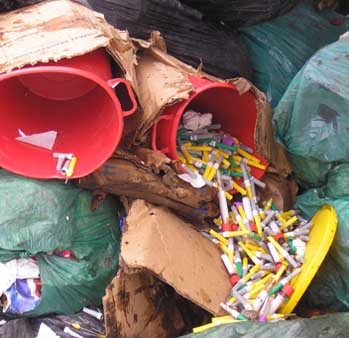 Photo by Todd Pepper
Bucket of bloody, unsterilized needles was dumped in
Liberia.Incineration is one of the traditional means of dealing with medical waste, but it has largely been banned in developed countries due to air quality issues. Of special concern is mercury from broken thermometers and batteries, dioxins, and chlorine from PVC tubing and bags if these are not properly separated. Autoclave sterilization uses high heat and steam to kill pathogens much the same way beans are cooked in a pressure cooker. The resulting mass then can be sent to the landfill safely. A company called Manejo Profesional de Desechos does provide a private biohazard disposal service for smaller Caja facilities, laboratories, dentists, and some veterinarians. It has its own dedicated trucks and autoclave operation. Coverage is mostly in the greater metropolitan area but the firm is expanding to underserved areas in Guanacaste and the southern part of the country. The company does not handle radioactive waste or heavy metals. According to Argelia Ramírez of Manejo Profesional de Desechos, many veterinarians do not understand about disposal of biohazards and deny that they can be a danger to human health. Ms. Ramírez said dentists are charged from 6,500 to 30,000 colons monthly. Many dentists have their own autoclaves, she said. Small autoclaves for sterilizing dental instruments cost several thousand dollars in the United States, so it seems unlikely smaller offices would have one. The firm also charges 615 colons per kilo to pick up sharp objects from the Caja’s San Sebastian clinic. Tht amounts to 30-to 40 kilos (66 to 88 pounds) per month, according to sources at the clinic. |
| Trip
to Liberia dump shows scavengers and workers exposed |
|
|
By Dennis Rogers
Special to A.M. Costa Rica A chance visit to the city dump in Liberia revealed several places where the chain to proper disposal of medical waste can fail. In this case it appeared that the local municipality’s garbage collectors mishandled a bucket of needles that had not been sterilized according to the local hospital’s own procedures. At the dump, the day’s waste was still uncovered. At a properly-run sanitary landfill, all garbage is covered for the night. Numerous red bags reserved for infectious waste were in view on the surface. On inspection these revealed a mix of hospital garbage, most of it benign. A compactor truck, apparently the same one that had dumped those bags, arrived and unloaded the collection from the next trip. At the back of the load, what had been loaded first, came two red buckets for “sharps.” These contained a pile of needles used for drawing blood and several vials, each with some blood. No hypodermics were seen, but they are handled the same way. These containers are not meant to be compacted, and should have been placed in the waste cell to be covered later. The truck driver said they had come from the hospital. It appeared the buckets had been transported correctly in the |
cab of the
truck but not left at the dump. Then they were thrown into the
compactor box at the start of the next route. A number of scavengers were at the site and, given the Guanacaste heat, were not wearing boots. In the unlikely event that a blood sample came from a patient with HIV or Hepatitis C, any puncture could theoretically transmit the disease. A municipal employee operating the truck ram did nearly step on the needles. At the hospital a housekeeper denied that waste was going to the dump. She said all medical items were put in red bags and these were “burned in a hole in there,” gesturing towards the center of the hospital compound. No, the special bags were used only for contagious hazards, the employee said. In plain sight at the entrance a trash bin held a red bag with several recyclable soda bottles. Jober Dávila of the hospital administration said that it has an agreement with the Municipalidad de Liberia to handle the hospital waste after it is sterilized in the hospital’s autoclave. He said the sharps should have been sterilized as well. It was evident they had not been, with papers and labels intact. Human body parts and placentas are buried in the municipal cemetery, Dávila said. |
|
Presale pricing in effect for one more week only
 |
| You need to see Costa Rican tourism information HERE! |
| A.M. Costa Rica fourth news page |
|||||||||
| Home |
Tourism |
Calendar |
Classifieds |
Entertainment |
Real
estate |
Rentals |
Sports |
About us |
|
| San José, Costa Rica, Thursday, June 7, 2007, Vol. 7, No. 112 | |||||||||
| Amnesty UK warns of dramatic erosion of online freedoms |
|
|
By the A.M. Costa Rica wire services
Amnesty International warns that the Internet could change dramatically, unless action is taken against the erosion of online freedoms. Amnesty International UK made the warning before a global Web-cast conference that will feature victims of Internet repression from around the world. Tim Hancock, Amnesty International UK's campaign director, said "the virus of Internet repression" is spreading. He cited China, where the Internet allows economic growth but curbs free speech or privacy. Hancock said dozens of governments are following the Chinese model by arresting bloggers and blocking Web sites. He accused major Internet companies of attempting to expand their markets by colluding with governments' efforts to control what people see on line. Amnesty says Internet companies such as Cisco, Google, Microsoft and Yahoo! are providing filter hardware and releasing personal data that leads to arrests. When challenged on their presence in countries such as China, the Internet companies have maintained that they are simply abiding by local laws. Amnesty spokesman Steve Ballinger said that the companies are putting profit ahead of the human rights of Web users who are their customers. "Companies have tried to use local laws as an excuse for the way they have operated in these countries," said Ballinger. "All Amnesty is saying is the companies have an |
obligation to act within international
human rights standards and global human rights norms and just because
the laws in a country like China for example might require them to act
against human rights that does not mean they must roll over and do so
without a fight." Amnesty noted an increase in reports of 'Internet filtering' around the world. It says some governments block access to specific sites or sites featuring particular words or themes. Azerbaijan, Bahrain, Burma Ethiopia, India, Iran, Morocco, Saudi Arabia, South Korea, Thailand and Tunisia are named as among at least 25 countries where state-mandated net filtering is practiced. Politically motivated closures of Web sites and Internet cafes, as well as threats or imprisonment are more widespread, Amnesty says. It gave the example of Egyptian blogger Abdul Kareem Nabeel Suleiman who was sentenced to four years of prison earlier this year for "contempt of religion" and "defaming the President of Egypt." The conference Web cast is entitled "Some People Think the Internet is a Bad Thing: The Struggle for Freedom of Expression in Cyberspace" can be watched on www.amnesty.org.uk/Webcast. It will look into the future of Internet freedom and how Web users are using the power of the Internet to resist attempts to repress freedom of speech by governments and global information technology companies. Amnesty said it recognizes the need for some limits to freedom of expression, such as stopping Web sites promoting racial hatred, violence or child pornography. |
| Students and others continue to protest shutdown of Venezuelan TV station |
|
|
By the A.M. Costa Rica wire services
Thousands of Venezuelans are protesting in the streets of the capital, Caracas, again Wednesday to show their anger at the government shutdown of the nation's oldest private broadcaster. The demonstrators, many of them university students, marched to the attorney general's office in Caracas, calling for freedom of expression. |
The protests have gone on since Radio Television Caracas, or RCTV, went
off the air May 27, after the government refused to renew its broadcast
license, saying it had violated broadcast laws. The decision has
prompted international criticism from countries such as the United
States and Spain. Saturday, supporters of President Hugo Chavez rallied in the capital in a show of support for his decision to close the station. It has been replaced by a state-funded channel. |
| News from
the BBC up to the minute |
BBC sports news up to the minute |
| BBC news and sports feeds are disabled on archived pages. |
|
| A.M. Costa Rica Sports news local and from the wires |
 |
|
|
|
|
|
|
|
|
| San José, Costa Rica, Thursday, June 7, 2007, Vol. 7, No. 112 | ||||||
|
||||||||
|
|
|
|
|
|
|
|
| What we published this week: | Monday | Tuesday | Wednesday | Thursday | Friday | Earlier |
|
|