
|

mmmm
|
Your daily English-language
|
 |
|
|
|
|
|
|
|
|
|
|
|
|
||||||||||||||||||
|

|
||||||||||||||||||
|
Second news page |
 |
|
|
|
|
|
|
|
|
|
|
 |
| Costa Rica Expertise Ltd http://crexpertise.com E-mail info@crexpertise.com Tel:506-256-8585 Fax:506-256-9393 |

|

|
|
|
|
|
Chiquita Brands International, Inc., has admitted that some employees have engaged in anti-competitive practices. The company has disavowed the practices. The Cincinnati-based firm has extensive holdings in Costa Rica and has produced bananas here since 1871. The company said in a press release Friday that it is cooperating with an investigation by the European Commission, which is looking into producers and distributors of bananas and pineapples for possible violations of European laws that promote competition. The British press reported over the weekend that the admissions by Chiquita triggered raids of the offices of some of the largest fruit producers. Included were offices of Dole and Del Monte Chiquita said that it became aware that certain of its employees had shared pricing and volume information over many years with competitors in Europe and that the employees may have engaged in other conduct in violation of European laws and company policies. The company said that it has stopped the practices and voluntarily reported the developments to the European |
commission. The company noted that
by reporting the transgressions voluntarily it gained immunity from any
fines that may be levied by the European Commission. Antitrust fines can
be up to 10 percent of income.
Chiquita also said that certain of its employees in one Latin American country shared information with competitors regarding the volume of fruit shipped from that country to North America. While Chiquita said it does not believe that such conduct had any anti-competitive effects, the company has discontinued the conduct and notified the appropriate regulatory authorities in the United States and Canada. The company said it intends to cooperate fully should any governmental inquiry or investigation be undertaken in the United States or Canada. In addition to Costa Rica, Chiquita is involved in banana production in Colombia and Guatemala. There was no indication which Latin American country was the source of the leak or if reports already had been made to officials in that country. The company is one of the largest banana producers in the world and a major supplier of bananas in Europe and North America. The company also distributes and markets fresh-cut fruit and other fruit products. |
|
A reply to Jo Stuart’s column Dear AM Costa Rica: As a Blue-State-Liberal-Democrat who has never voted for a Republican in his lifetime, I always read, with great amusement, Jo Stuart's perverse views on world events. It is beyond me that anyone would take this, ah, well never mind, seriously on any subject and think she represents the view of the liberal faction in this nation. I fear, however, that some people think her twisted views do represent we liberals. As an example, her latest fear that the United States is heading for a possible civil war or will turn into another Iraq is so far off the radar screen that its beyond the pale. I can't believe that AM Costa Rica continues to publish and pay her. First off, we, the United States have had a civil war Ms. Stewart and it occurred before Costa Rica's. Duh. I know from reading your pieces that Costa Rica is paradise found and the most advanced nation on the face of the earth. First and best with everything. But even they can't think of all things first, including civil wars. We produced Lincoln from ours. How'd Figueres (father and son) work out for Costa Rica? If you’re stumped, don't worry, just ask Robert Vesco. Second, yes, there is divisiveness in the United States currently and it is bitter. Our history is full of divisiveness if you would care to check. You might want to revisit the Vietnam war when we heard the same dire predictions from folks like you. Or the Great Depression. Or the Grange movement. You wouldn't know this seeing as how you have fled the U.S. for a run-down-corrupt-third-world-sinkhole (for which I, and others, are grateful) where you think the living is great. But, Americans always have disagreements given we are an actual democracy, and as the passions cool, and the arguments on both sides are considered, in the end we always return to the middle, where the majority of the nation resides. We shall again and without bloodshed. Sorry to disappoint you Ms. Stuart. So flee back to your third floor walkup (how are the bugs that were a subject of one of your pieces doing these days?). And after you write about your astonishment at the prices for Denny's Early Bird Specials, continue writing on those things you know. How about Area 51? Hey, the little green men may be at the heart of the forthcoming civil war. Get on that ASAP. C. K. Hobbs
And yet another reply
New York Dear A.M. Costa Rica: I am a United States citizen. My brother moved to Costa Rica because of his job, and I have been there several times to visit. Occasionally I read A.M. Costa Rica online. I would like to comment on the recent article, "The U.S. is so polarized that conflict is possible" by Jo Stuart. When the United States was founded, it was founded on Christian principles. That is a historical fact. And while there may have been some dissent, the United States was overwhelmingly a Christian nation. The founding fathers' beliefs caused the government to be set up the way it was, the Constitution to be written as it was, and laws to be established the way they were. These beliefs guided everything the United States did (including the Revolutionary and Civil wars, in which the United States fought for freedom for its citizens). Throughout time however, something happened. Those with the most saliency and influence in the U.S., including government officials, lawmakers, educators, entertainers, and the media, became less Christian and more liberal. While liberalism became increasingly visible, the "everyday" American people remained fundamentally Christian and conservative in their political beliefs. Few realized it, because virtually everything on television, in the papers, in the classrooms, and in the movies projected liberalism. To be frank, I think that liberals assumed everyone was just like them. During this time, Christians disagreed respectfully and quietly with the course of their nation. It was only in recent years that Christians became disgusted, and, yes, enraged, enough to make their voices heard. What Ms. Stuart observed is the result of Christians for the first time taking a firm and vocal stand on the issues that are important to them. Is the US polarized? Yes. Wherever two or more people are gathered together, disagreement is inevitable, and it is okay. It is even okay for people to passionately defend their beliefs. I thank God every day that I live in the U.S. — a nation where people are free to express their views, and a nation where neighbors, friends, family members, and co-workers can disagree and still love and respect one another. Fortunately, the country's Christian roots in that area are still intact. Finally, while I do not doubt what Ms. Stuart observed, I disagree with the tone and intent of the article. It's comparison of "blue" and "red" states to "free" and "slave" states is completely inappropriate, and I assume was meant to strike doubt and fear in the hearts of Costa Ricans toward the United States? The country where men and women are right now voluntarily sacrificing their lives to free slaves halfway across the world? I hope you print this article. I desperately want my brothers and sisters in Costa Rica to get to know the REAL United States. Tracy Polinsky
Pennsylvania, U.S.
By the A.M. Costa Rica staff Two persons died in the Río Machuca near Orotina Saturday when they were caught by a swell of water. They were with three other swimmers who survived by hanging on to limbs and branches for nearly two hours. The dead were found Sunday, the Fuerza Pública reported. They were Laura Vargas Muñoz, 24, of Heredia and Sergio Madrigal, 34, of Cartago. The area is near the spot where four persons drowned May 7 in the same
river. They were three members of the same family and a boyfriend.
Aserrí man murdered By the A.M. Costa Rica staff A man in Aserrí died early Sunday when men in a pickup tried to steal his motorcycle. He was identified as Victor Manuel Cascante Naranjo, between 25 and 30 years. Cascante was in a nearby bar and left about 2 a.m. He was held up not far from the bar. He was shot in the back of the head. The motorcycle lay nearby. Prisoner flees La Reforma By the A.M. Costa Rica staff Police in the Alajuela area are seeking a Cuban who somehow broke out of the La Reforma penitentiary. The man is Manuel Tata Rodríguez, 46, who is serving an 11-year sentence for murder. He also is wanted in the United States, officials said. He was reported missing Sunday morning. |
|
|
with the observations of Dr. Lenny Karpman Click HERE! |
 |
|
clowns with supplies Special to A.M. Costa Rica The gray sky promised rain, but it held off, and the 150 children gathered in the community center of Pila de Naranjo waited expectantly. Then the clowns appeared and the fun began. The occasion was a fiesta arranged by the San José Kiwanis Club with help from the International Church in Escazú, Maersk Shipping, and Vista del Valle Plantation Inn of Naranjo. The purpose was to entertain and to distribute to Isabel Iglesias Primary School several boxes of badly-needed school supplies. In the months ahead the notebooks, pens, pencils, art paper, plasticine and other materials will make school life more interesting, maybe even more enjoyable, for these children of mostly poor families. The event was arranged by parent Rolan Muñoz and Kiwanis President Ron Tucker. |
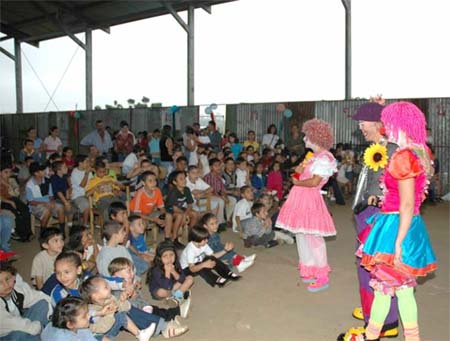
Photo by Ross Gilchrist
|
|
|
|||
| Estar acabangado no es nada bonito
"There’s nothing nice about being sad." The word acabangado is pure dialect and probably comes from the standard Spanish cabizbajo, meaning "sad" or literally "with the head bowed." We might also say, for example, anda de cabanga meaning "his walk is sad" or "he’s walking sad" maybe because he has lost someone dear to him or he misses his wife who has left him. Cabanga is also the primary emotional ingredient in those wonderful crying songs from México. My favorite cabanga song is "Noche de Rondas." In this canción, the singer addresses the moon, and asks her where his lover may be, and with whom she is walking in the moonlight. "But please tell her," the singer mournfully implores the moon, "that I will be here waiting until she tires of walking around in the moonlight with another and comes back to me." I’m telling you that if that guy whose wife left him heard this song he’d have to go right out and buy himself a big bottle of tequila to drown his sorrow like some character in a Mexican soap opera or Pedro Infante in one of his old movies. Cabanga, accurately describes the sort of wistfully melancholy feeling I sometimes get when I remember my Costa Rica of days gone by, when walking in the streets was such a pleasant evening occupation, when people would stop their cars to say hello, and when going to the Avenida Central at Christmastime to throw confetti on passersby was considered a friendly gesture instead of a provocation. Cabanga is not quite the same as nostalgia because things that trigger feelings of nostalgia often get resurrected to live again, like feeling nostalgic for the music of the 60s, for example. The things that bring on feelings of cabanga we know will never come back, and this in and of itself is the essence of the meaning of the word. Many years ago one of my older brothers, his wife, and |
I went to see a Mexican tear jerker called "La de la Mochila Azul," "The Girl With the Blue Backpack." It tells the story of an 8-year-old boy who lives in San Diego, California. His parents are being deported back to México, and he goes to live with his uncle, played by a very well known Mexican comedian known as Resortes (the word resortes means "springs" in English). In this movie, however, Resortes plays a drunkard, who loves his nephew very much. The child welfare agency has found out that the little boy is pretty much unsupervised and that his uncle is a drunk. So they move to take the boy away from the uncle and place him in foster care. There is one very big emotional scene when the uncle goes to court and makes an impassioned plea to regain custody of the boy. But the entire movie is so sad that everyone is dabbing their eyes as they leave the theater, including my big, bad macho brother. In this film Pedrito Fernández, who many will recall won the Latin Grammy award a few years ago, sings the song "La de la Mochila Azul" to his girlfriend. You can mention this film to almost any Costa Rican over the age of 30 and they will tell you just how sad and acabangada it is. |
||
|
|
|
|
and special reports Costa Rica again ended up in the middle category of the U.S. State Department's human trafficking report released Friday. Noting that the United States spent $96 million in anti-trafficking assistance to foreign governments and non-government organizations, U.S. Secretary of State Condoleezza Rice characterized trafficking as modern-day slavery. The report covers all types of human trafficking, including transportation for forced labor and sexual slavery. Costa Rica was characterized as a country that is a source, a transit point and a destination for men, women, and children trafficked for the purposes of labor and sexual exploitation. Women and children from Cuba, the Dominican Republic, China, Colombia, Nicaragua, Peru, Russia, Romania, the Philippines, Ecuador, and Guatemala are trafficked for sexual exploitation, said the report. Costa Rica is in the middle category of the report because it does not comply fully with international standards, said the report. The country had limited laws to prosecute and convict traffickers. However, a proposed immigration law that is moving toward passage in the Asamblea Nacional does contain such sanctions. Ambassador John Miller, the director of the State Department’s Office to Monitor and Combat Trafficking in Persons, explained how the ratings are made at a Washington, D.C. briefing: "Our sources of information are diverse: law enforcement, U.S. embassies, NGOs, daring activists, foreign governments, our own visits. Everything enters the mix, extensive analysis and debate goes into the |
assessment of each country and assignment
into Tier 1, Tier 2, Tier 2 watch list, or Tier 3."
"We didn't design the system, he said. "Congress designed the system with important help from nongovernmental organization and faith-based communities." This is the fifth year that the department generated the congressionally mandated report. Costa Rica’s hands-off policy on adult prostitution seems to run counter to the tenor of the report. The U.S. Government adopted a strong position against legalized prostitution in a December 2002 National Security Presidential Directive based on evidence that prostitution is inherently harmful and dehumanizing, and fuels trafficking in persons, said the report. Prostitution and related activities, including pimping and patronizing or maintaining brothels, fuel the growth of modern-day slavery by providing a façade behind which traffickers for sexual exploitation operate, the report said. Where prostitution is legalized or tolerated, there is a greater demand for human trafficking victims and nearly always an increase in the number of women and children trafficked into commercial sex slaver, it added. The report estimated 600,000 to 800,000 people are trafficked across international borders annually, 80 percent of victims are female, and up to 50 percent are children. Hundreds of thousands of these women and children are used in prostitution each year, said the report. The report said that prosecution of trafficking offenses lags in Costa Rica because the judicial system is unable to protect victims. The report also said that border monitoring remains poor and there are reports of complicity of immigration officials who are facilitating the cross-border movement of people, including trafficking victims. |
|
|
|
|
Here is the narrative in the U.S. State Department’s human trafficking report that relates to Costa Rica: Costa Rica is a country of source, transit, and destination for men, women, and children trafficked for the purposes of labor and sexual exploitation. Women and children from Cuba, the Dominican Republic, China, Colombia, Nicaragua, Peru, Russia, Romania, the Philippines, Ecuador, and Guatemala are trafficked for sexual exploitation. Costa Rica also serves as a transit point for individuals trafficked to the United States, Mexico, Canada, Japan, and Europe for sexual exploitation. Women and children are trafficked within the country for sexual exploitation. Men, women, and children are trafficked internally for forced labor as domestics, agriculture workers, and workers in the fishing industry. Child sex tourism is a major problem in the country. The Government of Costa Rica does not fully comply with the minimum standards for the elimination of trafficking; however, it is making significant efforts to do so. Costa Rica continues to lack a comprehensive law enforcement strategy, thereby limiting its ability to effectively investigate, arrest, prosecute, and convict traffickers. Costa Rica needs to amend its laws to address trafficking offenses, increase efforts to protect victims, and work regionally to detect trafficking that is occurring as part of transnational illegal migration. Costa Rica also needs to appoint a single coordinating authority on trafficking and task it with drafting a national plan. Prosecution Despite the continued absence of a cogent law enforcement strategy, the government was able to make modest law enforcement gains over the last year. The Judicial Investigative Police (OIJ) created a new investigative unit dedicated solely to trafficking and smuggling. Costa Rica lacks an anti-trafficking law, which greatly inhibits its ability to prosecute and convict traffickers. Scattered criminal statutes may be used against traffickers, and prosecutors use these sporadically. The government secured ten convictions |
among the different prosecutors’
offices for trafficking-related offenses over the last year. Although hundreds
of investigations into the commercial sexual exploitation of children have
been initiated, few have resulted in successful prosecution because of
the government’s inefficiency and inability to protect victims. There are
several offices in Costa Rica responsible for trafficking offenses, but
little coordination among them frustrates law enforcement efforts. There
have also been reports of corruption along the borders among immigration
officials.
Protection The government’s efforts to protect trafficking victims remained inadequate over the last year, partly as a result of resource constraints. The government’s victim protection policy is ad hoc and unevenly applied; it provides some assistance to Costa Rican victims, but shelter space is very limited and does not accommodate the large number of victims in the country. The government does allow foreign victims to stay in the country to testify against traffickers, but this does not happen often due to the lack of government assistance for victims. Instead, foreign victims (excluding children) are often deported. Prevention Recognizing that trafficking is a serious problem, senior government officials spoke out on the dangers of trafficking and the need to do more. The government, in collaboration with international organizations, conducted a large-scale information campaign designed to warn tourists of the penalties for sexually exploiting children. The campaign included inserts in immigration documents and posted billboards. The government is in the process of printing a booklet for foreign diplomats that explains trafficking and how to assist trafficking victims. Additionally, there are a number of other prevention efforts under way, including a 911-system to report sexual exploitation of minors. However, border monitoring remains poor and there are reports of complicity of immigration officials who are facilitating the cross-border movement of people, including trafficking victims. |
|
Human trafficking report requires independent study |
|
|
The description of human trafficking in Costa Rica by the U.S. State Department seems to run counter to the opinions of those on the ground here. There also appears to be something wrong with a report that relies on input from "non-governmental organization and faith-based communities," as a senior State Department representative said. With the United States spending $96 million a year to stem human trafficking, few non-government organizations would gore their own ox by saying there is not much of a problem. The situation in Costa Rica is complex. With adult prostitution ignored, there is no wonder that individuals under 18 also want to make money selling their bodies. But there has been little evidence of compulsion here. There is the case of a Russian prostitute murdered by persons unknown near Jacó. One theory is that she wanted to return home and suffered the wrath of her handlers. But even when she lived in Sabana Sur she was not locked up and could come and go as she pleased. Happier is the lot of another Russian prostitute who came here on a language student visa three years ago to work in an exclusive brothel in Guanacaste. She fell in love with the cook and fled with him even though she had not paid back the cost of her plane ticket. |
The specter of forced prostitution
of minors always comes up when human trafficking is discussed. In many
countries this is a serious problem. But in Costa Rica, the supply of prostitutes
of any age seems to exceed the demand. Hundreds of girls and women come
to Costa Rica from Latin lands and eastern Europe. They do so of their
own will looking for the only work they know.
And statistics have shown that sex with underage children is much more of a local problem than a tourist attraction. The U.S. Federal Bureau of Investigation set up a Web site in Florida as bait to trap would-be customers of underage prostitutes. That was the "taboo vacations" Web site. Those who used the Web site’s services to book a trip to Costa Rica for an underage encounter were arrested before their flight left Florida. Nevertheless, the FBI managed to arrest only 11 persons during the extended period the Web site functioned. Entrapment issues aside, if the FBI really was in the child sex business, agents would have gone broke. Clearly what is needed is a serious effort to evaluate the scope and definition of the human trafficking situation in Costa Rica. And there should be many categories. One should not lump 20-year-old men seeking to be illegal immigrants into the United States with 9-year-old girls enslaved for perverted sexual purposes. And the evaluation should be done by individuals who do not have a financial stake in the outcome. |
|
|
|
|
|
|
|
|
| What we published this week: | Monday | Tuesday | Wednesday | Thursday | Friday | Earlier |
|
|





