
Your daily English-language news source
|
|
|
Your daily English-language news source |
|
|
|
|
|
|
|
|
|
|
|
|
|
|
|||||||||||
|
|
|||||||||||
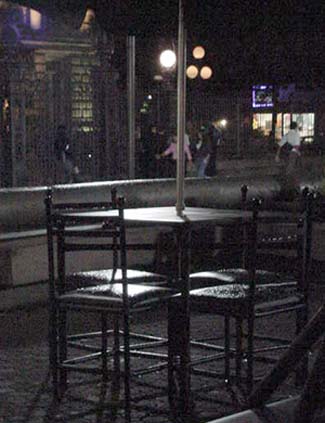
A.M. Costa Rica photo
The long-suffering chairs at a sidewalk cafe near the Teatro Nacional
beaded with precipitation as the city recovers from another heavy downpour.
The photo was taken about 6 p.m. Tuesday. |
about 30 colons Friday By the A.M. Costa Rica staff Taxi rates are going up Friday once the official notice is published in the governmental La Gaceta. The base price for a ride will go from the present 210 colons to 240, according to a decision announced Tuesday by the Autoridad Reguladora de Servicios Publicos. The base, 240 colons, is about 61 cents, about the same price that taxis have been for three years. The occasional increases just make up for the devaluation of the colon. Three years ago when the colon was valued at 310 to the U.S. dollar, the base taxi rate was 180 colons, about 58 cents. The charge for each additional kilometer in urban areas will go from 125 to 135 colons. The last increase in the taxi rates took place in August when drivers got just a 10-colon increase in the basic rate. Drivers have felt they were behind the curve and sought an increase in the base rate of 40 colons. But since the request was made to the price-setting agency, the Iraqi war ended as well as fears of a substantial hike in the price of gasoline. |
| Dengue outbreak
in La Fortuna By the A.M. Costa Rica staff Health officials are fighting to control an outbreak of dengue in La Fortuna de San Carlos and hope that it can be controlled in the next two weeks, according to Rocío Sáenz Madrigal, minister of Salud. She said Tuesday that since April 27 some 184 cases of dengue have been reported and that 81 of the cases were discovered last week. Officials are not certain why La Fortuna has become such a dengue hot spot. The disease is spread by mosquitoes. The community is the principal tourist center for visitors to Arenal Volcano, which is just to the west. Typically dengue outbreaks occur along both coasts. TV show fined
By the A.M. Costa Rica staff The Chilean national television council, Consejo Nacional de Televisión, has fined the Televisión Nacional network $2,580 for showing a pregnant Nicaraguan 9-year-old even though the child’s parents brought her to Chile. This was announced Tuesday by Casa Alianza, the child advocacy organization that raised the issue. The organization gave this account: The child, Rosita, was in Costa Rica when she first made the news because she was so young and pregnant. The child’s parents took her to Nicaragua where she underwent an abortion. The television show "Con Mucho Cariño" aired an interview with the child and her parents March 13, and Casa Alianza filed a complaint along with a Chilean organization. They cited an international treaty over the rights of children. The council decided that the show unnecessarily exploited the child and did not protect her identity. Miss Dominican Republic
By the A.M. Costa Rica staff PANAMA CITY, Panamá — An 18-year-old contestant from the Dominican Republic became Miss Universe here Tuesday. She is Amelia Vega, who also won a prize for the best national costume. Other finalists were Miss Venezuela Mariangel Ruiz, Miss Japan Miyako Miyazaki, Miss South Africa Cindy Nell and Miss Serbia and Montenegro Sanja Papic. The event drew 70 contestants. The Miss Universe Pageant is owned partly by Donald Trump, the U.S. tycoon. Martha Stewart may
By the A.M. Costa Rica wire services NEW YORK, N.Y. — Scandal-plagued U.S. style mogul Martha Stewart may face criminal charges ranging from insider trading to obstruction of justice, officials at her company announced Tuesday, as shareholders gathered here for an annual meeting. If she is found guilty, Ms. Stewart, one of the world's wealthiest women, could face a jail term. The scandal was started with Martha Stewart's sale of 4,000 shares of ImClone Systems in December of 2001. One day before the U.S. Food and Drug Administration announced it would not review ImClone's application for approval of a promising cancer drug called, "Erbitux". ImClone's stock price plunged on the news. Since then, federal authorities have been trying to determine if Stewart sold the shares because she had prior, "insider" knowledge of the FDA decision due to her friendship with ImClone founder Samuel Waksal. He already has pleaded guilty to insider trading, and faces six to seven years in prison at his sentencing next week. Ms. Stewart has denied any wrongdoing in the ImClone stock sell-off. She says her broker had been told in advance to sell the stock if it dropped to a pre-determined price. Her chief attorney, Robert Morvillo, says "If Martha Stewart is indicted, she intends to declare her innocence and proceed to trial." |
|
|
|
|
|
WASHINGTON, D.C. — The vice president of Colombia appeared before a U.S. Senate panel Tuesday to appeal to lawmakers to continue funding U.S. efforts in support of his country's anti-drug initiatives. Colombian Vice President Francisco Santos Calderon offered a positive assessment of his country's efforts to fight drug production and trafficking in testimony before the Senate Caucus on International Narcotics Control. He noted that illegal coca crops were reduced by 30 percent since the start of last year, thanks in large part to an aggressive spraying operation begun by the government of Alvaro Uribe, a close U.S. ally who took office last August. Santos also underscored his government's commitment to cracking down Marxist guerrillas and far-right paramilitary groups. He said in the first months of this year, homicides decreased by 20 percent, compared to the same period last year, while kidnappings went down by 40 percent. He also praised an agreement with the United States under which his government has extradited 78 Colombians to the United States to face narco-trafficking crimes. "The Uribe administration is implementing a multi-track fight against the illegal drug trade," he said. "This involves eradication of illegal crops, interdiction, destruction of narco-trafficking infrastructure, and seizing their assets, military and police action against traffickers and law enforcement and judicial operations. All this effort is directed at a certain goal: zero tolerance for drug-trafficking and total eradication of this activity by the year 2006." The United States has given Colombia some $2.5 billion over four years, mostly to buy, operate and maintain helicopters and spray planes for coca crop eradication. It is also training Colombians to pilot the planes so they can take full control of the missions. But a new study by the General Accounting Office, the investigative arm of Congress, says Colombia lacks the money and trained personnel to sustain |
the program. The GAO says it will
be up to the
United States to keep the effort going, along with the U.S. contractors who fly and maintain the planes, at a cost of some $230 million a year. It also says Colombian police never agreed to the U.S. plan to have it take over the program. But Acting Assistant Secretary of State Paul Simons took issue with the report. "All of the helicopters now have Colombian co-pilots, who are fully qualified, and we are in the process of converting those co-pilots into pilots in command," he said. "Now that process is going to take a couple of years, but we are well on our way to a 'Colombianization' of the pilot crews for all of these helicopters." Simons said the Bush administration's budget request for next year includes $731 million in anti-drug funding for Andean countries, more than two-thirds of which would go to Colombia. The administration is seeking another $110 million to aid the Colombian military in the anti-drug effort. Colombia is the largest producer of cocaine in the world and is a major supplier of heroin to the United States. Bomb blast kills
By the A.M. Costa Rica wire services BOGOTA, Colombia — Authorities in Colombia say a bomb explosion has killed four people and wounded at least 10 others. Police say the blast took place late Monday in the town of Granada, northwest of here. An army official has blamed the attack on Colombia's main rebel group the Revolutionary Armed Forces, or FARC. Authorities have offered $7,000 for information leading to the arrest of the bombers. Colombia is mired in a 39-year civil war involving leftist rebels, rightist paramilitaries and the government. The conflict leaves several thousand people dead each year. |
|
|
|
|
MEXICO CITY, México — A small leftist political party in Mexico has filed complaints against five prelates and officials of the Roman Catholic Church accusing them of violating the constitution by instructing parishioners on how to vote in an upcoming election. Leaders of the México Posible party are leading the charge against the church officials citing pastoral messages issued in several churches in recent weeks, telling the faithful not to vote for any candidate who favors legalizing abortion, marijuana use or homosexual marriage. The México Possible party favors all three propositions and is competing in the nationwide mid-term elections set for July 6. Party leader Ramon Loya said the church officials cannot be allowed to violate the law and interfere with the electoral process. He said it is immoral for any official or cleric from any religion to use their influence for political purposes with their congregations, something that is illegal in Mexico. Friction between civil and church authorities dates back to colonial times in México. After the country gained independence from Spain in the early 19th century, restrictions were placed on the church. |
During the 1920s the government repressed
the
church and even executed a number of priests. Until 1993, when restrictions on the church were relaxed, priests and nuns were not allowed to wear their religious garb in public. The Mexican constitution forbids any intrusion by the church in civil affairs, and Interior Department officials say the recent statements by church officials could lead to legal action, including fines of as much as 800,000 pesos, about $80,000. México City's Catholic Cardinal Norberto Rivera denied any attempt by the church to interfere in the electoral process with an eye towards establishing itself as the official religion. He said religious people have a right to speak freely and that the church officials under attack did not refer to any party or candidate by name in their pronouncements. He said they simply spoke of principles that are a fundamental part of Catholic doctrine and belief. Other church officials have accused the México Possible party of provoking the dispute with the church in order to gain free publicity ahead of the July election. Under electoral rules a party must gain at least 2 percent of the vote in order to qualify for future funding from the government. México Possible is one of several small parties that have been able to continue largely because of this funding. |
| What we published this week: | Monday | Tuesday | Wednesday | Thursday | Friday | Earlier |
|
|


 E-mail:


