|

mmmm
|
Your daily English-language
|
 |
|
|
|
|
|
|
|
|
|
|
|
|
||||||||||||||
|

|
|
Second news page |
 |
|
|
|
|
|
|
|
|
|
|
 |
| Costa Rica Expertise Ltd http://crexpertise.com E-mail info@crexpertise.com Tel:506-256-8585 Fax:506-256-9393 |

|

|
| Air crash survivor
found
after nearly a day in sea By the A.M. Costa Rica staff A U.S. skydiver spent nearly a day floating in the Pacific off Playa Herradura until he was rescued by a fishing boat Wednesday afternoon. Five of his companions still are missing. The man, identified by the security ministry as William Slater, was hospitalized but reported in stable condition. He and his companions left the local airport at Esterillos near Parrita about 4:45 p.m. Tuesday for practice parachute jumps, officials said. The aircraft was reported missing and a major search was mounted Wednesday, but officials did not know whether to look in the sea or in the nearby mountains. Officials said that the aircraft encountered a storm and got into trouble. Three of the occupants, including Slater, used their parachuting skills to abandon the plane before it crashed. Searchers found a fuel slick in the Pacific earlier Wednesday but for technical reasons they did not think it came from a crashed plane. In addition to Slater, those in the plane were identified as Jorge Meléndez, the Costa Rican pilot; a Canadian named Milton Burton, who was the owner of the aircraft; a Mexican, Emanuel Sánchez; another U.S. citizen named James Simplicio, and a U.S. citizen for whom searchers had only the last name of Jeans. Most were believed to be tourists. Rescue workers, including representatives of the Ministerio de Gobernación, Policías y Seguridad Pública and Cruz Roja will direct all their attention to the Pacific today as the search starts anew. Slater was found in the Bahía Los Sueños about two and a half miles off the coast. The aircraft was identified as a Cesna 206. Still unknown is why the men were going to practice parachuting over the open ocean, if they had ocean survival gear and why they were doing that so late in the day. Coincidentally that is the same type of craft that crashed Friday killing three Costa Ricans near Pursical. They ran into a mountain. Newspaper set record
By the A.M. Costa Rica staff A.M. Costa Rica registered 2.35 million Internet hits during the month of May, another record for the 4-year-old daily newspaper. The old record was 2.16 million hits in March. The May statistics show a 106 percent increase over May 2004. More details are available HERE. A.M. Costa Rica makes its monthly statistics public for the benefit of readers and advertisers. In all, some 97,576 persons read 391,699 pages during the month, an average of a bit more than four pages in each visit to the newspaper Web site. However, March readers, some 99,351 were more numerous. In May, 42,870 readers were listed as unique, in that they only were counted once no matter how many times they visited the newspaper each day. Periods of high readership continue to be in the morning between 6 a.m. and 9 a.m. and in the evening after dinner. The newspaper is posted to the Web site between 1 and 2 a.m. each Monday through Friday. The newspaper is read in some 85 countries beside Costa Rica and on the same day that it is posted to the Web site, as any advertiser knows. The statistics are gathered by an independent calculating program operated by the owners of the servers where the newspaper rents space in the United States. The statistics do not count hits or visits generated by Internet data-gathering robots, worms and other automatic devices. Art show will benefit
By the A.M. Costa Rica staff Two world renown Costa Rican artists will be featured in an art show that will benefit the Fundación Roberta Felix, which helps disabled youngsters on the central Pacific coast. The artist are Fabio Herrera and Mario Maffioli, whose works will hang at the Hotel California and at the Picasso Cafe in Manuel Antonio. The show will run all month, and the proceeds will go toward helping us buy a van or bus to help get the kids who most need physical therapy to a new center constructed by the foundation, said Ms. Felix. The reception for the shows are Friday from 5 to 8 p.m. at the Picasso Cafe in Manuel Antonio in the commercial center on the main road beside Banco Promerica and Saturday at the Hotel California, 200 meters east of Hotel Mono Azul from 5 to 8 p.m. Both shows contain works of both artists, said an announcement. The artists have been featured throughout the world in major expositions. They are two of the most prolific painters in Costa Rica. The works are very modern art mixed with a few other styles of theirs over the years, said the announcement. Both have exhibited in the United States, Europe and Asia. Piano students perform
Special to A.M. Costa Rica A special piano recital commemorating the 15th anniversary of the Suzuki Piano Talent Education Program of Costa Rica, taught and directed by Carol Murphy-Wunderle, featured student Sebastián Otalvaro, 15, of Alajuela who received a certificate award of achievement for successfully completing and performing Volume 2 of the Suzuki Piano School. Kirsten Aanderud, 11, from Escazú, who is soon to be moving back to the United States, received a certificate award for seven years of accomplishment in the program. Other performers at a May recital ranging in age from 4 to 18 were:
Daniel Jop, 4, from Escazú, José Leonardo Brenes, 4, from
Escazú; Amanda Goméz, 5, Couloir Hanson, 6, from Escazú,
Nicole Jop, 6, from
Band to perform in Puntarenas By the A.M. Costa Rica staff The Banda Nacional de Puntarenas plans a free concert of popular Latin American music at 6:30 p.m. today in the Casa de la Cultura in that Pacific community. Also featured will be singers. The band has 21 musicians and is led by Mauricio Salas Ramírez, director. |
|
|
with the observations of Dr. Lenny Karpman Click HERE! |
 |
 |

Yendry Pamela Arce Rojas washes organic peppers at the Centro de Acopia inspection and shipping center. |

Flor Alicia Paniagua wraps organic broccoli in plastic at the same center. The product will sell for nearly twice its non-certified counterpart. |
|
|
|
|
Special to A.M. Costa Rica The Costa Rican government's tourism slogan, "Costa Rica: No Artificial Ingredients," plays upon the country's growing reputation as a beacon of environmental protection and a paradise for eco-minded tourists. On the ground, however, the farmers who actually use no artificial ingredients are still struggling to sell their organically grown produce, the head of one of the nation's organic farm groups said this week. Although more organic farms are popping up each year, the head of the Zarcero-area Asociación de Productos Orgánicos de Alfaro Ruiz said consumers have been slow to jump aboard the organic movement. "In the supermarket, if there is my pepper that costs 100 colones and another that costs 80 colones, people will buy the one that costs 80 colones," association head Henry Guerrero said. "People don't know, and they don't care." Guerrero, who has been growing organic crops without synthetic pesticides at his Finca El Guerrero for 18 years, said he has seen only slow growth in the organic market over the past 10 years. Costa Rica's scattering of organic farmers have continued to push the movement forward, however, by forming coalitions like Guerrero's to share the financial burdens of organic farming. Alone, many small farmers cannot afford to have their farms certified by one of the six government-acknowledged certifying agencies. Eco-LOGICA, the largest of the six, estimates that one farmer trying to get certified alone would have to pay approximately 120,000 colons, some $254 at today’s rate of exchange. There are also regular fees for inspections, which the agencies conduct twice a year to make sure the farms are actually abiding by the country's rules, first written in 1997, that prohibit synthetic pesticides on designated organic farms. Certification for a group of Guerrero's size, 15 farms, is still pricey, at about 25,000 colons ($53) per farm, but the cost is far more manageable. Guerrero said his group, which was created last July, shares the weekly cost of about 4,500 colons ($9.50) in fees. It seems the farmers' strategy of working together is paying off. In 2004, 109 Costa Rican farms, spanning about 10,500 hectacres (25,935 acres), achieved organic certification, according to statistics from the government's Gerencia Técnica de Acreditación y Registro en Agricultura Orgánica. Data was not available about how many of those farms are part of associations like Guerrero's. More than 50 percent of the newly certified land was in Limón province. Guerrero said his association sells produce to major supermarket chains Automercado and Mas X Menos. The items are difficult to find in central San José, however. The Mas X Menos on Avenida Central carries no organic produce. The Automercado on Avenida Tres has four small bins of organics. Perimercado, the other big market in the middle of the city, has no organic produce. Guerrero's group tries to keep prices not more than 20 percent higher than conventional products, he said. In the Automercado Wednesday morning, a package of organic carrots cost 450 colons while conventional cost 405; organic broccoli cost 1,460 colons per kilogram and conventional cost 750, and a bag of organic sweet peppers cost 975 colons, 316 colons (67 U.S. cents) more than conventional. |
A.M. Costa Rica photos by Susan Reines
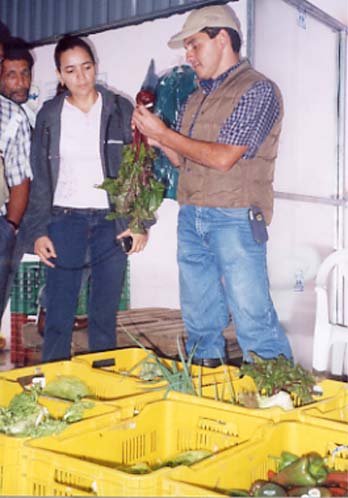
Henry Guerrero shows off his organic products to a Honduran tour group.
Asked why organic goods are more expensive than conventional, Guerrero said farmers must nurture their soil for many years, with many losses, before they can produce strong crops. The actual organic fertilizer, usually made of decomposed foodstuffs and solution containing microbiotic organisms, is actually much cheaper than sythetic pesticides, he said. Guerrero said he thought of the higher costs of organic farming as "investments" in health and in the earth. "There are some peppers that wouldn't be healthy for you," he said, holding up one of his sweet red peppers. "because they're made with chemicals. They would make you sick." In terms of hard research, there is little available to back up Guerrero's statement. National and international standards, implemented within the last decade, have not been in effect nearly long enough to study long-term questions, like whether eating organics reduces the risk of cancer. Italian researchers did recently find that organic produce might contain more antioxidants, which are thought to fight heart disease. The American Cancer Society officially states that there is no evidence that pesticides cause cancer in humans, but it also reports that laboratory animals exposed to high doses of pesticides are more likely to develop cancer, and that pesticides can be stored in human fat — for example, breast tissue. Traces of the toxic pesticide DDT have been found in the breast milk of Costa Rican mothers, according to information provided by Costa Rica's Programa Nacional de Agricultura Orgánica. Organic farming is about more than human health, however, Guerrero said. Organic farming is a system of natural production that not only excludes synthetic pesticides, he said, but includes practices such as crop rotation and soil fortification, which prevent erosion and keep soil fertile. |
|
|
|
|
|
LIMA, Peru — Doctors early Wednesday successfully separated the fused legs of a baby girl known as Peru's "mermaid." The little girl suffered from a congenital defect that occurs in one out of every 70,000 newborns. A team of 11 doctors at Lima's Solidarity Hospital took part in the operation, including plastic surgeons, pediatricians, and heart specialists. 13-month-old Milagros Cerron was born with a rare congenital defect known as sirenomelia, or "mermaid syndrome," with her legs fused together from her thighs to her ankles. The surgery was carried in a live, closed-circuit feed. Milagros' parents watched the procedure in a nearby room. After four-and-a-half hours, doctors separated Milagros' legs, holding her up to show the line of stitches extending from her heels to her inner thighs. |
The procedure actually surpassed
doctors' expectations. They had only planned to separate the girl's legs
up to her knees.
Milagros' parents, Sara Arauco and Ricardo Cerron, expressed their gratitude. Sara says, "I feel content to see my baby like that. I feel happy, very happy. I had faith and that faith is becoming reality. Never, never did I give up my faith" Her father Ricardo adds, "In that moment I saw the separation of my baby's legs and I know that in a couple of days she will be able to move and sit and that makes me feel happy." The lead surgeon, Dr. Luis Rubio, says Milagros will need up to 15 years of corrective surgery to reconstruct and repair her sexual, digestive, and other internal organs. But he says her intellectual development has been remarkable, particularly her speech and vocabulary. |
|
|
|
|
LA PAZ, Boilivia — Thousands of demonstrators have gathered in the Bolivian capital in the latest protest to demand nationalization of the energy sector. Protesters rallied Wednesday outside the congressional building in La Paz, a day after demonstrations in the city turned violent. Miners, peasants and leftist activists have protested for months, demanding a series of economic measures |
including the full nationalization
of the oil and gas industries. Bolivia's Congress recently passed a bill
to increase taxes on foreign oil companies.
The measure calls for the companies to pay a 32 percent tax on their oil production, in addition to an 18 percent royalty tax they already pay. Opponents say the law is not strong enough. In Washington, a State Department spokesman Richard Boucher said Wednesday U.S. officials are in touch with Bolivian leaders on the turmoil in the country. |
|
|
|
|
PORT-AU-PRINCE, Haiti — A French diplomat has been shot dead in Haiti while driving through the capital here. The French Embassy in Haiti says that Paul-Henri Mourral, the honorary French consul to the northern city of Cap-Haitien, was shot late Tuesday by gunmen |
who then stole his vehicle. He died
several hours later at a local hospital.
The French Foreign Ministry condemned the killing and demanded the Haitian government find the killers. United Nations peacekeepers were deployed in Haiti last year to try to restore stability after President Jean Bertrand-Aristide was ousted during a revolt. |
|
|
|
|
|
|
|
|
| What we published this week: | Monday | Tuesday | Wednesday | Thursday | Friday | Earlier |
|
|