Your daily English-language news source
|
|
|
Your daily English-language news source |
|
|
|
|
|
|
|
|
|
|
|
|
|
|
||||||||||
|
|
||||||||||
|
|
|
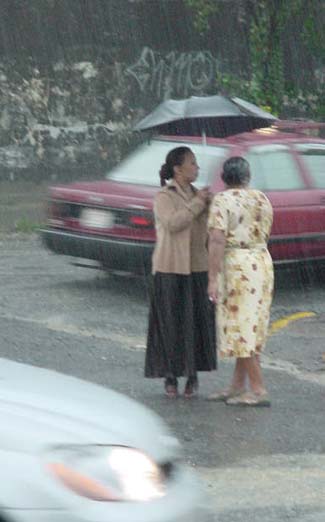
A.M. Costa Rica photo
Two women, trapped in a downpour Monday afternoon, try to make their
way across a city street. |
Plan on staying wet for the rest of the week. And plan on watching out for slides. The Costa Rican "winter" season is in full swing with heavy downpours, mostly in the late morning and afternoons. That’s also the prediction for today. Monday some 2.44 inches of rain fell in the Central Valley. That’s 40.7 mms. The rain caused some washouts, and emergency personnel are keeping an eye on more than 300 shanty towns throughout the country where the danger exists that the dwellings will be swept away by rain-driven slides. This is a recurrent problem in Costa Rica as homes are slapped together without consideration of the weather and gravity, frequently on filled land. The occupants usually are poor families. The weather bureau blamed the heavy rain Monday on a Pacific tropical disturbance that was stalled over northwestern Costa Rica. This caused heavy rain all over the country. The Institution Meteorológico Nacional also noted that two important events will happen Thursday. The first is the official start of the Caribbean hurricane season. This year nine tropical storms and four hurricanes are predicted. Although the storms do not hit Costa Rica, they can cause havoc higher up Central American and in México. Plus the rain spinoff of the storms can drench Costa Rica, depending on the path. The second major event Thursday is at night, a full eclipse of the moon. Totality begins at 9:14 p.m., said the weather experts. |
| Paseo Colon filled
with ICE marchers By the A.M. Costa Rica staff No one realized that so many people worked for ICE until a march estimated to contain 20,000 persons dominated Paseo Colon Monday. ICE is the Instituto Costarricense de Electricidad, and the marchers are demanding that the Banco Central de Costa Rica issue some 38 billion colons in bonds that the institute would use to modernize. That’s about $96.6 million. However, the march had another meaning. The workers were showing their strength so that no Costa Rican politician even considers briefly the idea of privatization or ending the institute’s monopoly. ICE runs the telephone service. A subsidiary is the electric company. Another subsidiary is the Internet monopoly. Workers think that their monopoly status is endangered by free trade treaty negotiations even though President Abel Pacheco has promised not to downsize the institute. While employees from all over the country were marching, few people were minding the stores. So little routine business was done Monday. Later the Casa Presidencial issued a statement saying that the government has fulfilled all the points of an accord reached last Feb. 16 with the institute. Jorge Walter Bolaños, minister of Hacienda, said that the problem with providing funds for ICE is that the institute has not provided figures that were clear and consistent in negotiations to raise rates or in discussions about longer-term financing with government officials. Due to national economics, the Central Bank has decided not to float the bond issue that ICE employees want, he said, adding that the government has negotiated a line of credit with the Banco de Costa Rica and international entities. Employees want the Central Bank to float the bonds to underwrite certain projects of the institute. This would result in more job security. The employees formed up in Sabana Norte Monday morning and marched to the Banco Central in the middle of the downtown to press their demands. They may end up going on strike Friday to continue to press their claims. Clothes vendor dies
By the A.M. Costa Rica staff Holdup men murdered a clothes vendor near his home Monday morning as the man and his wife were leaving for work. The bandits shot the man when he offered resistance. He was identified as Jorge Vega, 45. The murder happened about 9 a.m. in El Carmen de Goicoechea northeast of San José. The holdup men took the couple’s van that contained clothing they were
going to sell door to door. The vehicle was located later with some of
the merchandise missing.
|
|
|
|
|
|
GUATEMALA CITY, Guatemala — More than five years after a peace accord ended the civil war here, representatives of governments and international organizations that support the peace process are to meet to assess its progress this week. As the meeting approached, various sectors of Guatemalan society and diplomatic missions unleashed a wave of criticism of what they say is a stagnated process. Each morning, Guatemala's national palace guard performs a solemn ceremony in which they change a single white rose laid on the palace's monument to peace. Palace tour guide Italo Liberati talks to a group of tourists watching the ceremony. "In 1996 the table where the parts in conflict signed the peace was in that place, so the Guatemala artist Luis Carlos made this sculpture dedicated to the signing of the peace on Dec. 29, 1996, [ending] 36 years of internal war," he told the group. The daily changing of the rose is a symbol of the constant renewal of the peace process. But as the country nears the fifth meeting of the consultative group, as the donor nations and international organizations are known, many in Guatemala are saying the peace process needs more than a symbolic renewal. Tom Koenigs is the chief of mission for the United Nations office in charge of monitoring the implementation of the accords. He will present a report to the consultative group this week, assessing progress since their last meeting. He says that the improvement in the area of human rights that the group hoped for has not happened and the progress made in the implementation of the accords since February 2002 has been disappointing. The accords ended the armed conflict, but they also set out to address its causes, like poverty, |
racism, and impunity, while compensating
victims of wartime rights violations.
Critics say little has been done to address these issues. They complain that budget allocations for the armed forces are equal to that of wartime, while social spending is lagging. They cite recent events that they say demonstrate the lack of advances and the government's skewed priorities. In what was a highly controversial move, the government last week began paying compensation to former paramilitary groups for their obligatory wartime service to the army. The truth commission report identified these groups as responsible for wartime atrocities. Critics say it is an insult that the government is paying these groups when it has not put in motion the accord-stipulated compensation program for victims of wartime rights violations. Also last week an appeals court reversed a recent conviction for the 1990 murder of anthropologist Myrna Mack. The October verdict was the first-ever conviction of a high-ranking military officer for a wartime rights violation. Rights groups in Guatemala and abroad have scorned the appeal court's decision as a significant setback for justice. But critics and government alike agree that the accords are ambitious in scope. Guatemala's Secretary of Peace Catalina Soberanis says the government has made some important advances, but that fulfilling the accords in their entirety is costly and will take time. She says that many civil society groups and donor nations have recognized that some commitments are so ambitious, that their completion will require at least two more administrations. Despite the harsh reviews of the current administration's performance, detractors say the peace accords are not only the best framework, but the only one, that can ensure Guatemala a better future. |
| What we published this week: | Monday | Tuesday | Wednesday | Thursday | Friday | Earlier |
|
|