Your daily
English-language
news source
Monday through Friday

|
|
Your daily
English-language |
|
|
|
|
|
|
|
|
|
|
|
|
|
|||||||||||||||
|
|
|||||||||||||||
|
Second news page |
 |
|
|
|
|
|
|
|
|
|
|
 |
| Costa Rica Expertise Ltd http://crexpertise.com E-mail info@crexpertise.com Tel:506-256-8585 Fax:506-256-7575 |
 |
|
will get commercial area By the A.M. Costa Rica staff
The tourism institute is putting in a roofed structure in Puerto Limón where artisans and food vendors can sell to tourists who come in on cruise ships. The central government has frequently been criticized for failing to provide resources for the Caribbean coast. This project will create 1,700 square meters (18,298 square feet) of roofed space along the breakers. The cost will be 145 million colons or about $286,500. Deco S.A. has the contract and is expected to begin in the next few weeks, said the Instituto Costarricense de Turismo. The work will take about four months, an announcement said. In addition to the roof over sales areas, the job will include a continuation of the boulevard that passes in front of the municipal building in Limón. The wooden structure will have a concrete base. Biodiesel cars coming here By the A.M. Costa Rica staff
Three Volkswagens going from Alaska to Tierra del Fuego on biodiesel fuel will be in Costa Rica Thursday. The team of Matthias Jeschke y Jörg Sand is attempting to drive the 25,000 kilometers (15,500 miles) in 15 days with a change of drivers every five hours. The visit here is sponsored in part by the Embassy of Germany. The cars will be on Paseo Colón in the parking lot of the Hotel Parque del Lago, which is on Calle 40. They are expected about 4 p.m. Our readers opinions
Let the buyer and seller beware, reader insists Dear A.M. Costa Rica: Garland Baker’s weekly column is of invaluable service to those English speaking-only readers going below the surface of simply being a tourist in Costa Rica. Hats off to his effort! However, in his column on the dangers of selling a property in Costa Rica, I feel that he put excessive emphasis on the tricks of malintentioned buyers rather than balancing it by pointing out that there are necessary limits when protecting the ignorant or foolish from themselves. Without such a perfectly logical defintion of “a sale is ‘perfect’ when thing and price are agreed upon” as a base, commerce would find itself in a morass of inoperability. Admittedly, other elements are required to enter into a sale, such as how the price is paid, quality, warranty and delivery time if the thing is a product or a service, etc, for the sale to be ‘more perfect,’ but the sale is construed by law to be ‘perfect’ without them. For the most part, these elements are covered by Costa Rican laws in protection of the buyer who can not be expected to disassemble a computer or an automobile to see what is inside or be knowledgeable of medical treatments before consenting to their purchase. But to believe that the buyer needs protection when a piece of property is used as a guarantee for a mortgage payment is beyond reason limits. At this point, common business sense needs to kick in. Only God protects the foolish. Why wasn’t the seller paying attention to the warning flags of a shady deal when the buyer wanted to substitute the property being sold for another as the guarantee of payment? Why was not a first mortgage on his sold property guarantee enough? Asleep at the helm of his thinking ship? The best pricinciple to be applied when your money is at risk, especially in an environment you are not familiar with is “caveat emptor”, or in this case, “seller beware.” And with this awareness and lacking in expertise, seek out someone for advice. “Caveat emptor” applies to advice givers as well. In a rare disagreement with Mr. Baker, “flipping” is not a predatory practice. It is a common business one in which the buyer purchases something, usually real estate, with the intention of quickly reselling it because of a rapidly growing market. Nothing unethical about that. Wrong choice of words, Mr. Baker, nothing more, the rest just fine. Walter Fila
Ciudad Colon EDITOR’S NOTE: ‘Flipping’ is generally defined as in the story: the fake sale of a property to give the impression its value has increased. Reader laments absence of Caribbean officials Dear A.M. Costa Rica: Just a small comment regarding the photo of Arias and his new first vice president and second vice president. I see nothing has changed in Costa Rica, meaning the Spaniards still rule You can clearly see there’s no one from the Caribean coast in Arias’ cabinet. My husband left Costa Rica in 1975, and over the years, he attempted to explain to me how racist the country was. I had read how prior to 1948, no blacks were allowed to travel to San José, and, having visited the country several times over the years, have experienced the racism first hand. I truly wonder if Arias is going to be any different this time around. Sure, you say he won the Nobel Peace Prize. Be realistic. He was not the only one involved in those peace accords. He was just “in the right place at the right time.” He’s just like the rest of the politicians in Costa Rica — maybe just not quite as crooked. Kathleen Mullins-Hall
Cincinnati, Ohio |
|
||||||||||||||||
 |
 |
|
on our real estate page HERE! |
 |
|
Third news page |
 |
|
|
|
|
|
|
|
|
| San José,
Costa Rica, Tuesday, May 9, 2006, Vol. 6, No. 91 |
||||||
 |
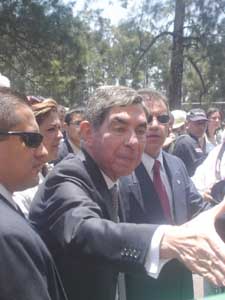 A.M. Costa Rica/Saray
Ramírez Vindas
Arias greets one of many on his walk from his Rohrmoser home
to the inaugural ceremony. |
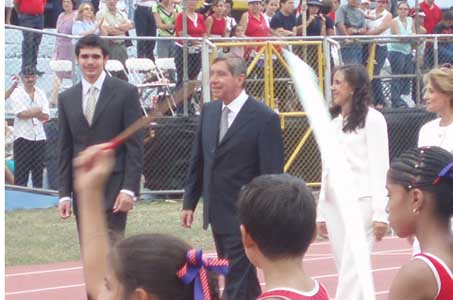 A.M. Costa
Rica/José Pablo Ramírez Vindas
Arias and children Oscar Filipe and Silvia Elena walk
around the stadium track. The children were with him 20 years ago when he was sworn in for his first four-year term. |
| Arias promised to define and steer a clear course |
|
|
By the A.M. Costa Rica staff
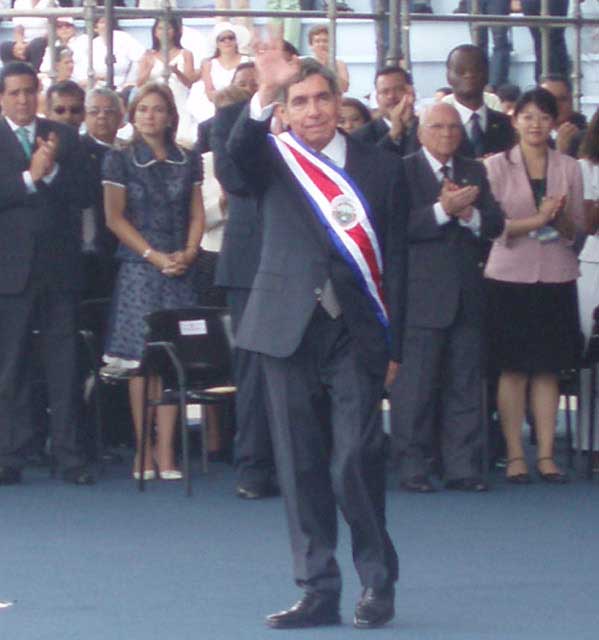
Costa Rica can no longer afford indecision, so the task that confronts the new administration is in defining a course and beginning to sail toward it, Óscar Arias Sánchez said Monday. In his inaugural speech, moments after being sworn in as president, Arias told the nation that it has chosen to adopt indecision as a way of confronting life. "For many years now, we as a country have lost our energy and direction, and on a steep path this can only result in backsliding," he said. Arias said that his administration is adopting a clear course in a number of problem areas, including public education, the fight against crime, corruption, drugs, foreign policy and in modernizing the state. He invited his listeners and all Costa Ricans, "men and women, young and old, of all political persuasions and religious creeds," to join him on this quest. "I ask all Costa Ricans to respond to fear with optimism; to powerlessness with enthusiasm; to paralysis with dynamism; to apathy with commitment; to small-mindedness with unbreakable faith in the bright future of Costa Rica," he said. Arias received the presidential sash at the Estadio Nacional about a half hour later than expected. His plan to walk from his Rohrmoser home to the stadium took twice as long because he was inundated with television crews and well-wishers. Outside the stadium, young, masked protesters were yelling vulgarities at passing persons who appeared to be U.S. citizens. Then they burned a U.S. flag. They oppose the free trade treaty with the United States. Arias had a message for them, too: "Turning our back on economic integration, returning to commercial protectionism and disdaining the attraction of foreign investment at this time constitute the surest ways to condemn Costa Rica's youth to unemployment and Costa Rica to underdevelopment. . . . In this, I want to be very clear: sovereignty is not defended with prejudices and slogans, but rather, with work and concrete plans for creating prosperity in Costa Rica." Arias said his administration would adopt clear courses for: • in the struggle against poverty and inequality by resolving the state's perennial fiscal crisis and by remaining faithful to the country's tradition of social rights, including universal health care. He said the adoption of an appropriate progressive tax system was vital for the future. • the productive sector of Costa Rica to make it internationally competitive with the creation of more jobs and deepening the nation's ties to the world economy. • public education with a pledge to dedicate 8 percent of the nation's gross domestic product "so that our educational system attracts sharper and sharper minds with a greater focus on service." |
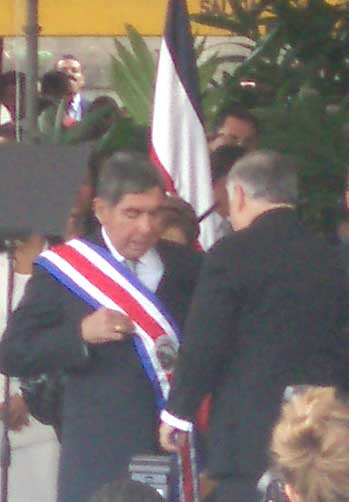 A.M. Costa Rica/José
Pablo Ramírez Vindas
Óscar Arias Sánchez assumes
the presidential banner.
• crime and drugs by improving the mechanisms
for reporting crime and
for reporting domestic violence, "the most insidious and widespread
type of crime."
• modernization of the state to provide the country with agile, efficient and transparent institutions that will support the pursuits of the citizens. • for the national investment in infrastructure and transportation so "nevermore will our highways, ports and airports be a cause of national embarrassment. . . ." • foreign policy in which Costa Rica will defend democracy, full promotion and protection of human rights, global peace, disarmament and commitment to human development. Protection of the environment will be a priority in foreign policy. • honesty in public office. Arias also called on political parties other than his Partido Liberación Nacional and social organizations to work with him for the future. ". . . the responsible exercise of political power is much more than pointing fingers, denouncing and obstructing. . . . " An extensive program of athletics, dance and exercise, mostly by school children, took place in the 15,000-seat stadium, which was full, and the colors of the Costa Rican flag were everywhere — even in the student seating section where rows of students wore red, white and blue shirts. Security was tight because many heads of state visited., including Vincente Fox of México and Laura Bush, wife of the U.S. president. |
| New government takes quck action on three fronts |
|
|
By the A.M. Costa Rica staff
The Arias administration did not waste any time in following up on projects to address key elements of its plan of government. During the first consejo de gobierno Monday, cabinet ministers and President Óscar Arias Sánchez issued three decrees. One would begin a pilot program to provide financial incentives for high school students who are in jeopardy of dropping out. Fernando Zumbado, minister of Vivienda y Asentamientos, said the idea is to cover every potential high school dropout in three years. The incentive would be from 40,000 to 50,000 colons per family, he said. That's from $80 to nearly $100. Zumbado spoke at a press conference in the Centro Nacional de la Cultura after the cabinet meeting. Rodrigo Arias Sánchez, the brother of the president and the minister of the Presidencia, said that a second decree advanced the concept of digital government. A |
third calls for the
simplification of government paperwork. Decrees have the force of law, particularly in the bureaucracy, even though they are issued by the president and his ministers. The simplification decree places a moratorium on creating additional requirements for governmental permits and similar. The incentive program for school children is designed to break the vicious cycle of poverty, the ministers said. In addition to monthly checks, the plan envisions creating a bank account for each student with small deposits each month. They would be able to get the money when they graduated from high school or colegio, as it is called here. There are similar programs in México and Brazil, the ministers said. The next step will be to create a system for identifying the youngsters in danger of becoming dropouts. |
 |
|
|
|
Fourth news page |
|
|
|
|
|
|
|
|
|
| San José,
Costa Rica, Tuesday, May 9, 2006, Vol. 6, No. 91 |
||||||
 |
| Masked individuals, presumably
students, burn the U.S. flag as part of their anti-free trade protest. The event took place outside the stadium where Óscar Arias Sánchez was inangurated Monday. |
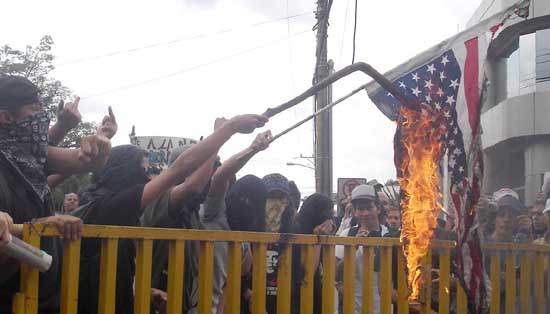 A.M. Costa Rica/Saray
Ramírez Vindas
|
| U.S. first lady brought her own bulletproof Cadillac |
|
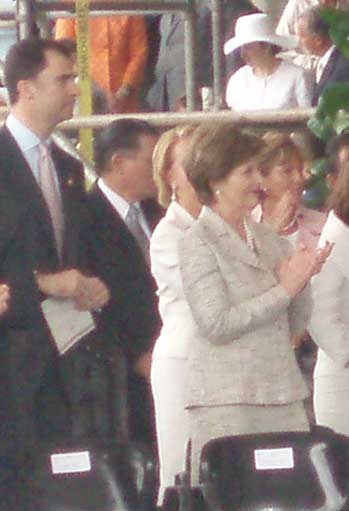 A.M. Costa Rica/José
Pablo Ramírez Vindas
Laura Bush applaudes the inauguration of a new president. To
her right is Felipe de Borbón y Grecia, the heir to the Spanish
throne. |
By the A.M. Costa Rica staff
The visit included one public appearance at a school in Heredia. The first lady is a former teacher and librarian. Then she watched Óscar Arias Sánchez take the oath of office and deliver his inaugural address. Then she dropped into the inaugural reception for some 20 minutes while an army of anxious Secret Service agents caused a traffic jam and blocked the arrival of heads of state and others. Then she was off to the Juan Santamaría airport in a bulletproof, black Cadillac limo flown in especially for the ride. The army of men in black (and one woman) following in hulking 4x4s also brought in for the occasion. The scene at the Centro Nacional de la Cultura probably would have been a mess even without the U.S. Secret Service. Heavy rain broke out seconds before the first guests arrived. But the committee in charge of the inauguration was prepared with a corps of young women who raced out with umbrellas to shield arriving guests from the rain. Although heads of state arrived for the reception in passenger cars, ambassadors who were heads of delegations had to take chartered buses. |
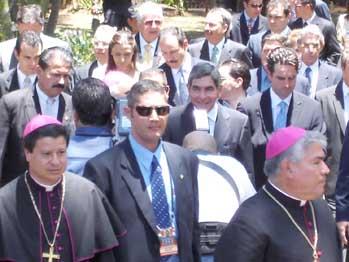 xxx The morning walk by Arias included a stop at the papal legation near his home. |
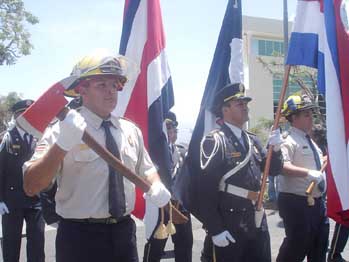 A.M. Costa Rica
photos/Saray Ramírez Vindas
Firemen provided the colors and the color guard for the walk
to the Inaugural ceremony. |
 |
 |
 |
|
|
|
|
|
|
|
|
| What we published this week: | Monday | Tuesday | Wednesday | Thursday | Friday | Earlier |
|
|