|

mmmm
|
Your daily English-language
|
 |
|
|
|
|
|
|
|
|
|
|
|
|
|||||||||||||||||||||
|

|
|||||||||||||||||||||
 |
|
Second news page |
 |
|
|
|
|
|
|
|
|
|
|
 |
| Costa Rica Expertise Ltd http://crexpertise.com E-mail info@crexpertise.com Tel:506-256-8585 Fax:506-256-9393 |
 |

|
| Chilean OAS candidate
fails to get 3 votes By the A.M. Costa Rica wire services After weeks of diplomatic maneuvering and multiple votes, the Organization of American States has a new secretary general, a top official of the Chilean government, José Miguel Insulza. He takes the post that was held briefly by a former Costa Rican president now facing corruption allegations. In Monday's balloting, Insulza, the Chilean interior minister, was the only remaining candidate for the post of secretary general after the withdrawal of Mexico's foreign secretary, Luis Ernesto Derbez. Insulza received 31 of the 34 votes cast. There were no votes against Insulza, although Mexico and Bolivia abstained, and Peru cast a blank ballot. Addressing the body, comprised of all nations of the Americas except Cuba, Insulza voiced his expectations for the region: "The people of the Americas have a right to democracy. And the governments have the obligation to generate conditions of good governance, and to exercise their mandate in a democratic fashion. Citizens' fundamental rights must be amply respected, including public liberties and the rights of minorities. Only in this way can social, political, economic and cultural progress be promoted." In congratulating Insulza, numerous diplomats spoke of regional unity and consensus. Yet those qualities were in short supply for much of last month, as repeated votes for secretary general ended in a tie. Just before Monday's vote, there was still dissension. Peru said it could not vote for a Chilean candidate, given Chile's alleged support for Ecuador in the decades-old border dispute between Ecuador and Peru. Bolivian Foreign Minister Juan Ignacio Siles complained of Chilean obstructionism regarding Bolivia's long-standing quest to regain direct access to the Pacific Ocean, which was lost in a series of conflicts beginning in the late 1800s. Siles said, "We are a peaceful people. We believe in integration with our neighbors. But we are convinced that, without justice there cannot be true integration, and we will never give up our demand for access to the sea." But virtually every other nation praised Insulza and his election. Several nations paid tribute to U.S. diplomat Luigi Einaudi, who had
led the secretary general’s job on an interim basis since last October
when former Costa Rican president Miguel Ángel Rodriguez had to
quit and return home to face corruption allegations.
Sala IV court will hear
By the A.M. Costa Rica staff Environmentalists are being invited to a public session of the Sala IV constitutional court Thursday where the topic will be gold mining in Miramar de Puntarenas. The invitation was sent out by Asociación Preservacionista de Flora y Fauna Silvestre. Luis Diego Marín Schumacher, executive president, said that the court case hinges on irregularities in the awarding of permits for the open pit gold mine. The mine involved is the Bellavista. The operator, Glencairn Gold Corp., said last month that it had about 12,000 tons of ore on leach pads and ready for extraction. This will be the first gold generated by the company in the location near Puntarenas. Bellavista is expected to produce an average of 60,000 ounces of gold per year over eight years based on current reserves, said the company. The mine is controversial because the leach process uses cyanide to
extract the gold. The leach pits are lined with material to prevent the
gold or chemical from getting outside the pit, but environmentalists still
are critical of the project.
Rural fair in Pejibaye
By the A.M. Costa Rica staff The Festival Ambiental Río Pejibaye will be in full swing Saturday and Sunday in the town of Pejibaye in the Cantón de Jiménez in Cartago Province. Dances are held both nights, but a 10 a.m. Sunday triathlon of some 35 kilometers (22 miles) and a 1 p.m. concert by the group Marvel are highlights. The Instituto Costarricense de Turismo said that visitors also could
take advantage of the many attractions near the community, including agrotourism.
Tourism chamber sets
By the A.M. Costa Rica staff The Cámara Nacional de Turismo plans its annual BingoTour night Friday in the Hotel Tryp Corobicí, starting at 6 p.m. This is the 19th year for the event, which is a fund-raiser. The entry
fee is 4,500 colons (about $9.60) which gives partygoers the chance to
participate in raffles for tours, national and international air tickets,
rental cars and even dental treatment.
West coast rattled again By the A.M. Costa Rica staff An earthquake of an estimated 3.5 magnitude took place about 2:10 p.m. Monday. The epicenter was south of the city of Puntarenas. No injuries were reported. |
|
|
with the observations of Dr. Lenny Karpman Click HERE! |
 |
|
Third news page |
|
|||||||
| Home | Calendar | Place
a
classified ad |
Classifieds | Real estate | Food | About us | ||
|
|
||||||||
 |

|
|
|
|
|
and wire service reports U.S. President George Bush has invited Costa Rican President Abel Pacheco and other Central American leaders to a meeting in Washington, D.C., May 12 on the proposed free trade treaty. A spokesperson at Casa Presidencial could not confirm Monday that Pacheco would attend. The Costa Rican president appears to have backpedaled on his support for the free trade plan. The White House said Monday that Bush will meet with the presidents of Costa Rica, the Dominican Republic, El Salvador, Guatemala, Honduras and Nicaragua. "The president looks forward to discussing with his colleagues the Central American and Dominican Republic Free Trade Agreement, as well as efforts to advance our common goal of a more democratic and prosperous western hemisphere‚" said Scott McClellan, White House press secretary. Some U.S. proponents of the free trade pact feared that Bush has been distracted by the war in Iraq and his plans to change the U.S. Social Security system. The pact is being considered for ratification by the U.S. Congress, but approval is not assured. A vote is expected later this month or in June. Legislatures in Honduras, El Salvador and Guatemala have ratified the trade pact. During her tour of Latin America, the U.S. secretary of State said that the Bush administration will work closely with governments in the region to win congressional approval of the trade pact. |
Speaking in El Salvador Friday, the
secretary, Condoleezza Rice, said: "We will work very, very hard to pass
CAFTA because we believe that it is very good for the region, for Central
America, but it’s also good for the United States because when we can trade
freely with good and hardworking people . . . especially in our hemisphere."
She was appearing with President Antonia Saca whose country of El Salvador was the first to ratify the agreement. Saca said that ratification would open up opportunities for employment and direct investment. The meeting and the comments from Ms. Rice suggest a campaign by the Bush administration to encourage ratification by the other three nations that are party to the agreement. A separate free trade agreement is being negotiated with Panamá. The treaty in Costa Rica has become divisive, in part because the pact would help break up the state monopolies in telecommunications, and insurance. A May Day workers march Sunday was unified in its condemnation of the trade agreement. Pacheco seemed to support the measure even in the face of a threat of a general strike by public employee unions. But in the last week he seems to have cooled. He only mentioned the agreement briefly in his Sunday state of the nation speech, and Tuesday he said he would appoint an unidentified group of five uninvolved persons to study the benefit of the agreement. Considering that Pacheco was in command of the negotiating team a year ago, the desire for a committee opinion was interpreted as stalling. He has just 12 months in office, and the front-running presidential candidate, Oscar Arias Sánchez is a strong supporter. |
|
|
|
|
of the A.M. Costa Rica staff A man accused of beating to death his own mother was not even a guest at the hotel where the murder happened, said the general manager there. Instead, the man, Garrett Gora, 34, simply showed up at the hotel where his mother was staying, said Erick Barrantes, the manager. The woman, a U.S. citizen, reserved a room at the Las Orquideas Inn for Friday night and then extended her stay one more day. The son showed up there as a visitor, said Barrantes. The mother, Dorlene Annete Gora, 62, suffered severe blows to the body and the face, so much so that bones were fractured. People heard fighting on the second floor of the hotel, and then they heard the voice of a man calling for help, |
said the manager. The man yelling
was later identified as Gora, and his clothes were covered with blood.
The manager continued:
When hotel security officials arrived at the second-floor room, the son leaped from the balcony and fled into the five hectares that make up the hotel grounds. Eventually security agents located him and held him until the Fuerza Pública arrived. Although police said they confiscated crack cocaine from the son, Barrantes said he had no knowledge of any drug use. The son was described as being very athletic, perhaps a martial arts student. Both mother and son were believed to be from California and had entered Costa Rica as tourists. The hotel is in El Cacao, which is between Grecia and Poás. Gora has been jailed for six months preventative detention, said a Poder Judicial spokesman. |
 |
|
Fourth news page |
Are you still spending 70 percent
You need to fill this space ASAP! |
||||||
| Home | Calendar | Place
a
classified ad |
Classifieds | Real estate | Food | About us | |
|
|
|||||||
 |
|
|
|
|
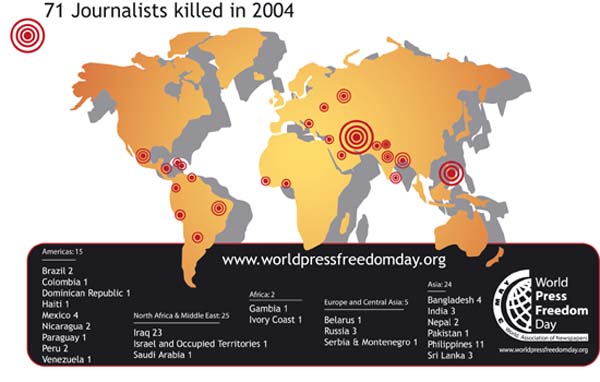
for the World Association of Newspapers The worldwide toll of journalists and critical support staff killed
covering the story is spiralling. Last year was the deadliest in at least
a decade. So far this year, the International News Safety Institute has
recorded 19 members of the news media killed at work in 11 countries, all
but two of them murdered and no one brought to justice.
In great swathes of the world, across many countries, murder is a relatively cheap, safe and easy way to censor the press. A probing reporter is silenced and friends and colleagues terrorised. And it will only get worse as long as a culture of impunity protects the guilty. Failure by governments to punish the killers can only encourage others. The Committee to Protect Journalists estimated on World Press Freedom Day in 2003 that in 94 per cent of cases over the preceding 10 years those who murdered journalists did so with impunity. Killing a reporter is only half as risky as burgling a house in London. And Scotland Yard is hammered daily in the British press for being hopelessly inefficient in combating crime. There is little sign of this appalling situation improving, despite appeals from UNESCO and journalist support groups such as the World Association of Newspapers, the International Federation of Journalists, the International Press Institute, the Committee to Protect Journalists, Reporters Without Borders et al. The problem of impunity prompted a UNESCO resolution, adopted by member states, in 1997. It urged governments to refine legislation to make it possible to prosecute those who instigated the assassination of people exercising their rights to free expression, and requested legal action to ensure that "persons responsible for offences against journalists exercising their professional duties . . . be judged before civil and/or ordinary courts." Depressingly, the director-general of UNESCO, Koichiro Matsuura, felt obliged to return to the issue in 2003, when he made impunity the centrepiece of his organisation’s celebration of World Press Freedom Day. "I appeal to all governments, at all levels, to fulfil their responsibility to ensure that crimes against journalists do not go unpunished," he declared. "It is essential that all violations are investigated thoroughly, that all perpetrators are prosecuted, and that all judicial systems and processes are capable of punishing those found guilty." "Putting an end to impunity fulfils our need for justice; in addition it will do much to help prevent abuses occurring in the first place." By the evidence, he may as well have saved UNESCO’s breath. Again. Murderous assaults this year so far include: Colombia: hit men on motorbikes shoot down popular radio journalist Julio Palacio Pakistan: gunmen fire into a small bus filled with journalists on their way back from a story, killing Allah Noor and Mir Nawab Somalia: a sniper kills BBC producer Kate Peyton shortly after she arrives in Mogadishu Bangladesh: Sheikh Belaluddin, a correspondent for the daily Sangram newspaper, dies of heart failure following the bombing of a press club Philippines: The body of community newspaper columnist Arnulfo Villanueva, who had been investigating corruption and illegal gambling, is found riddled with bullets Azerbaijan: Seven bullets rip into Elmar Huseinov, a fierce government critic and editor-in-chief of an opposition magazine. And of course there is Iraq, the bloodiest killing ground for journalists in modern times. INSI has recorded 68 dead journalists and other news media workers since the conflict began two years ago, four of them this year. |
Most were Iraqis experiencing the
first fruits of press "freedom" after the Saddam dictatorship; the rest
came from 15 other countries. No one thus far has been held to account
for a single death.
In a chorus of concern that underscores their anger and frustration, the IFJ, WAN, IPI and CPJ in recent months have all stepped up their attacks on the thriving culture of impunity. The IFJ called for more concerted action by political and civil society groups. "Too often governments display a heartless and cruel indifference to the suffering endured by the victims and their families," said General Secretary Aidan White. "There tends to be a few meaningless words of regret, a cursory inquiry and a shrug of indifference." CPJ Executive Director Ann Cooper condemned the murder with impunity of journalists in 2004 as "shameful and debilitating". "Governments have an obligation to pursue and prosecute those responsible. By failing to do so, they let criminals set the limits of the news that citizens see and read," she said. Launching its campaign called "Impunity - Getting away With Murder," World Association of Newspapers director-general Timothy Balding said: "We call on governments to show much greater determination in tracking down and prosecuting the killers." The IPI said one common thread linked the deaths of journalists in countries as diverse as Bangladesh, Belarus, Haiti, The Gambia, Mexico, the Philippines, the Ukraine and many others. "Their shameful connection is the authorities’ failure to properly investigate and prosecute the killers," said Director Johann Fritz. What can journalists do other than protest and, apparently, continue to suffer as they try to shine light on the dark corners of society? They can publicise each and every attack and — critically — sustain the pressure until results are achieved. In this regard, global news organisations can help local outlets who have fewer resources and are more at risk. With few exceptions, the news giants tend to take notice only when international journalists are targeted, whereas the vast majority of victims are locals covering the countries of their birth. Press groups and journalists can investigate and publicise - and refuse to let go until there is a resolution. In this context, the International News Safety Institute was formed in 2003 by a unique coalition of news organisations and journalist support groups. It grew out of the realisation that journalists must act to protect themselves: no one else would. Since then, INSI has attempted to address the issue in practical ways. As well as providing safety training to help vulnerable journalists look after themselves, INSI has begun discussions with key militaries on how to improve procedures to protect journalists on the battlefield. Amongst other things, INSI is pressing for commitments to hold full and transparent inquiries when war reporters are killed by soldiers. INSI is also leading a global inquiry into the factors behind the rising number of journalist deaths. A Committee of Inquiry, comprising news organisations, legal experts, journalists and support groups and humanitarian bodies, is charged with gathering and collating evidence and producing a report and recommendations to address the issue. As UNESCO’s Matsuura said two years ago: "The debt we collectively incur when journalists suffer on our behalf must be repaid in practical ways. "At the very least, we must declare war on impunity." * Rodney Pinder is director of the International News Safety Institute and a former Global Editor for Reuters Television. He was an international correspondent and news executive for 35 years, covering conflicts from Northern Ireland through the Middle East and the Gulf to South Africa. He wrote this article for the World Association of Newspapers. |
|
|
|
|
Of the 71 newspeople killed in the line of duty last year, 15 died in the Americas. Here is the 2004 death toll, as compiled by the World Association of Newspapers: Brazil (2) Jorge Lourenço dos Santos was shot four times in the town of Santana do Ipanema in northeastern Brazil on July 11. Dos Santos was both the owner and a host on Criativa FM, a radio station which was run out of his home. An unidentified assailant, who fled the scene in a car, shot the journalist outside his home. According to local reports, investigating authorities have confirmed that the journalist had received death threats in the past and had previously been the target of two attempted killings. Police are reportedly investigating whether dos Santos’ murder could have been politically motivated, as the journalist was also politically active, having run for council in the nearby town of Major Isidoro in 1996 and 2000. José Carlos Araújo was killed by two assailants on April 24 as he left a recording studio at the radio station for which he worked, Timbaúba FM, in northeastern Brazil. Three days later, police arrested the alleged murderer, Helton Jonas Gonçalves de Oliveira, 18. Local media have reported that de Oliveira confessed to having killed Araújo after the journalist accused him in his programme, "José Carlos Entrevista" of being behind several murders. Araújo had used the programme to expose the existence of murder squads and the alleged involvement of local figures in criminal cases. De Oliveira, along with his accomplice Marcelo Melo, 22, reportedly borrowed a motorcycle from a third individual to kill the journalist. Colombia (1) Oscar Alberto Polanco Herrera was shot outside his offices by two unidentified gunmen on Jan. 4 in Cartago, a town situated 200 kilometres from Bogota. Polanco was director of the local news programme, CNC Noticias, on the television station Cable Unión de Occidente. The motive for his murder is unknown. Dominican Republic (1) Juan Emilio Andújar Matos, host of Radio Azua’s weekly show "Encuentro Mil 60" and correspondent with the Santo Domingo-based daily "Listín Diario", was shot in the head by two men on motorcycles, as he left a radio station in the town of Azua Sept. 14. During the program broadcast immediately prior to his murder, Andújar had discussed a crime wave and a surge in violence between local gangs and police in the city. At least six other local journalists who have reported on the violence have been threatened with death and are currently receiving police protection. Radio reporter Jorge Luis Sención, who came to Andújar’s aid, was shot in a later attack, allegedly by the same men, resulting in the amputation of his right forearm. Police reportedly killed one of the assailants in a later gun battle. Haiti (1) Ricardo Ortega was shot twice in the chest March 7 in the capital of Port-au-Prince, when gunmen opened fire on demonstrators calling for the prosecution of former President Jean-Bertrand. The Spanish journalist, a correspondent for the Spanish television station Antena 3, was taken to hospital where he died from his wounds. Ortega began his career working for the Spanish news agency EFE in Moscow. As correspondent for Antena 3, he covered armed conflicts in Chechnya, Sarajevo, and Afghanistan. Ortega also covered the Sept 11, 2001, attacks in New York City. Mexico (4) Gregorio Rodriguez, a photographer with "El Debate," a newspaper with editions in cities of Culiacan and Mazatlan, was killed by unidentified gunmen Nov. 27 in the northwestern state of Sinaloa. The journalist had been eating dinner with his family in a local restaurant in the community of Escuinapa when several armed men approached his table and opened fire. Rodriguez died instantly. The motive for the murder is not yet known, however the state of Sinaloa is known to be home to many of Mexico’s top drug bosses. Francisco Arratia Saldierna was abducted and tortured to death on Aug. 31 in the northeastern city of Matamoros, Tamaulipas state. Saldierna was a political journalist who often covered sensitive issues such as corruption, drug-trafficking and organised crime. His commentaries appeared in four newspapers in the region, "El Imparcial", "El Regional", "Mercurio" and "El Cinco". He was reportedly lured by unknown assailants out of his garage and was found just over an hour later, lying seriously wounded in front of the local Red Cross offices. Saldierna died in hospital a few hours later as a result of a broken skull and fingers and burns and injuries on his stomach and shoulders. Francisco Javier Ortiz Franco was gunned down by unidentified assailants in the border city of Tijuana June 22. According to reports, Ortiz Franco, a lawyer and co-editor of the Tijuana-based weekly Zeta, had just left a physical therapy clinic with his two children when masked gunmen in a vehicle pulled up to his car and shot him four times in the head and neck. The journalist died at the scene. His children were unharmed. Ortiz Franco was one of the founders of Zeta as well as a member of its editorial board. He was reportedly involved in many of the newspaper’s investigative reports. In addition, Ortiz Franco was a member of a working group jointly created by the Mexican government and the Inter-American Press Association with a mandate to review the official investigations |
and legal proceedings on the murders
of Héctor Félix Miranda, Zeta’s co-founder, and Víctor
Manuel Oropeza, a columnist with the Diario de Juárez newspaper.
A clear motive for the attack has not yet been found, however local authorities
have launched an investigation into the murder. The newspaper has also
reportedly launched its own investigation.
Roberto Javier Mora García was stabbed to death March 19 near his home in the town of Nuevo Laredo, near the U.S. border. The journalist was editorial director of the daily El Mañana and editor of the weekly North Mexico Business. Mora was known for publishing articles about Golfo, a local drug trafficking cartel. No motive has yet to be found for his murder, however, local police reportedly ruled out theft as a motive, after finding Mora García’s wallet, watch and car keys at the scene of the crime. Nicaragua (2) María José Bravo was fatally shot outside an electoral office in the city of Juigalpa Nov. 9. According to local sources, Bravo, a correspondent for the Managua daily La Prensa, had just exited the vote-counting centre and was talking to a group of people when she was shot once at close range. She was taken to a hospital but declared dead on arrival. Bravo had been covering protests over the results of the Nov. 7 elections in two municipalities. According to "La Prensa." police have detained Eugenio Hernández González, a former mayor of the town of El Ayote, and identified him as the main suspect in Bravo’s death. Police reportedly took a .38-caliber handgun from Hernández. Some witnesses interviewed by "La Prensa" claimed to have seen Hernández reach for a handgun just before Bravo was shot. It is unclear whether Bravo was targeted, and, if so, what the motive for her killing was. Carlos José Guadamuz was shot as he was arriving to work Feb. 10 in the capital city of Managua. The journalist, who was a host of "Dardos al centro" on Canal 23 television station, was struck at point-blank range by a gunman while stepping out of his vehicle. The gunmen, identified as William Hurtado García, a local merchant and a security guard, was subsequently caught while fleeing the scene and apprehended. Guadamuz, a former high-ranking member of the opposition Frente Sandinista de Liberación Nacional (FSLN) party, was imprisoned in the late 1960s for opposing Nicaraguan dictator Anastasio Somoza. Although members of his family have reportedly said the journalist had previously received death threats, no motive for his slaying has been found. Paraguay (1) Samuel Román was shot dead in the township of Coronel Sapucaia April 20. The journalist was reportedly hit by 13 bullets when fired on by two men in front of his home on an avenue between the twin towns of Coronel Sapucaia (Brazil) and Capitán Bado (Paraguay). Román, a Brazilian national, had worked for 20 years in local radio in Paraguay and was very well known in Capitán Bado. Román hosted a program entitled "Voice of the People", on which he reportedly invited listeners to comment on political life. According to the local press he also reportedly used the programme to expose drug trafficking and rampant criminality in the region. Peru (2) Antonio de la Torre Echeandía was stabbed to death Feb. 14 by two assailants on his way home from a party. De la Torre hosted a program on Radio Órbita in the city of Yungay, northern Peru. The journalist was a harsh critic of the city’s mayor, Amaro León, whom he accused of corruption. Before he died, de la Torre reportedly identified one of his attackers as "El Negro," a nickname for Hipólito Casiano Vega Jara, who worked as a driver for Mayor León office. In 2002, de la Torre had worked as a campaign chief for León and was appointed as head of communications following León’s election. De la Torre resigned, however, three months after the mayor’s appointment to office after discovering several instances of alleged corruption. The police have arrested Vega. León and his daughter have also reportedly been detained on charges of masterminding de la Torre’s murder. Alberto Rivera Fernández was killed by two unidentified individuals while working in his office in the city of Pucallpa, eastern Peru, April 21. The journalist, a former member of parliament and president of the Ucayali Journalists’ Federation, was the host of "Transparencia", a radio programme that was broadcasted daily on the Frecuencia Oriental radio station. Rivera was known for his strong opposition to local and regional authorities because of certain land dealings. However, no apparent motive is yet known for his murder. Venezuela (1) Mauro Marcano was shot by unidentified attackers in the parking lot of his apartment building Sept. 1 in the city of Maturín, eastern Monagas State. The journalist hosted the radio show "De frente con el pueblo" (Facing the People), for the station Radio Maturín. In addition, he wrote a weekly column titled "Sin bozal" (Without Muzzle) for the Maturín-based daily "El Oriental". A handgun belonging to Marcano was reportedly found by his body. At the time of his murder, Marcano was also a municipal councilman for the regional political movement Fuerza Monaguense. According to his colleagues, Marcano aggressively denounced drug trafficking and police corruption on both his show and in his column. His reports have also been attributed with helping police capture drug traffickers in the past. |
|
|
|
|
|
|
|
|
| What we published this week: | Monday | Tuesday | Wednesday | Thursday | Friday | Earlier |
|
|