|
 |
Your daily
English-language |
 |
|
|
|
|
|
|
|
|
|
|
|
|
|||||||||||||
|
|
|||||||||||||
 |
|
Second news page |
 |
|
|
|
|
|
|
|
|
|
|
 |
| Costa Rica Expertise Ltd http://crexpertise.com E-mail info@crexpertise.com Tel:506-256-8585 Fax:506-256-7575 |
 |
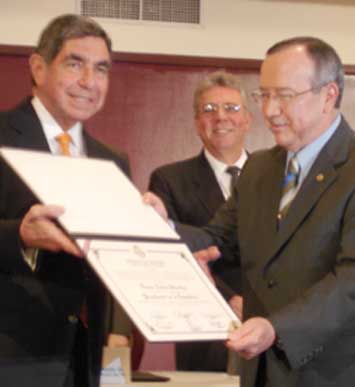 A.M. Costa Rica/Saray
Ramírez Vindas
Óscar Arias receives his certification as president
from Oscar Fonseca of the Tribunal Supremo de Elecciones.Arias certified as president, asks U.S. to be generous By the A.M. Costa Rica staff
Óscar Arias Sánchez received his certification Friday from the Tribunal Supreme de Elecciones and then urged the U.S. government to be more generous. Arias, who will take office May 8, participated in a ceremony at the Tribunal where he and his two vice presidents each received a diploma-like document. First vice president is Laura Chinchila, and second vice president is Kevin Casas. During the ceremony Arias was warned by Oscar Fonseca, Tribunal president, that the job is a great responsibility. But it also is the highest honor the people of Costa Rica can bestow, he noted, adding that the current election put the system to the test. The close race between Arias and Ottón Solís of the Partido Acción Ciudadana kept the country wondering for more than a week while the Tribunal counted votes. Arias, 65, of Liberación Nacional, has been president before, in 1986 to 1990. It was during a reception after the 20-minute Tribunal ceremony that Arias spoke to the press. He said that the United States sometimes behaves arrogantly. He said he differentiates between the government and the American people, which he said were very generous. He cited Bill Gates, the Microsoft founder, who gave billions to various charities. Countries in Central America have been punished for promoting peace, and have had their external support cut by the U.S. government, he said, a reference to his last presidency when Costa Rica steered a neutral course while war raged in Nicaragua between the Sandinistas and the U.S.-backed Contras. Court rejects sentence in money laundering case By the A.M. Costa Rica staff
The Sala III high criminal court has ordered a new sentence be handed down for a Mexican couple who have been convicted of money laundering or, as it is called in Spanish, legitimación de capitales. The man, who has the last names of Aguiano Aburto, is 29. The woman, who was accompanying him when he was arrested, has the last names of Martínez Castillo and is 50. They were detained March 8, 2004 at Juan Santamaría airport when police found $400,000 in their luggage. They were traveling from México to Panamá with a layover here. The high court upheld the conviction but ordered a new sentencing. The pair had been ordered to spend eight years in prison. Trade treaty in force in two more countries Special to A.M. Costa Rica
President George Bush issued a proclamation Friday to implement the U.S.-Central America-Dominican Republic Free Trade Agreement in Honduras and Nicaragua Saturday. "Honduras and Nicaragua are now ready to join El Salvador as countries that have fully implemented the agreement," U.S. Trade Representative Rob Portman said in a statement. Other countries participating in the free trade agreement with the United States are Guatemala, Costa Rica and the Dominican Republic. All but Costa Rica now have ratified the trade pact.  Sketch released of man sought
Invesigators have released a sketch of an English speaker who is wanted for questioning in the death of a woman found in a hotel room in Quepos last week. A photograph appeared here Friday. Investigators can be reached at 777-0511 or 777-1511. |
|
|||||||||||||||||
 |
 |
|
on our real estate page HERE! |
 |
|
Third news page |
 |
|
|
|
|
|
|
|
|
| San José,
Costa Rica, Monday, April 3, 2006, Vol. 6, No. 66 |
||||||
 |
| Stop the presses! La Nación discovers Hotel Del Rey |
|
|
By the A.M. Costa Rica staff
The Spanish-language daily La Nación has discovered the Hotel Del Rey as a place where professional women meet men, and the hotel earned a headline on the newspaper's Monday front page. The news stories contain little that even the most casual North American visitor to Costa Rica would not know, but the tone appears to be one of surprise that a major hotel with a designation as a tourist site would facilitate meetings between male tourists and prostitutes. The Del Rey has been in operation since at least 1992. "The sex market grows parallel to the Hotel Del Rey," says the headline. Authorities have inspected the hotel but have found no irregularities, says the story. The authors are Otto Vargas and Rubén Bonilla. Vargas wrote an exposé on the visit by the so-called Michigan Boys to Flamingo in May 2004 where some also met professional women. |
Vargas and Bonilla also
wrote that the Del Rey is mentioned frequently on Internet Web pages. The newspaper quotes Rodrigo Castro, minister of Turismo as saying that his ministry has no knowledge that the Del Rey foments prostitution. He also said that Costa Rica's tourism is based on nature and adventure, not sex tourism. The reporting team also said they entered the Del Rey's Blue Marlin Bar where they met a 35-year-old woman who was pimping younger prostitutes, something that is illegal in Costa Rica. However, the generally favorable secondary article said that the women were charging $100 per hour of sexual entertainment or $500 for the night, which probably would be a surprise to most of the women there. The news story does not seem to be the precursor to a crackdown because even law enforcement officials interviewed say that the hotel is working within the letter of the law and is fully licensed as a hotel, bar and casino. |
| New immigration scandal involves airport workers |
|
|
By the A.M. Costa Rica staff
A Cuban arrived at Juan Santamaría airport carrying what proved to be a false residency cédula, and the investigation that followed resulted in allegations being leveled against two employees of the immigration service. The case began March 24 when the Cuban, identified by the last names of Barreto García arrived at the airport. He was spotted by anti-drug agents because they said he was acting nervously. When he was flagged at customs, drug agents searched him and his bags but found nothing. Then the man admitted that the document he carried that said he was married to a Costa Rican was false. He told agents that he was instructed to pass by a certain immigration booth on his arrival. Agents said they checked his papers and found that his passport had not been stamped, as is required. |
The dicrepancy
reflected on two workers of the Direcion General de
Migración y Extranjería who had been working at the
particular booth. They were suspended and a case opened with the Ministerio Público. They were ordered by a judge not to leave the country. Johnny Marín, director of Migración, said the case adds to the list of irregularities that the immigration department has been facing in the last several months. These include false signatures and suspect marriages between Costa Ricans and persons from Asia and Cuba. In addition, investigators allege that two persons in the immigraiton headquarters were making false entries in the main computer system to falsify that persons had entered and left the country. The two immigration employees in the lastest case were identified by the names Orozco and Mora. |
|
When ungrateful has a
much stronger meaning
|
|||
| No sea ingrato “Do not be ungrateful.” This dicho is one that is often used in a somewhat different way than is apparent from its literal meaning. Additionally, when Costa Ricans speak fast we have a tendency to elide the first two words together so they come out sounding like one word. Thus, no sea ingrato comes out sounding like nosea ingrato. An example of the way that our dicho is used that may sound odd to English ears is: Fuimos al lago Arenal y nos montamos en una embarcación. Nos dimos un tur por las islas. Y no sea ingrato que lugar más bello. Translation: “We went to Lake Arenal and took a boat tour of the islands. Do not be ungrateful, the place is so beautiful.” But the literal translation does not capture the speaker’s real intent. The meaning of no sea ingrato here is something like “don’t be insensitive,” or “don’t be a clod.” The word ingrato is connected with harshness, unpleasantness, injustice, bad behavior and even suffering. When someone has been ingrato they have done a wrong, be it in word or deed. Here’s another example: No sea ingrato el guarda lineas del partido de fútbol entre Saprissa y el Toluca. ¡Que muchacho más chapa! Meaning: “The third referee shouldn’t have been so unjust during the soccer game between Saprissa and Toluca. What a dunce!” |
I hasten to add that I agree with the assessment of most
people
concerning this fellow, and Saprissa isn’t even my team. This
particular referee really acted as though he didn’t understand the
game. However, it must also be noted that the childish behavior of many
Saprissa fans who threw things onto the field and then ran onto the
playing area after the game trying to physically attack the referee
didn’t help matters either. |
||
 |
|
|
|
Fourth news page |
|
|
|
|
|
|
|
|
|
| San José,
Costa Rica, Monday, April 3, 2006, Vol. 6, No. 66 |
||||||
 |
| Summit in Cancun dominated by immigration talks |
|
|
Special to A.M. Costa Rica
CANCUN, México — How to deal with the troublesome issue of immigration has dominated daylong talks among the leaders of the United States, Mexico and Canada Friday. The trilateral summit at this Mexican resort once again focused attention on the movement of people across the United States' southern and northern land borders. For those crossing the southern U.S. border from Mexico, President George Bush is backing legislation to create a temporary program for Mexican workers. "An important part of securing the border and enforcing our laws is to recognize there are people in our country doing work that Americans will not do, and those people ought to be given the chance to have a tamper-proof card that enables them to work in our country legally for a period of time," said Bush. Mexican President Vicente Fox also supports the guest worker program, saying it is part of a regional security and prosperity initiative. Six million Mexicans make up more than half of the illegal-alien population in the United States. The money they send home is an important part of the Mexican economy. The Inter-American Development Bank says that Mexicans sent $20 billion home last year from the United States. The U.S. Senate Judiciary Committee last week approved a temporary worker program that would also offer permanent residency and U.S. citizenship for some. That has brought opposition from members of President Bush's own Republican Party, who feel it is a form of amnesty for people who entered the country illegally. Speaking at the close of their two-day summit, President Bush said illegal immigrants would not be |
given preference over
legal immigrants
waiting for citizenship. He says he looks forward to working with
Congress to bring people out of the shadows, and put out of business
the criminals who exploit foreigners desperate to enter the United
States. For those crossing the northern border with Canada, President Bush said he intends to enforce laws requiring passports, or a new identity card by the end of next year. If properly implemented, he says, it will boost trade and travel between the neighbors. "Envision a card that can be swiped across a reading device that facilitates the movement of people. Look, I understand this issue has created consternation," explained Bush. "Your prime minister made it very clear to me that he is very worried that such an implementation of laws on the books will make it less likely people will want to travel between our countries." Canadian Prime Minister Stephen Harper says he understands the need for secure borders, but questions the effect the identity provisions will have on commerce. "We are obviously concerned that, if we do not move quickly and properly on this, that this could have effects on trade and movement of people, conventions, you name it, that it is not helpful to our economy, or our relationships," said Bush. Following the summit, President Bush spends the weekend at his Texas ranch before returning to Washington and the debate over the Senate immigration bill. That measure must pass the full Senate before being reconciled with a stricter House bill that makes it a felony to be in the country illegally, and stiffens penalties for employers who hire illegal aliens. |
| Money sent home from U.S. was a record $53.6 billion last
year |
|
|
Special to A.M. Costa Rica
The Inter-American Development Bank says Latin American and Caribbean workers living abroad sent a record $53.6 billion home last year, up 17 percent from 2004. The IDB presented the figures Thursday at a seminar in Belo Horizonte, Brazil, where the bank's Board of Governors holds its annual meeting next month. The development bank says México is still the leading recipient of those remittances in Latin America, with |
its expatriates
sending more than $20 billion home last year. The figure marks an
increase of about 20 percent from 2004. The bank noted that some 25 million people born in Latin America and the Caribbean have moved abroad and that two thirds of them send money home. Officials noted, however, that many migrants and their families still remain outside the formal financial system, and that fewer than 10 percent of those residents who receive money transfers have access to bank accounts, credit or home loans. |
 |
 |
|
|
|
|
|
|
|
|
| What we published this week: | Monday | Tuesday | Wednesday | Thursday | Friday | Earlier |
|
|